


Report Overview
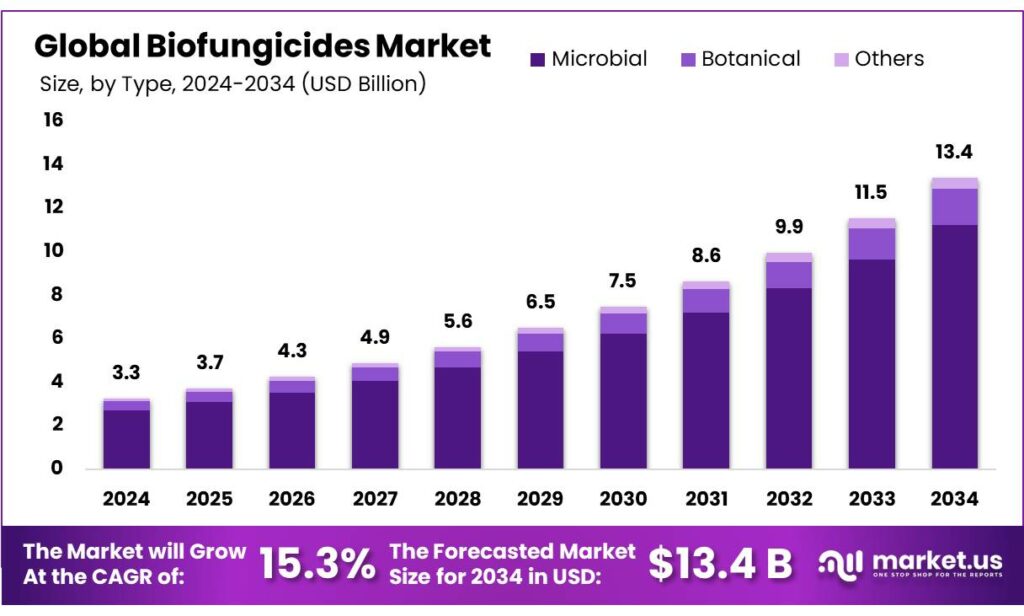
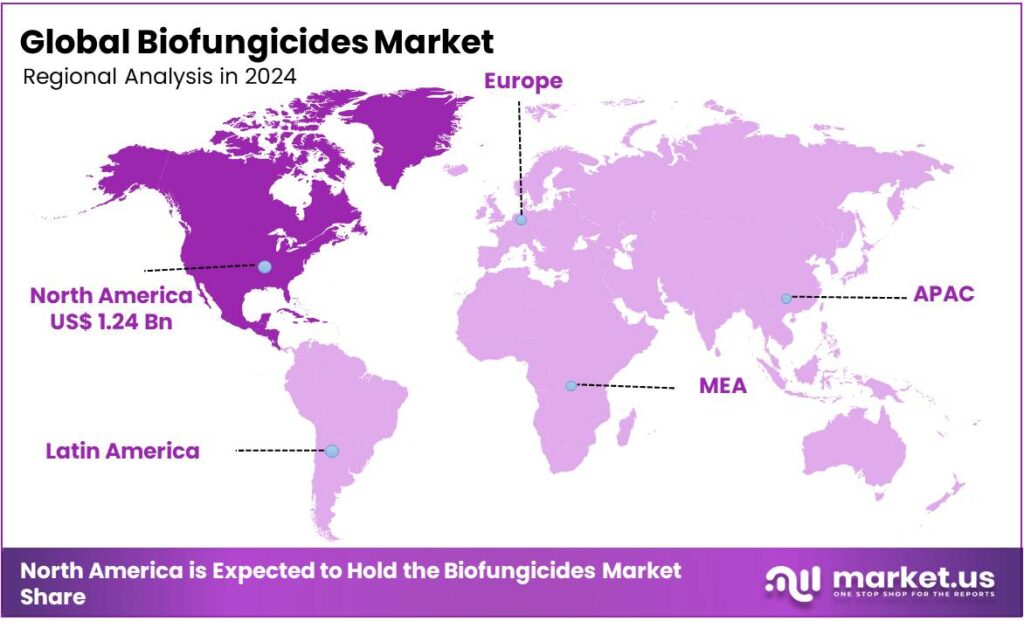
The Global Biofungicides Market size is expected to be worth around USD 13.4 Billion by 2034, from USD 3.3 Billion in 2024, growing at a CAGR of 15.3% during the forecast period from 2025 to 2034. In 2024 North Americaheld a dominant market position, capturing more than a 38.2%share, holding USD 1.24 Billion in revenue.
Biofungicides are biological formulations composed of living organisms specifically designed to suppress plant-pathogenic fungi and bacteria. Their principle is rooted in naturally occurring processes, where beneficial microorganisms—commonly isolated from soil ecosystems—interfere with the growth and activity of plant pathogens.
These biocontrol agents, which include free-living fungi, bacteria, and actinomycetes, function effectively in diverse environments such as the rhizosphere, soil, and foliage. The market’s expansion is primarily driven by rising consumer demand for organic and residue-free food, supported by favorable government initiatives and increasing adoption of sustainable farming practices.
- Every year, up to 40% of global crop production is lost due to plant pests and diseases. These losses cost the global economy over USD 220 billion annually. Invasive pests alone cost countries at least USD 70 billion each year, and these pests are also significant drivers of biodiversity loss.
Regulatory bodies across regions—particularly in Europe, the U.S., and Brazil—are accelerating the registration of bio-based inputs, reflecting a global shift toward environmentally friendly agriculture. However, the market faces restraints from competition with chemically dominant fungicides, which continue to outperform biologicals in large-scale, conventional systems due to higher reliability and established supply chains.
Technological innovation represents the next major growth wave, with biotech advancements enhancing microbial stability, formulation efficiency, and field performance. Integration of artificial intelligence (AI) is also transforming disease detection and precision agriculture, paving the way for predictive crop protection systems. Geopolitically, new U.S. tariffs on copper and agricultural imports are reshaping trade flows and production costs, indirectly promoting biofungicide adoption as farmers seek cost-stable, eco-safe alternatives.
- According to the OECD-FAO Agricultural Outlook, global food consumption is projected to grow by approximately 1.3% annually over the next decade. Much of this rise is driven by middle-income countries—especially India, Southeast Asia, and parts of Africa—where calorie intake per capita is expected to increase by 7% by 2033. This intensification in food demand directly fuels the need for agrochemicals to maintain and extend agricultural productivity.
Key Takeaways
- The global biofungicides market was valued at USD 3.3 billion in 2024.
- The global biofungicides market is projected to grow at a CAGR of 15.3% and is estimated to reach USD 13.4 billion by 2034.
- Between types, microbial accounted for the largest market share of 83.1%.
- Among formulations, liquid dominated the market with the largest share of 63.0%.
- Based on application methods, foliar spray accounted for the majority of the market share at 39.1%.
- Among crop types, cereal & grains held a market share of 44.5%.
- North America is estimated as the largest market for Biofungicides with a share of 38.2% of the market share.
- Asia Pacific is estimated second largest growing market with a CAGR of 16.4%
Type Analysis
Microbial Biofungicides Dominated the Global Market
Based on type, the market is further divided into microbial, botanical & others. As of 2024, microbial biofungicides dominated the biofungicides market with an 83.1% share due to their proven effectiveness, broad-spectrum activity, and compatibility with sustainable agricultural practices. Microbial products, derived from beneficial bacteria, fungi, and actinomycetes, are highly effective in controlling a wide range of plant pathogens through mechanisms such as competition, antibiosis, and induced systemic resistance. Their adaptability to diverse crops, soils, and climatic conditions has made them the preferred choice for farmers seeking reliable alternatives to synthetic fungicides.
Additionally, microbial biofungicides often improve soil health and plant vigor, offering dual benefits of disease management and crop productivity enhancement. Regulatory support and consumer demand for residue-free produce further accelerate their adoption, particularly in organic and integrated pest management systems. Compared to botanical and other categories, microbial biofungicides also benefit from greater commercialization, established product portfolios, and ongoing R&D investments, solidifying their leading position in the global market.
Global Biofungicides Market, By Type, 2020-2024 (USD Mn)
| Type | 2020 | 2021 | 2022 | 2023 | 2024 | |||||||||||||||||||||||||||||||
|---|---|---|---|---|---|---|---|---|---|---|---|---|---|---|---|---|---|---|---|---|---|---|---|---|---|---|---|---|---|---|---|---|---|---|---|---|
| Region | 2020 | 2021 | 2022 | 2023 | 2024 |
| North America | 467.5 | 700.4 | 1,050.7 | 1,577.2 | 2,368.9 |
| Europe | 1,207.4 | 1,851.1 | 2,841.9 | 4,366.4 | 6,713.5 |
| Asia Pacific | 602.5 | 902.2 | 1,353.5 | 2,032.9 | 3,056.8 |
| Middle East & Africa | 62.5 | 89.9 | 129.4 | 186.5 | 269.0 |
| Latin America | 160.0 | 235.8 | 347.9 | 513.6 | 758.9 |
Key Regions and Countries
- North America
- The US
- Canada
- Europe
- Germany
- France
- The UK
- Spain
- Italy
- Russia & CIS
- Rest of Europe
- APAC
- China
- Japan
- South Korea
- India
- ASEAN
- Rest of APAC
- Latin America
- Brazil
- Mexico
- Rest of Latin America
- Middle East & Africa
- GCC
- South Africa
- Rest of MEA
Key Players Analysis
Product Innovation, Strategic Partnerships, And Geographic Expansion Are The Key Strategies Of Major Players In the Biofungicides Market.
The key strategies of major players in the Biofungicides Market center around product innovation, strategic partnerships, and geographic expansion to meet growing demand for sustainable crop protection solutions. Leading companies such as Bayer AG, BASF SE, Syngenta AG, UPL Limited, and Corteva Agriscience are heavily investing in R&D to develop next-generation biofungicides based on advanced microbial strains, botanicals, and RNA-based technologies that offer broader spectrum control and improved field stability. Several players are pursuing collaborations and acquisitions with biotech startups to strengthen their biological portfolios and accelerate regulatory approvals.
Additionally, firms are expanding into emerging markets in Asia-Pacific and Latin America, where sustainable agriculture initiatives are rapidly evolving. Digital agriculture platforms and precision farming tools are being integrated to optimize biofungicide use, enhancing efficacy and return on investment. Collectively, these strategies reflect a shift toward sustainable innovation and data-driven crop protection ecosystems in the global biofungicides landscape.
The major players in the industry
- BASF SE
- Bayer AG
- Bioworks Inc.
- Corteva Agriscience
- Seipasa SA
- Nufarm
- UPL Ltd.
- Koppert B.V.
- Novonesis Group
- FMC Corporation
- Certis USA L.L.C.
- Andermatt Group AG
- Lallemand Inc.
- Gowan Company
- AgriLife
- Other Key Players
Key Development
In October 2025, Gowan Company acquires Ceradis B.V., a Netherlands-based biocontrol innovator specializing in sustainable disease management solutions. This acquisition expands Gowan’s biocontrol formulations and enhances its global biological crop protection portfolio, positioning the company as a leading player in sustainable fungicide alternatives.
In April 2024, UPL Ltd. completed the acquisition of Corteva’s Dithane mancozeb business, strengthening its crop protection footprint and bio-based product offerings. Concurrently, UPL launched Thiopron biofungicide in Australia, targeting grapevine diseases as part of its NPP BioSolutions expansion.
In March 2024, Certis Biologicals (USA) acquired Howler and Theia biofungicides from AgBiome, expanding its biofungicide product line and ensuring production continuity to meet rising demand for biological disease control solutions.
In February 2023, Bayer AG partnered with Kimitec Group to co-develop two next-generation biological products—Ambition Complete Gen2 and Ambition Secure Gen2—under its biologicals innovation program. These biofungicides represent Bayer’s ongoing strategy to expand its sustainable crop protection portfolio and reduce chemical dependency.

- 蓝茶市场(2026—2031)
0评论2026-09-15

- 泡沫材料市场(2026—2031)
0评论2026-09-15

- 重铬酸钠市场(2026—2031)
0评论2026-09-15

- 家族性淀粉样多发性神经病(FAP)市场(2026—2031)
0评论2026-09-15

- 次氯酸钙市场(2026—2031)
0评论2026-09-15

- 海上储能市场(2026—2031)
0评论2026-09-12

- 混凝土市场(2026—2031)
0评论2026-09-12

- 矫形器械市场(2026—2031)
0评论2026-09-12

- 木质素基树脂市场(2026—2031)
0评论2026-09-12

- 聚碳酸酯二元醇市场(2026—2031)
0评论2026-09-12