


Market Overview
The global internet service provider (ISP) market size stood at USD 389.70 billion in 2022 and the global market is projected to reach USD 565.9 billion by 2032. The global industry is anticipated to expand at a CAGR of 3.90% between 2023 and 2032.
An Internet Service Provider (ISP) is an organization that offers services for accessing, using, or participating in the Internet. ISPs may provide internet access via various technologies including broadband, satellite, cable, and DSL to individual users and organizations, enabling a wide range of services such as web browsing, file sharing, and video streaming.
The ISP market is a dynamic sector crucial for global connectivity and digital communication. It encompasses various service types from broadband and fiber optics to satellite and mobile networks, catering to both individual consumers and organizational clients.
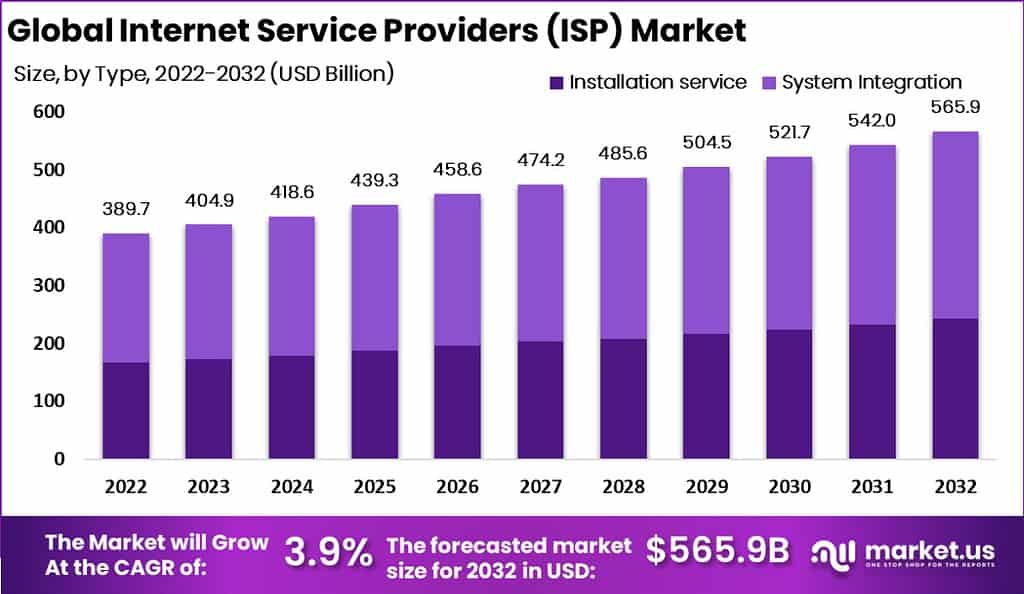
The principal goal of the ISP market is to deliver extensive, reliable, and high-speed internet access, enabling enhanced connectivity and supporting the increasing demands of modern technology usage in businesses and homes.
The primary drivers for the ISP market include the escalating demand for high-speed internet due to increasing digital transformation across various sectors, and the expansion of 5G networks enhancing data transmission speeds and network reliability. This growth is further supported by the rising adoption of cloud services and streaming media, requiring robust and fast internet connections.
Demand in the ISP market is predominantly driven by the residential segment, as homes increasingly require higher bandwidth for streaming services, smart home devices, and remote work setups. The commercial sector also shows significant demand, particularly from businesses needing reliable connections for cloud computing and daily operations.
Key Takeaways
- Market Growth: The global ISP market is expected to reach USD 565.9 billion by 2032, with a projected Compound Annual Growth Rate (CAGR) of 3.90% between 2023 and 2032.
- Product Type Analysis: Installation Service Segment, encompassing residential and commercial installations, is anticipated to be the most lucrative. ISPs offer comprehensive installation services, including hardware setup, software configuration, and testing/troubleshooting.
- Application Analysis: Online E-trading Segment: Considered the most profitable segment within the global Internet Service Providers (ISP) market , this sector’s growth is driven by the surging demand for high-speed internet connections, essential for executing online transactions efficiently.
- Drivers: Increasing Demand for Internet Services, Rapid Digital Transformation, Advancements in Network Technologies and Expanding E-commerce and Online Activities
- Restraints: Infrastructure Limitations in remote and rural areas, Regulatory Constraints affecting service expansion and Intense Competition leading to pricing pressures
- Opportunities: Customized Solutions catering to specific customer needs, Business Expansion into untapped markets and Partnerships and Collaboration with businesses and real estate developers
- Challenges: Ensuring Customer Satisfaction through efficient installations and robust customer service, Adapting to Technology Evolution in network technologies and Prioritizing Cybersecurity to protect customer data
- Regional Analysis: North America: Strong emphasis on advanced network technologies like fiber optics and 5G
- Recent Developments: China Mobile’s 5G network launch in all 31 provinces and Ericsson and Thales’ partnership to develop 6G technology.
Analysts’ Viewpoint
Significant investment opportunities exist in expanding network infrastructure, especially in rural and developing regions where internet penetration is still low. Additionally, the advent of smart cities and the expanding Internet of Things (IoT) ecosystem are prompting ISPs to invest in advanced technologies to manage large data inflows and ensure connectivity across varied environments.
Moreover, cybersecurity enhancements present critical investment avenues as threats increase in sophistication and frequency. The ISP industry is at the forefront of adopting cutting-edge technologies to improve and expand service offerings.
Innovations such as fiber-optic technology, 5G, and enhanced satellite internet services are transforming the landscape, offering faster speeds and more reliable connections. These advancements are critical for supporting the bandwidth-intensive applications of modern internet users, including high-definition video streaming, large-scale online gaming, and extensive cloud-based applications.
Artificial intelligence is reshaping the ISP industry by optimizing network operations and improving customer service. AI applications help in predictive maintenance, traffic management, and troubleshooting, ensuring high efficiency and minimal downtime. Additionally, AI-driven analytics provide ISPs with insights into user behavior and network performance, facilitating proactive improvements and personalized service offerings.
Product Type Analysis
The Installation Service Segment is Estimated to be the Most Lucrative Segment
- Residential Installations: ISPs offer installation services to individuals and households, enabling them to connect to the internet in their homes. This involves setting up the necessary equipment, such as modems, routers, and cables, to establish a stable and high-speed internet connection.
- Commercial Installations: For businesses and enterprises, Internet service provider (ISP) provide installation services tailored to their specific needs. This may involve configuring more complex network setups, ensuring robust security measures, and facilitating reliable connections to support business operations.
- Hardware Setup: ISP installation services involve the proper installation and configuration of hardware components, including routers, modems, switches, and access points. Technicians ensure that the hardware is correctly connected and optimized for optimal performance.
- Software Configuration: In addition to hardware setup, ISP technicians configure software settings on devices to enable internet access. This includes entering network credentials, establishing Wi-Fi passwords, and setting up security features.
- Testing and Troubleshooting: After installation, technicians conduct thorough testing to ensure that the internet connection is stable and functioning correctly. They address any potential issues or connectivity problems promptly to provide a smooth and uninterrupted user experience.

Note: Actual Numbers Might Vary In The Final Report
Application Analysis
The Online E-trading Segment is the Most Lucrative in the Global Internet Service Providers (ISP) Market
The online E-trading segment indeed holds the title of being the most lucrative in the global Internet Service Providers (ISP) market, primarily due to the rapid growth of e-commerce, which has sparked a surge in demand for high-speed Internet connections. As businesses and individuals engage in online trading activities, they require dependable and fast Internet connections to execute transactions efficiently. ISPs that can provide high-speed internet services tailored to the needs of online traders have the opportunity to charge premium prices for their offerings, thus bolstering their revenue streams.
Moreover, the online E-trading segment is also known for its dynamic nature within the global ISP market. The e-commerce landscape is constantly evolving, with new platforms emerging regularly, and existing platforms continuously updating their services and offerings. In this ever-changing environment, ISPs must stay agile and adaptable to meet the evolving demands of online traders. To remain competitive, ISPs need to stay ahead of the curve by continuously enhancing their infrastructure, investing in cutting-edge technologies, and staying abreast of the latest trends and developments in the e-commerce industry.
By catering to the specific requirements of online traders, ISPs can position themselves as reliable partners, offering seamless connectivity and low-latency services, which are vital for real-time data transmission and order execution. Such high-quality offerings enable online traders to seize market opportunities swiftly, thus boosting their confidence in the chosen Internet service provider (ISP) market.
Additionally, given the growing significance of mobile trading applications, ISPs have the opportunity to extend their services to cater to the mobile trading segment as well. This entails optimizing internet connectivity for mobile devices, ensuring traders can access trading platforms on the go with the same level of efficiency and reliability.
As the online E-trading segment continues to thrive, ISPs must proactively invest in their network infrastructure, deploying high-speed technologies such as fiber optics and 5G to meet the surging demand for seamless connectivity. By doing so, ISPs can foster a loyal customer base within the lucrative online E-trading sector.
Key Market Segments
Type
- Installation service
- System Integration
Application
- Online E-trading
- Entertainment
- Global Corporations
- Corporations
Drivers
- Increasing Demand for Internet Services: The growing reliance on the internet for work, education, entertainment, and communication is driving the demand for ISP installation services.
- Rapid Digital Transformation: The ongoing digital transformation of businesses and organizations creates opportunities for ISPs to provide tailored installation solutions to support their connectivity needs.
- Advancements in Network Technologies: The adoption of high-speed technologies like fiber optics and 5G requires skilled technicians to optimize installations and deliver enhanced internet experiences.
- Expanding E-commerce and Online Activities: The rise of e-commerce platforms and online activities is boosting the demand for reliable and fast internet connections, further driving the need for efficient ISP installations.
Restraints
- Infrastructure Limitations: In remote and rural areas, limited infrastructure can pose challenges for ISPs to offer seamless and high-speed internet installations.
- Regulatory Constraints: ISPs must adhere to various regulatory requirements, such as licensing and compliance, which can impact their ability to offer services in certain regions.
- Intense Competition: The ISP installation service segment is highly competitive, leading to price pressures and the need to differentiate through service quality and value-added offerings.
Opportunities
- Customized Solutions: Tailoring installation services to the specific needs of residential, commercial, and institutional customers presents opportunities for ISPs to offer personalized experiences.
- Business Expansion: Expanding into untapped markets, particularly in emerging economies, offers ISPs the chance to grow their customer base and increase market share.
- Partnerships and Collaboration: Collaborating with businesses, e-commerce platforms, and real estate developers can lead to exclusive partnerships and expanded market reach.
Challenges
- Customer Satisfaction: Meeting customer expectations for efficient and reliable installations requires skilled technicians and robust customer service.
- Technology Evolution: Keeping up with rapidly evolving network technologies and adapting installation practices accordingly can be challenging for ISPs.
- Cybersecurity Concerns: ISPs need to prioritize cybersecurity during installations to protect customer data and ensure safe internet usage.
Regional Analysis
North America
North America remains a highly competitive market for ISP installation services. The region experiences steady demand due to the widespread adoption of high-speed internet connections. ISPs in North America focus on offering advanced network technologies, including fiber optics and 5G, to meet the increasing demand for faster and more reliable connections. The deployment of 5G networks in major cities has led to a surge in demand for installation services optimized for 5G-enabled devices.
Europe
Europe sees robust growth in the ISP installation service segment, driven by the expansion of digital services and the growing number of smart homes. ISPs in Europe are actively investing in fiber optic infrastructure to enhance network capabilities and cater to the rising demand for high-speed connections. The region’s regulatory environment plays a significant role in shaping ISP operations, with compliance requirements impacting service offerings.
Asia-Pacific
The Asia-Pacific region experiences rapid growth in the ISP installation service segment, attributed to the increasing internet penetration and digital transformation of businesses. ISPs in this region face the challenge of serving diverse markets with varying levels of infrastructure development. Urban areas tend to offer advanced technologies, while rural areas present opportunities for infrastructure expansion. Emerging economies in Asia-Pacific offer substantial growth potential, attracting investments from both local and international ISPs.
Latin America
Latin America witnesses notable growth in the ISP installation service segment, fueled by the growing e-commerce market and rising internet usage. ISPs in this region focus on expanding network coverage to remote and underserved areas, bridging the digital divide and reaching a broader customer base. Government initiatives and regulatory reforms are supporting infrastructure development and incentivizing ISPs to extend their services to rural regions.
Middle East and Africa
The Middle East and Africa show promising growth in the ISP installation service segment, driven by increased smartphone adoption, digital inclusion efforts, and rising demand for online services. ISPs in this region face unique challenges related to political instability, varying infrastructure quality, and localized market dynamics. Mobile internet plays a crucial role in this region, with ISPs offering specialized installation services to support mobile-based connectivity.

Note: Actual Numbers Might Vary In The Final Report
Key Regions and Countries Covered in this Report:
- North America
- The US
- Canada
- Europe
- Germany
- France
- The UK
- Spain
- Italy
- Russia
- Netherland
- Rest of Europe
- APAC
- China
- Japan
- South Korea
- India
- Australia
- New Zealand
- Singapore
- Thailand
- Vietnam
- Rest of APAC
- Latin America
- Brazil
- Mexico
- Rest of Latin America
- Middle East and Africa
- South Africa
- Saudi Arabia
- UAE
- Rest of MEA
Market Players
- Accenture
- Amazon Web Services
- AT&T
- Cisco
- GE
- IBM
- TCS
- Atmel
- Atos
- Bosch
- CSC
- CTS
- Dell
- EMC
- Ericsson
- General Electric
- Hitachi
- HP
- Huawei
Recent Developments
- China Mobile, the largest telecommunications company in the world, announced that it had launched its 5G network in all 31 provinces in China. The company said that it had over 100 million 5G subscribers.
- Ericsson, the Swedish telecommunications company, and Thales, the French defense company, announced that they had partnered to develop 6G technology. 6G is the next generation of cellular network technology, and it is expected to offer speeds of up to 1 terabit per second.









