


Report Overview
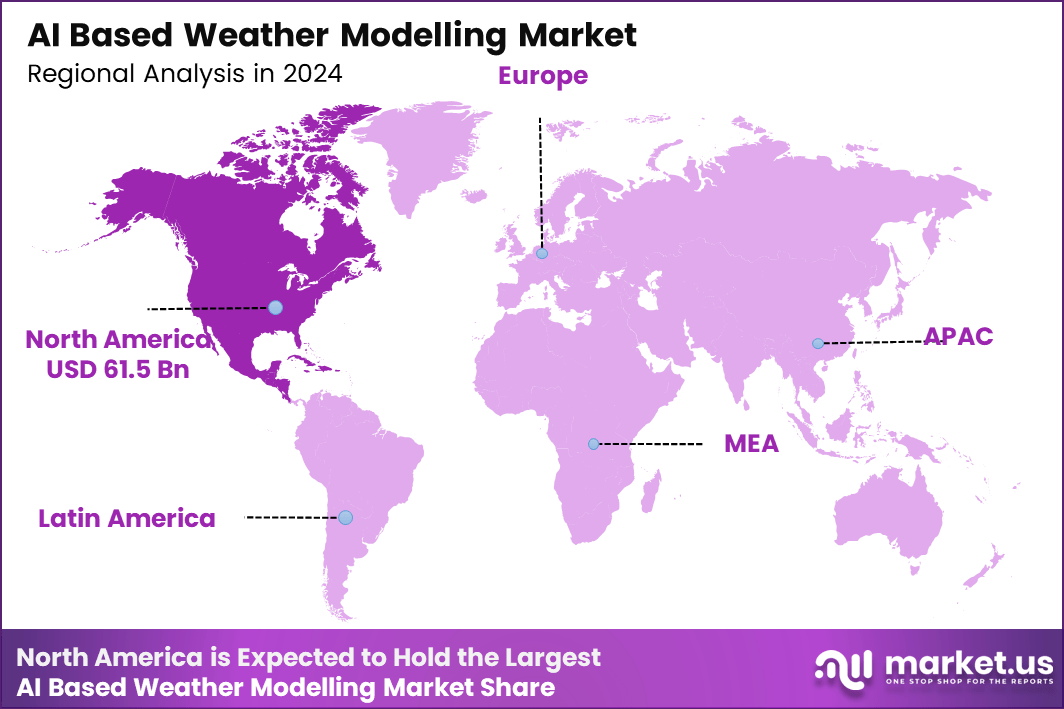
The Global AI-Based Weather Modelling Market generated USD 135.6 Million in 2024 and is predicted to register growth from USD 164.9 Million in 2025 to about USD 958.6 Million by 2034, recording a CAGR of 5.94% throughout the forecast span. In 2024, North America held a dominan market position, capturing more than a 45.4% share, holding USD 61.5 Million revenue.
The AI‑based weather modelling market refers to systems and platforms that apply artificial intelligence (AI), machine learning (ML), neural networks, and related methods to forecast weather and climatic phenomena with greater accuracy, speed, and resolution. These systems ingest vast volumes of meteorological, satellite, sensor, and geospatial data, perform pattern recognition, correct biases, and generate forecasts or warnings for use by governments, utilities, agriculture, transportation, and other sectors.
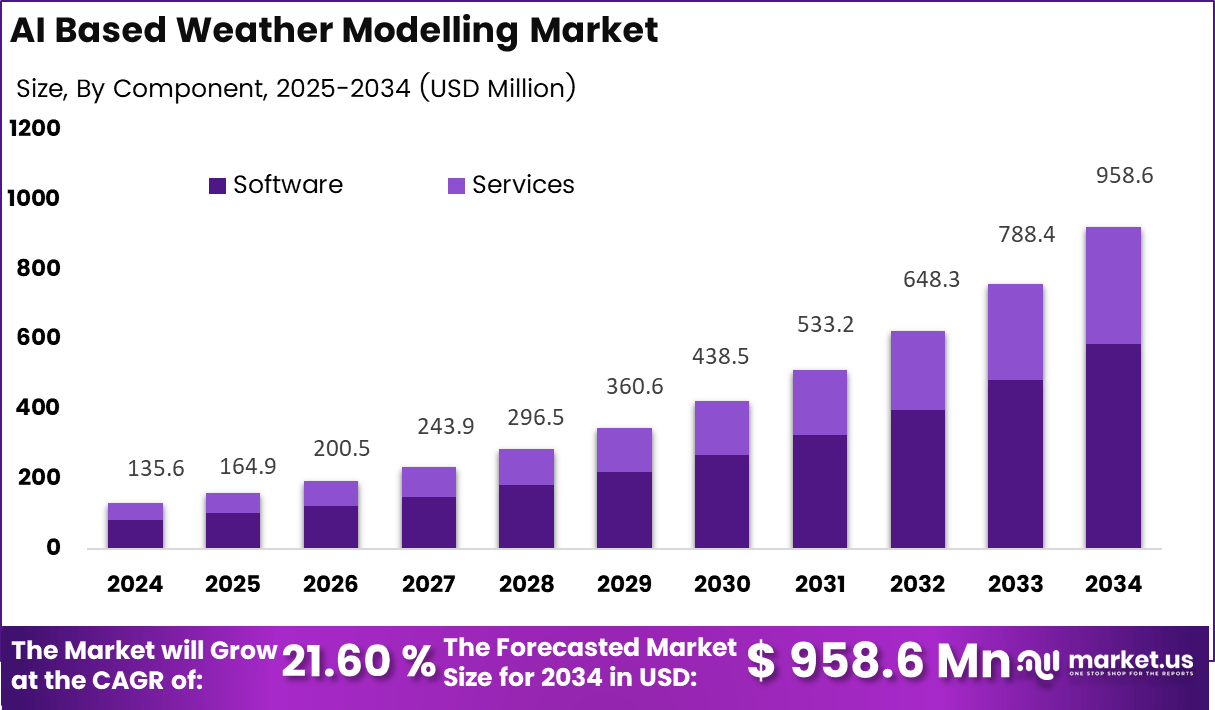
The surge in AI-based weather modelling is primarily driven by the rising frequency and intensity of extreme weather events such as hurricanes, heatwaves, and flash floods. These events have led to significant economic losses and human casualties, compelling governments and industries to invest in more accurate forecasting tools.
For instance, machine learning models can now identify early signs of atmospheric instability up to 48 hours earlier than traditional systems, improving evacuation timelines and emergency preparedness. Another key driver is the increasing availability of high-resolution environmental data from low-cost satellite constellations and IoT-enabled weather stations, which feed AI models with continuous, real-time inputs.
Demand for AI-powered weather insights spans multiple sectors, each with distinct needs. In agriculture, farmers rely on hyperlocal forecasts to optimize irrigation, planting schedules, and pest control, reducing water use by up to 30% in drought-prone regions. The energy sector uses AI models to predict wind and solar output with greater accuracy, helping grid operators balance supply and demand and avoid blackouts.
Key Takeaways
- Software contributes nearly 61.3%, showing that most buyers prioritize predictive and analytical tools over hardware systems.
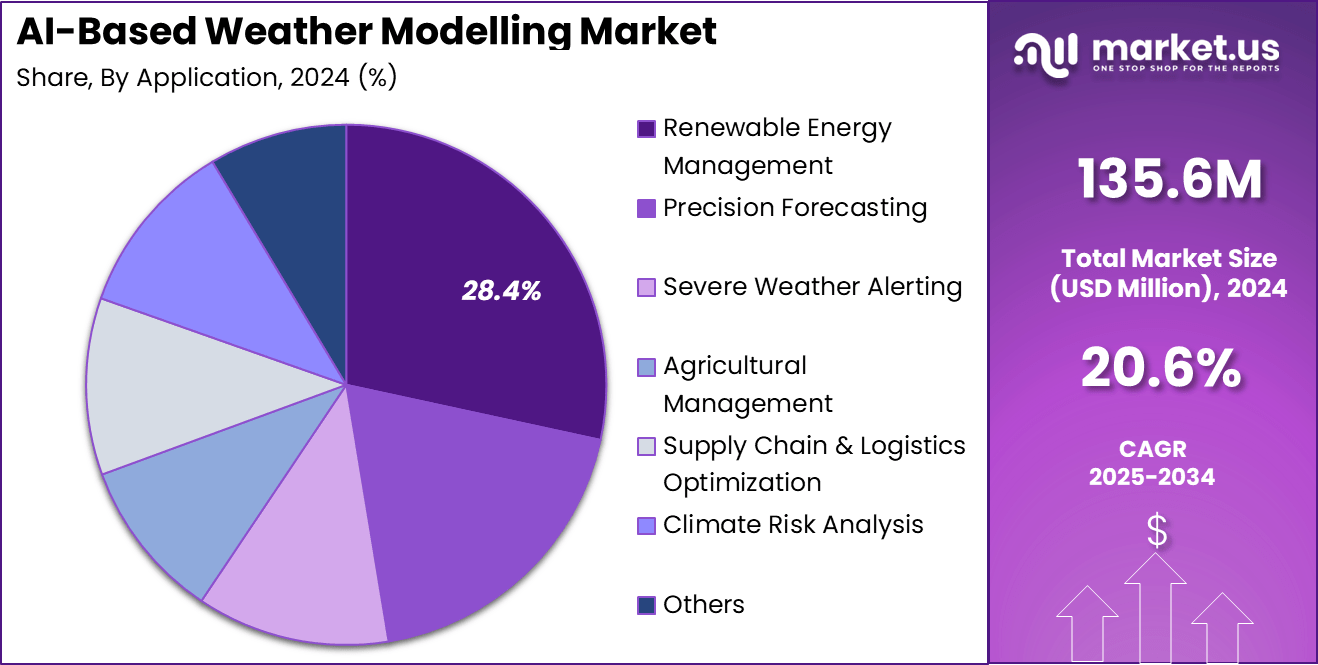
- Renewable energy management holds around 28.4%, reflecting the need for accurate forecasting to optimize solar, wind, and grid planning.
- Enterprise and business users make up about 54.1%, indicating strong commercial adoption for operational planning and risk reduction.
- North America accounts for nearly 45.4%, driven by climate-tech investments, utility upgrades, and advanced research use.
- The U.S. leads regional demand due to policy support, weather intelligence projects, and insurance-related forecasting needs.
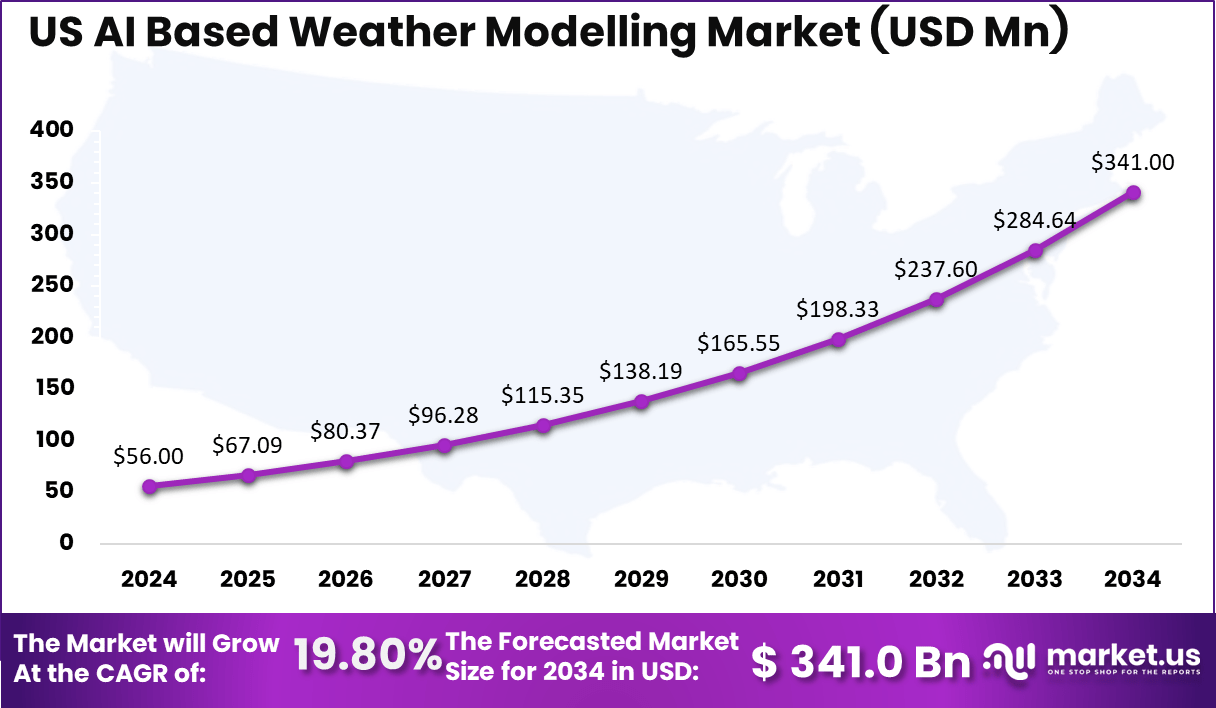
- Growth around 19.8% CAGR signals rising dependence on AI to address climate volatility and infrastructure planning.
Analysts’ Viewpoint
The adoption of AI in weather modelling is accelerating due to breakthroughs in deep learning architectures such as Graph Neural Networks (GNNs) and Transformers, which excel at processing spatiotemporal data. These models can simulate atmospheric dynamics by learning from historical weather patterns and real-time observations, reducing reliance on computationally expensive numerical weather prediction (NWP) models.
For example, Google’s GraphCast model has demonstrated the ability to generate global forecasts in under a minute, compared to hours required by traditional systems. Additionally, hybrid approaches that combine AI with physics-based models are gaining traction, ensuring predictions remain grounded in scientific principles while benefiting from data-driven adaptability.
Organizations are turning to AI-based weather models for several compelling reasons. First, they offer faster forecast generation, enabling timely responses to rapidly evolving weather conditions. Second, they improve forecast accuracy, especially for short-term and localized events like thunderstorms or urban heat islands. Third, AI models can operate with lower computational costs when deployed on cloud platforms, making advanced forecasting accessible to smaller institutions and developing countries.
Role of Generative AI
AI-based weather modelling is transforming how weather predictions are made, becoming more precise and faster. Generative AI plays a crucial role by creating detailed and realistic weather forecast ensembles that help capture uncertainty and complex patterns in atmospheric data. For instance, generative AI models like SEEDS can produce weather forecasts with spatial and temporal consistency at a fraction of the computational cost of traditional physics-based models.
This technology improves the reliability of short-term forecasts and helps in recognizing extreme weather events more effectively, contributing to better decision-making in sectors sensitive to weather changes. Research shows that generative AI has driven a nearly 375% annual increase in weather modeling publications over recent years, highlighting its growing impact.
Moreover, generative AI is instrumental in quantifying the uncertainty of weather forecasts, which is critical for risk management and climate resilience. Traditional methods rely on costly simulation ensembles, whereas generative AI can efficiently generate large ensembles, facilitating better assessment of extreme weather probabilities.
This advancement supports improved forecasting for phenomena such as heat waves or heavy rainfall, enhancing preparedness efforts and improving warning systems for communities at risk. Studies confirm that generative AI can mimic realistic weather conditions, capturing correlations between atmospheric variables important for weather prediction accuracy.
Investment Outlook
Investment in AI weather technologies is expanding beyond tech giants to include startups, research institutions, and public-private partnerships. Venture capital funding has increased in firms developing AI-driven microclimate models for smart cities and precision agriculture.
Governments are also investing in national AI meteorology initiatives, such as the U.S. National Oceanic and Atmospheric Administration’s (NOAA) collaboration with AI labs to modernize forecasting infrastructure. Emerging markets present significant opportunities, particularly in South and Southeast Asia, where monsoon variability impacts millions of livelihoods.
With over 38 million farmers in India now receiving AI-powered monsoon forecasts via mobile apps, the potential for scalable, low-cost solutions is evident. Businesses leveraging AI weather models gain tangible advantages in operational efficiency and risk mitigation. Retailers use weather-driven demand forecasting to adjust inventory levels ahead of storms or heatwaves, reducing waste and stockouts.
Logistics companies optimize delivery routes based on predicted weather disruptions, cutting fuel costs and improving service reliability. Renewable energy producers increase revenue by 10-15% through better forecasting of generation capacity, allowing them to bid more effectively in energy markets. Moreover, companies with climate-resilient operations enhance their ESG (Environmental, Social, and Governance) profiles, attracting investors focused on sustainability and long-term resilience.
US Market Size
The United States specifically generates a notable revenue of USD 56.0 million, with a high compounded annual growth rate of 19.8%. The country leads with advanced AI weather modelling initiatives often backed by federal agencies and private partnerships focused on enhancing forecasting accuracy and response times for extreme weather events. The U.S. also benefits from collaborations among academia, technology providers, and industry that accelerate AI model innovation.
In the U.S., integration of AI in climate and weather systems supports not only national disaster preparedness but also feeds directly into sectors like renewable energy grid management and financial risk analytics. This proactive use of AI-driven weather models is bolstered by regulatory frameworks and technology infrastructure that encourage adoption and scalability.
North America holds a commanding 45.4% share of the AI-based weather modelling market, driven by extensive adoption across government, energy, and industrial sectors. The region benefits from strong infrastructure, significant investments in AI research, and sophisticated data collection networks including satellites and IoT sensors.
This ecosystem supports continuous improvement in AI weather modelling capabilities and broad deployment of these technologies in operational settings. Heavy government involvement and funding for advanced forecasting technologies enhance the region’s leadership in this market. North America’s focus on mitigating climate risks and supporting sectors like agriculture, aviation, and insurance through AI-driven weather insights further consolidates its dominant position.
Emerging Trends
Emerging trends in AI-based weather modelling include the integration of diverse data sources such as satellite images, IoT sensors, and radar information, enabling more comprehensive climate analysis. Deep learning models are now able to recognize nonlinear weather patterns, significantly enhancing forecast precision.
For example, there has been a 70% increase in adoption of deep learning techniques to analyze complex climate data, improving short-term and seasonal forecasts. These trends are accelerating the use of AI not only for weather prediction but also climate risk assessments. Additionally, collaboration is expanding globally, with international data-sharing frameworks and partnerships between governments and research institutions.
Such cooperation fosters innovation and standardizes forecasting methods, benefiting sectors like agriculture, energy, and disaster management worldwide. The increased availability of cloud-based AI platforms has boosted data accessibility and model scalability, contributing to a 60% growth in the deployment of AI-powered weather services. This growing connectivity ensures timely and accurate weather information dissemination tailored to local needs.
Growth factors
Growth factors driving AI-based weather modelling include heightened awareness of climate change impacts and the increasing frequency of extreme weather events, which push governments and businesses to seek better prediction tools. AI models enhance disaster preparedness by improving early warning systems that can detect and forecast events with greater speed and accuracy.
For example, AI-enabled early warnings have improved lead time by 25%, helping to reduce damage and save lives in vulnerable regions. Furthermore, advances in computing power and data storage have made it feasible to process large climate datasets in real time, facilitating accurate and localized weather forecasts.
The adoption of user-friendly AI software and visualization tools has lowered the barrier for meteorologists, encouraging widespread use. This technological progress has resulted in a 50% increase in the number of meteorological agencies adopting AI in their forecasting workflows, supporting better climate resilience strategies.
By Component
In 2024, Software dominates the AI-based weather modelling market with a significant 61.3% share. This is due to the critical role software plays in processing large volumes of climate data and producing precise forecasts using advanced machine learning algorithms.
The continuous improvements in software capabilities, including the integration of big data analytics and cloud computing, allow for more accurate, real-time weather predictions that are essential for various sectors. AI-driven software solutions can analyze complex atmospheric patterns faster and more reliably than traditional methods, which supports better decision-making in weather-dependent activities.
The high software adoption also stems from the need for customizable and scalable models that can be adjusted to specific regional climates or industry requirements. Software in weather modelling often incorporates satellite imagery, sensor data, and IoT inputs, making it highly adaptable and capable of continuous learning based on new data inputs.
By Application
In 2024, Renewable energy management accounts for 28.4% of the AI-based weather modelling market, reflecting the growing importance of accurate weather forecasts in optimizing the generation and distribution of renewable energy sources such as solar and wind.
Precise weather predictions enable energy producers to anticipate fluctuations in energy supply and adjust grid operations accordingly, improving efficiency and reducing costs. AI weather models assist in forecasting solar irradiance and wind speeds, critical factors that directly impact renewable energy output.
This application is increasingly vital for grid stability and integration, especially as countries shift towards greener energy policies. By accurately predicting weather conditions, AI-based weather modelling helps prevent energy shortages or surpluses and supports storage management and maintenance scheduling.
By End-User
In 2024, Enterprise and business users form the largest end-user segment in AI-based weather modelling with a 54.1% share. These users include sectors like agriculture, energy, insurance, and transportation, all of which rely heavily on precise weather insights to optimize operations and mitigate risks. Enterprises utilize AI-driven forecasts for planning, operational decisions, and disaster preparedness, which can lead to considerable cost savings and efficiency improvements.
Businesses benefit from AI models’ abilities to provide location-specific weather information with lower latency and higher accuracy. This has created a growing ecosystem where businesses integrate weather data to improve supply chain management, optimize energy usage, and prepare for climate-related disruptions. The enterprise sector’s expanding reliance on AI weather modelling highlights its essential role in contemporary business strategies.
Key Market Segment
By Component
- Software
- Services
- Consulting & Integration
- Support & Maintenance
- DataasaService (DaaS)
By Application
- Precision Forecasting
- Severe Weather Alerting
- Renewable Energy Management
- Agricultural Management
- Supply Chain & Logistics Optimization
- Climate Risk Analysis
- Others
By EndUser
- Enterprise & Business
- Agriculture
- Renewable Energy (Wind, Solar)
- Aviation
- Retail & Ecommerce
- Insurance & Reinsurance
- Maritime & Logistics
- Media & Broadcasting
- Government & Defense
- National Meteorological Services
- Disaster Management Agencies
- Military Operations
- Research & Academia
Key Regions and Countries
- North America
- US
- Canada
- Europe
- Germany
- France
- The UK
- Spain
- Italy
- Rest of Europe
- Asia Pacific
- China
- Japan
- South Korea
- India
- Australia
- Singapore
- Rest of Asia Pacific
- Latin America
- Brazil
- Mexico
- Rest of Latin America
- Middle East & Africa
- South Africa
- Saudi Arabia
- UAE
- Rest of MEA
Top 5 Use Cases
- Renewable Energy Forecasting: AI models optimize solar and wind power generation by predicting weather patterns and energy output fluctuations up to 35% more accurately, improving grid stability and reducing energy loss.
- Disaster Management & Early Warning Systems: Machine learning algorithms enable rapid detection of severe storms, floods, and wildfires, enhancing early warning accuracy by nearly 40%, aiding timely evacuation and risk mitigation.
- Precision Agriculture: AI-based weather models help farmers plan irrigation, crop protection, and harvesting schedules, improving yield efficiency by 25–30% through accurate rainfall and temperature forecasts.
- Aviation & Maritime Navigation: AI tools improve route optimization and turbulence prediction, reducing fuel consumption and delays by approximately 15–20%, ensuring safer and more efficient travel operations.
- Urban Planning & Climate Risk Assessment: Cities use AI-driven weather insights to design climate-resilient infrastructure, manage heatwaves, and plan flood defenses, cutting potential climate-related losses by up to 22% annually.
Driver
Increasing Frequency of Extreme Weather Events
The rising frequency of extreme weather events is a key driver for the adoption of AI-based weather modelling. As severe hurricanes, droughts, floods, and wildfires become more frequent, there is a growing demand for accurate and localized weather predictions.
AI models provide improved precision in anticipating these events, enabling governments, industries, and communities to better prepare and respond to such disasters. This pushes the market growth as real-time forecasting aids in minimizing damage and enhancing safety.
More extreme weather creates urgency for better forecasting techniques. The precision gained from AI models supports adaptive strategies in disaster response, agriculture, energy management, and insurance risk assessment. The trend of frequent, unpredictable weather phenomena fuels interest in technologies that can deliver timely and actionable insights, creating strong demand for AI-powered weather solutions.
Restraint
Data Availability and Quality Limitations
One major restraint on AI-based weather modelling is the availability and quality of consistent, comprehensive environmental data. AI models require large volumes of accurate data from diverse sources such as satellites, sensors, and historical records to train effectively. Gaps, inconsistencies, or low-quality inputs can reduce the accuracy and reliability of these models.
Data fragmentation and incomplete datasets limit the capability of AI to deliver precise predictions, especially in under-monitored regions. The challenge to access and integrate vast heterogeneous data affects model robustness. This restraint hampers scaling AI weather models globally and affects trust in their forecasts.
Opportunity
Enhanced Disaster Preparedness and Risk Management
AI-based weather modelling offers significant opportunities in improving disaster preparedness and risk management across sectors. More accurate, localized, and timely forecasts enable better planning in agriculture, aviation, energy, and insurance. For instance, AI models support farmers in adjusting planting schedules and protecting crops from adverse weather effectively, increasing yields and sustainability.
Governments and private sectors investing in AI weather models can optimize resource allocation and coordinate responses to extreme events. The integration of AI with real-time data and IoT expands possibilities for predictive maintenance of infrastructure and enhances climate resilience. This opportunity strengthens demand for AI solutions that improve operational efficiency and community safety.
Challenge
High Costs and Technical Complexity
A significant challenge for AI-based weather modelling is the high cost and technical complexity involved in implementing these solutions. Developing sophisticated AI models requires substantial financial investment in computing infrastructure, data acquisition, and ongoing maintenance. The need for expertise in AI, meteorology, and data science further raises barriers.
Additionally, integrating data from multiple sources like satellites and IoT devices poses technical difficulties. Energy consumption for running large-scale AI simulations is also a concern. These factors can slow adoption, especially in regions with limited resources, making it difficult to scale AI-driven weather forecasting universally.
Key Players Analysis
The AI-Based Weather Modelling Market is driven by major technology providers such as Google LLC, Microsoft, IBM Corporation, and NVIDIA Corporation. These companies leverage AI, cloud computing, and high-performance simulation to improve forecasting accuracy, climate prediction, and real-time weather analytics.
Specialized weather and climate intelligence firms including AccuWeather, Inc., ClimateAi, and The Tomorrow Companies Inc. focus on hyperlocal forecasting, climate risk assessment, and industry-specific weather insights. Their AI-driven tools help businesses make informed decisions around supply chain planning, disaster readiness, and resource management.
Emerging players such as Jupiter, Atmos Climate, Open Climate Fix, and Climavision, along with other key participants, contribute through advanced climate modelling, satellite data fusion, and predictive analytics. Their innovations address gaps in regional climate data, extreme weather forecasting, and renewable energy planning.
Top Key Players
- Google LLC
- Microsoft
- IBM Corporation
- NVIDIA Corporation
- AccuWeather, Inc.
- ClimateAi
- The Tomorrow Companies Inc.
- Jupiter
- Atmos Climate
- Open Climate Fix
- Climavision
- Other Key Players
Recent Developments
- May 2025, Microsoft Research unveiled Aurora, a cutting-edge AI foundation model trained on over a million hours of weather data. Aurora delivers highly accurate medium-range forecasts and improves predictions of extreme weather. Microsoft integrated Aurora into MSN Weather and made its source publicly available for innovation.
- March 2025, University of Cambridge, in collaboration with Microsoft Research, launched the Aardvark Weather AI system. This model delivers forecasts tens of times faster while using thousands of times less computing power than traditional systems, showcasing a major efficiency breakthrough in weather prediction.









