


Report Overview
The Global DJ Equipment Market size is expected to be worth around USD 1,273.9 Million by 2034, from USD 672.3 Million in 2024, growing at a CAGR of 6.6% during the forecast period from 2025 to 2034.
DJ equipment refers to specialized gear used to mix, create, and play music at live events. It typically includes mixers, headphones, controllers, speakers, and turntables. DJs commonly use this equipment at parties, clubs, or weddings. Reliable and high-quality gear helps DJs enhance audience experience by delivering better sound quality.
Customers include professional DJs, hobbyists, and venues. This market targets the entertainment industry, focusing on providing reliable and high-performance equipment to enhance live events.
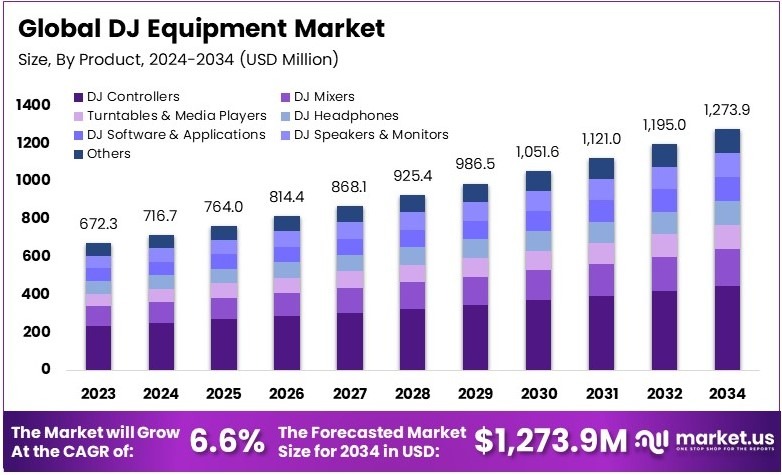
The DJ equipment market is currently thriving due to the burgeoning interest in electronic music and the rise of live music and DJ performances. Market competitiveness remains intense, with major brands consistently innovating to capture the attention of both new entrants and professional DJs.
Government regulations and economic conditions play critical roles in shaping the DJ equipment market. The significant decrease in the number of nightclubs in the UK, from 1,700 in 2013 to just below 800 in late 2024, illustrates the market’s volatility. Nevertheless, areas like New York City, where the nightlife industry annually contributes US$35 billion and sustains 300,000 jobs, offer a contrasting narrative of vitality and growth.
Globally, the nightlife sector significantly impacts local economies. For instance, the UK’s night-time economy generates an impressive $85 billion each year, ranking as the fifth-largest industry nationally and supporting over 1.3 million jobs.
Cities such as Liverpool are not just surviving but thriving, with their night-time expenditures outperforming other major UK cities. This resilience in specific locales highlights the potential for targeted growth and investment in the DJ equipment market, even as some areas face downturns.
Key Takeaways
- The DJ Equipment Market was valued at USD 672.3 million in 2024 and is expected to reach USD 1,273.9 million by 2034, with a CAGR of 6.6%.
- In 2024, DJ Controllers dominate the product type segment with 35.2%, due to their versatility and ease of use.
- In 2024, Digital Technology leads with 67.5%, driven by advancements in music production and seamless integration with software.
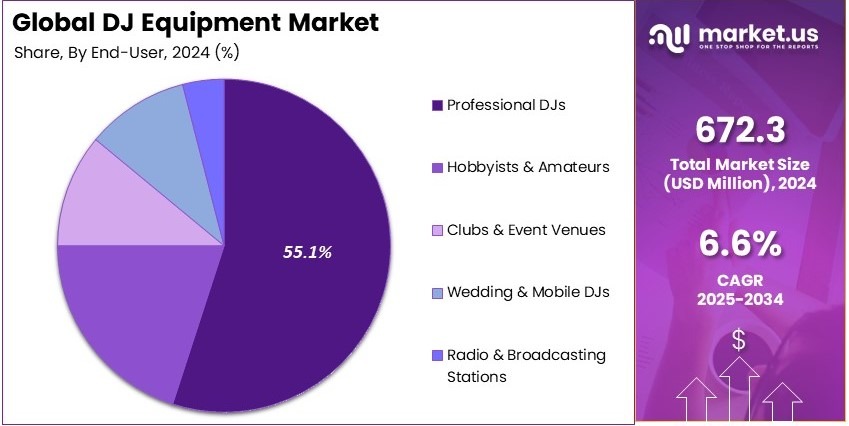
- In 2024, Professional DJs dominate the end-user segment with 55.1%, as demand for high-quality DJ equipment continues to rise.
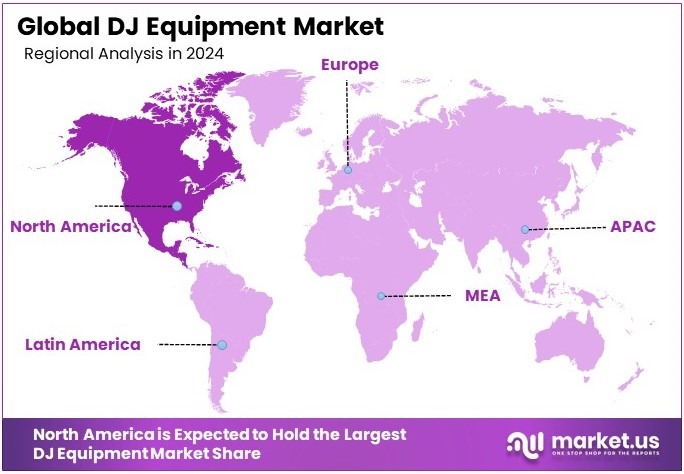
- In 2024, North America holds the largest market share, supported by a strong entertainment industry and music festivals.
Product Type Analysis
DJ Controllers dominate with 35.2% due to their versatility and integration capabilities.
In the DJ Equipment Market, the Product Type segment is diverse, but DJ Controllers emerge as the dominant sub-segment, holding a 35.2% market share. This prominence is due to their ability to integrate various functionalities like mixing, looping, and effects into one device, offering DJs a comprehensive tool for performance. They are favored for their convenience, allowing seamless control over digital music files.
DJ Mixers remain vital for traditional DJ setups, enabling sound mixing with multiple channels. Turntables & Media Players appeal to purists and those who value the tactile feel of vinyl. DJ Headphones are essential for live performance accuracy, ensuring DJs can cue and mix tracks effectively.
DJ Software & Applications are integral in modern DJing, providing digital solutions that enhance creative possibilities. DJ Speakers & Monitors are crucial for delivering quality sound in various venues. Lighting & Effects Equipment enhance the visual experience of DJ performances. Lastly, Microphones & Accessories are necessary for events where DJs host or interact with the audience.
Technology Analysis
Digital technology dominates with 67.5% due to its adaptability and advanced features.
Technology within the DJ Equipment Market is categorized into Analog and Digital, with Digital technology holding a dominant position at 67.5%. This segment’s leadership is driven by the digital equipment’s ability to adapt to diverse DJing needs and its incorporation of advanced features that enhance performance, such as MIDI compatibility and software integration.
Analog technology, while less prevalent, continues to be cherished in the DJ community for its rich sound quality and the tactile interaction it offers, important for DJs who prefer a more traditional feel to their setups.
End-User Analysis
Professional DJs dominate with 55.1% due to their reliance on high-quality, reliable equipment for performance.
End-Users of DJ equipment vary, but Professional DJs are the dominant segment, accounting for 55.1% of the market. This group prioritizes high-quality, reliable equipment to ensure seamless performances, making their preferences influential in the market.
Hobbyists & Amateurs also form a significant portion of the market, often opting for more accessible and cost-effective equipment as they build their skills. Clubs & Event Venues require robust systems that can withstand frequent use and cater to large audiences, emphasizing durability and sound quality. Wedding & Mobile DJs need portable and versatile equipment to adapt to different venues and events. Radio & Broadcasting Stations use DJ equipment for live broadcasts and events, prioritizing clarity and connectivity.
Key Market Segments
By Product Type
- DJ Controllers
- DJ Mixers
- Turntables & Media Players
- DJ Headphones
- DJ Software & Applications
- DJ Speakers & Monitors
- Lighting & Effects Equipment
- Microphones & Accessories
By Technology
- Analog
- Digital
By End-User
- Professional DJs
- Hobbyists & Amateurs
- Clubs & Event Venues
- Wedding & Mobile DJs
- Radio & Broadcasting Stations
Driving Factors
Vibrant Experiences Drive Market Growth
Global popularity of electronic dance music has spurred a significant rise in demand for DJ equipment. Consumers seek professional quality sound and innovative design. Nightlife venues and entertainment events thrive on energetic music, attracting diverse audiences. This cultural shift boosts interest in advanced DJ technology and creative performance tools globally.
Technological advancements have made DJ interfaces more user-friendly and accessible. Manufacturers invest in innovation to simplify controls and enhance sound quality. Home-based DJ setups are becoming popular among amateur enthusiasts. These developments provide improved performance features and attract a new generation of hobbyists and professionals alike across diverse regions worldwide.
Expansion of nightlife and festival scenes supports robust demand for quality DJ gear. Operators require reliable and versatile equipment to meet high standards. The increasing frequency of music events drives continuous investment in state-of-the-art technology. This trend reinforces market growth and encourages manufacturers to develop innovative, high-performance products consistently globally.
Restraining Factors
Market Saturation Restrains Growth
High initial investment costs limit entry-level consumer adoption of DJ equipment. New users face steep prices that deter potential buyers. Many aspiring DJs find the financial barrier prohibitive. This challenge forces consumers to postpone purchases or seek alternative, lower-cost solutions instead, which significantly impacts market penetration rates globally in reality.
Music streaming services have grown in popularity, reducing demand for physical DJ gear. As consumers access digital music libraries, the need for traditional equipment declines. This shift challenges manufacturers to justify higher prices and reconfigure product strategies. Cost pressures force some companies to adjust profit margins across competitive markets globally.
Market saturation further intensifies price competition among manufacturers. Numerous brands vie for consumer attention, resulting in lower profit margins and reduced innovation. The crowded market makes it challenging for new entrants to establish themselves. Rapid technological evolution also leads to frequent obsolescence of existing equipment models, hurting overall growth significantly.
Obsolescence due to rapid technological progress forces companies to continuously update product lines. This need for frequent upgrades results in higher costs for both manufacturers and consumers. The combination of steep initial investments and fast-paced innovation creates market uncertainty. Overall, these restraining factors slow down overall market expansion and profitability.
Growth Opportunities
Strategic Collaborations Provide Opportunities
Increased adoption of portable and compact DJ systems creates new opportunities in the market. Consumers now seek lightweight and versatile equipment that offers convenience without compromising quality. Manufacturers are responding by developing innovative products tailored for mobility and ease of use. These portable solutions appeal to both professionals and hobbyists.
Growth of online streaming and virtual DJing platforms further expands market reach. These platforms enable remote performances and live interactions with audiences. The integration of digital solutions attracts new customer segments and supports engagement. Virtual setups allow DJs to perform without geographical constraints, thereby broadening consumer access to innovative services.
Rising demand for customized DJ gear presents further growth opportunities. Consumers increasingly look for personalized features that match their performance styles. Manufacturers now offer options to customize color schemes, functionalities, and interfaces. This trend enhances brand loyalty and fosters a deeper connection between providers and end users across multiple markets.
Emerging markets provide untapped consumer bases for DJ equipment sales. Regions with developing nightlife scenes are beginning to invest in quality gear. Manufacturers target these areas with cost-effective models and tailored marketing strategies. This focus on new territories promises to drive significant revenue growth and expand the industry’s global footprint.
Emerging Trends
Evolving Trends Are Latest Trending Factor
Rising popularity of wireless and Bluetooth-compatible DJ equipment is evident in today’s market. Consumers appreciate the freedom of wireless connections and ease of setup. These features improve mobility and performance during live events. The demand for such innovative equipment continues to grow among both professional DJs and amateurs worldwide adoption.
Increasing adoption of AI-assisted DJ tools and automated music mixing software enhances performance quality. These technological solutions simplify complex tasks and offer creative options for dynamic shows. The use of smart software aids DJs in delivering seamless transitions. Such advancements support a modern approach to music production and live performance.
Growth of hybrid events that blend live performances with digital DJ sets is reshaping the industry. These events combine physical venues with online streaming, reaching broader audiences. This trend encourages innovative service models and creative show formats. Organizers value the flexibility and extended engagement provided by such hybrid setups significantly.
Surge in demand for environmentally sustainable DJ equipment and accessories reflects growing eco-conscious consumer trends. Manufacturers are developing greener products using sustainable materials and energy-efficient designs. This shift supports corporate social responsibility and appeals to environmentally aware customers. The focus on sustainability is becoming a key differentiator in a market.
Regional Analysis
North America Dominates with Major Market Share
North America leads the DJ Equipment Market with a major market share, fueled by a thriving music and entertainment industry. This significant dominance is driven by the region’s rich culture of music innovation and a strong presence of both amateur and professional DJs.
Key factors contributing to this high market share include advanced technological infrastructure, high disposable incomes that enable spending on premium DJ equipment, and a large number of music events, clubs, and live performances. Additionally, North America is home to many leading manufacturers of DJ equipment, which supports local market growth and innovation.
Looking forward, North America is expected to maintain a strong influence in the global DJ Equipment Market. Continued technological advancements, growing interest in DJing as a profession, and an increase in DJ academies and training schools are likely to further drive the market’s growth in the region.
Regional Mentions:
- Europe: Europe remains a significant player in the DJ Equipment Market, with its vibrant club scene and numerous music festivals. The region’s DJs are keen on adopting new technologies, supporting steady market growth.
- Asia Pacific: The Asia Pacific region is rapidly growing in the DJ Equipment Market, thanks to increasing urbanization and the rising popularity of electronic music. Countries like Japan and South Korea are at the forefront of this expansion.
- Middle East & Africa: The Middle East and Africa are witnessing gradual growth in the DJ Equipment Market. Increased entertainment options and music festivals across the region are driving this development.
- Latin America: Latin America shows potential for growth in the DJ Equipment Market, fueled by its rich musical culture and increasing number of public and private music events.
Key Regions and Countries Covered in the Report
- North America
- US
- Canada
- Europe
- Germany
- France
- The UK
- Spain
- Italy
- Rest of Europe
- Asia Pacific
- China
- Japan
- South Korea
- India
- Australia
- Rest of APAC
- Latin America
- Brazil
- Mexico
- Rest of Latin America
- Middle East & Africa
- South Africa
- Saudi Arabia
- UAE
- Rest of MEA
Competitive Landscape
In the DJ Equipment Market, several key players dominate due to their innovative products, brand reputation, and ability to meet the diverse needs of DJs across all skill levels. Among these, four companies stand out:
Pioneer DJ is a leading brand known for setting industry standards with its high-quality, robust, and innovative DJ gear. Pioneer DJ’s equipment is favored by professional DJs globally for its reliability and advanced features that enhance creative possibilities.
Denon DJ offers cutting-edge DJ technology with a strong focus on integration and versatility. Their equipment, known for intuitive interfaces and powerful performance, appeals to both seasoned professionals and newcomers to the DJ scene.
Numark provides a broad range of DJ equipment that combines usability with innovative technology, making it accessible to DJs at all skill levels. Numark is particularly appreciated for its value-oriented approach without compromising on the performance that DJs require.
Rane DJ is highly regarded for its premium quality mixers and sophisticated performance equipment tailored for battle DJs and turntablists. Rane’s commitment to quality and durability makes it a favorite among DJs who value precision and dependability.
These companies drive the DJ Equipment Market by continuously innovating and adapting to the evolving needs of the DJ community, ensuring they remain at the forefront of this dynamic industry.
Major Companies in the Market
- Pioneer DJ
- Denon DJ
- Numark
- Rane DJ
- Native Instruments
- Hercules DJ
- Allen & Heath
- Roland
- Gemini Sound
- Stanton DJ
- Behringer
- Akai Professional
- American Audio
Recent Developments
- MXER: On August 2024, UK-based music fashion brand MXER introduced a new collection of bags designed for DJs, producers, and audiophiles. The bags offer a fashionable and functional alternative to traditional cross-body designs, featuring compartments for headphones, USB drives, phones, SD cards, and identification. Their construction from water-resistant recycled ripstop nylon and modular design with detachable components provide versatile usage options.
- CFRC 101.9 FM: On July 2024, CFRC 101.9 FM announced the commencement of its fall term Airwave YGK DJ workshops for beginners, scheduled to begin in September 2024. The workshops, led by local professional DJ Mat Almeida, target community members aged 17 and above as well as Queen’s University students, covering topics ranging from equipment setup to live on-air performance.









