


Report Overview
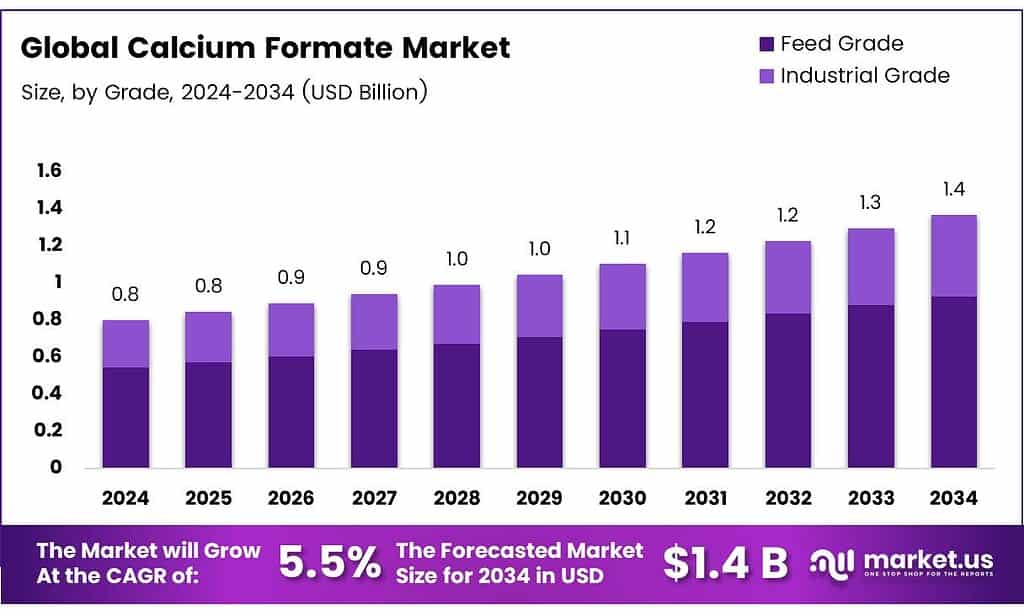
The Global Calcium Formate Market size is expected to be worth around USD 1.4 billion by 2034, from USD 0.8 billion in 2024, growing at a CAGR of 5.5% during the forecast period from 2025 to 2034.
Calcium formate [Ca(HCOO)₂] is a versatile compound employed as a feed additive for livestock, a food additive for humans, and an auxiliary in industrial and construction materials. It regulates the pH of the livestock alimentary canal, promoting digestion and nutrient absorption. In cement applications, it serves as a hydration accelerator, primarily to counteract the retarding effects of water-reducing admixtures. With a low solubility of approximately 160 g/L at 20°C (or 17 g/100 g), it is typically added as a powder, which can lead to dispersion challenges.
As an organic salt, calcium formate is well-suited for pig and poultry diets, functioning as a feedstock preservative with an acidifying effect on the gastrointestinal tract to support gut health. The efficiency of digestion in these animals relies on indigenous microorganism concentrations in the gut. With impending bans on prophylactic antibiotics in animal feed to control disease and growth, alternatives like calcium formate are essential to suppress pathogenic bacteria such as E. coli and Salmonella, which hinder digestion and cause enteric diseases.
In construction, the accelerator is typically dosed at 0.5–2% by weight of cement. While many accelerators derive from chemicals like calcium chloride—which faces restrictions in numerous countries due to its corrosive impact on reinforced concrete metal—calcium formate offers a safer alternative. It is sometimes combined with sodium nitrite or other substances to enhance its properties, yielding desirable synergistic effects. Though less effective than calcium chloride, other commercially available accelerators include de-acidised calcium formate, sodium aluminate, and triethanolamine.
Calcium salts generally exhibit superior activity over most metal salts but are hindered by low water solubility; calcium formate mimics calcium chloride’s action yet requires higher dosages due to its reduced solubility. Calcium formate exhibits a low order of toxicity, with an acute oral LD₅₀ of 2,650 mg/kg in rats and 154 mg/kg via intravenous injection. Long-term studies in rats, involving 0.2% in drinking water for three years or 0.4% for two years, showed no adverse effects on growth, fertility, or function across up to five generations.
Key Takeaways
- The Global Calcium Formate Market is projected to reach USD 1.4 billion by 2034, up from USD 0.8 billion in 2024, with a steady 5.5% CAGR from 2025 to 2034.
- Feed Grade dominated the By Grade segment with a 67.9% share, excelling in enhancing livestock health through effective nutrition support.
- Feed Additive led the By Application segment in 2024, holding a 59.3% share by swiftly boosting animal nutrient absorption and gut health.
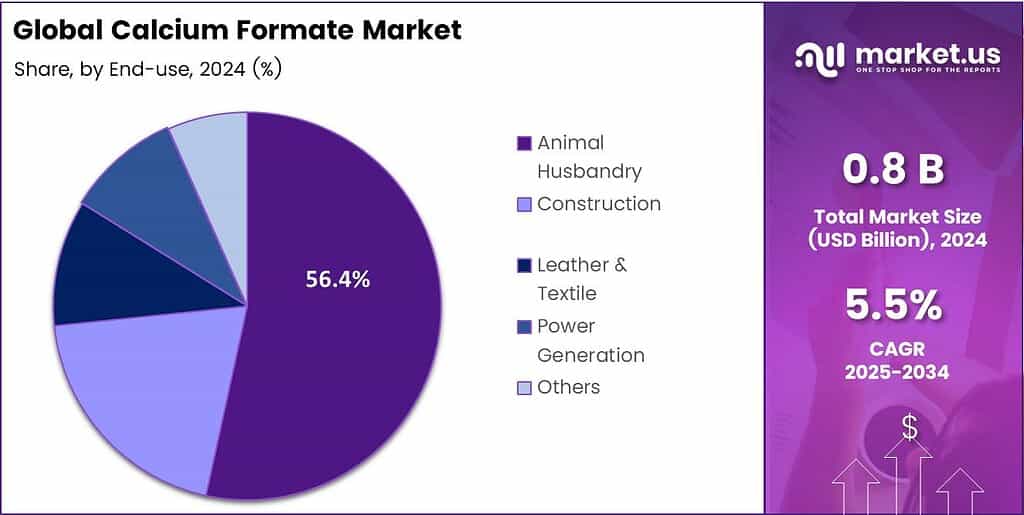
- Animal Husbandry commanded the By End-use segment in 2024 with a 56.4% share, thriving on its role in fostering healthier livestock populations worldwide.
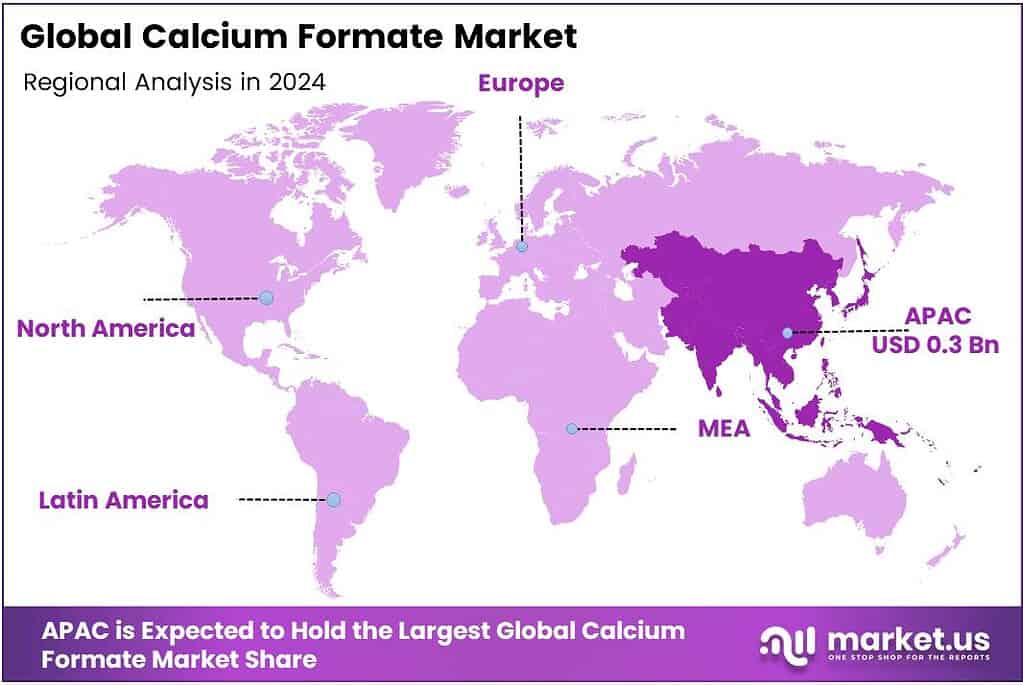
- Asia-Pacific region captured a commanding 49.3% global share in 2024, valued at USD 0.3 billion, fueled by booming infrastructure, urbanization, and cement industries.
By Grade Analysis
Feed Grade dominates with 67.9% due to its essential role in animal nutrition worldwide.
In 2024, Feed Grade held a dominant market position in the By Grade Analysis segment of the Calcium Formate Market, with a 67.9% share. This segment leads because it enhances livestock health effectively. Farmers increasingly adopt it to boost digestion and growth. Its acidifying properties combat pathogens naturally. Thus, demand surges in global feed industries, driving market expansion steadily.
The Industrial Grade follows as a key player, supporting diverse manufacturing needs. It accelerates processes in construction and chemicals efficiently. Industries value its reliability despite a lower share. Growth occurs through innovative applications. Consequently, it contributes significantly to overall market dynamics, ensuring balanced development.
By Application Analysis
Feed Additive dominates with 59.3% thanks to rising livestock farming demands globally.
In 2024, Feed Additive held a dominant market position in the By Application Analysis segment of the Calcium Formate Market, with a 59.3% share. This application excels by improving nutrient absorption in animals swiftly. It preserves feed quality and promotes gut health reliably. With antibiotic bans looming, it emerges as a vital alternative.
Therefore, adoption accelerates across the poultry and pig sectors, fueling robust growth. The Concrete Additive segment gains traction in building projects worldwide. It speeds up hydration, enhancing efficiency on sites. Builders prefer it for cold-weather performance.
Usage rises with infrastructure booms. Hence, it strengthens market presence through practical benefits. Textile Dyeing and Finishing utilizes the compound for better color fixation processes. It regulates pH, ensuring vibrant results consistently. Textile firms integrate it to meet quality standards. Expansion happens via sustainable dyeing trends. As a result, it bolsters the application’s relevance in the fashion industry.
By End-use Analysis
Animal Husbandry dominates with 56.4% driven by a focus on sustainable animal rearing practices.
In 2024, Animal Husbandry held a dominant market position in the By End-use Analysis segment of the Calcium Formate Market, with a 56.4% share. This end-use thrives by supporting healthier livestock populations effectively. It reduces disease risks and improves feed efficiency. Producers rely on it for better yields.
Thus, it propels market leadership amid growing meat demands. The Construction end-use benefits from faster setting times in cement mixes. It counters admixtures’ delays, aiding timely completions. Urbanization boosts its necessity worldwide. Projects incorporate it for durability. Consequently, it drives steady segmental progress.
Leather and Textile employs the product for tanning and finishing enhancements. It softens hides and stabilizes dyes precisely. Industries adopt it to cut processing times. Sustainability pushes further integration. Therefore, it enriches the end-use portfolio dynamically.
Key Market Segments
By Grade
- Feed Grade
- Industrial Grade
By Application
- Feed Additive
- Concrete Additive
- Textile Dyeing and Finishing
- Others
By End-use
- Animal Husbandry
- Construction
- Leather and Textile
- Power Generation
- Others
Emerging Trends
Shift to chloride-free accelerators in low-carbon concrete
A clear trend in calcium formate is its rising use as a chloride-free set accelerator for low-carbon concrete that must still gain early strength quickly. Builders are moving away from calcium chloride because codes strictly cap total chloride in reinforced and prestressed concrete to protect steel. Typical ACI limits are 0.06% (prestressed), 0.15% (reinforced exposed to chlorides), 0.30% (other reinforced), and 1.0% (plain), all by mass of cement.
- Calcium formate meets these durability rules while delivering cold-weather set and turn-around benefits that contractors need. It also slots neatly into European admixture standards, where set accelerators are dosed in small amounts, typically <5% of cement mass under EN 934-2 practice. The macro driver is cement’s decarbonization push: the IEA notes the sector must cut CO₂ intensity by 4% per year to align with net-zero pathways, and global energy-related CO₂ reached 37.8 Gt in 2024, keeping pressure on hard-to-abate industries like cement.
Practically, calcium formate helps crews meet ACI cold-weather guidance that discourages chloride accelerators near embedded steel and requires protection when ambient temperatures fall, without risking rebar corrosion. With the world still producing about 4.1 billion tonnes of cement annually, even modest substitution toward chloride-free accelerators can touch a huge volume of mixes, particularly those rich in SCMs (slag/fly ash) that need reliable early strength.
Drivers
Surge in Infrastructure and Construction Activity
The International Energy Agency (IEA), the construction sector requires around 4 billion tons of cement annually, and future demand remains high, especially in emerging markets. As concrete producers aim to deliver early-strength mixes, faster turnaround, and reliable performance under varied conditions, additives like calcium formate are increasingly sought.
- The IEA emphasises that in a net-zero scenario, material efficiency and improved cementitious technologies are crucial. On the other hand, specific product-level literature shows that calcium formate speeds up cement hardening and enhances early strength in mortars and tile adhesives. One manufacturer states typical dosages of 1% to 2.5 % of cement weight for such usage.
Many governments and development agencies are putting big budgets behind infrastructure-led growth. When public procurement of large concrete works picks up, it raises demand for reliable, high-performance additives. The fact that calcium formate is approved and used for accelerators in cementitious systems gives it a favourable position.
Restraints
Tight dosage caps and environmental/compliance burdens
A real restraint on calcium formate is that several high-volume use cases face strict dosage, environmental, and workplace limits that add cost and cap demand. In animal nutrition, EU risk assessments allow calcium formate only up to 10,000 mg formic acid equivalents per kg of complete feed for most species, and 12,000 mg/kg for pigs—hard upper bounds that ration inclusion rates and keep volumes in check.
Calcium formate (E238) was considered safe only when ≤15,000 mg/kg complete feed. Environmental guardrails also weigh on de-icing and infrastructure budgets, where formate salts would otherwise grow. Transportation studies have found that organic acetate/formate deicers increase biochemical oxygen demand (BOD) in receiving waters, which can depress dissolved oxygen, a concern for agencies managing sensitive watersheds.
- The organic deicers like potassium acetate can cost USD 600–1,200/ton, versus USD 30–100/ton for rock salt (NaCl). This large price gap pressures winter-maintenance budgets and tends to limit broader adoption of organic acetate/formate systems except at airports or high-priority corridors, an indirect headwind for calcium formate penetration.
Opportunity
Accelerating Demand from the Build-out of Sustainable Infrastructure
Calcium Formate is how the global push for sustainable infrastructure is raising demand for higher-performance concrete systems—and that in turn boosts the need for effective additives like calcium formate. The International Energy Agency (IEA), emissions from the building and construction sector (including manufacturing of cement, steel, and aluminium) accounted for about 34% of global final energy use.
- The key raw material for concrete continues to grow: in its roadmap, the IEA projects cement demand to increase from around 4.2 billion tonnes per year to approximately 4.7 billion tonnes under its reference scenario. Calcium formate offers value in this environment because it acts as a set-accelerator or early-strength enhancer, helping concrete achieve the required strength in a shorter time or in challenging conditions.
Governments are responding too: many national infrastructure programmes increasingly include sustainability targets, lower embodied carbon, lower cement/clinker content, and higher durability. For instance, global policy frameworks such as the IEA’s Cement and Concrete Breakthrough initiative underline the importance of material efficiency and alternative cement technologies to decarbonise construction.
Regional Analysis
Asia-Pacific leads with a 49.3% share and a USD 0.3 Billion market value.
In 2024, Asia-Pacific held a dominant market position in the global calcium formate market, capturing 49.3% share valued at USD 0.3 billion. The region’s leadership is primarily driven by large-scale infrastructure expansion, rapid urbanization, and thriving cement and construction industries across China, India, Indonesia, and Vietnam.
Calcium formate serves as a vital additive for cement acceleration, tile adhesives, and grout formulations, all of which are in high demand as the region experiences unprecedented construction growth. Additionally, growing animal feed manufacturing in Southeast Asia supports steady demand for calcium formate as a feed preservative and acidifier.
The Food and Agriculture Organization (FAO) notes that Asia’s compound feed production underlines the region’s influence on additive markets. Industrial users are also adopting calcium formate for leather tanning, flue gas desulfurization, and de-icing formulations, particularly in China, Japan, and South Korea, where industrial compliance and performance requirements are tightening.
Government-backed green infrastructure policies, such as India’s Smart Cities Mission and China’s Dual Carbon targets, further promote eco-friendly additives that improve cement efficiency and durability. These factors, combined with expanding chemical manufacturing capacity and favorable cost structures, cement Asia-Pacific’s status as the largest and fastest-growing regional market for calcium formate.
Key Regions and Countries
- North America
- US
- Canada
- Europe
- Germany
- France
- The UK
- Spain
- Italy
- Rest of Europe
- Asia Pacific
- China
- Japan
- South Korea
- India
- Australia
- Rest of APAC
- Latin America
- Brazil
- Mexico
- Rest of Latin America
- Middle East & Africa
- GCC
- South Africa
- Rest of MEA
Key Players Analysis
LANXESS is a major force in the calcium formate market. The company leverages its extensive production expertise and worldwide distribution network to supply high-purity products. Its primary focus is serving the construction industry, where its products are essential additives for cement and concrete, enabling faster setting times and improved performance. LANXESS’s strong technical support and reputation for quality solidify its position as a key supplier for industrial applications.
Perstorp Holding AB is a prominent specialty chemicals innovator with a significant stake in the calcium formate market. The company emphasizes sustainable production and offers high-quality, eco-friendly solutions. Its products are critical in animal feed nutrition as a non-antibiotic growth promoter and in construction as a versatile additive. Perstorp’s strength lies in its customer-centric approach and its ability to provide tailored solutions that meet stringent regulatory and performance demands across its diverse target markets.
Chongqing Chuandong Chemical (Group) Co., Ltd. is a dominant Chinese producer and a leading volume supplier in the global calcium formate market. The company’s competitive advantage stems from its large-scale, integrated manufacturing capabilities and cost-effective production. It serves both domestic and international markets, providing essential products primarily for the construction and leather tanning industries.
Top Key Players in the Market
- LANXESS
- Perstorp Holding AB
- Chongqing Chuandong Chemical (Group) Co., Ltd.
- Zibo ruibao chemical Co., LTD.
- Henan Botai Chemical Building Material Co., Ltd.
- Shandong Baoyuan Chemical Co., Ltd
- Jiangxi Kosin Frontier Technology Co., Ltd.
- SIDLEY CHEMICAL CO., LTD.
- Zouping Fenlian Biotech Co., Ltd.
- American Elements
- Wujiang yingchuang chemical co., ltd.
- Minerals Technologies Inc.
- Cerne Calcium Company
Recent Developments
- In 2024, LANXESS, a leading producer of calcium formate for feed additives and construction applications, has focused on broader sustainability and portfolio optimization, with indirect ties to its specialty chemicals, including formate-based products. The company announced the sale of its Urethane Systems business unit.
- In 2024, Perstorp has seen notable expansions directly boosting its calcium formate production, solidifying its position as a key global supplier for animal feed acidification and construction accelerators. The company inaugurated its state-of-the-art Sayakha site in Gujarat.









