


Report Overview
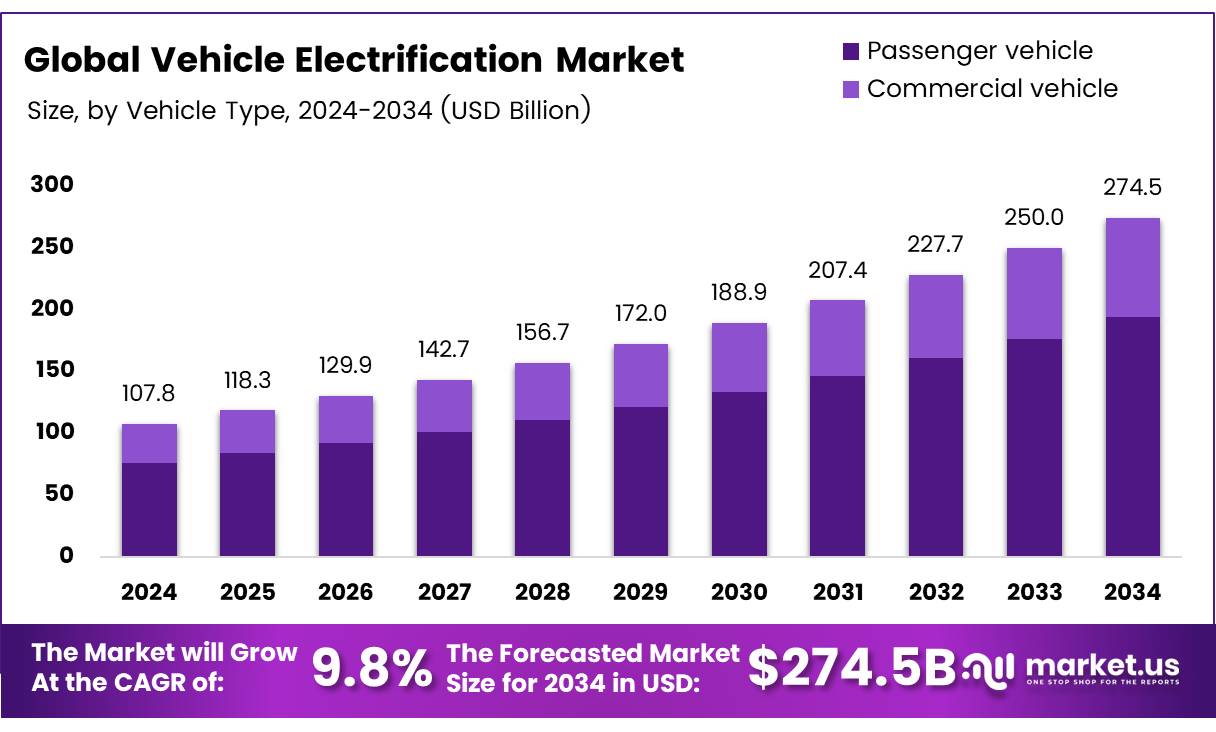
The Global Vehicle Electrification Market size is expected to be worth around USD 274.5 Billion by 2034, from USD 107.8 Billion in 2024, growing at a CAGR of 9.8% during the forecast period from 2025 to 2034.
Vehicle electrification signifies a transformative shift in automotive technology, focusing on the integration of electrical components in place of mechanical ones. Key components such as electric motors, battery systems, and electronic control units are pivotal to this transformation.
This shift not only enhances vehicle efficiency and reduces emissions but also aligns with global sustainability goals. The Vehicle Electrification Market encompasses the production, distribution, and sale of these electric components and systems, catering to both new electric vehicle (EV) constructions and the retrofitting of existing vehicles.
With a decade of experience in market research, it can be observed that vehicle electrification is not merely a trend, but a cornerstone of future transportation. This shift is driven by advancements in battery technology, increased consumer demand for sustainable products, and significant investment from automotive giants. The evolution from mechanical to electrical systems in vehicles is reducing dependency on fossil fuels and promoting a cleaner environment, which is essential in the face of global climate challenges.
The Vehicle Electrification Market is poised for substantial growth. According to Electrum Charging, electrified vehicles achieved a significant milestone by capturing 20% of U.S. new car sales in 2024, with forecasts indicating continued expansion in 2025. This surge is underpinned by robust governmental support through incentives for EV purchases and stringent emissions regulations.
Moreover, historical data from Auto Insurance shows a dramatic increase in total EV sales in the U.S. from 17,763 in 2011 to 1,456,484 in 2023, marking an average annual growth rate of 53%. This trajectory suggests a robust consumer shift towards electrified vehicles, bolstered by improving charging infrastructure and decreasing costs of EV components.
The growth potential for the Vehicle Electrification Market is immense. Strategic government investments and favorable regulations are creating fertile ground for this sector’s expansion. Initiatives such as tax incentives for electric vehicle buyers and mandates for automotive manufacturers to reduce carbon footprints are significant growth accelerators.
Additionally, as reported by GO-E, by 2040, electrified vehicles are anticipated to constitute over 30% of the total fleet for both light vehicles and trucks. This forecast highlights not only the increasing acceptance of EVs among consumers but also the scaling production capabilities of manufacturers. Such trends present lucrative opportunities for stakeholders across the supply chain, from component manufacturers to end retailers, positioning the Vehicle Electrification Market as a key player in the global push for sustainable transportation.
Key Takeaways
- The global vehicle electrification market is expected to reach USD 274.5 billion by 2034, growing at a CAGR of 9.8%.
- Passenger vehicles dominated the market in 2024, holding 71.6% of the market share due to high consumer demand and environmental concerns.
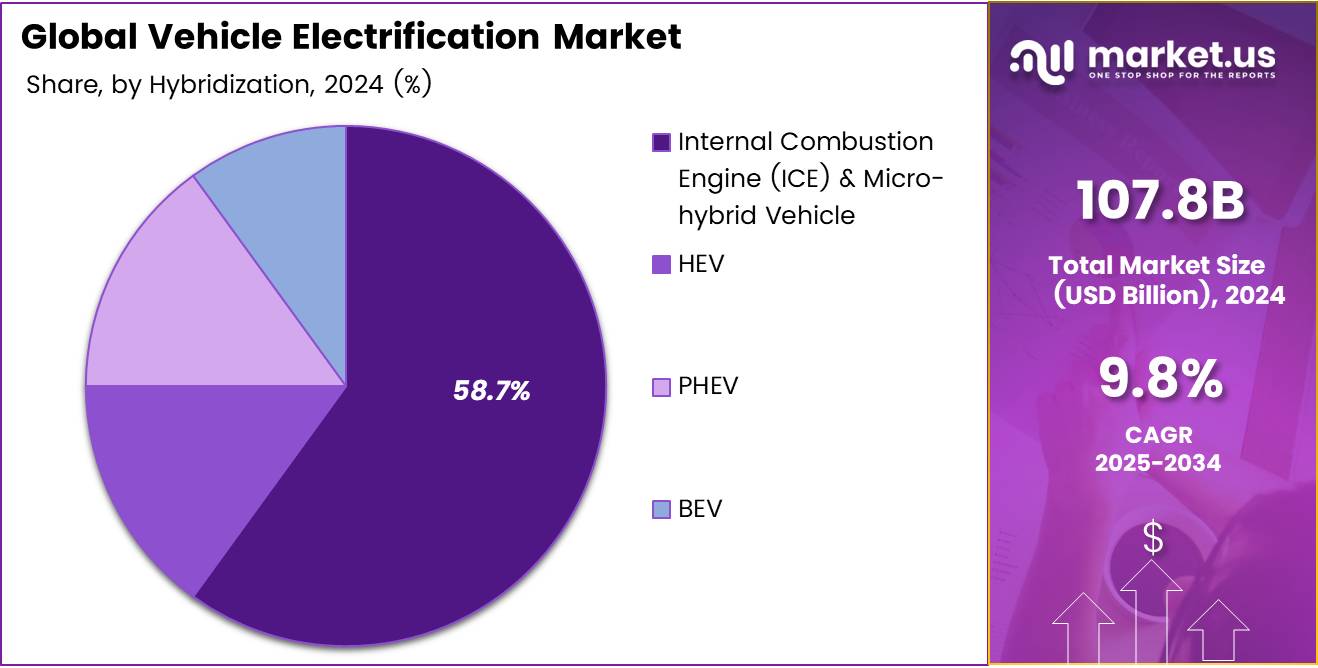
- Internal Combustion Engine (ICE) & Micro-hybrid vehicles captured 58.7% of the market share in the By Hybridization Analysis segment in 2024.
- The Electric Vacuum Pump led the By Product Analysis segment in 2024, securing 14.1% of the market share.
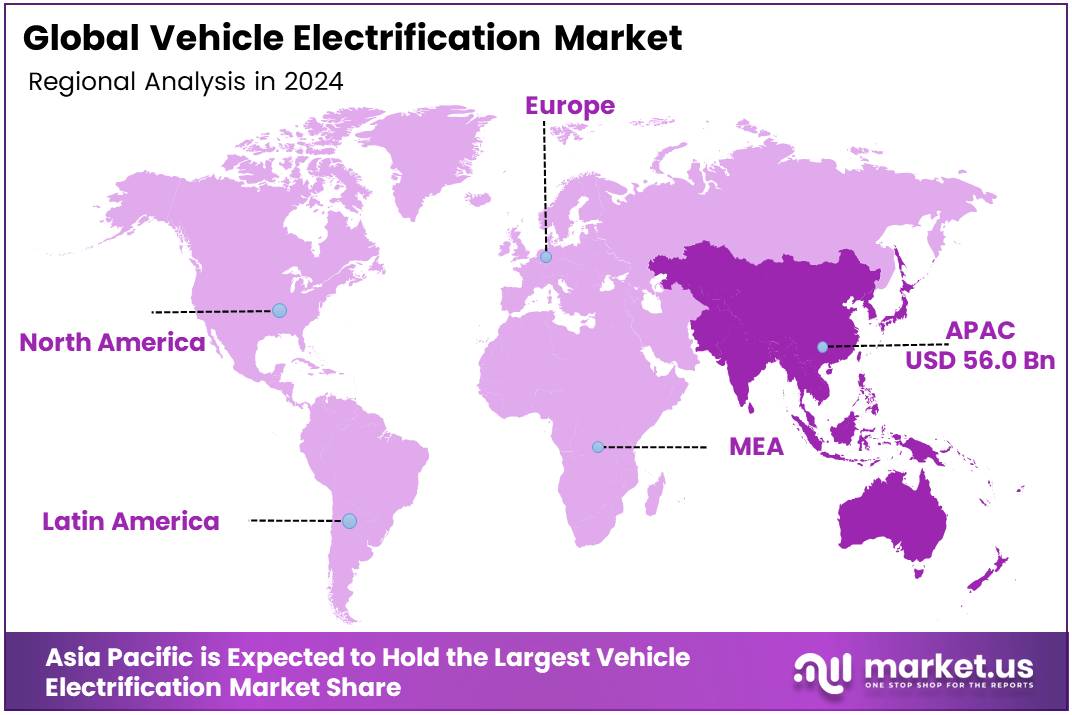
- Asia Pacific holds the largest share of the vehicle electrification market at 52.4%, driven by strong EV infrastructure investment and government policies.
Vehicle Type Analysis
Passenger Vehicles Lead with 71.6% in Vehicle Electrification Market
In 2024, the By Vehicle Type Analysis segment of the vehicle electrification market witnessed a predominant position of passenger vehicles, capturing a market share of 71.6%. This dominance can be attributed to increased consumer demand for electric cars driven by rising fuel prices and growing environmental awareness. The electrification of passenger vehicles is further supported by significant advancements in battery technology and government incentives aimed at reducing carbon emissions.
Commercial vehicles, while holding a smaller portion of the market, are also transitioning towards electrification. This shift is propelled by the need for businesses to decrease operational costs and comply with stringent emissions regulations. However, the adaptation rate in commercial vehicles is tempered by higher initial investment costs and the need for more substantial infrastructure developments.
The overall growth in the vehicle electrification market is supported by both segments, with passenger vehicles leading the charge. The data indicates a robust expansion trajectory as technologies improve and market acceptance increases. This segment’s growth is crucial for achieving broader goals in sustainability and emission reductions in the transportation sector.
Hybridization Analysis
Dominance of ICE & Micro-hybrid Vehicles in the Vehicle Electrification Market
In 2024, the Internal Combustion Engine (ICE) & Micro-hybrid Vehicle segment maintained a commanding presence in the Vehicle Electrification Market, capturing 58.7% of the market share in the By Hybridization Analysis category. This significant market share underscores the ongoing reliance on traditional combustion engine technologies and the incremental adoption of micro-hybrid systems, which enhance fuel efficiency and reduce emissions without the full shift to electric drivetrains.
Hybrid Electric Vehicles (HEVs), Plug-in Hybrid Electric Vehicles (PHEVs), and Battery Electric Vehicles (BEVs) represent the evolving stages of vehicle electrification. HEVs combine the ICE with electric motors, offering a balance of efficiency and range, while PHEVs provide an extended electric-only driving capability, appealing to consumers seeking to reduce their carbon footprint. Conversely, BEVs represent the pinnacle of this evolution with a fully electric solution, eliminating tailpipe emissions entirely.
Despite the growing popularity of PHEVs and BEVs, driven by environmental concerns and advancing technology, ICE & Micro-hybrid vehicles continue to dominate due to their lower upfront costs and widespread infrastructure support. The market dynamics suggest a gradual transition towards more sustainable electric alternatives, with ICE & Micro-hybrid vehicles serving as a critical transitional technology in the near term.
Product Analysis
Electric Vacuum Pump Leads with 14.1% in Vehicle Electrification Market’s Product Analysis
In 2024, the Electric Vacuum Pump emerged as the preeminent product in the Vehicle Electrification Market, capturing a significant 14.1% market share within the By Product Analysis segment. This dominant position underscores its pivotal role in the burgeoning market for electrified vehicles, a sector witnessing rapid advancements and integration of innovative technologies.
The Electric Vacuum Pump, essential for providing the necessary vacuum for brake boosters in electric and hybrid vehicles, has become increasingly vital as automakers shift towards more sustainable and fuel-efficient transportation solutions. Its robust market share reflects the growing prioritization of components that enhance vehicle performance while adhering to stringent environmental regulations.
Other notable components in the Vehicle Electrification Market include the Start/Stop System, Electric Oil Pump, Electric Power Steering, and various others such as Starter Motor & Alternator, Integrated Starter Generator, Liquid Heater PTC, Electric Air Conditioner Compressor, Electric Water Pump, and Actuators.
Each of these components plays a critical role in the overall efficiency and functionality of electrified vehicles, contributing to a comprehensive ecosystem that supports the transition from traditional combustion engines to electrically powered alternatives.
The integration and optimization of these components are crucial for meeting the evolving demands of consumers and regulatory bodies alike, further driving the expansion of the vehicle electrification market.
Key Market Segments
By Vehicle Type
- Passenger vehicle
- Commercial vehicle
By Hybridization
- Internal Combustion Engine (ICE) & Micro-hybrid Vehicle
- HEV
- PHEV
- BEV
By Product
- Electric Vacuum Pump
- Start/Stop System
- Electric Oil Pump
- Electric Power Steering
- Starter Motor & Alternator
- Integrated Starter Generator
- Liquid Heater Ptc
- Electric Air Conditioner Compressor
- Electric Water Pump
- Actuators
Drivers
Environmental Concerns Fuel Vehicle Electrification Market Growth
The vehicle electrification market is experiencing significant growth, primarily driven by heightened awareness of the environmental impacts associated with fossil fuel consumption. This shift in consumer and business attitudes is markedly accelerating the adoption of electric vehicles (EVs) as a sustainable alternative. Complementing this trend, advancements in battery technology have played a pivotal role in enhancing the appeal of EVs.
Modern batteries now boast greater energy density and improved charging speeds, making electric vehicles more practical for everyday use. Furthermore, the expansion of charging infrastructure is mitigating previous hurdles like range anxiety, by increasing the availability and convenience of charging options. This infrastructure development is crucial in supporting the growing number of EV users.
Additionally, the integration of advanced technologies such as regenerative braking, electric power steering, and electric air conditioning compressors is enriching the driving experience by increasing efficiency and vehicle performance. Collectively, these factors are steering both consumers and industries towards a more electrified automotive future.
Restraints
High Initial Costs Deter Vehicle Electrification Adoption
The vehicle electrification market faces significant challenges, notably the high initial costs associated with electric vehicles (EVs) and related technologies. These costs are often considerably higher than those for traditional internal combustion engine vehicles, posing a substantial barrier to widespread adoption. Potential buyers, especially in cost-sensitive segments, may hesitate to invest in EVs due to these upfront expenses.
Additionally, range anxiety remains a critical concern. Consumers are apprehensive about the driving ranges offered by current EV models and the sparse distribution of charging infrastructure. This anxiety further complicates the decision-making process for potential EV buyers, as the fear of running out of power without accessible charging options persists as a tangible restraint on the growth of the vehicle electrification market.
Together, these factors inhibit the transition towards more sustainable automotive technologies, slowing down the adoption rate of electric vehicles across various demographics and geographic regions.
Growth Factors
Wireless Charging Innovations Propel Vehicle Electrification Market
The vehicle electrification market is poised for substantial growth, driven by several compelling opportunities. Key among these is the development of wireless charging technology, which promises to enhance convenience for users and accelerate the adoption of electric vehicles (EVs). This technology eliminates the need for physical cables, thereby reducing wear and tear and simplifying the charging process. Additionally, there is significant potential for market expansion in emerging regions where automotive sales are increasing, driven by urbanization and economic development.
Electrification of commercial and public transport also presents a substantial opportunity. By converting buses, trucks, and other vehicles to electric, substantial reductions in fuel emissions and improvements in urban air quality can be achieved. Furthermore, hybrid vehicles, which utilize both fuel and electric power, offer a transitional technology that could capture a significant share of the market as consumers increasingly move towards full electrification. These vehicles provide a practical solution for consumers not yet ready to transition fully to electric vehicles, making them an essential part of the electrification trend.
Emerging Trends
Autonomous and Connected Electric Vehicles Propel Market Innovation
The vehicle electrification market is witnessing significant transformation driven by key trends that shape consumer preferences and manufacturing innovations. Foremost, the integration of electrification with autonomous driving technology and vehicle connectivity is revolutionizing the automotive landscape, offering advanced functionalities and novel user experiences. This convergence enables vehicles to achieve greater efficiency and safety, making electric vehicles (EVs) more appealing to a broader audience.
Additionally, the emphasis on sustainable manufacturing practices is gaining traction, where producers are increasingly utilizing recycled materials and renewable energy sources to minimize environmental impact. Another pivotal trend is the shift toward solid-state batteries, which promise enhanced safety, superior energy density, and extended lifespans, potentially overcoming the limitations of traditional lithium-ion batteries.
Furthermore, rapid advancements in fast charging technology are emerging, significantly reducing charging times and aligning the convenience of EVs with that of gasoline-powered vehicles, thereby supporting wider adoption. Collectively, these trends are setting a dynamic course for the electrification of the automotive sector, underscoring a robust growth trajectory in the vehicle electrification market.
Regional Analysis
Asia Pacific Leads Global Vehicle Electrification with 52.4% Market Share, Valued at USD 56.0 Billion
The vehicle electrification market exhibits distinct characteristics and growth trajectories across various global regions, with Asia Pacific emerging as the dominant force. Holding a commanding share of 52.4%, this region’s market valuation reached USD 56.0 billion, driven by robust investments in electric vehicle (EV) infrastructure and supportive government policies. Particularly, China and Japan lead in manufacturing and adoption rates, capitalizing on advanced technology and consumer readiness for electric vehicles.
Regional Mentions:
In North America, the market is propelled by stringent emissions regulations and a growing consumer preference for sustainable transportation solutions. The U.S. and Canada are seeing increased federal support, such as subsidies and tax incentives, which encourage both manufacturers and consumers to pivot towards vehicle electrification.
Europe’s market is characterized by aggressive climate policies and high consumer awareness, with countries like Germany, France, and the Nordic nations at the forefront of this transition. The integration of renewable energy sources with electric vehicle charging infrastructure is enhancing the region’s capacity for sustainable mobility.
Conversely, the Middle East & Africa region, while still nascent in vehicle electrification, shows potential due to increased urbanization and economic diversification away from oil dependency. Initiatives in countries like the UAE and South Africa are gradually establishing the foundation for a more robust electric vehicle market.
Latin America’s market is developing at a slower pace due to economic variability and infrastructure challenges. However, nations such as Brazil and Argentina are beginning to invest in electric public transportation systems, indicating a gradual shift towards vehicle electrification.
Collectively, these regional markets contribute to the global landscape of vehicle electrification, with Asia Pacific leading significantly in market share and value, setting a precedent for other regions to follow in the path towards sustainable transportation.
Key Regions and Countries
- North America
- US
- Canada
- Europe
- Germany
- France
- The UK
- Spain
- Italy
- Rest of Europe
- Asia Pacific
- China
- Japan
- South Korea
- India
- Australia
- Rest of APAC
- Latin America
- Brazil
- Mexico
- Rest of Latin America
- Middle East & Africa
- South Africa
- Saudi Arabia
- UAE
- Rest of MEA
Key Players Analysis
In the rapidly evolving Vehicle Electrification Market, key players such as BorgWarner Inc., Valeo SA, and Continental AG are pivotal in driving innovation and market growth. BorgWarner Inc., with its extensive portfolio in electric propulsion systems, is well-positioned to leverage the increasing demand for hybrid and electric vehicles. The company’s focus on developing high-efficiency powertrain components positions it as a leader in this sector.
Valeo SA, renowned for its advanced automotive technologies, particularly in the realm of electric systems and thermal management solutions, continues to expand its capabilities to support the shift towards vehicle electrification. Their commitment to innovation in electric powertrain systems is critical as the industry moves towards more sustainable transportation options.
Continental AG stands out with its comprehensive range of electrification technologies for commercial vehicles, including electric powertrain and battery management systems. The company’s strategic focus on autonomous driving and connected services complements its electrification efforts, making it a formidable player in the market.
These companies, along with others like DENSO CORPORATION and ZF Friedrichshafen AG, are crucial in the transition towards electrified transportation. Their investments in research and development and strategic partnerships enhance their market position and ability to respond to the dynamic needs of the automotive industry. The growth of the Vehicle Electrification Market can be attributed to these key players’ relentless pursuit of technological advancements and their adaptability to the changing market dynamics.
Top Key Players in the Market
- BorgWarner Inc.
- Valeo SA
- Aptiv
- AISIN CORPORATION
- Wabco Holdings Inc.
- Hitachi Astemo, Ltd.
- Mitsubishi Electric Corporation
- ZF Friedrichshafen AG
- Johnson Electric Holdings Limited
- DENSO CORPORATION
- Continental AG
- JTEKT Corporation
- Robert Bosch GmbH
- Magna International Inc.
- Johnson Controls
Recent Developments
- In June 2024, EV Connect was acquired by Schneider Electric, a strategic move designed to accelerate advancements in the electric vehicle (EV) sector. This acquisition aims to enhance EV infrastructure and support broader adoption of electric vehicles globally.
- In January 2025, American Axle & Manufacturing (AAM) acquired GKN, significantly impacting the automotive driveline market and electric vehicle (EV) production. This acquisition is expected to drive innovation and efficiency in driveline technologies and expand AAM’s global footprint.
- In February 2025, Uno Minda took a significant step in the EV market by acquiring a 100% stake in UnoMinda EV Systems for INR 195 crore. This acquisition strengthens Uno Minda’s position in the electric vehicle components industry, aiming to boost its capabilities and market reach.









