


Report Overview
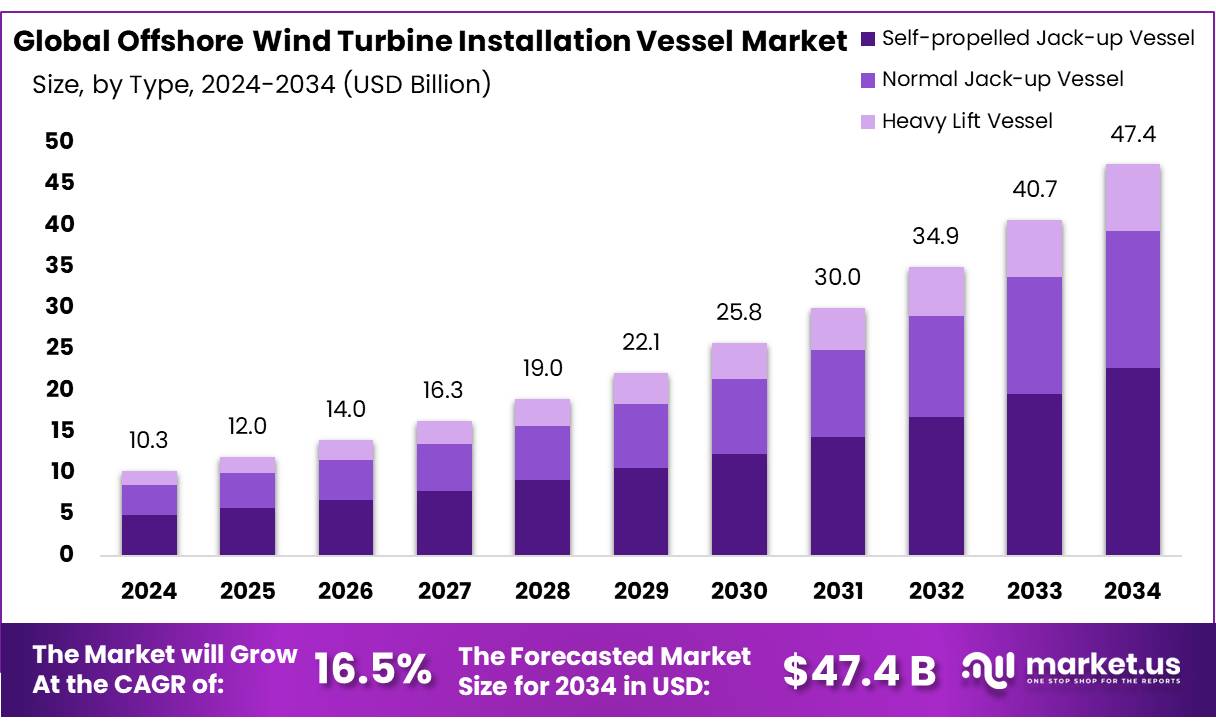
The Global Offshore Wind Turbine Installation Vessel Market size is expected to be worth around USD 47.4 Billion by 2034, from USD 10.3 Billion in 2024, growing at a CAGR of 16.5% during the forecast period from 2025 to 2034.
The Offshore Wind Turbine Installation Vessel (WTIV) Market plays a pivotal role in the renewable energy sector, facilitating the deployment of offshore wind farms critical to achieving global sustainability goals. These specialized vessels, including self-propelled jack-up vessels, normal jack-up vessels, and heavy-lift vessels, are engineered to transport, lift, and install wind turbine components in challenging marine environments.
The industrial scenario of the offshore WTIV market is characterized by a surge in demand for specialized vessels capable of handling next-generation wind turbines, which are growing in size and capacity. Modern offshore wind turbines now exceed 12-15 MW, with rotor diameters surpassing 220 meters, necessitating advanced installation vessels equipped with larger cranes and enhanced stability systems.
Europe dominates the market, accounting for over 46% of global installations, driven by countries like the UK, Germany, and Denmark. Meanwhile, Asia-Pacific, led by China, is emerging as a key growth region, contributing 30% of global capacity additions. The European Union’s Green Deal targets 300 GW of offshore wind capacity by 2050, while the U.S. aims to deploy 30 GW by 2030.
Technological advancements in vessel design, such as jack-up vessels and floating installation platforms, are enhancing operational efficiency and reducing installation costs, which currently range between $150,000 to $250,000 per day per vessel. The Offshore WTIV fleet is anticipated to grow by 40%, supporting the installation of over 250 GW of new offshore wind capacity worldwide.
Key Takeaways
The global Offshore Wind Turbine Installation Vessel Market is expected to reach USD 47.4 billion by 2034, growing at a CAGR of 16.5% from 2025 to 2034.
Self-propelled jack-up vessels captured over 48.3% of the market due to their mobility, stability, and ability to operate in harsh conditions.
Offshore wind farm installation held a dominant market share of over 69.2%, reflecting the vital role of these vessels in setting up offshore wind farms.
Vessels with medium capacity will dominate in 2024, accounting for more than 47.2% of the market due to their versatility and efficiency.
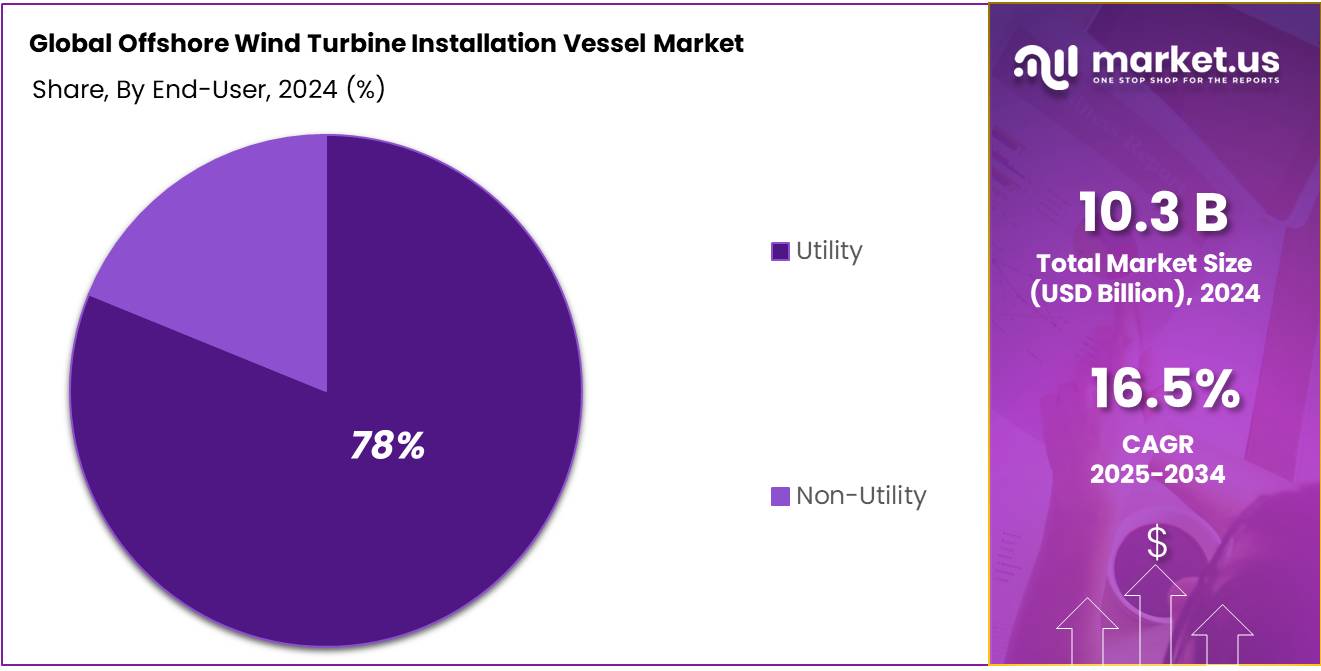
The utility sector captured more than 78.1% of the market in 2024, highlighting its significant role in driving large-scale offshore wind energy projects.
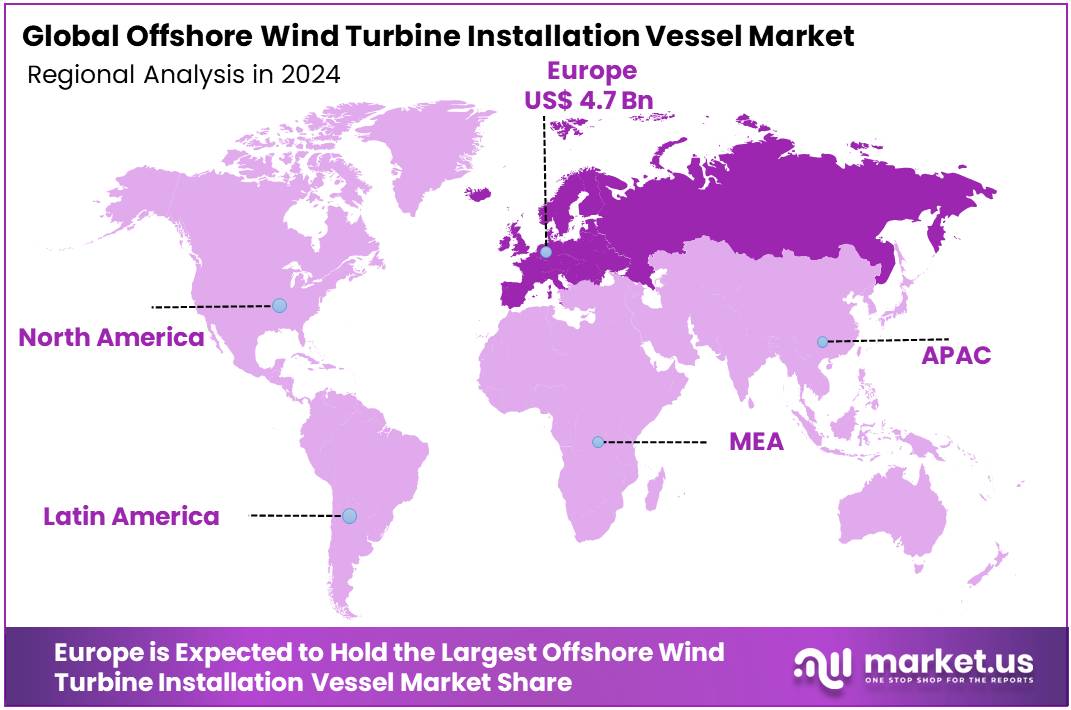
- Europe leads the offshore wind vessel market with a 46.3% share, driven by renewable goals.
By Type
In 2024, the Self-propelled Jack-up Vessel segment held a dominant position in the offshore wind turbine installation vessel market, capturing more than a 48.3% share. This type of vessel is highly favored for its mobility and stability, which are essential for installing large offshore wind turbines in varying sea conditions.
The self-propelled jack-up vessel is equipped with legs that can be lowered to the seabed to lift the hull above the surface, providing a stable platform during installation operations. This capability is particularly valuable in offshore wind farms located in waters that experience significant tidal variations and harsh weather conditions.
The substantial market share of self-propelled jack-up vessels is indicative of their crucial role in the deployment of offshore wind projects. These vessels are engineered to carry multiple large wind turbine components, including towers, blades, and nacelles, directly to the site, which reduces the time and cost associated with multiple trips.
By Application
In 2024, the application of offshore wind farm installation held a dominant market position, capturing more than a 69.2% share. This significant market share underscores the critical role these vessels play in establishing and expanding offshore wind farms. The complexity and scale of offshore wind projects necessitate specialized vessels that can handle the installation of towering turbines in marine environments.
These vessels are equipped with advanced navigation systems, dynamic positioning technologies, and heavy-lifting gear, making them indispensable for installing both the foundations and the superstructures of wind turbines. The demand for offshore wind farm installation services has been driven by the global shift toward renewable energy sources and the increasing number of offshore wind projects.
By Capacity
In 2024, vessels with medium capacity held a dominant market position in the offshore wind turbine installation sector, capturing more than a 47.2% share. This category typically includes vessels that can install turbines with capacities ranging from 3MW to 6 MW, making them highly versatile for a wide array of offshore wind projects.
Medium-capacity vessels are particularly valued for their balance between size and capability, allowing them to operate efficiently in both established and emerging markets. The preference for medium-capacity vessels stems from their ability to offer optimal operational efficiency and cost-effectiveness.
These vessels can navigate a variety of sea conditions and depths, which makes them suitable for a broad spectrum of geographical locations. They are equipped with features that facilitate quicker mobilization and demobilization, which is crucial for meeting the tight project timelines characteristic of many offshore wind developments.
By End-User
In 2024, the utility segment held a dominant market position in the offshore wind turbine installation vessel market, capturing more than a 78.1% share. This substantial market share is indicative of the critical role utilities play in the deployment and expansion of offshore wind energy projects.
Utilities, as primary providers of electricity, are increasingly investing in large-scale renewable energy projects to meet both regulatory requirements and growing consumer demand for sustainable energy sources.
The preference for utility-scale projects is driven by their ability to produce energy at a scale that significantly impacts power supply networks. Offshore wind installations by utilities often involve the deployment of multiple large turbines capable of generating substantial amounts of electricity.
Key Market Segments
By Type
- Self-propelled Jack-up Vessel
- Normal Jack-up Vessel
- Heavy Lift Vessel
By Application
- Offshore Wind Farm Installation
- Maintenance and Repair
- Others
By Capacity
- Small
- Medium
- Large
By End-User
- Utility
- Non-Utility
Drivers
Rising Global Demand for Renewable Energy
One of the primary driving factors for the offshore wind turbine installation vessel market is the escalating global demand for renewable energy. This trend is largely driven by the urgent need to reduce greenhouse gas emissions and reliance on fossil fuels.
According to the International Energy Agency (IEA), renewable energy is set to account for nearly 95% of the net increase in global power capacity through 2026, with wind power playing a significant role in this expansion.
The European Union has set ambitious targets to increase its offshore wind capacity from 12 GW in 2020 to at least 60 GW by 2030 and 300 GW by 2050. Such initiatives underscore the commitment to transitioning towards a more sustainable energy sector and the critical role that offshore wind will play in achieving these objectives.
Restraints
High Capital and Operational Costs
A significant restraint in the offshore wind turbine installation vessel market is the high capital and operational costs associated with these specialized vessels. The construction and maintenance of offshore wind turbines require advanced technology and vessels that are capable of handling massive components in challenging marine environments.
The cost of constructing a single offshore wind turbine installation vessel can exceed several hundred million dollars, making it a substantial investment for companies. Operational costs also contribute significantly to the financial challenges. The daily operational expenses of these vessels, including fuel, crew, and maintenance, are considerable.
Opportunity
Technological Advancements in Turbine Design
A major growth factor for the offshore wind turbine installation vessel market is the continual technological advancements in turbine design. As turbines grow larger and more efficient, they are capable of generating more power, which enhances the economic viability of offshore wind projects.
Recent years have seen significant innovations in turbine technology, with manufacturers producing turbines that exceed 10 MW in capacity. For instance, the Haliade-X wind turbine from GE Renewable Energy, one of the most powerful on the market, boasts a capacity of up to 14 MW with a rotor diameter of 220 meters.
Trends
Expansion into New Geographic Markets
One significant emerging factor for the offshore wind turbine installation vessel market is the geographic expansion into new regions that have traditionally been untapped markets for offshore wind energy. As the global demand for renewable energy sources intensifies, countries with large coastlines and favorable wind conditions are beginning to explore and invest in offshore wind projects.
This geographic expansion is supported by both local and international policy initiatives aimed at reducing carbon emissions and promoting renewable energy. For instance, Vietnam’s government has set ambitious targets for offshore wind energy, aiming for 3 GW by 2030 and 10 GW by 2045, as part of its national energy development strategy to increase the proportion of renewable energy sources.
Regional Analysis
Europe holds a commanding position in the offshore wind turbine installation vessel market, capturing 46.3% of the global share and valuing approximately USD 4.7 billion. This region’s dominance is supported by aggressive renewable energy targets and robust government backing across several European countries.
Europe has been at the forefront of offshore wind energy, driven by the need to transition toward sustainable energy sources and reduce reliance on fossil fuels. The United Kingdom, Germany, and Denmark are key players within the region, hosting some of the world’s largest offshore wind farms.
The European Union’s strategic energy technology plan aims to significantly expand offshore wind capacity from 12 gigawatts (GW) in 2020 to a targeted 60 GW by 2030 and 300 GW by 2050. This ambitious growth trajectory underscores the region’s commitment to enhancing its wind energy infrastructure, thereby propelling the demand for specialized installation vessels.
Europe’s leading position is bolstered by technological advancements and a mature supply chain capable of supporting large-scale offshore wind developments. European manufacturers and service providers of wind turbine installation vessels have continuously evolved, incorporating advanced technologies that improve efficiency and adaptability in deep waters and harsh maritime environments.
Key Regions and Countries
- North America
- US
- Canada
- Europe
- Germany
- France
- The UK
- Spain
- Italy
- Rest of Europe
- Asia Pacific
- China
- Japan
- South Korea
- India
- Australia
- Rest of APAC
- Latin America
- Brazil
- Mexico
- Rest of Latin America
- Middle East & Africa
- GCC
- South Africa
- Rest of MEA
Key Players Analysis
- A2SEA is renowned for pioneering solutions in offshore wind turbine installations. Their vessels are designed for efficient, safe, and reliable operations, making them a preferred choice in the European offshore wind sector. A2SEA has played a significant role in numerous large-scale wind projects, enhancing its reputation for project execution and technological advancement.
- COSCO SHIPPING Heavy Transport Inc. is Part of the global COSCO SHIPPING group. This company specializes in heavy lift and transportation services, including for offshore wind projects. Their fleet includes semi-submersible vessels capable of handling massive offshore structures, positioning them as a leader in logistics for wind turbine installations.
- Belgian-based Deme Group is a key player in the dredging, environmental, and marine engineering sectors, which includes offshore wind farm construction. Their subsidiary, GeoSea, operates a fleet of specialized vessels equipped for installing offshore wind turbines and foundations, underscoring their capability in renewable energy projects.
Top Key Players in the Market
- Deme Group
- A2SEA
- COSCO SHIPPING Heavy Transport Inc.
- Fred. Olsen Windcarrier
- Gaoh Offshore
- Geosea
- Jack-Up Barge
- Japan Marine United Corporation
- Lamprell Energy Ltd
- Longyuan Power
- MPI-Offshore
- Nantong Rainbow Offshore & Engineering Equipments Co. Ltd
- NO.3 Engineering
- O Seafox
- Pella Sietas GmbH
- SEAFOX
- Seajacks
- Shanghai Zhenhua Heavy Industries Co. Ltd
- Swire Blue Ocean
- Van Oord
- Xiamen Shipbuilding Industry Co. Ltd
Recent Developments
- In 2024, DEME Group advanced its WTIV capabilities with the Orion, a vessel boasting a 5,000-tonne crane, deployed for the Hollandse Kust Zuid wind farm. The company also introduced a hybrid propulsion system on its fleet, reducing emissions by 20% per project.
- In 2024, Fred. Olsen Windcarrier secured a contract with RWE for the Thor offshore wind farm in Denmark, utilizing its upgraded Blue Tern vessel with a 1,600-tonne crane. The company also partnered with Siemens Gamesa to optimize turbine installation logistics, achieving a 15% reduction in installation time. Vessel upgrades completed in 2024 enhanced lifting heights to 238 meters above sea level.









