


Report Overview
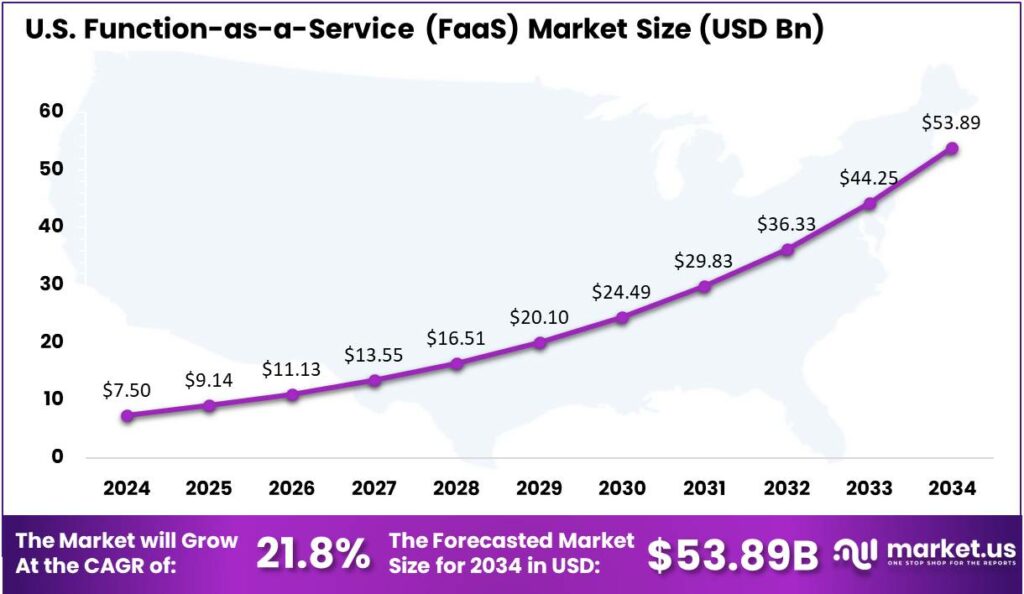
The Function-as-a-Service (FaaS) Market size is expected to be worth around USD 141 Bn By 2034, from USD 17.65 Bn in 2024, growing at a CAGR of 23.1% during the forecast period. In 2024, North America held the largest market share in the FaaS market with over 45%, generating approximately USD 7.9 bn in revenue. The U.S. market was valued at USD 7.5 bn and is projected to grow at a CAGR of 21.8%.
FaaS (Function-as-a-Service) is a serverless cloud computing model that enables developers to run event-driven code without managing infrastructure. The cloud provider handles the servers, scaling, and containers, allowing developers to focus on writing application logic. This results in more efficient, cost-effective development without the complexity of infrastructure management.
The growth of the FaaS market is driven by the demand for scalable and efficient computing solutions, as it eliminates the need for managing physical servers. Additionally, the rise of cloud-based technologies and digital transformation efforts has increased the adoption of FaaS, offering cost benefits and improved operational efficiency.
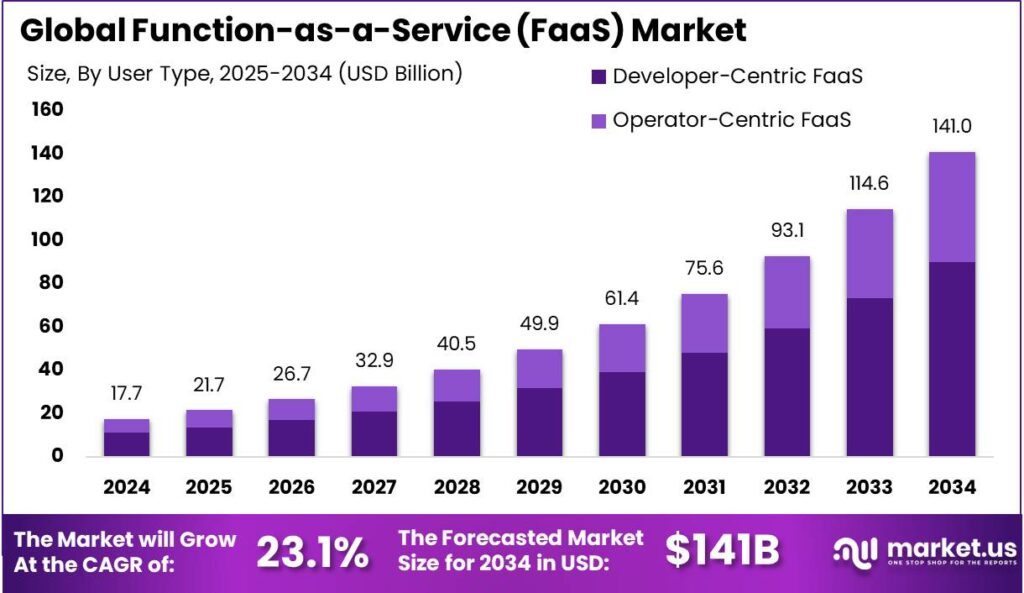
The primary drivers of the FaaS market include the ongoing shift towards serverless computing, the demand for more agile and cost-effective development solutions, and the growing need to reduce operational costs associated with physical servers and data centers. The model’s ability to scale automatically and pay-per-use pricing structure further fuels its adoption across various industry verticals.
The demand for FaaS solutions is particularly high among industries that require high scalability and flexibility in application development and deployment, such as IT and telecommunications, healthcare, financial services, and retail. Investment opportunities are huge in regions like Asia-Pacific, which is expected to experience the highest growth rate due to its rapid digital transformation and adoption of cloud technologies.
Key Takeaways
- The Global Function-as-a-Service (FaaS) Market size is expected to reach USD 141 Billion by 2034, growing from USD 17.65 Billion in 2024, at a CAGR of 23.10% during the forecast period from 2025 to 2034.
- In 2024, the Developer-Centric FaaS segment held a dominant position in the market, capturing more than 64% of the total market share.
- The Automation and Integration Service segment was also a leader in the market in 2024, holding more than 30% of the Function-as-a-Service (FaaS) market share.
- The Web-based and Mobile Applications segment dominated the market in 2024, with a share of over 52% in the Function-as-a-Service (FaaS) market.
- The Public Cloud segment maintained a dominant position in the market in 2024, capturing more than 65% of the market share.
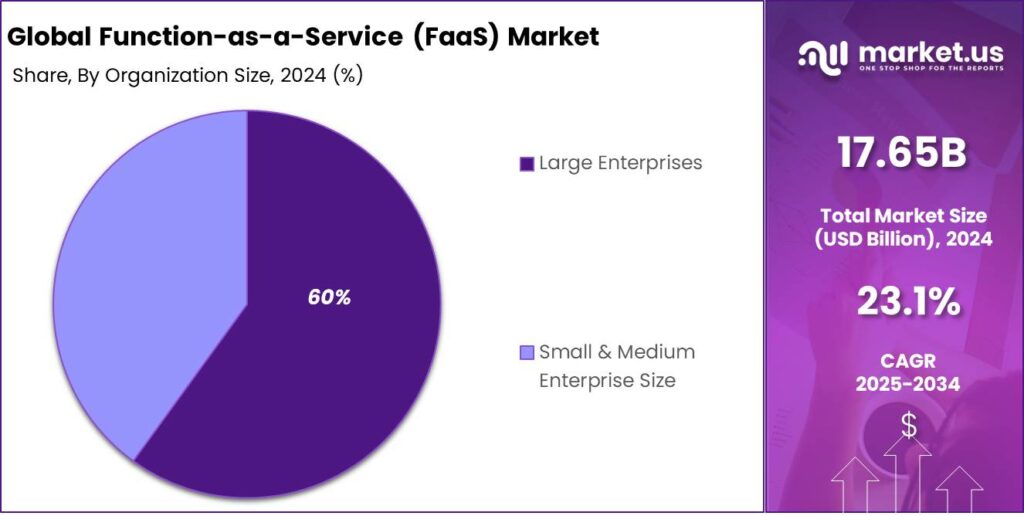
- In 2024, the Large Enterprises segment led the Function-as-a-Service (FaaS) market, holding more than 60% of the market share.
- The BFSI (Banking, Financial Services, and Insurance) segment commanded a dominant position in 2024, accounting for more than 25% of the market share in the Function-as-a-Service (FaaS) market.
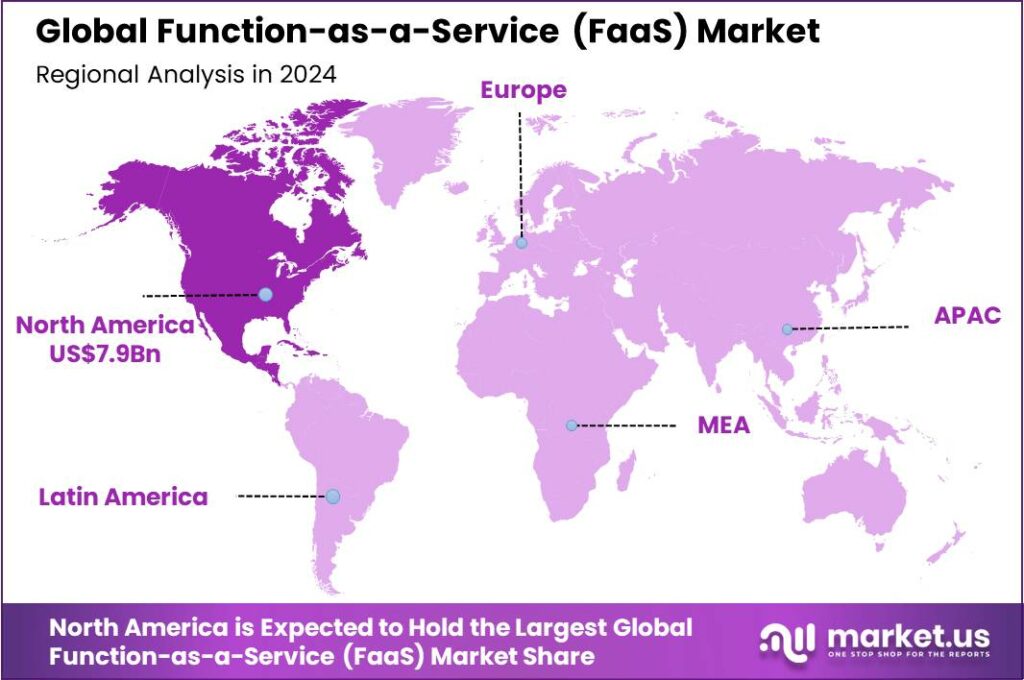
- North America held the largest market share in 2024, with a dominant position capturing more than 45% of the market and revenues of approximately USD 7.9 billion.
- In 2024, the U.S. Function-as-a-Service (FaaS) market was valued at USD 7.5 billion, and it is projected to grow at a CAGR of 21.8%.
Analysts’ Viewpoint
Factors such as advancements in cloud technology, the increasing popularity of digital transformation strategies, and the global expansion of internet-driven services impact the market significantly. The key business benefits of adopting FaaS include enhanced operational efficiency, cost savings on infrastructure, and quicker time to market for applications.
Recent technological advancements within the FaaS market include the introduction of more sophisticated error tracking and debugging tools, enhanced security features, and improved integration capabilities with existing IT infrastructure. Innovations in artificial intelligence and machine learning are also being integrated into FaaS platforms to enhance functionality and automation capabilities.
The regulatory environment for FaaS is increasingly focused on data security and privacy concerns, especially with the General Data Protection Regulation (GDPR) in Europe and similar regulations worldwide. Compliance with these regulations is critical for FaaS providers, as the nature of serverless computing involves multiple data transfers and storage across borders.
U.S. FaaS Market Size
In 2024, the U.S. Function-as-a-Service (FaaS) market achieved a valuation of USD 7.5 billion. It is projected to grow at a compound annual growth rate (CAGR) of 21.8%.
Function-as-a-Service, a category of cloud computing services, allows developers to build, run, and manage application functionalities without the complexity of maintaining infrastructure typically associated with developing and launching an app. The growth in the FaaS market can be attributed to the increasing adoption of serverless architecture. This architecture eliminates the need for developers to manage servers and allows them to focus purely on the individual functions in their applications.
Market growth is also driven by the flexibility of scaling services, lower deployment costs, and faster time to market. Advancements in AI and machine learning are further enhancing FaaS capabilities. As organizations adopt digital transformation strategies, demand for FaaS is expected to rise, boosting innovation in sectors like e-commerce, banking, and healthcare.
In 2024, North America held a dominant market position in the Function-as-a-Service (FaaS) market, capturing more than a 45% share, with revenues reaching approximately USD 7.9 billion. This prominent market leadership can be attributed to several factors that uniquely position North America at the forefront of FaaS adoption.
North America’s advanced technological infrastructure and leadership in cloud computing platforms create a strong foundation for the widespread adoption of Function-as-a-Service (FaaS) solutions. The presence of major FaaS providers like Amazon Web Services and Google Cloud Platform in the U.S. significantly contributes to the region’s growth.
The adoption of FaaS in North America is driven by the need for businesses to improve efficiency and reduce IT infrastructure costs. FaaS allows companies to pay only for the resources they use, eliminating server management expenses, which has led to widespread adoption across industries like finance, healthcare, and retail.
Also, North America’s stringent data security and privacy regulations drive businesses to adopt secure cloud services. FaaS providers in the region offer robust security features that comply with local regulations, encouraging more businesses to move to cloud-based solutions. This compliance strengthens North America’s position as a leader in the global FaaS market.
User Type Analysis
In 2024, the Developer-Centric FaaS segment held a dominant market position, capturing more than a 64% share of the Function-as-a-Service market. This segment primarily appeals to software developers due to its focus on agility, flexibility, and the efficiency of deploying code without the burden of managing the underlying infrastructure.
Developer-Centric FaaS solutions streamline the deployment process, enabling developers to focus on writing code that adds direct value to their applications, rather than handling complex backend configurations. This approach significantly reduces development time and accelerates the time to market for new applications and features.
The dominance of this segment can be attributed to the growing demand for scalable and efficient application development frameworks. In a digital-first world where speed and performance are paramount, Developer-Centric FaaS offers an optimal environment that supports continuous integration and continuous deployment (CI/CD) practices.
Another factor contributing to the success of the Developer-Centric FaaS segment is the increasing adoption of microservices architectures across various industries. Developer-Centric FaaS seamlessly integrates with microservices, allowing individual components of an application to be updated independently without disrupting the entire system.
Service Type Analysis
In 2024, the Automation and Integration Service segment held a dominant position within the Function-as-a-Service (FaaS) market, capturing more than a 30% share. This segment leads primarily because it directly addresses the increasing demand for streamlined business processes and enhanced workflow automation across various industries.
The Microservice Monitoring and Management Service is another critical segment of the FaaS market. This service helps organizations oversee and manage their microservices architecture, which is fundamental for ensuring application reliability and performance in a distributed system environment.
API Management Services are essential for businesses to enable seamless connectivity and data exchange between applications. These services provide tools to create, secure, and manage APIs across platforms, playing a crucial role in digital transformation by enhancing internal and external system integration.
The Support and Maintenance segment is vital for ensuring the smooth operation of FaaS solutions. It offers continuous support, updates, and maintenance, helping businesses avoid disruptions and maintain high service availability. As FaaS adoption grows, reliable support will be crucial for addressing issues and ensuring efficient application performance.
Application Analysis
In 2024, the Web-based and Mobile Applications segment held a dominant market position in the Function-as-a-Service (FaaS) market, capturing more than a 52% share. This segment’s leadership is driven by several key factors that underscore the integral role of FaaS in modern application development.
The growth of mobile devices and advancements in web technology have increased demand for scalable web and mobile apps. FaaS allows developers to quickly deploy and scale applications without managing infrastructure, making it ideal for businesses needing agility and responsiveness in development.
Rising consumer expectations for seamless digital experiences have pushed companies to optimize application performance. FaaS enables organizations to efficiently handle variable workloads by automatically adjusting resources, maintaining performance during peak times while minimizing costs during low usage.
Additionally, the integration of emerging technologies such as artificial intelligence, machine learning, and the Internet of Things (IoT) into web and mobile applications is further enhancing the appeal of FaaS. These technologies require a flexible and dynamic runtime environment that can process data in real-time, which FaaS platforms are ideally suited to provide.
Deployment Model Analysis
In 2024, the Public Cloud segment held a dominant market position in the Function-as-a-Service (FaaS) market, capturing more than a 65% share. This segment’s leadership can be traced back to several distinct advantages that the public cloud offers over its private and hybrid counterparts.
The public cloud model is popular for its cost-efficiency and scalability, offering a pay-as-you-go model that eliminates the need for large upfront investments. This makes it especially appealing to startups and small to medium-sized enterprises that lack resources for private cloud infrastructure. The public cloud offers unparalleled scalability, enabling businesses with fluctuating workloads to adjust FaaS capabilities based on real-time demand.
Public cloud infrastructure benefits from continuous upgrades and innovations, with providers investing in security and platform enhancements. Organizations using public cloud FaaS gain access to the latest technology advancements, improving security, performance, and features without managing upgrades themselves.
Organization Size Analysis
In 2024, the Large Enterprises segment held a dominant market position within the Function-as-a-Service (FaaS) market, capturing more than a 60% share. This substantial market share can be attributed to several factors that favor large-scale operations in the adoption and implementation of FaaS solutions.
The preference for FaaS among large enterprises is also driven by their need to handle vast amounts of data and execute complex computing tasks. The scalable nature of FaaS allows these organizations to manage fluctuating workloads efficiently, without the need for significant upfront investments in physical hardware.
Large enterprises often operate across multiple markets, requiring flexible and reliable IT solutions that can be quickly deployed and easily managed. FaaS platforms fulfill these needs by offering a framework that supports seamless development, deployment, and management of applications across diverse environments.
Ongoing digital transformation in large enterprises accelerates the adoption of FaaS solutions. As organizations seek innovation and competitiveness, integrating FaaS into their IT strategies speeds up application development, enhances inter-departmental collaboration, and drives overall business agility and growth.
Industry Vertical Analysis
In 2024, the BFSI (Banking, Financial Services, and Insurance) segment held a dominant market position within the Function-as-a-Service (FaaS) market, capturing more than a 25% share. This leadership can be largely attributed to the increasing demand for agile financial services solutions that require high levels of compliance and security.
The adoption of FaaS in the BFSI sector is driven by the need for cost-effective scalability. Financial institutions, facing dynamic market conditions and fluctuating demands, require IT solutions that can scale without significant capital investment. FaaS enables on-demand scaling, eliminating the need for extensive infrastructure and reducing costs while enhancing responsiveness to market changes.
The BFSI sector is embracing digital transformation to enhance customer experiences and streamline operations. FaaS accelerates application development and integrates easily with existing systems, offering the flexibility needed for banks and financial services firms to innovate and meet evolving customer needs.
The security features of FaaS platforms align with the BFSI sector’s regulatory needs, offering built-in compliance controls and protocols to protect sensitive data and ensure regulatory adherence. This focus on security and compliance drives the growing adoption of FaaS solutions, strengthening its position in the sector.
Key Market Segments
By User Type
- Developer-Centric FaaS
- Operator-Centric FaaS
By Service Type
- Automation and Integration Service
- Microservice Monitoring and Management Service
- API Management Service
- Support and Maintenance
- Training and Consulting
- Others (Metering and Billing)
By Application
- Web-based and Mobile Application
- Research and Academic Application
- Others (Stream Processing and Media Processing)
By Deployment Model
- Public Cloud
- Private Cloud
- Hybrid Cloud
By Organization Size
- Small and Medium Enterprise (SME)
- Large enterprise
By Industry Vertical
- BFSI
- Telecommunication and ITES
- Consumer Goods and Retail
- Healthcare and Life Sciences
- Government and Public Sector
- Manufacturing
- Media and Entertainment
- Others
Driver
Transitioning from DevOps to Serverless Computing
The transition from traditional DevOps methodologies to serverless computing has emerged as a significant driver for the Function-as-a-Service (FaaS) market. Serverless computing abstracts the underlying infrastructure, enabling developers to focus solely on writing and deploying code without the complexities of server management. This paradigm shift enhances development efficiency and accelerates time-to-market for applications.
By eliminating the need for infrastructure provisioning and maintenance, organizations can allocate resources more effectively, leading to cost reductions and operational agility. The inherent scalability of serverless architectures allows applications to handle varying workloads seamlessly, aligning with the dynamic demands of modern businesses.
Consequently, the adoption of serverless computing models is propelling the growth of the FaaS market, as organizations seek to leverage these benefits to optimize their development processes and achieve greater flexibility in deploying applications.
Restraint
Challenges in Application Portability
Ensuring seamless portability of applications across diverse cloud environments presents a significant challenge in the FaaS market. As organizations increasingly operate within multi-cloud or hybrid cloud configurations, the ability to move applications without compatibility issues becomes crucial.
This complexity can hinder the flexibility and scalability that FaaS aims to provide, potentially slowing down its adoption among businesses seeking versatile cloud solutions. Cold start issues, where functions face delays after inactivity, can impact performance in industries like finance, healthcare, and e-commerce that rely on real-time processing. Addressing these challenges requires advancements in FaaS platforms for faster and more efficient execution.
Opportunity
Edge Computing Integration
The integration of FaaS with edge computing presents a significant opportunity for the market. Edge computing brings computation and data storage closer to data sources, reducing latency and enhancing real-time processing capabilities. By deploying FaaS at the edge, organizations can achieve faster response times and improved performance, particularly for applications requiring immediate data processing.
This synergy between FaaS and edge computing enables more efficient resource utilization and supports the growing demand for low-latency services in sectors such as IoT, autonomous vehicles, and smart cities. As edge computing continues to expand, the adoption of FaaS in these environments is expected to rise, offering new avenues for innovation and service delivery.
Challenge
Security and Compliance Concerns
Security and compliance concerns present significant challenges in the adoption of Function-as-a-Service (FaaS) solutions. In serverless architectures, the abstraction of infrastructure management can obscure visibility into security controls, making it difficult for organizations to monitor and enforce security policies effectively.
Additionally, compliance with industry regulations requires stringent data protection measures, which can be challenging to implement in a serverless environment where control over the underlying infrastructure is limited. Addressing these challenges necessitates robust security frameworks and compliance strategies tailored to serverless architectures, ensuring that organizations can leverage the benefits of FaaS while maintaining the integrity and security of their applications and data.
Emerging Trends
FaaS is gaining traction within large enterprises due to its ability to streamline application development and deployment processes. This shift is underpinned by the increasing integration of FaaS with enterprise development environments, allowing organizations to leverage serverless computing to deploy applications rapidly.
The market is seeing a significant enhancement in the tools and frameworks available to developers. Vendors are improving the developer experience by offering more comprehensive and integrated development environments that cover not only deployment but also monitoring and security.
There’s a growing trend towards the use of hybrid and multi-cloud strategies to leverage the benefits of FaaS. This approach provides flexibility in deployment and helps in optimizing costs and performance across different cloud platforms.
Business Benefits
- Cost Efficiency: FaaS models are cost-effective as they eliminate the need for continuous server management and reduce the overhead costs associated with idle computing resources.
- Scalability: The ability to scale automatically in response to application workloads without manual intervention makes FaaS ideal for handling varying levels of demand.
- Faster Time to Market: By simplifying the deployment process and reducing the complexity associated with infrastructure management, FaaS allows businesses to accelerate the development cycle and improve time to market for new features and products.
- Operational Agility: FaaS provides businesses with the flexibility to respond quickly to market changes and customer needs by facilitating rapid application updates and deployments.
- Enhanced Focus on Core Business: By abstracting the complexities of the underlying infrastructure, FaaS enables companies to focus more on developing and improving their core applications rather than managing servers and hardware.
Key Regions and Countries
- North America
- US
- Canada
- Europe
- Germany
- France
- The UK
- Spain
- Italy
- Rest of Europe
- Asia Pacific
- China
- Japan
- South Korea
- India
- Australia
- Singapore
- Rest of Asia Pacific
- Latin America
- Brazil
- Mexico
- Rest of Latin America
- Middle East & Africa
- South Africa
- Saudi Arabia
- UAE
- Rest of MEA
Key Player Analysis
Amazon Web Services, is the largest player in the cloud market, and its FaaS offering, AWS Lambda, is a key part of its success. AWS Lambda enables businesses to run code in response to events without managing servers, offering efficiency and cost-effectiveness. Its integration with other AWS services, reliability, security, and global infrastructure make it a leader in the FaaS market.
IBM’s FaaS offering, IBM Cloud Functions, is based on Apache OpenWhisk, an open-source serverless platform. IBM stands out for focusing on hybrid cloud environments, which appeal to businesses needing flexibility in managing on-premises and cloud systems.
Google Inc. Cloud’s FaaS platform, Google Cloud Functions, is another strong competitor in the market. Google is known for its developer-friendly approach, offering seamless integration with its other services like Google Cloud Storage, BigQuery, and Firebase. It provides a simple, intuitive interface that allows developers to quickly deploy functions.
Top Key Players in the Market
- Amazon Web Services Inc.
- IBM Corporation
- Google Inc.
- Microsoft Corporation
- SAP SE
- Infosys Limited
- Dynatrace LLC
- Tibco Software Inc.
- Oracle Corporation
- Rogue Wave Software Inc
- Fiorano Software and Affiliates
- Other Key Players
Top Opportunities Awaiting For Players
The Function-as-a-Service (FaaS) market is poised for substantial growth, presenting numerous opportunities for market players.
- Increasing Adoption by Small and Medium Enterprises (SMEs): SMEs are expected to increasingly adopt FaaS due to its cost-effectiveness, scalability, and flexibility, which are essential for driving innovation and competitiveness in the digital economy.
- Expansion in the Banking, Financial Services, and Insurance (BFSI) Sector: The BFSI sector presents significant growth opportunities for FaaS, driven by the rise of open banking and API-driven ecosystems that require flexible, secure, and easily integrable serverless solutions.
- Integration with Internet of Things (IoT): FaaS is becoming integral in the IoT space, where it can manage data processing tasks efficiently. This capability is vital as the number of connected devices continues to grow, requiring robust and scalable computing solutions.
- Geographic Expansion into Emerging Markets: There is substantial potential for FaaS providers to expand into emerging markets like Asia-Pacific, where digital transformations are accelerating rapidly. Particularly, countries like China, India, and Japan are becoming key drivers of FaaS adoption due to their growing tech industries.
- Strategic Partnerships and Collaborations: Companies in the FaaS space are increasingly looking at strategic partnerships and collaborations to enhance their market presence. For example, partnerships with major cloud providers and tech companies can help FaaS providers to integrate more deeply into the existing tech ecosystems and expand their service offerings.
Recent Developments
- In August 2024, Google has rebranded Cloud Functions to Cloud Run Functions, streamlining its event-driven model on a single serverless platform. Now with GPU support, Python developers can easily run Hugging Face models without worrying about infrastructure, GPUs, containers, or drivers.
- In March 2025, E2E Cloud has unveiled its AI-powered Sovereign Cloud Platform, designed to give enterprises, governments, and data centers full control over their digital infrastructure. With over 50 cloud services, including compute, VPC, and database as a service, it tackles issues of data sovereignty, vendor lock-in and cloud restrictions.









