


Report Overview
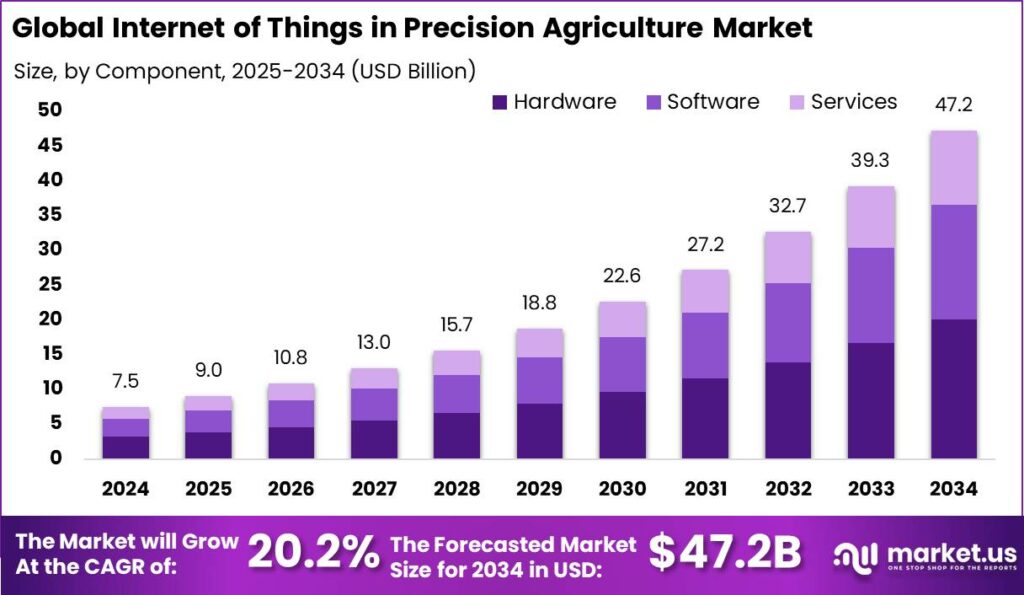
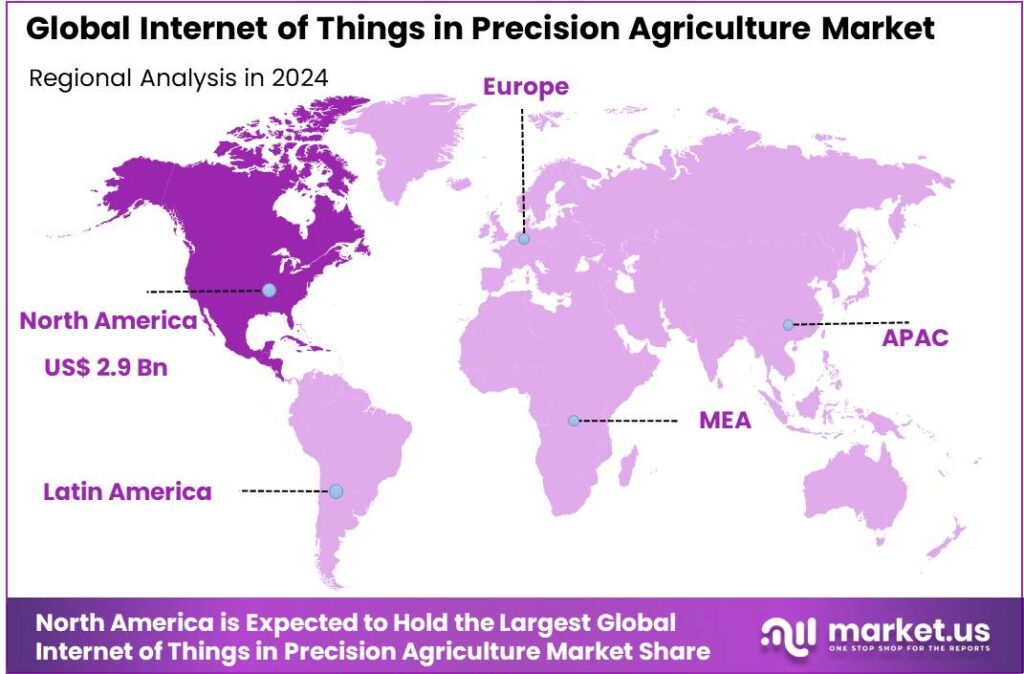
The Global IoT in Precision Agriculture Market size is expected to be worth around USD 47.2 Billion By 2034, from USD 7.5 Billion in 2024, growing at a CAGR of 20.20% during the forecast period from 2025 to 2034. In 2024, North America held a dominant market position in the IoT in precision agriculture sector, capturing more than 39.4% of the market share, with a revenue reaching USD 2.9 billion.
The Internet of Things (IoT) in precision agriculture encapsulates a sophisticated network of devices and technologies that enhance agricultural practices. This integration involves sensors, drones, and other connected technologies that actively monitor and optimize various aspects of farming operations, including soil conditions, crop health, water usage, and climate conditions.
The market for IoT in precision agriculture is rapidly expanding, driven by the increasing demand for optimized agricultural operations and sustainability. This market growth is propelled by technological advancements that enable more efficient resource use and higher crop yields, appealing to a broad range of agricultural stakeholders from small farms to large agribusinesses.
The adoption of IoT technologies in farming operations underscores a shift towards more data-driven and automated agricultural ecosystems. Key driving factors for IoT in precision agriculture include the need for enhanced crop productivity and efficiency in resource management.
The pressure to meet the rising global food demand, coupled with the necessity to minimize environmental impacts, compels farmers and agricultural businesses to adopt IoT solutions. These technologies not only improve yield outcomes but also contribute to sustainable farming practices by optimizing the use of water, fertilizers, and pesticides.
Another major driver is the advancement in technology, which has made IoT devices more affordable and accessible to farmers. The growing awareness among farmers about the potential benefits of IoT, such as reduced operational costs and increased crop yield, is accelerating the adoption of this technology in the agriculture sector.
According to the research conducted by Market.us, The Global Internet of Things (IoT) Market is set for significant expansion, with its value projected to rise from USD 492.7 billion in 2023 to approximately USD 3,454.2 billion by 2033, growing at a CAGR of 21.5% during the forecast period (2024-2033).
The demand for IoT in precision agriculture is bolstered by the increasing awareness among farmers about the benefits of real-time data-driven decision making. The need to reduce operational costs and increase crop yield through efficient farming practices further fuels this demand. As agricultural stakeholders seek to enhance productivity and sustainability, the uptake of IoT solutions in the sector continues to grow.
Key Takeaways
- The Global Internet of Things (IoT) in Precision Agriculture Market is expected to be worth around USD 47.2 Billion by 2034, growing from USD 7.5 Billion in 2024, at a CAGR of 20.20% during the forecast period from 2025 to 2034.
- In 2024, the Hardware segment held a dominant position in the IoT in precision agriculture market, capturing more than 42.5% of the market share.
- The Sensing System segment also held a dominant market position within IoT in precision agriculture in 2024, capturing over 38.8% of the market share.
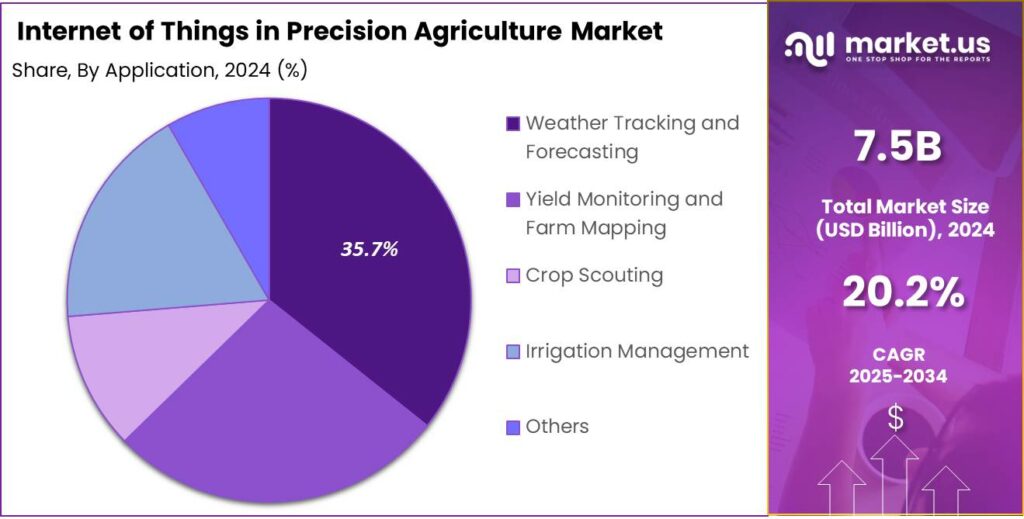
- The Weather Tracking and Forecasting segment commanded a dominant position in the IoT in precision agriculture market in 2024, holding more than 35.7% of the market share.
- In 2024, North America held a dominant market position in the IoT in precision agriculture sector, capturing more than 39.4% of the market share, with a revenue reaching USD 2.9 billion.
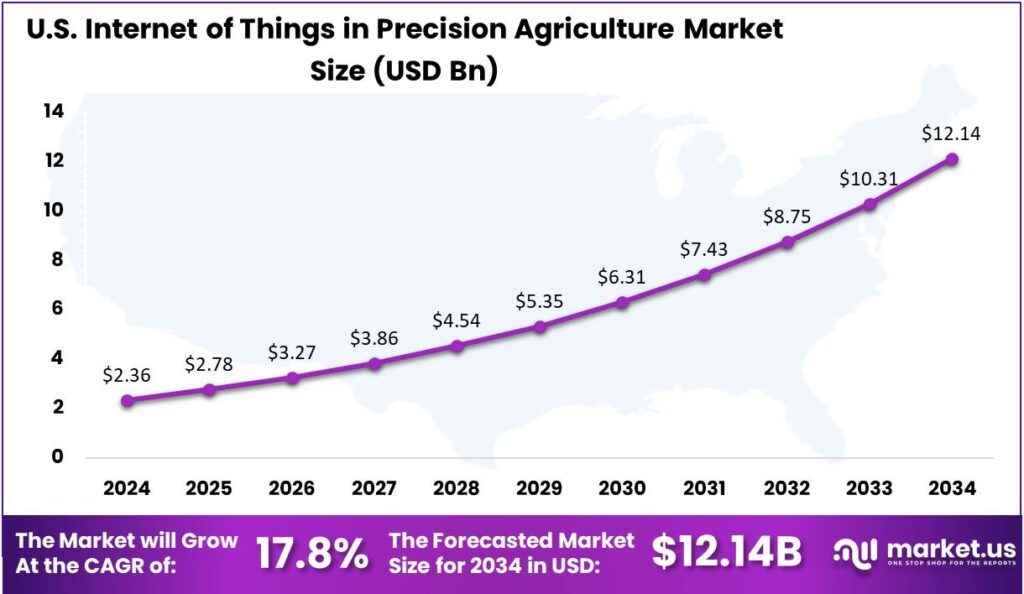
- The market value of the IoT in precision agriculture in the United States was estimated at USD 2.36 billion in 2024, with the sector projected to expand at a CAGR of 17.8%.
Analysts’ Viewpoint
The IoT in precision agriculture offers substantial investment opportunities, particularly in developing advanced sensor technologies, data analytics platforms, and automated farming solutions. Investors and technology firms are increasingly attracted to this sector due to its potential for high returns driven by innovations that meet the growing needs of modern agriculture.
IoT in precision agriculture provides numerous business benefits such as enhanced operational efficiency, reduced costs, and improved crop yields. These technologies enable farmers to make informed decisions based on accurate and timely data, leading to better management of resources and risk mitigation.
The regulatory environment for IoT in precision agriculture is evolving, with more emphasis on ensuring data security and privacy. Regulations may also cover the use of drones and other autonomous devices in agriculture, influencing how IoT technologies can be deployed in this sector. Compliance with these regulations is crucial for the adoption and scaling of IoT solutions in precision agriculture.
U.S. Market Size
In 2024, the market value for the Internet of Things (IoT) in Precision Agriculture in the United States was estimated at USD 2.36 billion. This sector is projected to expand at a compound annual growth rate (CAGR) of 17.8%.
The significant growth in the U.S. IoT in Precision Agriculture market can be attributed to the increasing adoption of advanced agricultural technologies aimed at enhancing crop yield and farm efficiency. IoT technologies like sensor-based soil monitoring and automated irrigation systems offer real-time data, helping optimize resource use and improve crop management.
This trend will grow as farmers and businesses aim to meet the rising food demand driven by a growing global population. Government initiatives promoting smart agriculture have been key to the sector’s growth, offering financial and technical support for IoT adoption.
The focus on sustainable farming practices has also driven the integration of IoT to reduce environmental impact, further boosting market growth. As IoT technology evolves, it holds significant potential for innovation and efficiency in agriculture.
In 2024, North America held a dominant market position in the Internet of Things (IoT) in Precision Agriculture, capturing more than a 39.4% share with revenue reaching USD 2.9 billion. This leadership stems from advanced tech infrastructure, high IoT adoption in agriculture, and strong government support for smart farming.
The region’s technological edge is a critical driver, with widespread access to advanced IoT technologies such as satellite imaging, drones, and sensor technology. These tools are extensively used by North American farmers to enhance yield accuracy, optimize inputs, and reduce costs, contributing to the growth of the market.
Government policies and subsidies also play a significant role in this region’s market dominance. Programs aimed at supporting precision agriculture have encouraged the adoption of IoT technologies by reducing the initial investment costs for farmers. These initiatives are part of broader efforts to increase sustainability and productivity in agriculture, aligning with environmental goals and food security objectives.
Heightened awareness among North American farmers about the benefits of precision agriculture, from cost savings to better production control, is driving market growth. Educational programs and workshops by public and private entities have further boosted IoT adoption in farming, solidifying North America’s leadership in the global IoT in Precision Agriculture market.
Component Analysis
In 2024, the Hardware segment held a dominant position in the Internet of Things (IoT) in precision agriculture market, capturing more than a 42.5% share. This segment includes essential devices such as sensors, actuators, GPS systems, and drones, which are foundational to implementing IoT in agricultural operations.
The prominence of the Hardware segment can be attributed to the critical role these devices play in collecting and transmitting data necessary for precision farming. Hardware components are essential to IoT solutions, enabling precise monitoring and management of agricultural environments to optimize farming practices.
The Hardware segment’s leadership is strengthened by ongoing innovations and falling IoT device costs. These advancements enhance efficiency and capabilities, while making devices more affordable and accessible to a wider range of farmers. This accessibility is vital for driving IoT adoption in agriculture, especially in cost-conscious developing regions.
The integration of IoT hardware with other agricultural technologies has boosted the appeal of the Hardware segment. For example, drones for aerial imaging and soil health sensors can work seamlessly with data analytics platforms, enabling more precise decision-making and resource allocation to increase yields and reduce waste.
System Analysis
In 2024, the Sensing System segment held a dominant market position within the Internet of Things (IoT) in Precision Agriculture, capturing more than a 38.8% share. This segment’s leadership can be primarily attributed to its critical role in facilitating real-time data collection and monitoring, which are foundational to optimizing agricultural practices.
Sensing systems include a variety of sensors that measure environmental conditions, soil properties, crop health, and more. These sensors provide vital data that enable farmers to make informed decisions, thereby increasing crop yields and improving resource efficiency.
The significance of sensing systems in precision agriculture is further underscored by their integration capabilities with other technological components. For example, the data collected by sensors are effectively utilized by advanced communication systems and data management systems to enhance the precision of farming operations.
Furthermore, the advancement in sensor technology has led to the development of more sophisticated and cost-effective solutions, making them accessible to a broader range of farmers. Innovations such as nanotechnology and IoT-enabled sensors have transformed traditional farming methods, allowing for more precise monitoring and control of agricultural environments.
Application Analysis
In 2024, the Weather Tracking and Forecasting segment held a dominant market position in the Internet of Things (IoT) in Precision Agriculture Market, capturing more than a 35.7% share. This segment’s leadership can be attributed to its critical role in enhancing the precision and efficiency of agricultural operations.
The Weather Tracking and Forecasting segment is growing due to increasing reliance on predictive agricultural analytics. As climate variability rises, accurate weather forecasting becomes crucial. Investments in IoT infrastructure enhance data collection and analysis, improving weather predictions and fostering more resilient agricultural practices.
The adoption of IoT in weather tracking for agriculture is driven by the need to reduce costs and boost productivity. Accurate weather data helps farmers minimize water and fertilizer use, resulting in cost savings and environmental sustainability. This proactive approach attracts stakeholders seeking smart agricultural solutions with long-term returns.
Regulatory support and government initiatives promoting smart agriculture have fueled the growth of the Weather Tracking and Forecasting segment. Programs enhancing productivity through technology encourage IoT adoption in weather monitoring. Emphasis on sustainable agriculture and compliance with environmental regulations further strengthens this segment, positioning IoT integration as a key innovation in precision agriculture.
Key Market Segments
By Component
- Hardware
- Software
- Services
By System
- Sensing System
- Communication System
- Cloud Computing
- Data Management System
- Others
By Application
- Weather Tracking and Forecasting
- Yield Monitoring and Farm Mapping
- Crop Scouting
- Irrigation Management
- Others
Key Regions and Countries
- North America
- US
- Canada
- Europe
- Germany
- France
- The UK
- Spain
- Italy
- Rest of Europe
- Asia Pacific
- China
- Japan
- South Korea
- India
- Australia
- Singapore
- Rest of Asia Pacific
- Latin America
- Brazil
- Mexico
- Rest of Latin America
- Middle East & Africa
- South Africa
- Saudi Arabia
- UAE
- Rest of MEA
Driver
Enhancing Resource Efficiency through IoT in Precision Agriculture
The integration of the Internet of Things (IoT) into precision agriculture significantly enhances resource efficiency, leading to increased productivity and sustainability in farming practices. IoT devices, such as soil moisture sensors, weather stations, and drone-based imaging, provide real-time data that enable farmers to make informed decisions regarding irrigation, fertilization, and pest control.
Moreover, drone-based imaging equipped with IoT technology offers detailed aerial views of fields, identifying areas affected by pests or diseases early.Early detection enables timely intervention, limiting infestations and reducing pesticide use, which lowers costs and promotes environmental health. The adoption of IoT in agriculture also facilitates precision fertilization. Real-time soil analysis allows farmers to apply fertilizers precisely, reducing runoff, preventing pollution, and improving soil health.
Restraint
High Initial Investment and Adoption Barriers
While the benefits of IoT in precision agriculture are substantial, the high initial investment required for technology acquisition and implementation poses a significant restraint, particularly for small-scale farmers and those in developing regions.
The costs associated with purchasing IoT devices, establishing connectivity infrastructure, and training personnel can be prohibitive, limiting widespread adoption. IoT devices like automated milking and feeding robots have high setup costs and require specialized training, which can be a barrier for small farmers and those in emerging economies.
Additionally, the lack of standardized protocols for IoT devices in agriculture leads to compatibility issues between different systems. This fragmentation can result in inefficiencies and increased costs, as farmers may need to invest in multiple platforms or customized solutions to achieve interoperability.
Opportunity
Advancements in IoT-Driven Sustainable Farming Practices
The integration of IoT technologies in precision agriculture presents a significant opportunity to advance sustainable farming practices. By leveraging real-time data and automation, IoT enables farmers to optimize resource use, reduce environmental impact, and enhance crop yields, aligning agricultural operations with sustainability goals.
IoT facilitates precision farming by collecting data on various environmental factors, such as soil moisture, temperature, and nutrient levels. This information allows for targeted interventions, ensuring that inputs like water and fertilizers are applied only where and when needed.
Such precision reduces waste, minimizes runoff into water bodies, and promotes soil health, contributing to more sustainable agricultural practices. Moreover, IoT-enabled monitoring systems can track livestock health and behavior, leading to improved animal welfare and productivity.
Challenge
Data Management and Security Concerns in IoT-Enabled Agriculture
IoT provides significant benefits but also creates challenges in data management and security. The large data volumes demand robust infrastructure for storage, processing, and analysis, which can be difficult for farmers and agribusinesses to manage without the right expertise or resources.
Moreover, the interconnectivity of devices increases the risk of cyber threats. Unauthorized access to agricultural data can lead to misuse of sensitive information, such as farm operations or proprietary techniques, potentially resulting in financial losses or compromised competitive advantage.
Additionally, reliance on IoT systems makes critical agricultural processes vulnerable to disruptions from cyber-attacks, which could affect food production and supply chains.
Emerging Trends
One notable trend is the use of smart sensors that monitor various environmental factors such as soil moisture, temperature, and humidity. These sensors provide real-time data, enabling farmers to make informed decisions about irrigation and fertilization, thereby optimizing resource use and improving crop yields.
Another significant development is the deployment of autonomous machinery equipped with IoT capabilities.John Deere’s autonomous tractors can precisely spray pesticides and fertilizers, reducing manual labor, minimizing waste, and lowering environmental impact.
Drones integrated with IoT technology are also gaining prominence in precision agriculture. These drones can capture high-resolution images and monitor crop health, allowing for early detection of issues such as pest infestations or nutrient deficiencies. This timely information enables farmers to address problems promptly, reducing potential losses and enhancing overall farm management.
Business Benefits
The adoption of IoT technologies in precision agriculture offers numerous business benefits, primarily through enhanced operational efficiency. By utilizing IoT-enabled sensors to monitor soil conditions, farmers can implement precise irrigation strategies, leading to significant water conservation and cost savings.
IoT also facilitates better resource management by enabling variable-rate technology (VRT) in the application of fertilizers and pesticides. With accurate data on field variability, inputs can be applied only where needed, decreasing the overall usage of chemicals. This precision not only cuts input costs but also minimizes environmental impact, aligning with sustainable farming practices.
Enhanced data analytics provided by IoT systems enable farmers to make more informed decisions, leading to improved crop management and higher yields. Real-time data on crop health and growth enables timely interventions, reducing losses and boosting output. This data-driven approach enhances planning and risk management, key for agricultural success.
Key Player Analysis
Key players in IoT-based precision agriculture drive advancements by providing innovative solutions that enhance decision-making for farmers.
Ag Leader Technology is a major player in the IoT-enabled precision agriculture market. Specializing in developing advanced technology solutions like yield monitors, GPS guidance, and automated equipment control, Ag Leader enhances the efficiency of farm operations. Their products help farmers collect and analyze data, ensuring smarter farming decisions, optimizing inputs like fertilizers and improving crop yields.
AgJunction, Inc. is another prominent company in the precision agriculture space. They are known for their suite of IoT-based solutions such as automated steering systems, machine control, and telematics. By providing integrated systems that connect various farming equipment, AgJunction helps farmers increase operational efficiency while reducing manual labor.
AKVA Group ASA focuses on IoT solutions for aquaculture, bringing precision agriculture to marine environments. By providing automated systems for monitoring water quality, feed management, and fish health, AKVA helps aquaculture farmers optimize their operations. Through IoT sensors and data analytics, AKVA ensures that fish farming becomes more efficient, sustainable, and profitable.
Top Key Players in the Market
- Ag Leader Technology
- AgJunction, Inc.
- AKVA Group ASA
- AeroFarms
- AmHydro
- AGRIVI
- Cisco Systems, Inc.
- Climate LLC
- Connecterra B.V.
- Deere & Company
- Eruvaka Technologies
- Heliospectra AB
- Hitachi, Ltd.
- IBM
- Others
Top Opportunities Awaiting for Players
The integration of the Internet of Things (IoT) into precision agriculture presents significant opportunities for industry players to enhance efficiency, productivity, and sustainability.
- Advanced Soil and Crop Monitoring: IoT-enabled sensors facilitate real-time monitoring of soil conditions, including moisture levels, nutrient content, and pH. This data allows for precise irrigation and fertilization, optimizing resource use and improving crop yields. For instance, moisture sensors can determine optimal watering times, reducing water consumption and promoting sustainable practices.
- Precision Livestock Management: IoT devices can be utilized to monitor livestock health and behavior. Wearable sensors track vital signs and movement patterns, enabling early detection of health issues and timely interventions. This leads to improved animal welfare and productivity, as well as reduced veterinary costs.
- Automated Farm Equipment: The development of autonomous machinery, such as self-steering tractors and harvesting robots, is facilitated by IoT connectivity. These machines can perform tasks like planting, fertilizing, and harvesting with high precision, reducing labor requirements and increasing operational efficiency.
- Supply Chain Optimization: IoT technologies enable real-time tracking of agricultural products from farm to market. This enhances supply chain transparency, reduces spoilage, and ensures quality control. Farmers and distributors can monitor storage conditions and transportation logistics, leading to reduced losses and improved profitability.
- Data-Driven Decision Making: The aggregation and analysis of data collected from IoT devices empower farmers to make informed decisions regarding crop management, resource allocation, and market strategies. Predictive analytics can forecast weather patterns, pest infestations, and market trends, allowing for proactive measures and risk mitigation.
Recent Developments
- In September 2024, AGCO and Trimble Agriculture launched PTx Trimble, a joint venture focusing on mixed fleet, retrofit precision agriculture, and autonomous technologies. This initiative was showcased at the Farm Progress 2024 event, marking its first major appearance in North America.
- In December 2024, IBM introduced an AI assistant tailored for agriculture, aiming to enhance decision-making processes for farmers by leveraging data analytics and IoT integrations.









