


Report Overview
The Global Second Hand Trading Platform Market size is expected to be worth around USD 2.0 Billion by 2033, from USD 1.2 Billion in 2023, growing at a CAGR of 5.3% during the forecast period from 2024 to 2033.
The Second-Hand Trading Platform Market involves online and offline platforms where users can buy and sell pre-owned goods. This market has grown rapidly due to rising consumer interest in sustainable practices and cost savings. Key players include specialized marketplaces and large e-commerce platforms that offer dedicated sections for second-hand goods. These platforms provide a variety of products, including clothing, electronics, furniture, and vehicles.
Technological advancements, such as AI-driven recommendation systems, enhance user experience by matching buyers with relevant products. Additionally, secure payment systems and transparent pricing contribute to consumer trust. This market appeals to a broad demographic, from cost-conscious consumers to environmentally conscious buyers.
The growth potential of this market is significant, driven by increasing consumer awareness and the push for circular economies. Companies entering this space must focus on user trust, seamless transactions, and the quality of goods offered. Strategic partnerships, scalability, and technological innovation are essential for success in this evolving market.

The second-hand trading platform market is witnessing significant growth, driven by increasing consumer awareness of sustainability and cost-efficiency. In 2021, the sector’s environmental impact was notable, with potential savings of 20.7 million tonnes of CO2 emissions, 1.2 million tonnes of plastic, and 7.8 million tonnes of steel. These savings highlight the critical role that second-hand platforms play in promoting the reuse of goods, thereby reducing the demand for new production and contributing to global sustainability efforts.
Major platforms such as eBay, Amazon Marketplace, and Facebook Marketplace are at the forefront of this growth. These online hubs have become essential for consumers looking to buy or sell pre-owned items, supporting the broader trend of sustainable consumption.
The appeal of these platforms is not limited to environmentally conscious consumers but also extends to those seeking cost-effective alternatives. The engagement in this market is substantial, with nearly 44% of U.S. consumers reporting that they bought or sold a pre-owned item online in the past year. This indicates a broadening consumer base that spans across various demographics.
Clothing, books, and electronics emerge as the most traded items on these platforms, reflecting diverse consumer interests. The popularity of these categories suggests that consumers are increasingly valuing access over ownership, a shift that aligns with the principles of the circular economy.
As the second-hand trading platform market expands, its potential to contribute to sustainability and economic resilience becomes more evident. The significant reduction in CO2 emissions, plastic, and steel usage underscores the market’s role in fostering a more sustainable consumption model.
Moreover, with a growing number of consumers participating in the second-hand economy, these platforms are well-positioned to capture a larger share of the retail market. This trend presents a compelling opportunity for further investment and innovation in the sector, as it continues to reshape traditional consumption patterns
Key Takeaways
- The Second Hand Trading Platform Market was valued at USD 1.2 billion in 2023 and is expected to reach USD 2.0 billion by 2033, with a CAGR of 5.3%.
- B2C dominates the type segment with 57.5% due to its strong appeal to consumers seeking verified and trustworthy transactions.
- Personal segment leads the application category with 61.4%, driven by increasing consumer preferences for individual reselling of items.
- Asia Pacific is the dominant region with 36.5%, attributed to the region’s rapid growth in e-commerce and second-hand trading activities.
Type Analysis
B2C sub-segment dominates with 57.5% due to its widespread adoption by established retailers and brands.
The Type segment of the Second Hand Trading Platform Market is broadly classified into Consumer-to-Consumer (C2C) and Business-to-Consumer (B2C). The B2C sub-segment has shown a significant dominance, holding 57.5% of the market share. This dominance can be attributed to several factors that appeal to both sellers and buyers.
Businesses find B2C e-commerce attractive as they provide a direct channel to reach consumers who are increasingly looking for sustainable and cost-effective shopping alternatives. Additionally, B2C platforms offer businesses a way to manage overstock, discontinued items, or returns efficiently, turning potential losses into revenue opportunities.
These platforms also benefit from higher trust levels among consumers, as they often guarantee product authenticity and quality, unlike C2C platforms, where such assurances are less standardized. Moreover, B2C platforms typically invest heavily in marketing and customer service, enhancing user experience and platform reliability, which further drives consumer traffic and increases sales volumes.
The expansion of B2C in the second-hand market is also fueled by the growing consumer awareness regarding sustainability. Purchasing second-hand items through B2C channels is increasingly viewed as a way to reduce environmental impact, supporting circular economy initiatives championed by consumers and governments alike.
In contrast, the C2C sub-segment, though smaller in market share, plays a crucial role in the ecosystem of second-hand trading by facilitating peer-to-peer transactions. This segment appeals to individuals looking for unique items and bargains and those wishing to declutter personal belongings in a community-like online environment.
C2C platforms are pivotal in driving the adoption of the sharing economy, influencing cultural shifts towards more sustainable consumption habits. They serve as a testing ground for new market trends and consumer behaviors, which can inform broader B2C strategies.
Application Analysis
The Personal sub-segment dominates with 61.4% due to the growing consumer preference for personalizing shopping.
Within the Application segment of the Second Hand Trading Platform Market, there are two primary categories: Merchant and Personal. The Personal sub-segment is the more dominant, capturing 61.4% of the market. This substantial market share is largely driven by the increasing number of individual consumers who are turning to second-hand markets to purchase personal items. Consumers are motivated by the lower prices on quality goods, the thrill of discovering rare or vintage items, and the growing societal push towards sustainable living.
Personal users of second-hand trading platforms are typically looking for items that are not readily available in regular retail channels, such as out-of-print books, vintage clothing, or discontinued electronics. This hunt for unique items has cultivated a vibrant community of like-minded individuals who are not only buyers but also sellers, contributing to a dynamic marketplace.
The role of technology in facilitating user-friendly experiences through features like mobile apps, advanced search filters, and community forums has also significantly propelled the growth of the Personal sub-segment. These technological advancements make transactions more convenient and safer, increasing platform loyalty among users.
On the other hand, the Merchant sub-segment, while smaller, supports the market by enabling businesses and professional sellers to reach a wider audience. Merchants typically offer a broader range of products and can provide additional services such as product refurbishing or authentication, which enhances buyer confidence.
The presence of merchants on these platforms helps stabilize supply, which is critical for maintaining user engagement and ensuring a steady flow of transactions. As merchants increasingly recognize the value proposition of participating in the second-hand economy, their integration into these platforms can be expected to deepen, promoting further market growth across both application sub-segments.

Key Market Segments
By Type
- C2C
- B2C
By Application
- Merchant
- Personal
Driver
Technological Advancements Drive Market Growth
The second-hand trading platform market is experiencing significant growth, driven by various technological advancements and strategic initiatives. One of the key factors is the increasing adoption of AI-driven tools, such as generative AI and machine learning models, which enhance user experience by personalizing recommendations and improving transaction security. This has led to a surge in job postings related to these technologies, indicating a robust demand for specialized skills in the sector.
In addition, cross-border e-commerce growth is fueled by the strategic investments of companies like Payoneer, which saw a 33% increase in card usage and is expanding its product offerings to support small and medium-sized businesses (SMBs). This expansion is pivotal as it enables these businesses to reach international markets more effectively, driving the overall growth of second-hand trading platforms.
Government initiatives also play a crucial role. For instance, investments in digital infrastructure and public-private partnerships are enhancing the efficiency and scalability of these platforms. The CHIPS for America Act, providing USD 52 billion to catalyze private-sector investment in semiconductor manufacturing, indirectly supports the technology backbone of online platforms, further boosting their reliability and reach.
Restraint
Regulatory Complexity Restraints Market Growth
The growth of the Second Hand Trading Platform Market is notably restrained by the complex and varied regulatory landscape. Government regulations across different regions impose various legal requirements on the operation of second-hand trading platforms, particularly concerning consumer protection, product safety, and taxation.
Similarly, in the United States, the Consumer Product Safety Improvement Act (CPSIA) mandates rigorous testing and certification processes for certain used goods, which can discourage smaller businesses from entering the market. Additionally, varying tax regulations across states and countries create challenges for platforms trying to scale their operations internationally, as they must navigate a myriad of tax codes, potentially deterring expansion efforts.
These regulatory challenges are compounded by the fact that second-hand goods often lack standardized pricing and valuation, leading to potential disputes and legal issues. The lack of uniform global regulations further complicates international transactions, where import-export rules may differ significantly, adding another layer of complexity to cross-border trade.
In particular, the importation of second-hand electronic goods is often subject to stringent environmental regulations, such as the Waste Electrical and Electronic Equipment (WEEE) directive in the EU, which requires the proper disposal or recycling of electronic waste. These regulations can limit the types of goods that can be traded across borders, thereby restraining market growth.
Opportunity
Consumer Trends, Sustainability, and Technological Advancements Provide Opportunities
The Second Hand Trading Platform Market presents significant opportunities for players, driven by evolving consumer trends, sustainability priorities, and technological advancements. Consumer preferences are shifting towards thriftiness and value-consciousness, creating a growing demand for pre-owned goods. This trend is particularly strong among younger demographics, such as Millennials and Gen Z, who are more open to purchasing second-hand items, especially in categories like fashion, electronics, and furniture.
Sustainability is another major opportunity. With rising awareness of environmental issues, consumers are increasingly choosing to buy second-hand as a way to reduce waste and minimize their ecological footprint. Platforms that emphasize their role in promoting a circular economy can differentiate themselves and appeal to eco-conscious consumers. By marketing their environmental benefits, companies can not only boost their brand image but also tap into a growing market segment that values sustainability.
Technological advancements further enhance opportunities for market players. The integration of AI and machine learning can improve user experiences by offering personalized recommendations and streamlined search functions.
Additionally, mobile app development and secure digital payment systems make transactions more convenient and accessible, attracting more users to these platforms. Expanding into new technologies, such as blockchain for ensuring product authenticity, can also create trust and transparency, encouraging more transactions.
Challenge
Regulatory Compliance Challenges Market Growth
The growth of the Second-Hand Trading Platform Market faces significant challenges due to regulatory compliance. Governments across different regions are increasingly focusing on consumer protection and anti-fraud measures. Platforms must adhere to strict regulations, which can vary widely from one country to another. Compliance with these regulations often requires substantial investments in legal expertise, technology, and staff training.
These costs can be burdensome, especially for smaller platforms, limiting their ability to scale. Additionally, the ever-changing nature of regulations requires continuous updates and adjustments to operational processes. This can divert resources away from market expansion efforts. Moreover, regulatory requirements related to data privacy and security are becoming more stringent. Platforms must implement advanced security measures to protect user data, adding another layer of complexity and cost.
Failure to comply with these regulations can result in hefty fines, reputational damage, and even the suspension of operations. All these factors create barriers to entry for new players and slow down the expansion of existing platforms. As a result, the overall market growth is tempered by the need to navigate and comply with these regulatory frameworks effectively.
Growth Factors
- Increased Consumer Trust: AI improves fraud detection and ensures safer transactions, building consumer trust in second-hand platforms. This increased confidence encourages more users to buy and sell, driving market growth.
- Enhanced User Experience: AI-powered personalization, such as tailored recommendations and better search results, enhances the shopping experience. A more enjoyable and efficient platform attracts more users, boosting market expansion.
- Efficiency in Pricing: AI enables dynamic pricing by analyzing market trends and product demand, ensuring fair and competitive prices. This attracts both buyers and sellers, increasing platform activity and contributing to market growth.
- Streamlined Operations: AI automates many administrative tasks, such as inventory management and customer service, reducing operational costs and improving platform efficiency. This allows platforms to scale more easily and grow faster.
- Broader Market Reach: AI helps platforms identify and target new market segments through data analysis and predictive modeling. By reaching more potential users, platforms can expand their user base and grow their market presence.
- Faster Transactions: AI speeds up the buying and selling process through automated matching and faster decision-making tools. Quicker transactions improve user satisfaction and encourage more frequent platform use, supporting sustained market growth.
Emerging Trends
- Growth of Mobile Apps: The increasing use of mobile apps for buying and selling second-hand goods is a key trend. Mobile apps offer convenience and real-time notifications, making it easier for users to engage in trading anytime, anywhere.
- Sustainability and Eco-Consciousness: As more consumers become environmentally conscious, the demand for second-hand goods is rising. Trading platforms that emphasize sustainability and eco-friendly practices are gaining popularity, appealing to a growing segment of green-minded consumers.
- AI-Powered Personalization: AI technology is being used to personalize the user experience on second-hand trading platforms. AI can recommend products based on user preferences and past behavior, increasing user engagement and driving more successful transactions.
- Blockchain for Trust and Transparency: Blockchain technology is emerging as a way to enhance trust and transparency in second-hand trading. By providing a secure and verifiable record of transactions, blockchain can reduce fraud and build confidence among users.
- Virtual Try-Ons and Augmented Reality (AR): AR technology is enabling virtual try-ons for items like clothing and accessories. This trend allows users to visualize products before purchase, reducing returns and improving buyer satisfaction.
- Social Media Integration: Integration with social media platforms is becoming more common, allowing users to share listings and purchases with their networks. This trend helps platforms reach a broader audience and create a more community-driven trading experience.
Regional Analysis
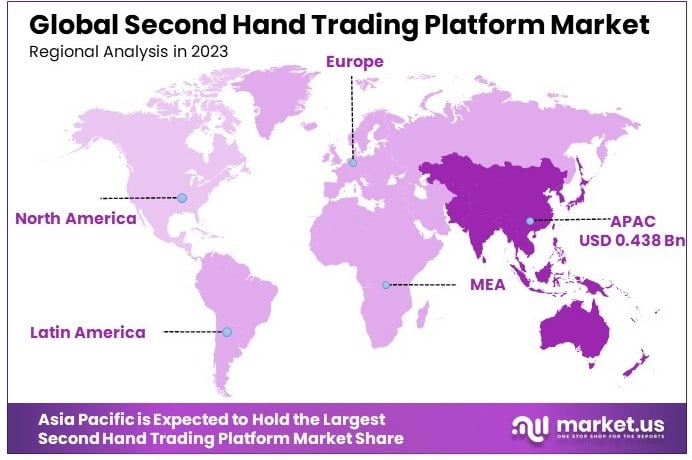
Asia Pacific Dominates with 36.5% Market Share in the Second Hand Trading Platform Market
Asia Pacific’s substantial 36.5% share with valuationo f USD 0.438 Bn in the second hand trading platform market can primarily be attributed to its large and increasingly tech-savvy population. Rapid urbanization and growing internet penetration have also played crucial roles. The region benefits from a strong culture of thrift and value for money, which boosts the popularity of second hand trading platforms. Furthermore, regulatory support in countries like China and India for sustainable consumption practices has encouraged the growth of these platforms.
The market dynamics in Asia Pacific are influenced by its diverse socioeconomic landscape. The rising middle class, with increasing disposable income, is more inclined to seek out bargains and sustainable options, bolstering the demand for second hand goods. Technological advancements and widespread mobile connectivity have made platforms more accessible, leading to user base expansion. Additionally, local startups have tapped into niche markets, integrating local cultural nuances into their business models, which resonate well with consumers.
Regional Analysis for Other Markets:
- North America: North America, holding a significant market share, is driven by a robust e-commerce infrastructure and high consumer spending power. The region shows a growing preference for sustainable goods amidst environmental concerns. With technological innovation at its core, platforms are increasingly integrating AI and machine learning to enhance user experiences, suggesting a stable growth trajectory for the market.
- Europe: Europe’s market is characterized by high environmental awareness and stringent regulations promoting sustainability, making it a strong player in the second hand trading sector. The presence of multiple established platforms, along with new startups focusing on specific niches like luxury goods, indicates a mature market with potential for steady growth.
- Middle East & Africa: The market in the Middle East and Africa is emerging, driven by increasing internet penetration and shifting consumer attitudes towards second hand goods. Economic diversification efforts and the young demographic are likely to boost platform adoption and market growth in the coming years.
- Latin America: In Latin America, economic fluctuations and the rising cost of living drive the demand for second hand trading platforms. As digital infrastructure improves and more consumers gain internet access, the market is expected to grow. The cultural acceptance of second hand goods further supports this upward trend.
Key Regions and Countries covered іn thе rероrt
- North America
- US
- Canada
- Mexico
- Europe
- Germany
- UK
- France
- Italy
- Russia
- Spain
- Rest of Europe
- Asia Pacific
- China
- Japan
- South Korea
- India
- Rest of Asia-Pacific
- South America
- Brazil
- Argentina
- Rest of South America
- Middle East & Africa
- GCC
- South Africa
- Israel
- Rest of MEA
Key Players Analysis
The Second-Hand Trading Platform Market is highly competitive, with several key players driving growth and shaping industry trends. Among these, eBay Inc., Vinted, and OLX Group stand out as the top three players due to their market influence, strategic positioning, and impact.
eBay Inc. is a pioneer in the second-hand market, leveraging its global presence and robust platform to dominate in many regions. Its strategic positioning as a leader in online auctions and consumer-to-consumer sales gives it significant influence. eBay’s brand recognition and user-friendly interface make it a preferred choice for both buyers and sellers, contributing to its strong market impact.
Vinted has emerged as a key player, especially in Europe. Its focus on fashion and apparel has carved out a niche market, appealing to eco-conscious consumers. Vinted’s strategic approach to community building and a simple, fee-free listing process has significantly boosted user engagement. This focus on sustainability and cost-effectiveness strengthens its market position and impact.
OLX Group, with a strong presence in emerging markets, holds significant influence. Its diversified platform offers a wide range of categories beyond just fashion, including electronics and household items. OLX’s strategic expansion in developing regions and its localized approach have solidified its market leadership. This broad reach and adaptability ensure its continued impact in the second-hand trading market.
These companies, through strategic positioning and market influence, lead the industry, driving innovation and growth in the second-hand trading platform market.
Top Key Players in the Market
- eBay Inc.
- Vinted
- Vestiaire Collective
- OLX Group
- JD.com
- Alibaba Group
- Suning
- 58.com
- Kongfz
- 2shoujie
- Guazi
- Beijing Shanyi Shanmei Technology
- Greendust
Recent Developments
- 2023: Alibaba’s second-hand trading platform, Idle Fish (Xianyu), reached a significant milestone, surpassing a daily Gross Merchandise Volume (GMV) of 1 billion yuan (approximately USD 141 million). This platform has become a key player in China’s circular economy, with over 100 million users listing items ranging from electronics to apparel.
- December 2023: Vestiaire Collective, a leading platform for second-hand luxury fashion, expanded its reach through a strategic collaboration with the Kering Group. This partnership aims to integrate luxury brands into the second-hand market, enhancing consumer trust and ensuring product authenticity.









