


Report Overview
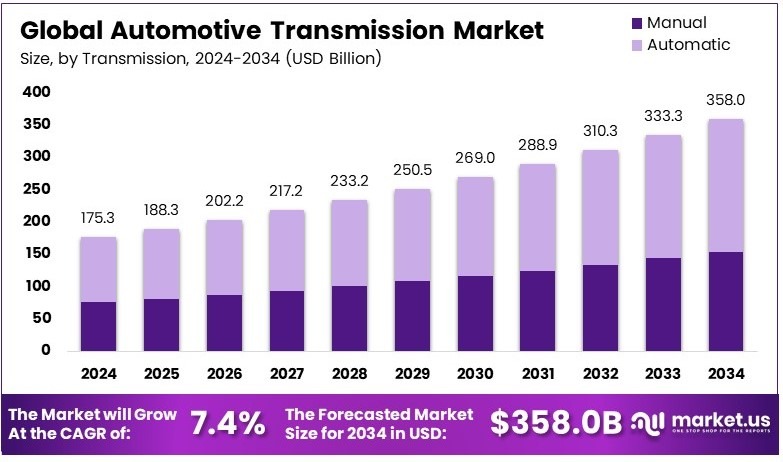
The Global Automotive Transmission Market size is expected to be worth around USD 358.0 Billion by 2034, from USD 175.3 Billion in 2024, growing at a CAGR of 7.4% during the forecast period from 2025 to 2034.
Automotive transmission is a system that controls a vehicle’s power and speed. It transfers energy from the engine to the wheels. Transmissions can be manual, automatic, or semi-automatic. They help improve fuel efficiency and driving performance. Modern transmissions use advanced technology to ensure smoother gear shifts and better control.
The Automotive Transmission Market includes the production and sales of transmission systems. Demand is driven by the rising number of vehicles and advancements in fuel-efficient technologies. Key players invest in electric and hybrid transmission systems. Market trends focus on sustainability, lightweight materials, and improved efficiency to meet global regulations.
The automotive transmission market is growing as vehicle demand rises globally. According to OICA, over 1.4 billion vehicles are on the road, driving steady transmission sales. In the U.S., 289 million vehicles create strong replacement demand. Automakers focus on fuel-efficient and automatic transmissions, boosting innovation. Consequently, hybrid and EV transmissions are expanding rapidly.
The automotive transmission aftermarket is highly competitive. Many suppliers offer similar products, making pricing and quality crucial. Automatic and CVT transmissions are gaining popularity due to smoother performance. Moreover, electric vehicles require specialized transmissions, creating fresh opportunities. As demand shifts, companies investing in advanced manufacturing and supply chain efficiency will gain a competitive edge.
Growing vehicle ownership fuels demand for transmissions, both new and aftermarket. In developing regions, rising disposable income boosts car sales, increasing transmission needs. Additionally, stricter emissions laws encourage fuel-efficient designs, influencing transmission technology. Hybrid and electric powertrains further reshape the market, requiring lighter, high-performance transmissions to maximize efficiency and durability.
Competition in the automotive transmission market is intense. Established brands focus on quality and warranties, while new entrants offer lower prices. Advanced transmission technology, like dual-clutch systems, improves efficiency. Meanwhile, EV growth forces automakers to rethink traditional transmissions. Companies adapting to these changes through research and development will stay competitive.
Key Takeaways
- The Automotive Transmission Market was valued at USD 175.3 billion in 2024 and is expected to reach USD 358.0 billion by 2034, with a CAGR of 7.4%.
- In 2024, Automatic transmission led the market with 57.3%, driven by increased consumer preference for convenience and fuel efficiency.
- In 2024, Gasoline-powered vehicles held the largest fuel type share at 57.4%, benefiting from their affordability and widespread availability.
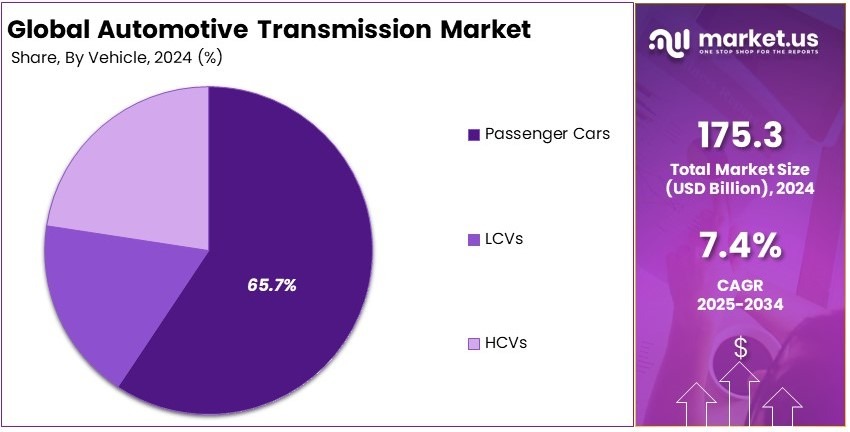
- In 2024, Passenger Cars dominated the vehicle segment with 65.7%, owing to rising consumer demand and urbanization.
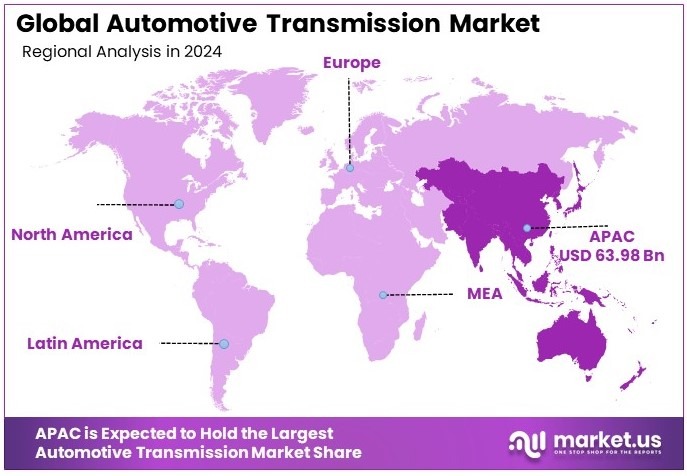
- In 2024, Asia Pacific accounted for 36.5% (USD 63.98 billion), fueled by rapid automotive industry expansion and technological advancements.
Transmission Analysis
Automatic dominates with 57.3% due to its ease of use and technological advancements.
In the Automotive Transmission Market, the Automatic transmission segment leads significantly, holding a 57.3% market share. This dominance is primarily due to the increasing demand for vehicles that are easier to drive and offer a more comfortable ride, especially in urban environments with frequent stop-and-go traffic.
Automatic transmissions have evolved with advancements in technology, offering better fuel efficiency and reliability, which enhances their appeal to modern consumers.
Conversely, Manual transmissions, though valued for their control and efficiency in fuel consumption, are becoming less popular in many markets. They remain prevalent in regions with a strong tradition of manual driving or where cost considerations prevail. However, their role in the market is diminishing as automatic transmissions become more accessible and preferred for their convenience.
Fuel Analysis
Gasoline dominates with 57.4% due to its widespread availability and mature technology.
Within the Fuel segment of the Automotive Transmission Market, Gasoline engines hold a dominant position with a 57.4% share. This predominance is supported by the extensive infrastructure for gasoline distribution and the established technology that makes gasoline engines cost-effective and reliable.
Additionally, gasoline engines are preferred in many markets due to their quick response and higher performance characteristics compared to other fuels.
In contrast, Diesel engines, known for their durability and fuel efficiency, play a critical role in sectors that value torque and long-distance performance. Despite facing challenges such as stricter emissions regulations, diesel engines are essential in commercial vehicle sectors and areas with high fuel costs.
The ‘Others’ category, which includes hybrid and electric powertrains, is growing as environmental regulations become stricter and technology improves. Although this segment currently holds a smaller share, its importance is increasing rapidly, indicating a significant shift towards more sustainable fuel options in the future.
Vehicle Analysis
Passenger Cars lead with 65.7% due to their high volume and broad consumer base.
The Vehicle segment is dominated by Passenger Cars, which account for 65.7% of the Automotive Transmission Market. This segment’s lead is due to the high volume of passenger vehicles manufactured and sold globally, driven by growing urbanization and the increasing purchasing power of the middle class in emerging markets.
Passenger cars are the most commonly owned type of vehicle, necessitating a wide variety of transmission types to meet consumer demands for comfort and performance.
Light Commercial Vehicles (LCVs) follow, serving as essential tools for businesses worldwide. They support a range of industries by providing versatile transportation solutions for goods and services, especially in urban settings.
Heavy Commercial Vehicles (HCVs), though fewer in number, are crucial for freight and logistics operations. They require robust transmission systems capable of handling heavy loads and rigorous use, underscoring their importance despite a smaller market share compared to passenger cars.
Key Market Segments
By Transmission
- Manual
- Automatic
By Fuel
- Gasoline
- Diesel
- Others
By Vehicle
- Passenger Cars
- LCVs
- HCVs
Driving Factors
Advanced Transmission Technologies and Vehicle Electrification Drive Market Growth
The growing adoption of automatic and continuously variable transmissions (CVTs) in passenger vehicles is significantly boosting the automotive transmission market. Consumers prefer automatic transmissions due to their convenience, smoother gear shifts, and improved fuel efficiency. This trend is especially strong in urban areas, where stop-and-go traffic makes automatic systems more practical.
Stringent fuel efficiency and emission regulations are further driving innovation in transmission technologies. Governments worldwide are imposing stricter norms to reduce carbon emissions, pushing automakers to develop advanced transmission systems that optimize fuel consumption. Technologies such as dual-clutch and multi-speed transmissions help achieve better mileage while maintaining performance.
Another major driver is the increasing demand for hybrid and electric vehicles (EVs), which require specialized transmission systems. Unlike conventional internal combustion engine (ICE) vehicles, EVs rely on single-speed or multi-speed transmissions to enhance efficiency and acceleration. As automakers expand their EV offerings, transmission manufacturers are focusing on innovative designs to improve power delivery and energy consumption.
Additionally, rising vehicle production is fueling the need for performance-oriented transmissions. Consumers demand better acceleration, responsiveness, and fuel economy, leading to the integration of high-performance transmission systems in both standard and luxury vehicles. With ongoing technological advancements, the market is poised for sustained growth.
Restraining Factors
High Costs and Technical Challenges Restrain Market Growth
The high cost of advanced transmission systems is a major challenge limiting market expansion. Modern transmission technologies, such as dual-clutch and continuously variable transmissions, require complex engineering and high-quality materials, increasing production costs. These costs are often passed on to consumers, making advanced transmissions less accessible for budget-conscious buyers.
Technical complexity also poses challenges, especially in retrofitting modern transmissions into older vehicles. Many car owners prefer to upgrade their existing vehicles rather than purchase new ones, but integrating advanced transmission systems into older models is difficult and costly. This limits the adoption of newer transmission technologies in the used car market.
Additionally, the limited availability of skilled technicians for transmission repairs and maintenance further hampers market growth. Advanced transmission systems require specialized knowledge for servicing, and the shortage of trained professionals leads to higher repair costs and longer waiting times for customers.
Supply chain disruptions are another restraining factor. The global shortage of semiconductor chips and essential transmission components has impacted production timelines. Delays in manufacturing and distribution have made it difficult for automakers to meet rising demand, further affecting the market’s growth potential.
Growth Opportunities
Smart Transmission Systems and Lightweight Materials Provide Growth Opportunities
The development of dual-clutch transmission (DCT) technology is creating significant growth opportunities in the market. DCTs offer faster gear shifts and improved fuel efficiency, making them ideal for both high-performance and fuel-efficient vehicles. Automakers are increasingly adopting DCTs to enhance driving experiences and meet emission standards.
Another promising area is the integration of smart and AI-based transmission control systems. These systems analyze driving patterns and road conditions to optimize gear shifts automatically. AI-driven transmissions improve fuel efficiency and vehicle performance by making real-time adjustments, reducing wear and tear on components.
The demand for lightweight transmission components is also increasing. Automakers are focusing on reducing vehicle weight to enhance fuel efficiency and battery performance in EVs. Advanced materials such as carbon fiber composites and aluminum alloys are being used to manufacture lightweight yet durable transmission components.
Furthermore, the expansion of transmission manufacturing in emerging markets is boosting industry growth. Countries such as China, India, and Brazil are experiencing rapid industrialization and vehicle production growth. Major transmission manufacturers are investing in local production facilities to meet rising demand, creating new business opportunities in these regions.
Emerging Trends
Electrification and Advanced Manufacturing Are Latest Trending Factors
The shift toward fully electrified and multi-speed transmissions in EVs is one of the most significant trends in the automotive transmission market. While traditional EVs use single-speed transmissions, new multi-speed systems improve efficiency and driving range. Automakers are developing advanced transmission solutions to enhance EV performance and energy savings.
The use of 3D printing for transmission component manufacturing is also gaining traction. This technology enables the production of complex and lightweight components with high precision. 3D printing reduces material waste and production costs, making transmission manufacturing more efficient and sustainable.
Another emerging trend is the rising popularity of adaptive and predictive transmission technologies. These systems use sensors and AI to predict driver behavior and road conditions, adjusting gear shifts accordingly. Adaptive transmissions enhance driving comfort, fuel efficiency, and overall vehicle performance.
Sustainability is also shaping the future of transmission systems. Automakers are focusing on recyclable and eco-friendly materials for transmission components to reduce environmental impact. The adoption of biodegradable lubricants and sustainable metals is becoming more common, aligning with global efforts to create greener automotive technologies. As these trends continue to evolve, the automotive transmission market is set for significant advancements in the coming years.
Regional Analysis
Asia Pacific Dominates with 36.5% Market Share
Asia Pacific leads the Automotive Transmission Market with a 36.5% share, totaling USD 63.98 billion. This strong market position is driven by the region’s large automotive manufacturing base and rapid economic growth, particularly in China, India, and Japan.
Key factors contributing to this dominance include high vehicle production rates, increasing consumer demand for automobiles, and advancements in automotive technology within the region. Additionally, Asia Pacific benefits from lower manufacturing costs and strategic investments in automotive R&D.
Looking forward, the influence of Asia Pacific on the global Automotive Transmission Market is expected to increase. This growth will be supported by further industrialization, rising disposable incomes, and the ongoing shift towards more fuel-efficient and technologically advanced vehicles.
Regional Mentions:
- North America: North America remains a key player in the Automotive Transmission Market, characterized by high demand for automatic transmissions and a strong preference for technologically advanced vehicles. The region’s commitment to innovation and quality maintains its competitive edge.
- Europe: Europe emphasizes environmentally friendly and energy-efficient transmissions, with strict emissions standards driving the market. The region’s focus on sustainability and high-quality engineering continues to influence its market dynamics.
- Middle East & Africa: The Middle East and Africa are experiencing growing demand for automotive transmissions due to increasing vehicle sales and economic diversification efforts. This region’s market is gradually expanding, with investments in automotive infrastructure playing a significant role.
- Latin America: Latin America’s Automotive Transmission Market is developing, fueled by economic recovery and an increasing interest in vehicle modernization. The region is seeing a slow but steady growth in demand for both manual and automatic transmissions.
Key Regions and Countries Covered in the Report
- North America
- US
- Canada
- Europe
- Germany
- France
- The UK
- Spain
- Italy
- Rest of Europe
- Asia Pacific
- China
- Japan
- South Korea
- India
- Australia
- Rest of APAC
- Latin America
- Brazil
- Mexico
- Rest of Latin America
- Middle East & Africa
- South Africa
- Saudi Arabia
- UAE
- Rest of MEA
Competitive Landscape
In the Automotive Transmission Market, AISIN CORPORATION, Allison Transmission, Inc., BorgWarner Inc., and ZF Friedrichshafen AG are the leading entities, significantly influencing market trends and technological advancements.
AISIN CORPORATION is renowned for its innovative, high-quality transmission systems that cater to a diverse automotive market, enhancing vehicle efficiency and performance. Allison Transmission stands out with its specialization in automatic transmissions for heavy-duty vehicles, contributing robust and reliable solutions particularly valued in commercial and industrial sectors.
BorgWarner Inc. is pivotal in the market for its wide range of transmission technologies, including components for electric and hybrid vehicles, aligning with the industry’s shift toward sustainability. ZF Friedrichshafen AG rounds out the top players with its advanced technology solutions in both manual and automatic transmissions, continually pushing the boundaries of transmission performance and fuel efficiency.
These companies lead the market through strategic innovation, commitment to quality, and by adapting to evolving environmental standards. Their developments in the automotive transmission sector enable enhanced vehicle dynamics and contribute to global efforts in reducing emissions, marking their strong presence in the global market dynamics.
Major Companies in the Market
- AISIN CORPORATION
- Allison Transmission, Inc.
- BorgWarner Inc.
- Continental AG
- Eaton
- Magna International Inc.
- GKN Automotive Limited (Dowlais Group plc)
- JATCO Ltd
- Schaeffler AG
- ZF Friedrichshafen AG
- Others
Recent Developments
- American Axle & Manufacturing and Dowlais Group: In January 2025, American Axle & Manufacturing agreed to acquire the UK’s Dowlais Group for £1.2 billion. This strategic move aims to strengthen both companies amid the automotive industry’s transition to electric vehicles. The merger is expected to yield $300 million in annual cost savings.
- Geely’s Zeekr and Lynk & Co: In November 2024, Geely announced a major restructuring, with its premium electric vehicle brand Zeekr set to acquire a 51% controlling stake in sister brand Lynk & Co. This integration aims to enhance efficiency and reduce costs by consolidating operations. The transaction is expected to be completed by June 2025.









