


Report Overview
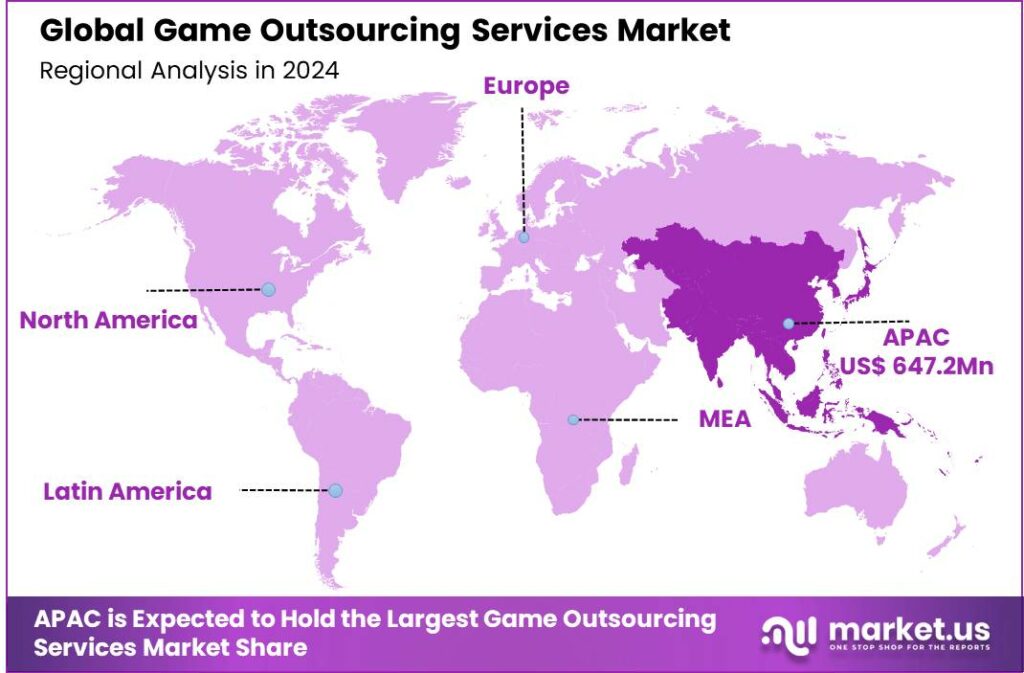
The Global Game Outsourcing Services Market size is expected to be worth around USD 9,043 Million By 2034, from USD 1865.2 Million in 2024, growing at a CAGR of 17.10% during the forecast period from 2025 to 2034. Asia-Pacific dominated the Game Outsourcing Services Market in 2024, accounting for more than 34.7% of the market, with revenues approximately reaching USD 647.2 million.
Game outsourcing services involve delegating specific tasks related to video game development to external firms or freelancers. Outsourcing in the gaming industry helps access specialized skills, manage resources efficiently, and reduce development costs. Tasks include art and design, like character modeling and environment creation, as well as technical areas such as coding, testing, and localization.
Outsourcing allows game developers to focus on core tasks while external teams manage supplementary functions, speeding up production and improving quality. As game developers strive to meet the increasing expectations of players for innovative and engaging content, outsourcing has emerged as a strategic approach to access global talent and accelerate development timelines.
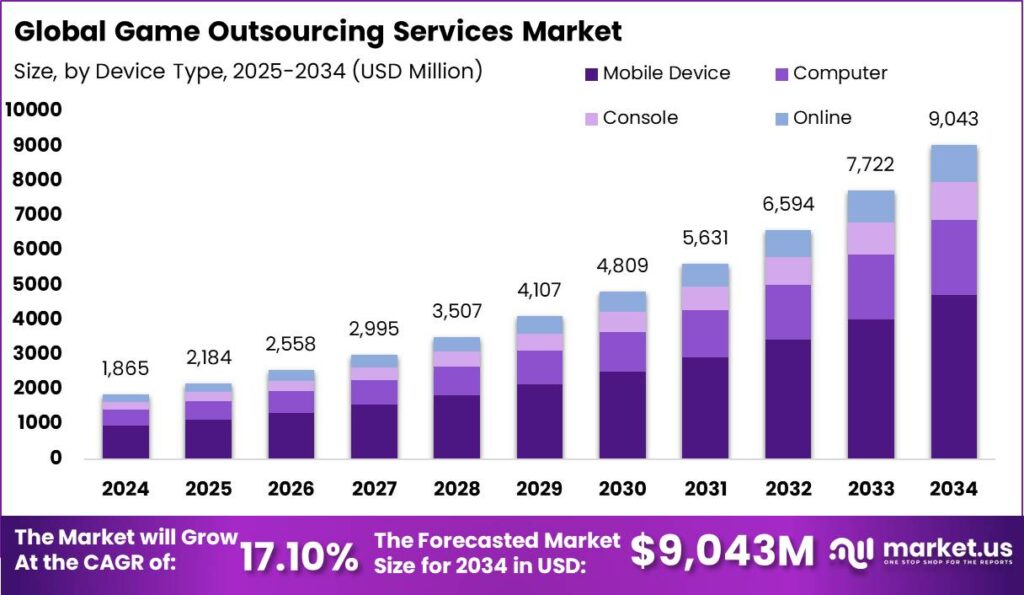
The demand in the game outsourcing services market is robust, spurred by the continuous growth in the gaming sector. Companies are increasingly outsourcing functions like game development, art and design, and testing to optimize operations, focus on core competencies, and ensure the delivery of high-quality gaming experiences.
Various opportunities are presented by the Game outsourcing services market, particularly in emerging technologies like VR and AR. As these technologies evolve, the demand for specialized expertise to create immersive experiences increases. Outsourcing providers with advanced VR and AR skills are well-positioned to attract a growing client base seeking these niche capabilities.
According to passive secrets, The outsourcing industry continues to expand as companies seek specialized expertise to bridge skill gaps and enhance operational efficiency. 74% of businesses now rely on external support for internal audits, while 92% of large enterprises (G2000) outsource IT services to streamline operations.
The U.S. IT outsourcing market is set to reach USD 197.33 billion in 2024, driven by increasing demand for cloud solutions, cybersecurity, and managed IT services. Small businesses are also turning to outsourcing, with 27% seeking marketing providers, 22% outsourcing IT services, and 21% opting for design support.
China remains the global leader in both manufacturing and IT outsourcing, benefiting from a skilled workforce and cost-effective solutions. In Europe, over 50% of companies outsource cybersecurity tasks, with growing investments in OT cybersecurity training (+5%) and vulnerability management (+3%), reflecting a proactive approach to digital security challenges
Key Takeaways
- The Global Game Outsourcing Services Market is projected to reach a value of USD 9,043 Million by 2034, up from USD 1,865.2 Million in 2024, growing at a CAGR of 17.10% from 2025 to 2034.
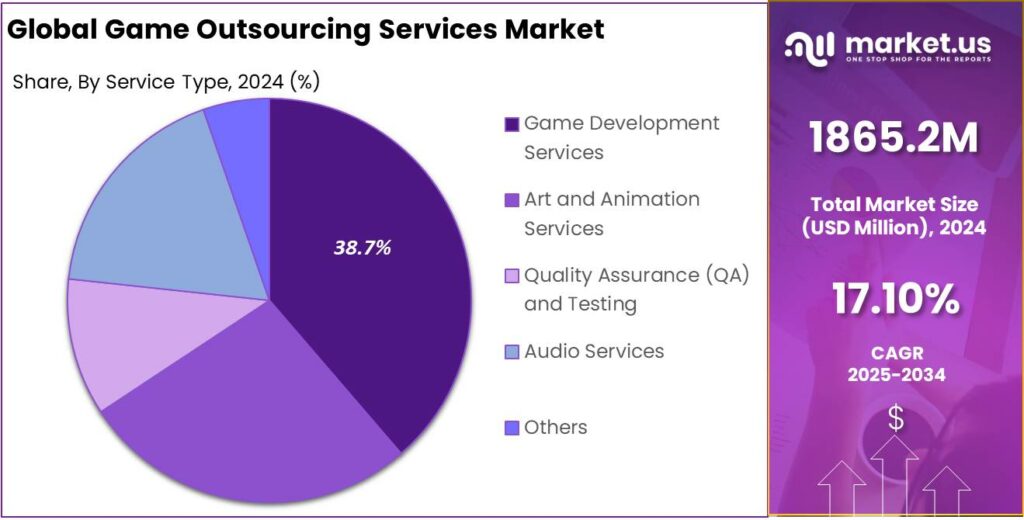
- In 2024, the Game Development Services segment held a dominant position in the market, capturing more than a 38.7% share.
- The Mobile Device segment also led the game outsourcing services industry in 2024, holding more than a 52.1% share.
- Asia-Pacific dominated the Game Outsourcing Services Market in 2024, accounting for more than 34.7% of the market, with revenues approximately reaching USD 647.2 million.
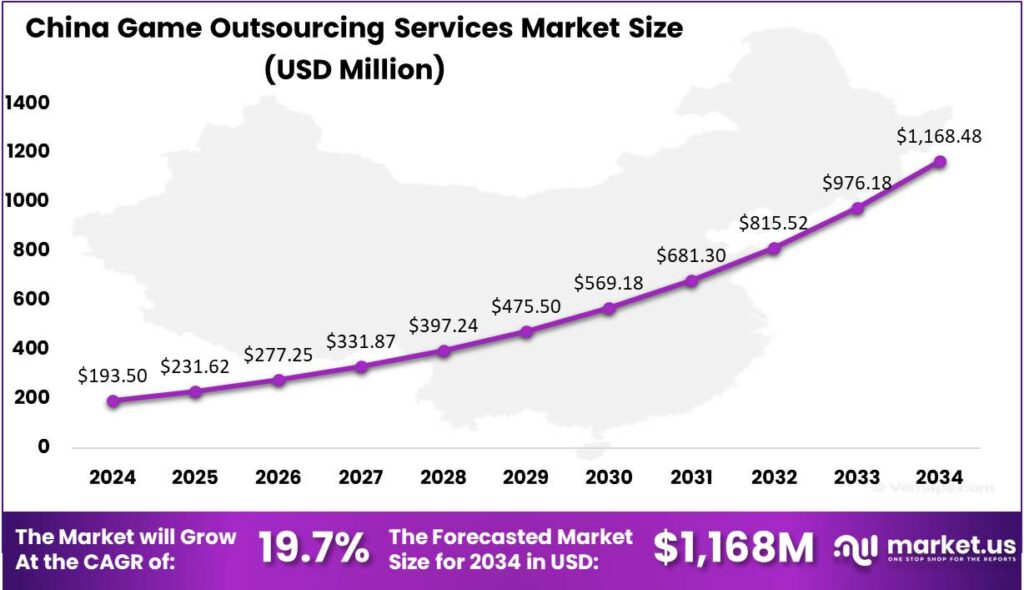
- Specifically, the market for game outsourcing services in China was valued at about USD 193.5 million in 2024 and is experiencing strong growth, with a CAGR of 19.7%.
AI Impact
- Enhanced Creative Processes: AI significantly boosts the creative capabilities within the game development cycle. It aids in generating content such as images, videos, 3D models, and music automatically. This not only speeds up the development process but also provides new inspiration and tools for creators, enhancing productivity and broadening the scope of what can be achieved creatively.
- Strategic and Collaborative Partnerships: The role of outsourcing companies in the game development ecosystem is evolving due to AI. These firms are transitioning from traditional service providers to strategic partners. AI enables these companies to offer more than just manpower; they now provide critical insights and collaborate on projects to leverage AI technologies, enhancing the strategic value they offer to game developers.
- Quality Control and Efficiency: AI tools are instrumental in automating routine and repetitive tasks within game development such as testing and debugging, which traditionally consume a lot of time. This automation not only speeds up the process but also improves accuracy and reduces human error, thus enhancing overall quality control.
- Predictive Analytics and Demand Forecasting: AI’s capability to analyze large volumes of data can be used to predict market trends and gamer preferences, allowing developers and outsourcing firms to better plan their projects and resource allocation. This foresight can lead to more targeted and successful game developments, aligning closely with market demands.
- Talent Development and Management: AI is reshaping the talent landscape in game development outsourcing. While it poses challenges such as potential job displacement, it also creates opportunities for upskilling and engaging in more complex, high-value tasks.
China Market Size
In 2024, the market for game outsourcing services in China was valued at approximately USD 193.5million. This market is experiencing a robust growth trajectory, with a compound annual growth rate (CAGR) of 19.7%.
The significant growth of the Chinese game outsourcing market is driven by increasing demand for diverse gaming content across mobile, PC, and console platforms. China’s cost-effective labor and skilled developers make it an appealing destination for international companies. Additionally, supportive government policies have fostered foreign investment and tech partnerships.
Looking ahead, the market is expected to continue its upward trajectory, driven by ongoing advancements in gaming technology, such as virtual reality (VR) and augmented reality (AR). These technologies require specialized skills and development capabilities, which are plentiful in the Chinese market.
Moreover, the increasing trend of cross-platform gaming experiences and the expansion of cloud gaming services are likely to open new avenues for growth in the outsourcing sector. The strategic positioning of Chinese companies in the gaming ecosystem, coupled with continuous innovation, positions the market for sustained growth in the coming years.
In 2024, Asia-Pacific held a dominant market position in the Game Outsourcing Services Market, capturing more than a 34.7% share with revenues reaching approximately USD 647.2 million. This region’s leadership in the market can be attributed to several strategic and economic factors that distinguish it from other global markets.
The Asia-Pacific region’s lead in the gaming industry is primarily driven by its robust digital infrastructure and a strong presence of skilled developers, particularly in countries like China, South Korea, and India. These nations have not only cultivated a rich ecosystem of gaming companies but also offer a cost-competitive environment that is conducive to outsourcing.
Government policies across the region have greatly boosted the game outsourcing market, with favorable regulations and incentives fostering innovation in digital and entertainment sectors. Tax incentives for tech startups and grants for multimedia projects encourage both domestic and international companies to outsource game development.
The growing dominance of mobile gaming in Asia-Pacific has turned the region into a key hub for mobile game development outsourcing. Advancements in smartphone technology, increasing internet access, and the rollout of 5G are fueling growth, further solidifying Asia-Pacific’s leading position in the global game outsourcing market.
Service Type Analysis
In 2024, the Game Development Services segment held a dominant position in the game outsourcing services market, capturing more than a 38.7% share. This segment encompasses a broad range of critical functions, including programming, level design, and mechanics formulation, which are essential for the foundational structure of video games.
Art and Animation Services also constitute a significant portion of the market. This segment focuses on the visual elements of game development, such as character design, environmental art, and animation. These services are crucial for creating visually appealing and engaging games that can attract and retain gamers’ attention.
The Quality Assurance (QA) and Testing segment ensures games meet high standards before release by identifying bugs, improving gameplay, and optimizing performance across platforms. Outsourcing these services provides developers with specialized expertise, enhancing the efficiency and effectiveness of the testing process.
Audio services in game outsourcing focus on sound effects, background scores, and voice-overs, which are essential for creating an immersive gaming experience. This includes the creation, editing, and integration of audio that complements the visual and interactive elements of a game. As games become more complex and narrative-driven, high-quality audio is in greater demand to enhance storytelling and overall atmosphere.
Device Type Analysis
In 2024, the Mobile Device segment held a dominant market position within the game outsourcing services industry, capturing more than a 52.1% share. This significant market share can be attributed to the widespread adoption of smartphones globally, which has made mobile games accessible to a vast audience.
The convenience and portability of mobile devices allow users to engage with games at any time and place, driving the demand for mobile game development. As a result, gaming companies are increasingly outsourcing mobile game development to tap into specialized skills and cost-effective solutions provided by external partners.
The Computer segment is important in the game outsourcing services market, driven by the high-performance capabilities of PCs for complex games with detailed graphics and extensive storytelling.While it holds a significant market share, it is overshadowed by the mobile segment due to higher global mobile device penetration.
The Console segment significantly contributes to the market, driven by dedicated gamers who prefer platforms like Xbox and PlayStation for immersive experiences. With a loyal customer base, it sustains demand for game development. However, the higher cost of consoles and games compared to mobile devices makes this segment less dominant in the overall market.
The Online segment, which includes games played over the internet without downloading, offers ease of access but is limited by the need for constant connectivity. As mobile apps with offline capabilities gain popularity, the Online segment’s market share remains smaller compared to the more versatile and accessible mobile devices.
Key Market Segments
By Service Type
- Art and Animation Services
- Game Development Services
- Quality Assurance (QA) and Testing
- Audio Services
- Others
By Device Type
- Mobile Device
- Computer
- Console
- Online
Key Regions and Countries
- North America
- US
- Canada
- Europe
- Germany
- France
- The UK
- Spain
- Italy
- Rest of Europe
- Asia Pacific
- China
- Japan
- South Korea
- India
- Australia
- Singapore
- Rest of Asia Pacific
- Latin America
- Brazil
- Mexico
- Rest of Latin America
- Middle East & Africa
- South Africa
- Saudi Arabia
- UAE
- Rest of MEA
Driver
Cost-Effectiveness in Game Development
Outsourcing game development has become a strategic approach for companies aiming to optimize their production budgets. By partnering with external vendors, game developers can access specialized skills and expertise at a lower cost than maintaining in-house teams.
This cost-effectiveness allows companies to allocate resources more efficiently, focusing on core competencies while leveraging external talent for specific tasks. The financial benefits of outsourcing are particularly evident in regions with lower labor costs.
For instance, outsourcing to countries with favorable economic conditions enables companies to reduce expenses without compromising on quality. This approach not only lowers development costs but also accelerates time-to-market, as external teams can work concurrently on different project aspects.Moreover, outsourcing provides flexibility in scaling the workforce based on project requirements.
Restraint
Communication Barriers in Outsourced Projects
While outsourcing offers many benefits, it also poses challenges, especially in communication. Collaborating across time zones and cultures can lead to misunderstandings and delays. In game development, clear communication is crucial for precision and creativity.
Language differences can exacerbate these challenges, leading to misinterpretations of project requirements or feedback. Additionally, varying cultural norms may influence work styles and expectations, potentially causing friction between in-house and outsourced teams.
To mitigate these issues, companies often invest in robust communication strategies, including regular meetings, detailed documentation, and the use of collaboration tools. However, these measures require additional time and resources, which may offset some of the cost benefits of outsourcing.
Opportunity
Access to Specialized Skills and Expertise
Outsourcing game development opens up opportunities to collaborate with specialists who possess unique skills not available in-house. This access to a global talent pool allows companies to incorporate advanced technologies, innovative design elements, and diverse artistic styles into their projects.
For example, a company can partner with AI experts to integrate advanced features, enhancing functionality and player experience without extensive internal training. Similarly, outsourcing art and animation to culturally diverse artists can create more appealing, varied game aesthetics.
Furthermore, outsourcing enables companies to stay abreast of industry trends by engaging with professionals who are at the forefront of technological advancements. This continuous infusion of fresh ideas and cutting-edge skills contributes to the development of innovative and competitive gaming products.
Challenge
Quality Control in Outsourced Game Development
Maintaining consistent quality is a critical challenge in outsourced game development projects. When tasks are delegated to external teams, ensuring that the output aligns with the company’s standards and vision requires diligent oversight.
Differences in quality benchmarks between the hiring company and the outsourcing partner can lead to discrepancies in the final product. Without proper quality control measures, there is a risk of subpar deliverables that may not meet the expectations of end-users.
This misalignment can result in additional costs for rework, project delays, and potential damage to the company’s reputation.To tackle this challenge, companies implement quality assurance protocols like clear expectations, regular reviews, and detailed guidelines. However, these processes can consume time and resources, reducing the cost benefits of outsourcing.
Key Growth Factors
- Increasing Complexity of Game Development: Modern games require advanced graphics, intricate storylines, and sophisticated mechanics, necessitating specialized skills. Outsourcing provides access to these specialized talents, allowing companies to meet the high demands of today’s gamers.
- Faster Time-to-Market: By leveraging external expertise, companies can expedite development processes, reducing the time required to bring a game from concept to market. This speed is crucial in the competitive gaming industry, where timely releases can significantly impact success.
- Access to Specialized Expertise: Outsourcing provides access to a global talent pool with specialized skills in areas like art design and quality assurance. This access ensures high-quality outputs that may not be achievable with in-house teams alone.
- Cost Optimization: Developing games in-house can be expensive, especially with rising labor costs in certain regions. Outsourcing to countries with lower operational costs enables companies to maintain quality while managing budgets effectively.
- Scalability and Flexibility: Outsourcing allows game developers to scale their teams based on project needs without long-term commitments. This flexibility facilitates quick pivots in response to market feedback, ensuring timely delivery of gaming products.
Emerging Trends
One prominent trend is the integration of emerging technologies such as Artificial Intelligence (AI), Virtual Reality (VR), and Augmented Reality (AR) into game development. Outsourcing partners are increasingly leveraging AI to enhance character behaviors and game environments, while VR and AR are being utilized to create immersive gaming experiences.
Another notable development is the rise of remote collaboration facilitated by advanced digital tools. Platforms like Slack, Trello, and Miro, along with cloud-based solutions such as Google Drive, enable seamless communication and project management across global teams. This shift not only broadens the talent pool but also introduces diverse perspectives into the creative process.
Specialization within outsourcing is also gaining momentum. Companies are seeking partners with expertise in specific art styles or technical domains to ensure high-quality outputs that align with their creative visions. This focus on specialized services allows for more tailored and efficient development processes.
Business Benefits
Game outsourcing accelerates production timelines. Specialized outsourcing studios provide ready-to-go teams, reducing hiring and training time. This efficiency enables games to reach the market faster, which is critical in the competitive gaming industry.
By leveraging outsourcing teams across different time zones, companies can ensure round-the-clock operations, especially for tasks like customer support and live game operations. Outsourcing offers flexibility to scale resources up or down based on project requirements. During peak development phases, companies can rapidly scale resources without long-term commitments.
Outsourced teams managing live operations and community engagement can improve player retention through timely updates, engaging events, and active community management. External teams bring fresh perspectives and innovative ideas that may not emerge from in-house teams.
According to Latis Global, outsourcing can deliver significant financial advantages. Research shows that businesses can reduce labor costs by as much as 70% to 90% by delegating non-essential tasks to external partners.
Key Player Analysis
Several key players are dominating Game Outsourcing Services Market and each brings unique expertise.
Keywords Studios is one of the largest and most well-known names in the game outsourcing industry. With a global presence, Keywords provides a wide array of services, including localization, testing, and art production. They are recognized for their ability to support major game developers in scaling their operations efficiently.
Testronic Labs has established itself as a top player in the quality assurance and testing space for the gaming industry. Specializing in ensuring that games meet high standards of performance and functionality, Testronic offers services like functional testing, localization testing, and certification.
Virtuos is a game outsourcing company known for providing high-quality art and design services, such as 3D modeling, character design, and environment creation. The company works with major game studios and has been involved in the development of many successful AAA games. Virtuos is unique because of its emphasis on creative artistry, combining technical skills with an artistic vision to produce stunning visuals.
Top Key Players in the Market
- Keywords Studios
- Testronic Labs
- Virtuos
- Lionbridge Technologies, Inc.
- VMC (Video Game Marketing Company)
- Pole To Win International
- Quantic Lab
- Zynga Inc.
- Cognizant Technology Solutions
- GameMill Entertainment
- Ubisoft Entertainment S.A.
- Mobo Studios
- XPEC Entertainment, Inc.
- Crossover, Inc.
- Cedar Lake Ventures
- Other Major Players
Top Opportunities Awaiting for Players
The Game outsourcing services market is poised for significant growth and offers a variety of opportunities for players in the industry.
- Specialization in Art and Design: There is an increasing demand for specialized art styles and unique game aesthetics, which can be a key opportunity for outsourcing studios. Companies like Virtuos and Keywords Studios have been successful because they offer specialized skills ranging from 2D art and animations to complex 3D modeling and technical art, enabling game developers to achieve distinctive visual appeals for their games.
- Cost Efficiency through Outsourcing: Outsourcing game development allows companies, especially smaller studios, to manage budgets more effectively. This includes not only the direct development costs but also expenses related to hiring, training, and maintaining in-house teams. This trend is particularly compelling in the context of rising development costs across the industry.
- Acceleration of Development Cycles: With the competitive pressure to regularly update games and launch new titles, outsourcing is a strategic move to expedite development cycles. By dividing workloads across different teams, companies can speed up production, maintain quality, and stay competitive.
- Integration of Advanced Technologies: As new technologies such as VR, AR, and cloud gaming evolve, there is a growing need for expertise in these areas. Outsourcing parts of game development to specialized firms can help integrate these technologies more efficiently, allowing game companies to stay at the forefront of innovation without substantial internal investments in training and development.
- Expansion into New Platforms and Regions: The global nature of the gaming market means there are opportunities in not just developing games but also in localizing and porting games to different platforms and geographical markets. Services that cater to these needs, including translation, culturalization, and adapting games for different hardware platforms, are increasingly valuable.
Recent Developments
- In November 2024, Keywords Studios acquired Certain Affinity, a US-based outsourcing games developer known for its work on major franchises like Call of Duty and Halo. This acquisition further strengthens Keywords’ position in the market.
- In March 2024, Virtuos acquired Beyond-FX, a visual effects studio based in Los Angeles. In August 2024, Virtuos further expanded by acquiring British indie developer Third Kind Games.
- In September 2024, Playtika announced plans to acquire SuperPlay, the creator of the popular game Dice Dreams, in a deal valued up to $1.95 billion.









