


Report Overview
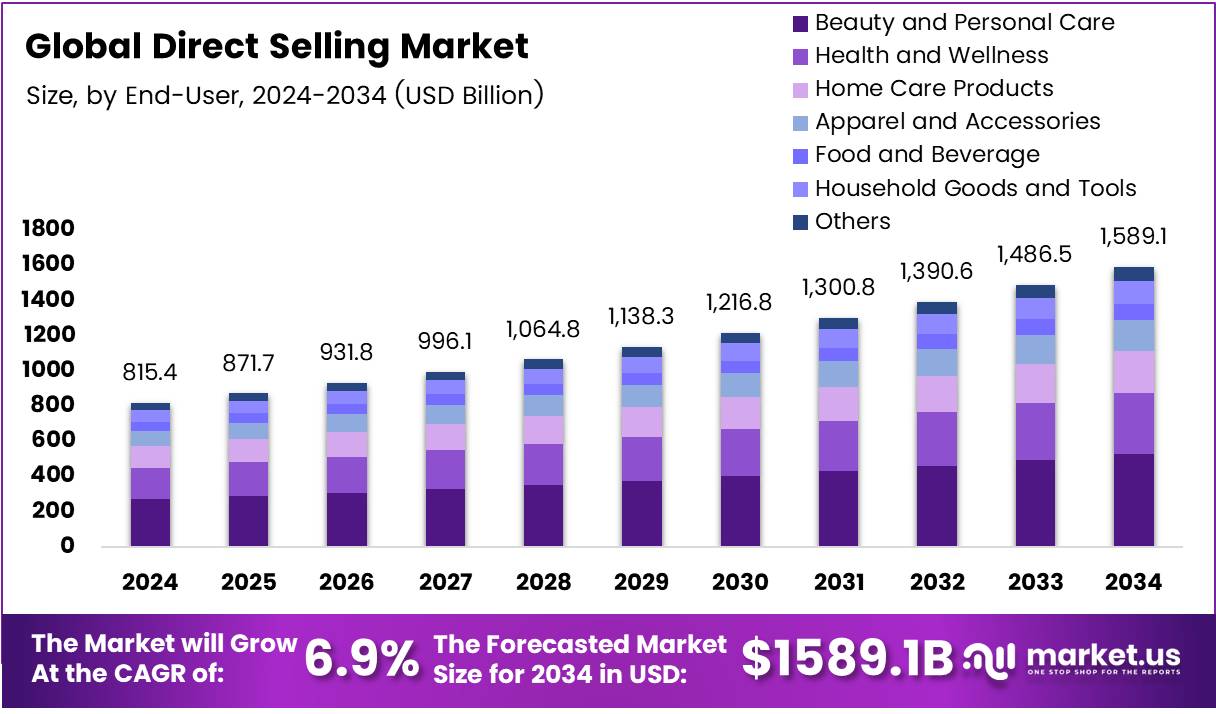
The Global Direct Selling Market size is expected to be worth around USD 1589.1 Billion by 2034, from USD 815.4 Billion in 2024, growing at a CAGR of 6.9% during the forecast period from 2025 to 2034.
Direct selling represents a dynamic and evolving retail model where products are marketed directly to consumers, bypassing traditional retail environments. This model leverages personal interactions and relationships to sell products, ranging from cosmetics and wellness items to household goods. According to Ventaforce, the direct selling industry boasts a significant global workforce, with over 118 million individuals engaged in this form of commerce.
The flexibility and entrepreneurial opportunity offered by direct selling appeal to a broad demographic, notably, as reported by the World Federation of Direct Selling Associations (WFDSA), approximately 70% of direct sellers worldwide are women, highlighting its role in empowering a predominantly female workforce.
The direct selling market has shown robust growth, particularly evidenced in the surge of direct e-commerce sales. According to Globaleyez, in the United States alone, direct e-commerce sales escalated from $128 billion in 2021 to approximately $182 billion by 2023. This substantial growth is not isolated but is part of a global trend fueled by increasing internet penetration and the widespread adoption of social media platforms, which enhance direct sellers’ ability to reach and engage with potential customers.
The sector’s expansion is further facilitated by government investments and favorable regulations that support small businesses and entrepreneurs, providing a conducive environment for the direct selling market to flourish. These factors collectively present significant opportunities for innovation and expansion in this market.
Government policies and investments play a pivotal role in shaping the direct selling landscape. Regulatory frameworks designed to protect consumers and ensure fair business practices are crucial for maintaining the integrity and credibility of the direct selling model. These regulations not only safeguard consumer interests but also bolster confidence in the direct selling system, thereby attracting more entrepreneurs to this industry.
Moreover, government initiatives that support small business financing, tax incentives, and entrepreneurial training directly benefit direct sellers, enhancing their business capabilities and market reach. Such supportive measures are essential for the sustained growth and development of the direct selling market, ensuring it remains a viable and attractive option for millions worldwide.
Key Takeaways
- The Global Direct Selling Market is projected to reach USD 1589.1 Billion by 2034, with a CAGR of 6.9% from 2025 to 2034.
- In 2024, the Health and Wellness segment led the Direct Selling Market’s End-User category with a dominant 36.2% share, driven by rising consumer focus on proactive wellness.
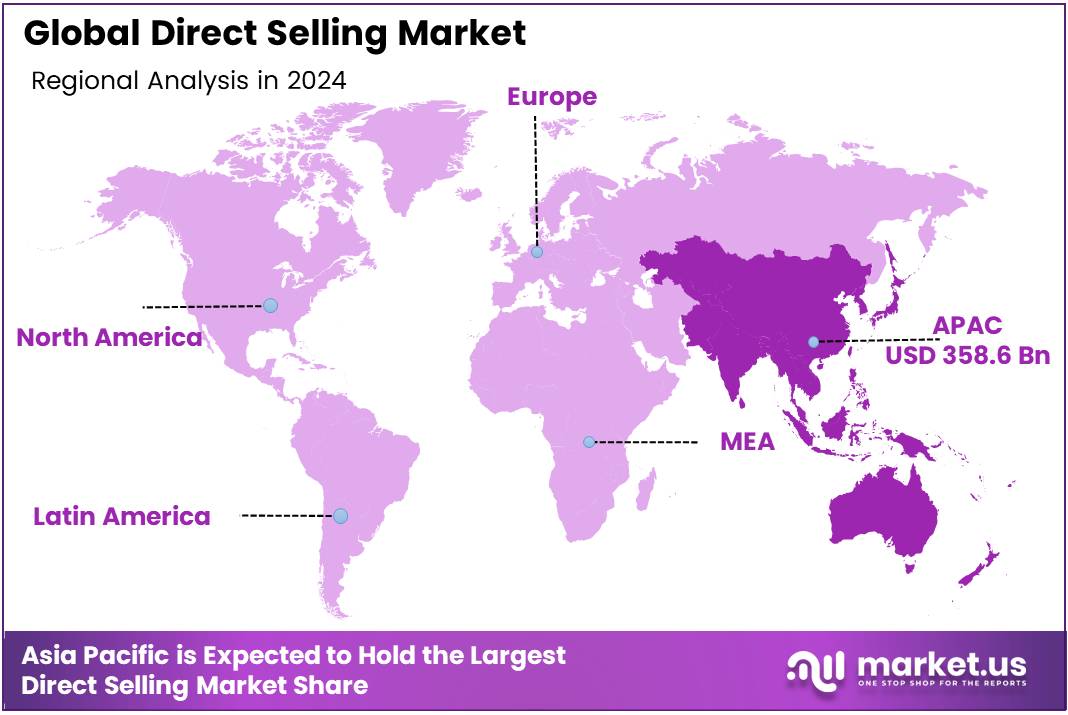
- Asia Pacific was the leading region in the direct selling market in 2024, with a 44.2% share and USD 358.6 billion in revenue, supported by a growing middle class and enhanced internet access.
Direct Selling Statistics
- In 2022, approximately 115 million individuals worldwide participated in the $172.9 billion direct selling industry, which included products ranging from fitness items to beauty and home care goods, according to Amway.
- India’s direct selling industry grew by over 12% year-on-year in 2022-23, reaching a turnover of Rs 21,282 crore, as reported by the Indian Direct Selling Association (IDSA).
- Direct sales in North America saw a decline of 9.3% in 2023, according to the World Federation of Direct Selling Associations (WFDSA).
- The number of direct sellers in India is expected to rise to 18 million by 2025, as projected by the WFDSA.
- Home care products in India experienced consistent growth, increasing by 27% over an eight-year period (2015-2023) and 80% over the past 20 years, as per analysis by Qnet India.
Use Cases
- Consumer Electronics Sales: Direct selling allows brands to reach tech enthusiasts directly, providing personalized product demonstrations and consultations for gadgets and smart devices.
- Health and Wellness Products: Direct selling enables wellness companies to offer one-on-one consultations, promoting nutritional supplements, skincare, and fitness products directly to consumers.
- Home Care Products: Companies use direct selling to introduce cleaning and household products, allowing demonstrations and providing personalized recommendations for better customer engagement.
- Cosmetics and Personal Care: Direct selling is utilized by beauty brands to create personalized experiences, with sales representatives offering consultations and makeup tutorials tailored to individual customer needs.
- Educational Materials: Educational tools and resources, such as tutoring services or learning aids, are sold directly to consumers, with sales reps customizing offerings based on educational needs.
End-User Analysis
Health and Wellness Captures a 36.2% Share in the Direct Selling Market
In 2024, the Health and Wellness segment held a commanding presence in the By End-User Analysis category within the Direct Selling Market, securing a 36.2% market share. This sector has consistently demonstrated robust growth, fueled by an increasing consumer focus on health and proactive wellness practices.
The Beauty and Personal Care segment followed closely, reflecting a market adaptation towards personal grooming and skincare, necessitated by heightened consumer awareness and the burgeoning influence of social media on beauty standards. Meanwhile, Home Care Products saw a steady increase in demand, attributed to a rising inclination towards maintaining a clean and hygienic living environment.
In the Apparel and Accessories domain, there was a noticeable shift towards sustainable and ethical fashion, which is beginning to reshape consumer preferences and market dynamics. Similarly, the Food and Beverage sector experienced a surge in demand for organic and locally sourced products, aligning with the global trend towards health-conscious dietary habits.
Technology and Electronics continued to innovate, particularly with products that integrate seamlessly into everyday life, enhancing consumer engagement through connectivity and smart features. The segment of Household Goods and Tools also observed a consistent demand, driven by the ongoing trend of home improvement and DIY projects.
Lastly, Baby and Parenting Products maintained a steady market position, supported by parents’ growing concerns for child safety and development-oriented products. The ‘Others’ category, encompassing diverse niche markets, highlighted the versatility and expansive reach of the direct selling industry, revealing potential pockets of opportunity for targeted market strategies.
Key Market Segments
By End-User Industry
- Beauty and Personal Care
- Skincare
- Haircare
- Cosmetics
- Personal Hygiene
- Men’s Grooming
- Others
- Health and Wellness
- Nutritional & Dietary Supplements
- Fitness Equipment
- Others
- Home Care Products
- Cleaning Products
- Laundry Care
- Air Care and Fresheners
- Kitchen Care
- Pest Control Products
- Others
- Apparel and Accessories
- Women’s Fashion
- Men’s Fashion
- Accessories
- Children’s Apparel
- Others
- Food and Beverage
- Beverages
- Organic and Natural Foods
- Frozen Food
- Bakery & Confectionery
- Others
- Household Goods and Tools
- Kitchen Appliances
- Home Improvement Tools
- Decor and Furniture
- Others
- Technology and Electronics
- Smart Home Devices
- Mobile Accessories
- Wearables
- Others
- Baby and Parenting Products
- Baby Care
- Toys and Educational Products
- Others
- Others
Drivers
Rising Demand for Convenience Boosts Direct Selling Market
The direct selling market is experiencing robust growth, primarily fueled by increasing consumer demand for convenience and personalized shopping experiences. This market model, where individuals can purchase products from home or through personal interactions with sales representatives, caters effectively to the modern consumer’s preference for tailored services.
Additionally, the integration of direct selling with e-commerce platforms has significantly expanded its reach, enabling companies to engage with a global audience and distribute their products more widely online.
This synergy has not only broadened market access but also enhanced consumer engagement through digital channels. Furthermore, the rising entrepreneurial spirit among individuals is a notable driver, as direct selling offers a low-cost, flexible pathway to entrepreneurship, presenting opportunities for income generation and personal business growth.
The market is also characterized by a diverse range of products, often including niche or specialized items not typically found in traditional retail settings, which appeals to consumers seeking uniqueness and customization in their purchases. These factors collectively contribute to the dynamic expansion of the direct selling industry.
Restraints
Negative Perceptions Challenge the Integrity of the Direct Selling Market
The direct selling market is currently facing significant challenges that may impede its growth and market expansion. Notably, direct selling, particularly those employing multi-level marketing (MLM) strategies, is frequently perceived negatively. This perception stems from associations with pyramid schemes and unethical practices, which foster consumer mistrust and tarnish the industry’s reputation.
Moreover, the market contends with high levels of competition from both traditional brick-and-mortar retailers and burgeoning online platforms. This intense competitive landscape not only threatens to constrain the growth of existing direct selling companies but also poses barriers to new entrants seeking to establish themselves in the industry. Consequently, these factors collectively create a formidable restraint on the expansion and overall success of the direct selling market.
Growth Factors
Expanding into Emerging Markets Fuels Growth in Direct Selling
The direct selling market presents robust growth opportunities, particularly through expansion into emerging markets where there is a heightened consumer interest in personalized shopping experiences and tailored products. These regions often exhibit increasing disposable incomes and a growing middle class, making them fertile ground for direct selling models that capitalize on direct customer relationships and personalized service.
Additionally, the health and wellness sector within direct selling is witnessing a surge, driven by a global shift towards nutritional supplements, fitness products, and organic goods. This trend is bolstered by a rising consciousness about health and lifestyle choices among consumers worldwide.
Moreover, there is a burgeoning demand for eco-friendly and sustainable products, aligning with global sustainability goals and consumer preferences for environmentally responsible purchasing options.
Technological advancements also play a pivotal role, as the integration of artificial intelligence, virtual selling platforms, and sophisticated customer relationship management (CRM) tools can significantly enhance operational efficiency and customer engagement. These technologies facilitate a more seamless and interactive buying experience, further propelling the market’s expansion and the reach of direct selling enterprises into new and untapped markets.
Emerging Trends
Social Commerce Boosts Direct Selling Market
The direct selling market is witnessing significant transformation driven by several trending factors. Firstly, social commerce is playing a pivotal role, as social media platforms become vital arenas for marketing and selling products, enhancing customer reach and engagement. Additionally, there is a growing emphasis on personalized selling strategies.
Sales representatives are increasingly focusing on one-on-one interactions, which foster a deeper connection and trust with consumers, tailoring experiences to individual needs. Another key trend is the heightened adoption of digital platforms for training sales representatives. These platforms provide essential training and development, improving their skills and product knowledge, which is crucial for optimizing sales performance.
Moreover, many direct selling companies are shifting towards subscription-based models, particularly in sectors like beauty and health supplements. This model ensures a consistent revenue stream and bolsters consumer loyalty by providing regular, convenient delivery of products. These factors collectively contribute to the evolving landscape of the direct selling market, indicating a robust trajectory for growth and innovation.
Regional Analysis
Asia Pacific Leads Global Direct Selling with 44.2% Market Share, Driven by Economic Expansion and Digital Engagement
Asia Pacific stands as the dominant region in the direct selling landscape, accounting for 44.2% of the global market and generating revenues of USD 358.6 billion. This region’s market is propelled by a burgeoning middle class and increasing internet penetration, which are pivotal in reaching a wider audience. Countries like China and India are pivotal markets, with local companies and international players contributing significantly to the sector’s expansion.
Regional Mentions:
The direct selling market exhibits distinct characteristics and growth trajectories across various global regions. In North America, the market is mature, with a focus on health and wellness products. Technological advancements and a high rate of digital adoption facilitate a hybrid model of face-to-face and online direct selling, enhancing consumer reach and operational efficiency.
Europe presents a diverse marketplace with stringent regulations overseeing direct selling activities. Consumer preferences for eco-friendly and ethically sourced products drive the region’s direct selling dynamics, particularly in Western Europe. The market benefits from a well-established direct selling framework, fostering growth in both central and eastern European nations.
The Middle East & Africa region is witnessing gradual growth in direct selling, driven by economic diversification efforts and an increasing entrepreneurial workforce. The market in these regions is relatively nascent but shows potential for significant growth through direct selling models adapted to local consumer preferences and commerce practices.
Latin America has seen a robust direct selling environment, characterized by deep cultural acceptance of direct selling as a viable business model and employment opportunity. Economic fluctuations in the region often lead to increased direct selling activities as a supplementary income source. This region’s market is notably responsive to personal care and beauty products, which remain the top categories in direct sales.
Each region’s unique economic, cultural, and technological landscapes shape its direct selling market, making a tailored approach essential for companies aiming to capitalize on regional opportunities. The Asia Pacific region, in particular, continues to lead the global market, driven by strong economic growth, digital transformation, and an expanding consumer base eager to engage with direct selling channels.
Key Regions and Countries
- North America
- US
- Canada
- Europe
- Germany
- France
- The UK
- Spain
- Italy
- Rest of Europe
- Asia Pacific
- China
- Japan
- South Korea
- India
- Australia
- Rest of APAC
- Latin America
- Brazil
- Mexico
- Rest of Latin America
- Middle East & Africa
- South Africa
- Saudi Arabia
- UAE
- Rest of MEA
Key Direct selling companies
In the global direct selling market, anticipated trends for 2024 suggest a continued evolution shaped by digital transformation and shifting consumer behaviors. The key companies identified, including Cutco Corporation, Natura & Co., Mary Kay Inc., Oriflame Holding AG, Herbalife Nutrition Ltd., Belcorp Corporation, Vorwerk, Nu Skin Enterprises, Tupperware Brands Corporation, and Amway Enterprises Pvt. Ltd., represent a diverse cross-section of strategies and market responses.
Cutco Corporation, traditionally strong in cutlery, may leverage its reputation for quality to enhance customer engagement through improved digital experiences. Natura & Co., known for its commitment to sustainability, is likely to continue capturing market share by appealing to environmentally conscious consumers. Mary Kay Inc., with its robust beauty consultant network, might focus on digital tools to empower its salesforce and enhance direct customer interactions.
Oriflame Holding AG and Herbalife Nutrition Ltd., both with significant international presence, are expected to strengthen their global footprints by tailoring offerings to local markets and intensifying digital marketing efforts. Similarly, Belcorp Corporation could enhance its competitive positioning through innovative beauty and personal care products tailored to regional tastes.
Vorwerk might focus on expanding its high-quality appliance offerings by integrating smart technology to align with the smart home trend. Nu Skin Enterprises is likely to capitalize on its anti-aging products, positioning itself at the forefront of personalized health and wellness solutions.
Tupperware Brands Corporation, facing challenges in market dynamics, may need to revamp its product lines and sales strategies to regain market strength. Lastly, Amway Enterprises Pvt. Ltd. is expected to continue dominating by leveraging its extensive product range and global network, focusing on new market segments and enhanced digital experiences to meet changing consumer preferences.
These companies’ ability to adapt to an increasingly digital and personalized market environment will be critical in sustaining their growth and competitive advantage in 2024.
Top Key Players in the Market
- Cutco Corporation
- Natura & Co.
- Mary Kay Inc.
- Oriflame Holding AG
- Herbalife Nutrition Ltd.
- Belcorp Corporation
- Vorwerk
- Nu Skin Enterprises
- Tupperware Brands Corporation
- Amway Enterprises Pvt. Ltd.
Recent Developments
- In January 2025, KARL STORZ expanded its direct sales network through the strategic acquisition of a Swiss company, enhancing its market reach and operational capabilities in Europe.
- In July 2024, Fluid further integrated technology into its sales strategy by acquiring NOW Tech, a company specialized in direct selling mobile applications, aiming to boost its digital engagement.
- In January 2024, Direct Selling (DSAQ) announced its merger with Hunch Mobility in a deal valued at $223 million, aiming to leverage synergies and expand its mobility solutions footprint.









