


Report Overview
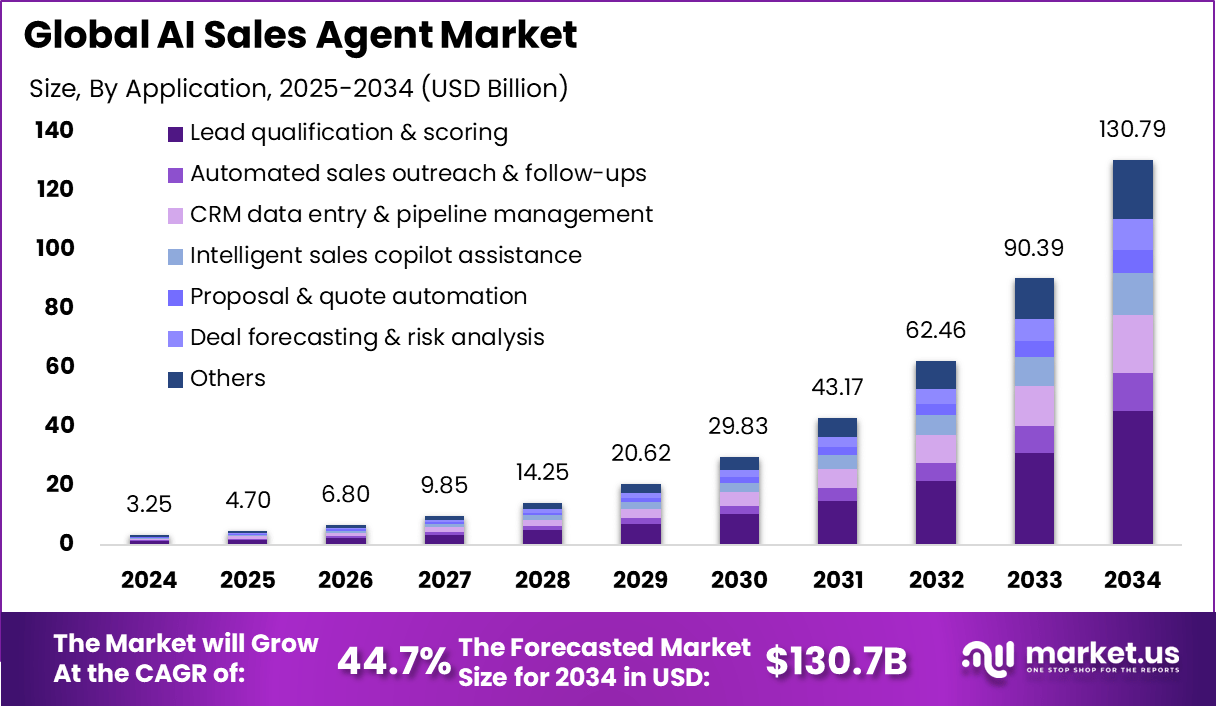
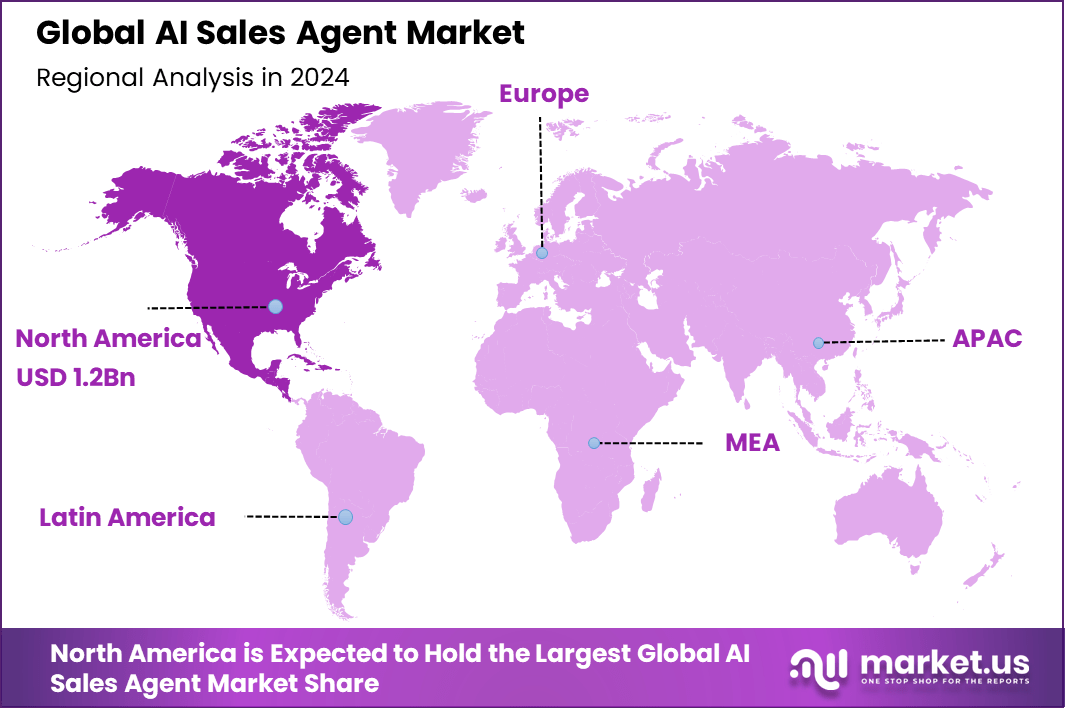
The Global AI Sales Agent Market generated USD 3.25 billion in 2024 and is predicted to register growth from USD 4.70 billion in 2025 to about USD 130.79 billion by 2034, recording a CAGR of 44.7% throughout the forecast span. In 2024, North America held a dominan market position, capturing more than a 39.63% share, holding USD 1.2 Billion revenue.
The AI sales agent market includes software platforms and virtual agents that use artificial intelligence to handle sales conversations, lead qualification, follow-ups, product recommendations, and customer engagement. These systems operate through chat, email, voice, or integrated CRM tools. They can interact with prospects in real time, understand intent, answer product queries, and move users through the sales funnel without human involvement.
Top driving factors for the growth of AI sales agents include advances in natural language processing (NLP), machine learning, and growing demand for personalized customer experiences. For example, by 2025, 85% of enterprises are expected to use AI agents, reflecting the urgent need for automation to meet changing buyer behaviors who expect seamless, tailor-made engagements.
Data from Patagon.ai indicates that sales have risen by 6.2%, while customer satisfaction improved by 7%. Marketing teams are also reporting a 7.2% reduction in overhead costs, showing that AI is streamlining their daily operations. Businesses using these tools are experiencing revenue growth in the range of 3-15%, with sales ROI increasing by 10-20%.
Accenture notes that lead conversion rates have climbed by as much as 30% for some companies after integrating AI into their sales workflows. Adoption trends further reinforce the impact. Research from Duke University shows that 94.1% of marketing teams have implemented AI in the past three years, and 60.4% adopted it just within the last year.
A recent ZoomInfo survey on AI in sales and marketing for 2025 shows how deeply automation is reshaping daily workflows. Sales teams using AI are saving as much as two hours every day on routine administrative work. That time savings is translating into a 47% rise in productivity, as teams are able to shift their focus toward selling, lead follow-ups and relationship building instead of paperwork or data entry.
Top Market Takeaways
- Autonomous AI sales agents hold about 65.7%, showing a strong shift toward fully automated engagement and conversion tools.
- Lead qualification and scoring account for nearly 34.6%, reflecting high demand for faster prospect assessment and improved sales accuracy.
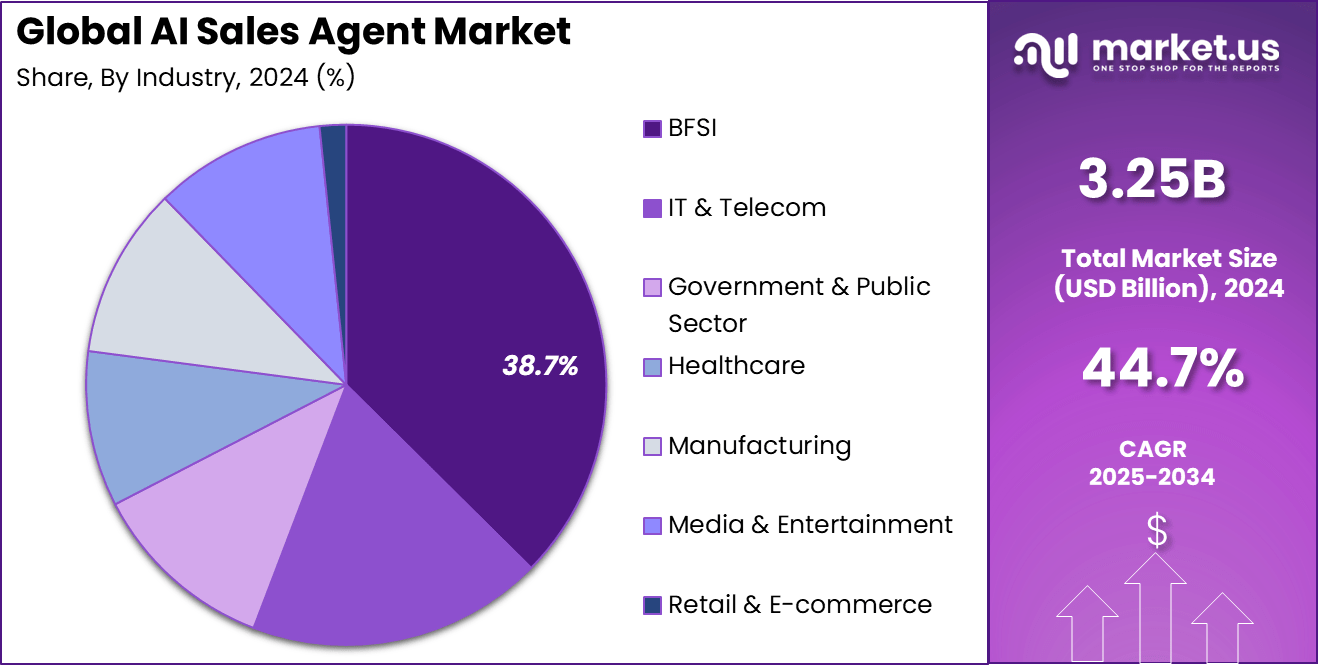
- BFSI contributes around 38.7%, driven by the need for automated client interaction, product recommendations, and compliance-friendly outreach.
- North America captures roughly 39.63%, supported by advanced CRM integration and strong digital sales infrastructure.
- The U.S. leads adoption with expanding use in finance, tech, and enterprise sales operations.
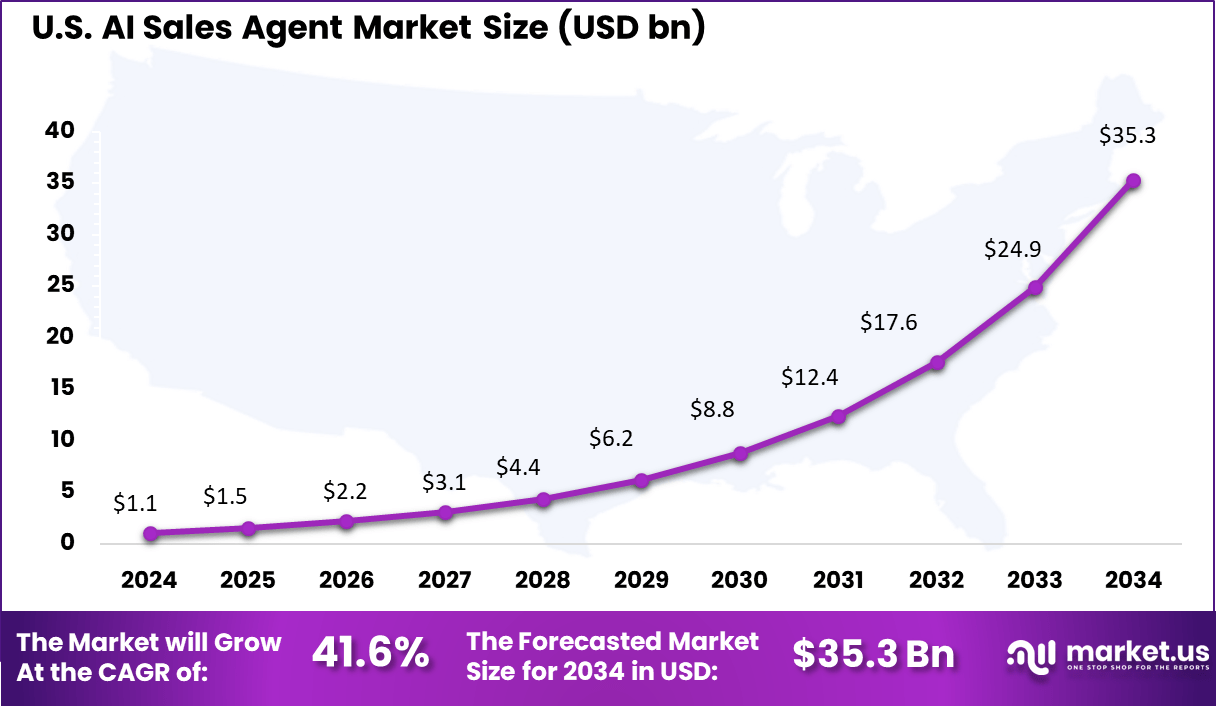
- A 41.6% share within the U.S. signals rapid scaling of AI-driven selling tools for customer engagement and pipeline management.
AI-Powered Sales Impact
Productivity and Efficiency
- Increased productivity: Sales teams using AI agents report significant efficiency gains, with surveys showing up to two hours saved daily on administrative tasks, translating to a 47% increase in productivity.
- Time savings: AI automation allows sales representatives to focus more on selling. A report found that 35% of teams use AI primarily to automate manual tasks.
- Faster cycle time: AI tools shorten sales cycles by up to 30%, enabling teams to allocate more time toward strategic and high-value activities.
Revenue and Sales Performance
- Revenue growth: Companies adopting AI in sales strategies have seen notable increases in revenue, with improvements ranging between 3–15%.
- Lead generation and qualification: AI sales agents boost pipeline performance, with some firms reporting up to a 50% increase in leads and 47% higher conversion rates.
- Dynamic pricing: AI-powered real-time pricing adjustments can generate an average 12% increase in revenue, based on case study evidence.
Customer Experience
- Enhanced satisfaction: Businesses report stronger customer satisfaction (CSAT) scores after deploying AI agents, with increases of 9% or more in some cases.
- Personalization at scale: AI recommendation engines have delivered measurable results, including a 25% increase in average order value for a leading retailer.
- 24/7 availability: Always-on AI support reduces wait times and provides personalized responses around the clock, driving more seamless customer engagement.
Quick Market Facts
Demand analysis reveals that AI sales agents are particularly popular in industries aiming to increase customer engagement and sales funnel efficiency. Around 39% of consumers are comfortable with AI agents scheduling appointments, and companies have seen a 40%+ increase in case resolution rates using AI-driven solutions.
This surge in adoption is also supported by AI’s ability to reduce cart abandonment rates, a problem affecting nearly 70% of online shoppers who leave without purchasing, by offering timely assistance and smart recommendations during the shopping process. Increasing adoption technologies include hyper-automation, conversational AI, and machine learning that empower these agents to make decisions, adapt, and personalize interactions autonomously.
Technological improvements in NLP enable sales agents to accurately understand customer queries, while machine learning sharpens their ability to predict lead behavior and prioritize high-conversion opportunities, with some models showing up to a 60% higher conversion rate for targeted prospects. These features are why companies lean on AI agents to stay competitive and deliver superior customer experiences.
Investment and Business benefits
Investment opportunities are growing as startups and established tech companies innovate within the AI sales agent space. Venture funding in AI startups reached $27.5 billion globally in 2024, with investors eager for exposure to high-growth AI-driven marketing and sales automation technologies.
Investors can choose between high-risk, high-reward startup investments or stable stakes in established tech firms that integrate AI agents into their cloud and software platforms. Business benefits from AI sales agents include increased efficiency, higher sales conversions, improved customer satisfaction, and scalability of sales operations.
Research shows sales reps only spend about 28% of their time actually selling, so automating routine sales tasks with AI leads to measurable improvements in productivity and engagement. Additionally, AI agents provide consistency in customer interactions and help businesses scale personalized outreach without a corresponding increase in human labor.
US Market Size
The United States stands out with a substantial market value around USD 1.09 billion and a growth rate near 41.6%. The US market is the most vibrant within North America, driven by the country’s leadership in AI technology development and adoption. Corporations across sectors deploy AI sales agents extensively to improve lead conversion, customer engagement, and operational efficiency.
Innovation hubs and AI-centric startups fuel continuous enhancements in autonomous agent capabilities that enable smarter, context-aware sales interactions. US companies prioritize solutions that integrate seamlessly with existing sales tools to maximize ROI. The regulatory environment coupled with high consumer digital engagement creates fertile ground for broad AI adoption in sales processes and beyond.
In 2024, North America holds a dominant 39.63% share of the AI sales agent market, reflecting strong early adoption and technological innovation. The region benefits from a mature technology ecosystem, active AI research, and widespread enterprise digital transformation efforts. Businesses in North America are integrating AI sales agents to reduce manual tasks, improve sales efficiency, and enhance customer engagement, particularly in highly competitive sectors like IT and financial services.
This region also invests heavily in developing AI capabilities, with numerous startups and established firms driving innovation. The blend of favorable regulatory frameworks and customer readiness for AI-based interactions further propels market growth. The use of AI agents extends beyond sales into marketing, customer support, and back-office automation, demonstrating a comprehensive approach to AI adoption.
By Type
In 2024, Autonomous AI sales agents dominate the market with a robust share of 65.7%. These agents operate independently, handling routine and repetitive sales tasks such as lead outreach, personalized follow-ups, and scheduling demos without requiring constant human involvement.
The autonomy they offer helps sales teams focus on closing deals with qualified leads by automating initial engagement processes. This improves efficiency by reducing the workload on salespeople and speeding up response times to potential customers.
The adoption of autonomous AI sales agents is fueled by advances in machine learning and natural language processing, which enables these tools to understand customer intent and tailor interactions accordingly.
Organizations report benefits like decreased sales cycle length and increased conversion rates after integrating autonomous agents into their sales processes. The widespread integration with CRM systems makes these tools even more strategic in managing complex pipelines while enhancing customer experience.
By Application
In 2024, Lead qualification and scoring hold a significant 34.6% share within the AI sales agent market. AI-powered lead scoring systems analyze vast datasets that include behavioral insights, past interactions, and engagement levels to identify high-potential prospects.
This automation enhances sales productivity by prioritizing leads likely to convert, allowing sales teams to allocate their efforts more effectively. Real-time updates in lead scores and seamless integration with sales platforms support dynamic adjustment of outreach strategies.
Companies implementing AI-driven lead qualification report measurable improvements, including a reduction in sales cycle duration by up to 30% and increases in conversion rates. This efficiency boost helps increase revenue while optimizing resource allocation. Additionally, personalized engagement based on AI insights has become a key factor in improving overall sales outcomes.
By Industry
In 2024, BFSI industry accounts for a leading 38.7% market share in adopting AI sales agents. Financial institutions leverage these agents to streamline complex sales cycles involving regulatory compliance and risk management.
AI helps in personalizing customer interactions, managing large client portfolios, and optimizing product recommendations, all while ensuring adherence to industry standards. The demand for AI sales agents in BFSI is also driven by the industry’s vast data generation and the need to enhance both customer experience and operational efficiency.
AI-powered solutions support tasks ranging from fraud detection to compliance checks while facilitating more targeted sales approaches. This adoption trend is supported by substantial investments in AI within financial institutions seeking competitive advantage through technology-driven sales innovation.
Emerging Trends
The AI sales agent market is rapidly evolving, with 85% of enterprises expected to use AI agents in 2025, driven by advances in natural language processing and machine learning. These agents are moving beyond simple automation to offering autonomous sales support, helping with lead qualification, data analysis, and personalized customer interactions.
For example, AI sales agents can improve sales forecasting accuracy by up to 30% and reduce sales cycles by 25%, which is helping companies respond faster to customer needs. Another trend is the fast growth in the Asia-Pacific region, where digital transformation efforts in countries like China, India, and Japan are expanding the adoption of AI sales agents with a growth rate around 49.5%.
This reflects how emerging markets are becoming major hubs for AI innovation. Meanwhile, new applications are focusing on improving automation in outreach efforts and real-time data-driven decisions, further embedding AI sales agents deeply into the sales process.
Growth Factors
Several factors are fueling growth in the AI sales agent space. One is the increasing sophistication of AI technologies, especially improvements in machine learning and natural language understanding, which allow AI agents to handle complex customer interactions with minimal human help.
Enterprises are adopting these technologies to improve efficiency and cut costs, with 84% of current users reporting higher sales through better and faster customer interactions. Customer expectations are also a strong growth driver. Buyers want personalized and seamless experiences with sales teams available 24/7.
AI agents offer these benefits by processing large amounts of customer data quickly and providing tailored recommendations. As a result, 85% of enterprises plan to deploy AI agents to meet these evolving demands, boosting customer satisfaction and engagement metrics significantly.
Impact on Sales Performance
- Increased revenue: Companies leveraging AI have reported measurable revenue growth and improved sales ROI, demonstrating direct business impact.
- Higher productivity: AI agents boost sales team efficiency by automating administrative tasks, enabling staff to focus on higher-value activities.
- Better lead generation and conversion: Businesses using AI for lead qualification report stronger pipelines, with more leads generated and higher conversion rates.
- Faster sales cycles: AI-driven insights and automation reduce friction, leading to shorter sales cycles and quicker deal closures.
- Improved forecasting: By analyzing large datasets and real-time market signals, AI agents deliver more accurate sales forecasts, supporting better planning and decision-making.
Key Market Segments
By Type
- Autonomous AI Sales Agents
- Assistive AI Sales Agents
By Application
- Lead qualification & scoring
- Automated sales outreach & follow-ups
- CRM data entry & pipeline management
- Intelligent sales copilot assistance
- Proposal & quote automation
- Deal forecasting & risk analysis
- Post-sales & customer retention
- Others
By Industry
- BFSI
- IT & Telecom
- Government & Public Sector
- Healthcare
- Manufacturing
- Media & Entertainment
- Retail & E-commerce
- Others
Regional Analysis and Coverage
- North America
- US
- Canada
- Europe
- Germany
- France
- The UK
- Spain
- Italy
- Russia
- Netherlands
- Rest of Europe
- Asia Pacific
- China
- Japan
- South Korea
- India
- Australia
- Singapore
- Thailand
- Vietnam
- Rest of Latin America
- Latin America
- Brazil
- Mexico
- Rest of Latin America
- Middle East & Africa
- South Africa
- Saudi Arabia
- UAE
- Rest of MEA
Driver
Rising Adoption of AI in Sales Processes
The main driver for AI sales agents is the increasing acceptance and integration of artificial intelligence into sales functions. Businesses are discovering that AI tools significantly improve efficiency, especially in lead generation, follow-up, and customer engagement. Many companies now prefer AI-driven solutions as they help automate routine tasks, freeing up human agents for more complex activities.
This shift is supported by advancements in natural language processing and machine learning, which make AI tools smarter and more reliable. As a result, organizations see greater productivity and faster sales cycles, which is why AI sales agents are gaining popularity rapidly. The adoption trend is expected to continue as technology becomes more accessible and cost-effective, fueling further growth in this market.
Restraint
Resistance to Change in Traditional Sales Teams
Despite its benefits, many companies still face resistance from their sales teams when adopting AI solutions. Sales staff often worry about job security or feel uncomfortable with automated tools replacing personal interactions. This fear can slow down the deployment of AI in their workflows. Furthermore, integrating AI with existing systems can sometimes be complex and costly, especially for smaller firms.
The hesitation to overhaul familiar processes and the concern over the high initial investment act as significant barriers. Without proper training and change management, widespread adoption may remain sluggish, which could limit the market growth. Overcoming this resistance requires strategic planning and clear communication about the benefits AI brings to the sales team.
Market Opportunity
Growing Market Size and Technological Advancements
The market for AI sales agents is expected to expand profoundly in the coming years. Industry reports project that the global value could reach nearly USD 236 billion by 2034, with a compound annual growth rate of over 43%. This strong growth outlook offers huge opportunities for vendors and businesses alike.
Rapid technological innovations like enhanced conversational AI, multi-modal capabilities, and real-time decision making will enable more personalized and efficient sales interactions. Additionally, the rise of AI-powered virtual assistants and chatbots creates new avenues for customer engagement. Companies investing early in these advanced solutions will gain a competitive edge and unlock new revenue streams.
Challenge
Data Privacy and Security Concerns
One of the biggest challenges facing AI sales agents is the handling of vast amounts of customer data. Privacy regulations like GDPR and CCPA impose strict rules on data collection and usage. Companies worry about how to ensure compliance while still leveraging AI for personalized sales strategies. Data breaches or mishandling customer information can lead to severe reputational and legal consequences.
Moreover, building trustworthy AI systems that operate securely and transparently remains a technical hurdle. Ensuring data privacy, securing sensitive information, and maintaining customer trust are ongoing challenges that could slow adoption if not properly addressed. Companies need to invest in robust security measures and transparent data practices to overcome this obstacle.
Competitive Analysis
The AI Sales Agent Market is driven by enterprise software leaders such as Salesforce, Inc., Automation Anywhere, Inc., and Creatio. These companies integrate conversational AI, CRM automation, and intelligent lead management into their platforms. Their solutions enable businesses to automate outreach, qualify leads, schedule appointments, and analyze customer intent with minimal human intervention, supporting both B2B and B2C sales environments.
Specialized providers such as SalesCloser AI, Netla Inc., and Plivo Inc. focus on AI-enabled virtual agents that handle sales calls, follow-ups, and pipeline engagement. Their tools combine speech recognition, natural language processing, and predictive analytics to improve conversion rates and reduce manual workload for sales teams. These platforms cater to SaaS businesses, financial services, real estate, and e-commerce sectors.
Additional players including OnSearch Pty Ltd, Vonage, Instantly Blog, and a range of other market participants contribute with communication APIs, automated prospecting, and omnichannel engagement tools. Their offerings support AI-driven outreach through email, SMS, calls, and social platforms. Collectively, these companies are accelerating the shift toward autonomous selling and AI-assisted customer acquisition.
Top Key Players in the Market
- Salesforce, Inc.
- Plivo Inc.
- SalesCloser AI
- Netla Inc.
- Automation Anywhere, Inc.
- OnSearch Pty Ltd
- Vonage
- Instantly Blog
- Creatio
- Other Major Players
Recent Developments
- October 2025, Vonage progressed in its agentic transformation with AI sales solutions that provide real-time coaching and multi-channel, natural language interactions, allowing 24/7 scaling at reduced costs. They emphasize enabling sales teams to focus on high-value tasks by automating routine lead engagements with advanced voice and conversation AI.
- September 2025, SalesCloser AI focused on sales automation by offering AI sales agents capable of handling calls, scheduling, lead discovery, and multilingual interactions with CRM integration. Their tools enable personalized discovery and demos, positioning AI as a virtual teammate that frees sales reps from routine tasks.









