


Report Overview
The Global Ground Engaging Tools (GET) Market size is expected to be worth around USD 13.1 Billion by 2034, from USD 8.6 Billion in 2024, growing at a CAGR of 4.3% during the forecast period from 2025 to 2034.
The Ground Engaging Tools (GET) market is a critical segment within the construction, mining, and agricultural equipment industries primarily focused on the manufacturing and supply of wear parts used in heavy machinery. These tools, including buckets, teeth, adapters, and blades, are essential for enhancing the efficiency and durability of equipment operating in harsh environments.
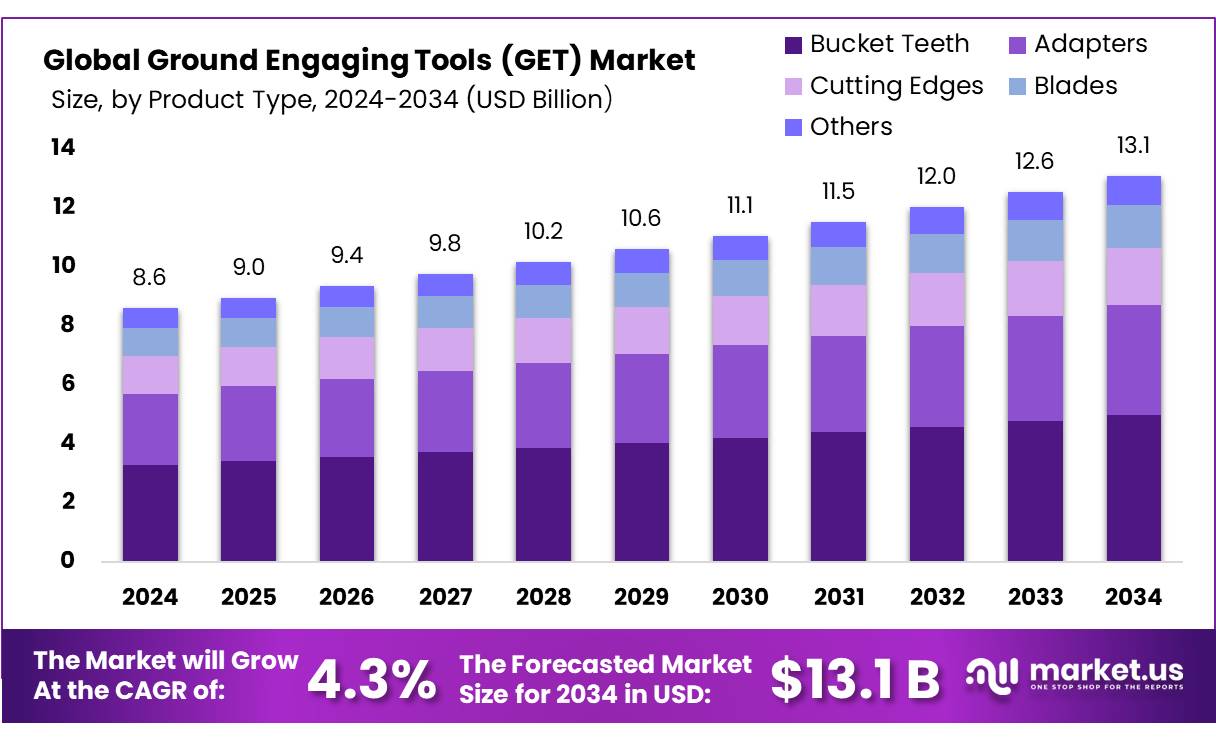
The market has witnessed steady growth, driven by the increasing demand for mining activities, infrastructure development, and agricultural mechanization worldwide. North America follows, contributing around 48.1% of the market revenue, fueled by increased construction activities and rising power consumption in the U.S., where electricity demand is expected to grow by 10% over the next decade.
The mining sector also bolsters the market, with global production costs rising by 5% annually, necessitating durable GET solutions to optimize equipment performance and reduce downtime. However, challenges such as labor shortages and fluctuating raw material costs, which have risen by 8%, pose hurdles to sustained growth.
Technological advancements, with innovations like wear-resistant alloys and IoT-enabled tools, have improved operational efficiency by 15% in recent years. Government investments in infrastructure, totaling USD 2 trillion globally in 2024, further propel demand. Alongside the rising need for eco-friendly tools amid stringent environmental regulations. The GET market is poised for sustained expansion, offering significant potential for innovation and investment.
Key Takeaways
- Global Ground Engaging Tools (GET) Market to reach USD 13.1 billion by 2034, growing at 4.3% CAGR from 2025-2034.
- Bucket Teeth lead with 38.5% share due to high demand in construction, mining, and excavation.
- Steel holds a 46.7% share in GET materials, favored for its strength, durability, and cost-effectiveness.
- Excavation dominates with a 38.5% share, driven by its critical role in construction and mining projects.
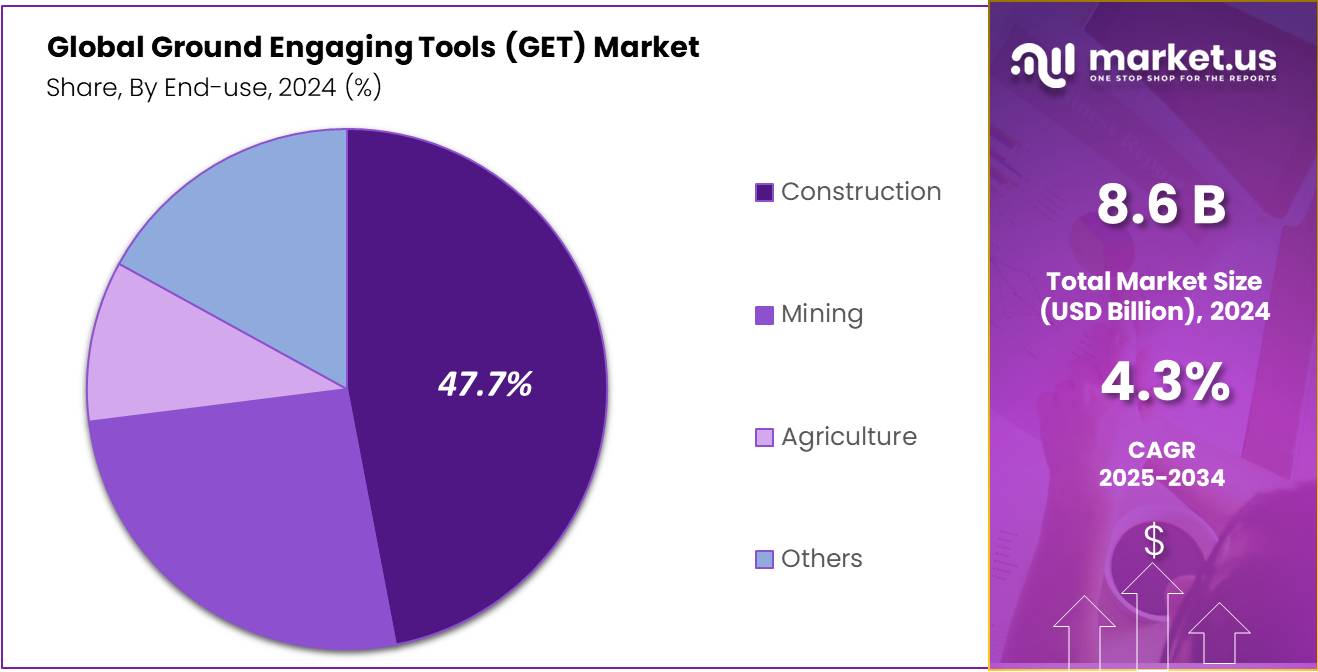
- Construction leads with 47.7% share, utilizing GET extensively in excavation, land clearing, and infrastructure development.
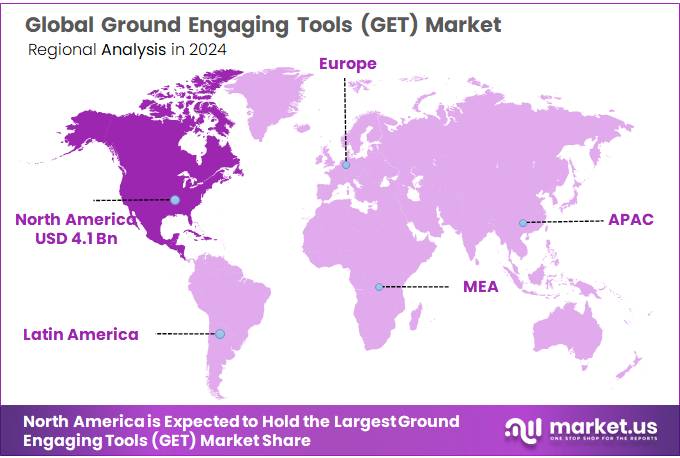
- North America holds a 48.1% market share (USD 4.1 billion), fueled by infrastructure investments and advanced construction practices.
By Product Type
Bucket Teeth held a dominant market position in the ground-engaging tools (GET) industry, capturing more than a 38.5% share. This segment’s strong performance can be attributed to its widespread use in construction, mining, and excavation activities, where durability and efficiency are critical.
Bucket teeth are essential components for heavy machinery like excavators and loaders, as they directly interact with the ground, making them prone to wear and tear. The high replacement rate of these tools further drives demand, ensuring consistent market growth. The bucket teeth segment is expected to maintain its leading position, with steady demand from emerging markets and increased infrastructure development projects worldwide.
The growing adoption of advanced materials, such as high-strength alloys, is also enhancing the lifespan and performance of bucket teeth, making them more cost-effective for end-users. The rise in mining activities and urbanization in developing regions is likely to fuel the demand for these tools, ensuring their continued dominance in the GET market.
By Material
Steel held a dominant market position in the ground-engaging tools (GET) industry, capturing more than a 46.7% share. This segment’s leadership is largely due to steel’s exceptional strength, durability, and cost-effectiveness, making it the preferred material for manufacturing GET.
Steel-based tools, such as bucket teeth, blades, and rippers, are widely used in demanding applications like mining, construction, and excavation, where resistance to wear and tear is critical. The material’s ability to withstand harsh operating conditions and heavy loads has solidified its position as the top choice for both manufacturers and end-users.
The steel segment is expected to maintain its stronghold in the market, driven by ongoing advancements in steel alloys that enhance performance and longevity. The increasing demand for durable and reliable tools in infrastructure development and mining activities will further support this segment’s growth.
By Application
The Excavation segment held a dominant market position in the ground-engaging tools (GET) industry, capturing more than a 38.5% share. This segment’s leadership is driven by the extensive use of GET in excavation activities, which are fundamental to construction, mining, and infrastructure development projects.
Excavation requires robust and reliable tools to handle tough terrains and heavy workloads, making ground-engaging tools like bucket teeth, blades, and rippers indispensable. The growing demand for urban development, road construction, and mining operations has significantly contributed to the segment’s strong performance.
The excavation segment is expected to maintain its leading position, supported by ongoing infrastructure projects and increased investments in construction activities globally. The rise in urbanization, particularly in developing regions, is likely to further boost the demand for excavation tools.
By End-use
The Construction sector held a dominant market position in the ground-engaging tools (GET) industry, capturing more than a 47.7% share. This segment’s leadership is driven by the extensive use of GET in various construction activities, including excavation, land clearing, and infrastructure development.
Ground-engaging tools like bucket teeth, blades, and rippers are essential for heavy machinery such as excavators, bulldozers, and loaders, which are widely employed in construction projects. The surge in urbanization, coupled with increased investments in residential, commercial, and public infrastructure, has significantly boosted the demand for these tools.
Governments and private sectors are increasingly focusing on building roads, bridges, and urban facilities, particularly in developing regions, which will further drive the need for durable and efficient ground-engaging tools. Additionally, advancements in tool design and materials are enhancing the performance and lifespan of GET, making them more cost-effective for construction companies.
Key Market Segments
By Product Type
- Bucket Teeth
- Adapters
- Cutting Edges
- Blades
- Others
By Material
- Steel
- Alloy Steel
- Cast Iron
- Polyurethane
- Ceramic
By Application
- Excavation
- Loading
- Grading
- Trenching
- Mining
- Others
By End-use
- Construction
- Mining
- Agriculture
- Others
Drivers
Rising Infrastructure Projects Drive Demand for Ground-Engaging Tools
One major driving factor for the ground-engaging tools market is the significant increase in global infrastructure projects. Governments around the world are heavily investing in infrastructure to boost economic growth, which directly impacts the demand for ground-engaging tools used in construction activities.
The U.S. government has initiated the “Infrastructure Investment and Jobs Act,” which allocates over USD 1 trillion for infrastructure projects. This substantial investment aims to rejuvenate aging roads, bridges, and other public structures, thereby escalating the need for robust construction tools and machinery, including ground-engaging tools. These tools are essential for earthmoving and construction tasks, making them indispensable in large-scale projects.
Restraints
High Costs and Economic Fluctuations: Major Restraints for Ground Engaging Tools Market
A significant restraint impacting the ground-engaging tools market is the high cost associated with these tools, coupled with economic fluctuations that affect purchasing power and investment decisions in the construction sector. Ground-engaging tools are essential for a variety of construction and earthmoving activities, but their high initial investment and maintenance costs can be prohibitive for small to medium-sized enterprises (SMEs).
Economic instability, such as that caused by the COVID-19 pandemic, can drastically affect the construction industry’s health. For instance, the Building and Construction Authority (BCA) of Singapore reported that the total construction demand in 2020 was projected to decline by up to 40% compared to the previous year due to economic uncertainties and delays in projects.
Opportunity
Technological Advancements Propel Growth in the Ground Engaging Tools Market
One significant growth factor for the ground-engaging tools market is the ongoing technological advancements that enhance the efficiency and effectiveness of construction equipment. Innovations in materials and design are making ground-engaging tools more durable and longer-lasting, which is crucial for demanding construction environments.
The integration of smart technology and automation in ground-engaging tools is a key driver of this sector. For instance, tools equipped with sensors can now provide real-time data on performance and wear, allowing for predictive maintenance. This not only extends the lifespan of the tools but also reduces downtime and maintenance costs, enhancing overall productivity in construction projects.
Trends
Increasing Urbanization: A Catalyst for Ground-Engaging Tools Demand
A major emerging factor boosting the demand for ground-engaging tools is the rapid pace of urbanization worldwide. As more people move to urban areas, the need for new residential and commercial buildings, roads, and public infrastructures grows significantly.
This urban expansion drives the construction industry to scale up operations, directly impacting the demand for efficient and durable ground-engaging tools. According to the United Nations, 68% of the world’s population is projected to live in urban areas by 2050, compared to 55%.
This significant increase in urban populations necessitates extensive construction activities to accommodate growing needs, from housing to transportation infrastructure. Ground-engaging tools, critical for excavation, grading, and other construction tasks, are thus seeing a surge in demand to support these expansive projects.
Regional Analysis
North America continues to lead the global ground-engaging tools market, commanding an impressive 48.1% share, which translates to a market value of approximately USD 4.1 billion. This dominance is primarily driven by robust investments in infrastructure development, a thriving construction sector, and stringent regulations promoting the adoption of advanced, environmentally friendly construction practices.
The region’s focus on modernizing and expanding its infrastructure is evident from the substantial governmental allocations. The United States Infrastructure Investment and Jobs Act earmarks billions of dollars for upgrading roads, bridges, and public utilities, which necessitates extensive use of ground-engaging tools.
The commitment to enhancing infrastructure not only supports the current demand for construction equipment but also sets a sustained growth trajectory for the market in this region. The push towards technological integration in construction practices in North America enhances the efficiency and effectiveness of ground-engaging tools.
Innovations such as GPS tracking, automation, and improved materials for wear resistance are particularly prevalent in the U.S. and Canada, helping extend the lifespan of these tools while optimizing their performance in challenging construction environments.
Key Regions and Countries
- North America
- US
- Canada
- Europe
- Germany
- France
- The UK
- Spain
- Italy
- Rest of Europe
- Asia Pacific
- China
- Japan
- South Korea
- India
- Australia
- Rest of APAC
- Latin America
- Brazil
- Mexico
- Rest of Latin America
- Middle East & Africa
- GCC
- South Africa
- Rest of MEA
Key Players Analysis
- Atlas Copco AB, a Swedish multinational industrial company, specializes in the manufacture of industrial tools and equipment. In the ground-engaging tools market, they offer a variety of products designed for robustness and efficiency, catering primarily to the mining and construction sectors.
- Caterpillar, Inc., based in the United States, is one of the world’s leading manufacturers of construction and mining equipment. As a significant player in the ground-engaging tools sector, Caterpillar provides a comprehensive range of products that are essential for heavy-duty construction tasks.
- Hitachi Construction Machinery, part of the Japanese multinational conglomerate Hitachi Ltd., is a prominent name in the production of construction equipment, including ground-engaging tools. They focus on supplying high-quality, innovative machinery that offers advanced solutions for the construction and mining industries.
- Komatsu Limited, another major Japanese firm, operates worldwide, providing cutting-edge equipment for construction and mining. In the ground-engaging tools market, Komatsu is known for its high-performance machinery that offers substantial operational efficiency. Their commitment to research and development drives continuous improvement in their product offerings, enhancing their competitiveness.
- Sandvik AB, a high-technology engineering group based in Sweden, is renowned for its tooling systems for metal cutting, equipment, and tools for the mining and construction industries. In the ground-engaging tools market, Sandvik stands out for its innovative and energy-efficient products designed to enhance productivity and profitability.
Top Key Players in the Market
- Atlas Copco AB
- Caterpillar, Inc.
- Hitachi Construction Machinery
- Komatsu Limited
- Sandvik AB
- Columbia Steel Casting Co., Inc.
- Doosan Corporation
- USCO S.p.A
- Volvo AB
- MB America, Inc.
- Sandvik
- Komatsu
- Epiroc
- Liebherr
- Caterpillar
- Terex Corporation
- Atlas Copco
- JCB
- Esco Corporation
- Kennametal
- Hitachi Construction Machinery
- Doosan Infracore
- MINUART MINERALURGICA LTDA.
- Volvo Construction Equipment
Recent Developments
- In 2025, Atlas Copco Group announced the acquisition of Neadvance Machine Vision, S.A., a software company specializing in automation solutions based in Portugal. While not directly tied to GET, this acquisition enhances Atlas Copco’s technological capabilities in automation, which could indirectly support advancements in construction and mining equipment, including GET applications.
- In 2024, Caterpillar showcased its advancements in electric and hybrid equipment at various industry events, including the introduction of battery-electric prototypes for construction and mining machinery. These developments are relevant to GET as they involve machines like excavators and loaders that rely on such tools.
- In 2024, Hitachi Construction Machinery announced enhancements to its ZX200-7 medium excavator, including improved durability and efficiency features. While not exclusively about GET, these upgrades involve components like buckets that directly use ground-engaging tools.









