


Report Overview
The Global Electric Motors Market size is expected to be worth around USD 283.3 Billion by 2034, from USD 149.5 Billion in 2024, growing at a CAGR of 6.6% during the forecast period from 2025 to 2034.
The Electric Motors Market has witnessed sustained expansion, underpinned by robust industrialization and rapid technological advancements. Electric motors, essential electromechanical devices converting electrical energy into mechanical energy, are integral across sectors such as automotive, manufacturing, energy, aerospace, and consumer electronics. As global emphasis shifts toward energy efficiency and sustainable practices, electric motors are increasingly adopted due to their reduced carbon emissions, high operational efficiency, and lower energy consumption.
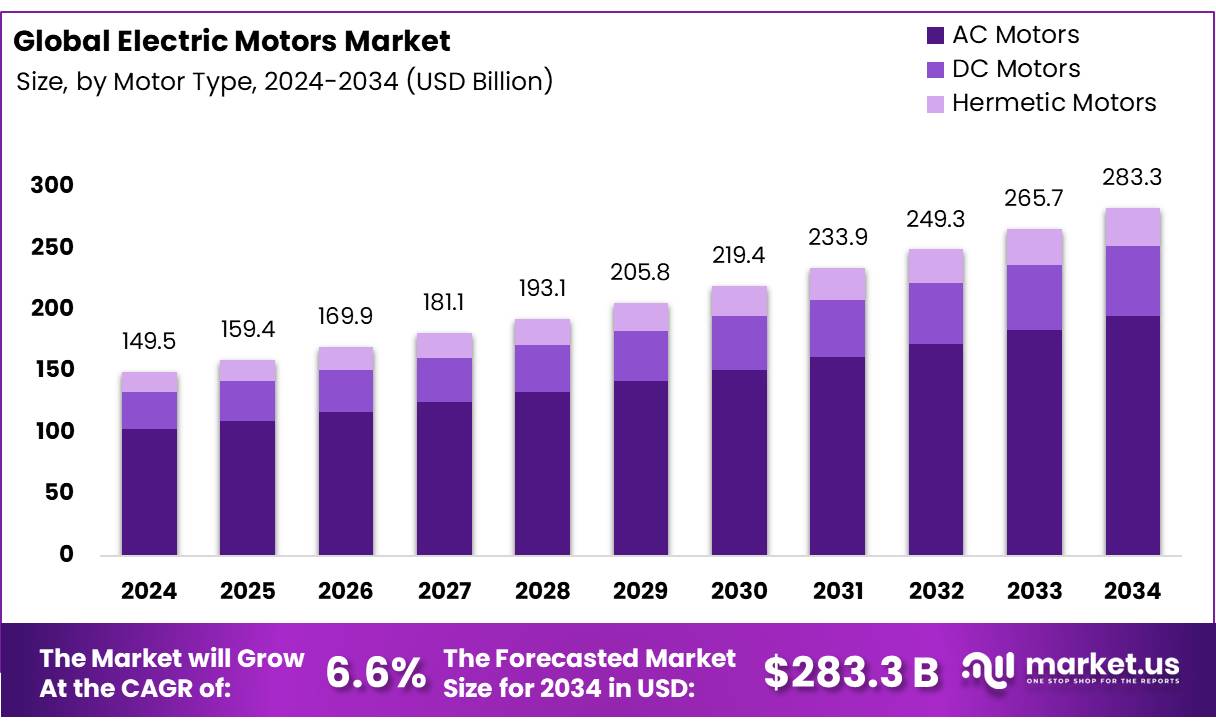
Industrial electric motors consume approximately 40% of global electricity demand, underscoring their vital role in industrial ecosystems. The ongoing transition from conventional internal combustion engines toward electrification, especially within the automotive and transportation sectors, has significantly accelerated demand.
The EV market, projected to reach 25 million units sold annually by 2025, is a major catalyst, alongside a 7% yearly growth in industrial automation. Future growth opportunities lie in smart motor technologies integrating IoT, expected to reduce operational costs by 20%, and renewable energy applications, with wind and solar sectors demanding 10% more motors annually.
The Asia-Pacific region, particularly China and India, dominates the electric motors market, accounting for nearly 49.5% of global consumption due to rapid industrialization, infrastructure development, and expansive automotive industries. Europe and North America follow closely, driven by the increasing adoption of electric vehicles, industrial automation, and favorable policy frameworks. The HVAC segment is expanding, driven by a 15% annual increase in demand for energy-efficient systems in commercial and residential spaces, particularly in emerging economies.
Key Takeaways
- The Global Electric Motors Market is projected to grow from USD 149.5 billion in 2024 to USD 283.3 billion by 2034, with a CAGR of 6.6% during the forecast period 2025 to 2034.
- AC motors lead the market with a 69.3% share, valued for their efficiency, reliability, and versatility across industries like household appliances and industrial machinery.
- Motors with output up to 1 HP hold a 58.2% share, widely used in compact, high-efficiency applications such as household appliances, HVAC systems, and automotive uses.
- Motors operating at up to 1 KV dominate with a 59.3% share, favored for their safety, efficiency, and compatibility with standard electrical systems in commercial and residential settings.
- Industrial machinery accounts for a 39.2% share, relying on electric motors for automation and precision in manufacturing processes like conveyors and assembly lines.
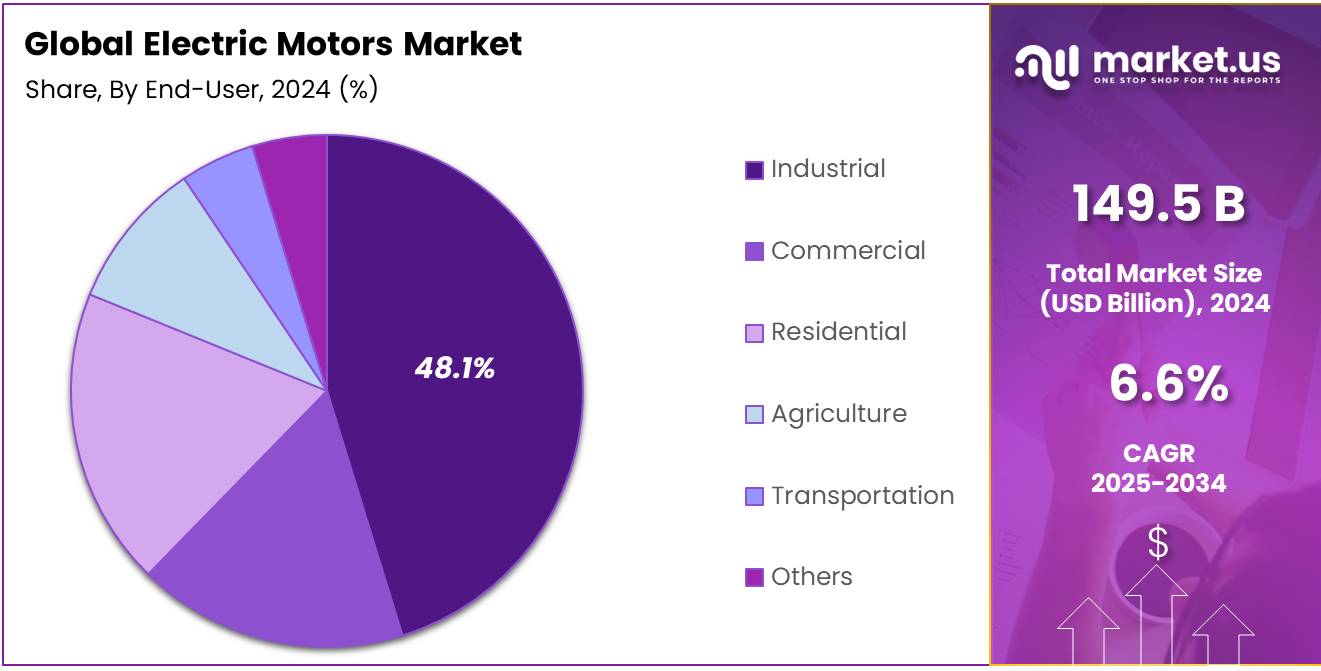
- The industrial sector holds a 48.1% share, driven by demand for robust, high-performance motors in manufacturing, processing, and automation.
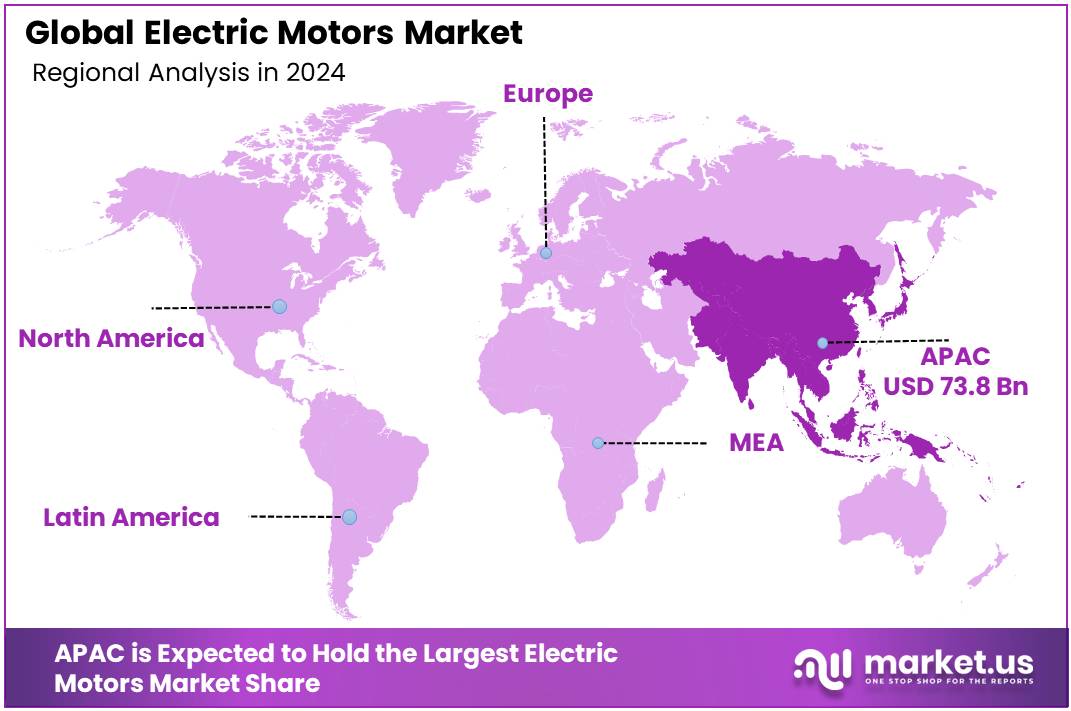
- The APAC region commands 49.5% of the global market, valued at USD 73.8 billion, fueled by rapid industrialization and urbanization in countries like China and India.
By Motor Type
AC Motors held a dominant market position, capturing more than a 69.3% share of the electric motors market. This type of motor is favored across various industries due to its efficiency and reliability. AC motors are widely used in applications ranging from household appliances to industrial machinery, largely because of their versatility and cost-effectiveness.
The strong preference for AC motors stems from their ability to operate at high voltages with considerable endurance, making them ideal for heavy-duty operations. The market’s lean towards AC motors is also driven by advancements in technology that have enhanced their performance and energy consumption ratios.
Innovations such as variable frequency drives have further broadened the applications of AC motors, enabling precise control of motor speed and torque in various settings. Looking ahead to 2025, the AC motors segment is expected to maintain its lead, propelled by ongoing industrial automation and increasing emphasis on energy efficiency in manufacturing processes.
By Power Output
Output Fractional Horsepower (Up to 1HP) motors held a dominant market position, capturing more than a 58.2% share of the electric motors market. These motors are particularly popular in applications where space is limited and high efficiency is essential. Commonly found in household appliances, HVAC systems, and automotive applications, fractional horsepower motors are crucial for tasks that require less power but high reliability.
The significant market share of these motors can be attributed to their cost-effectiveness and compact size, which makes them suitable for a wide range of consumer products and small-scale industrial equipment. As we look towards 2025, the demand for Output Fractional Horsepower motors is expected to remain robust, driven by the growing consumer electronics market and advancements in automation that prioritize space-saving designs and energy efficiency.
By Voltage
Electric Motors operating at Up to 1 KV held a dominant market position, capturing more than a 59.3% share. This segment’s popularity is primarily due to the widespread use of these motors in both commercial and residential settings, where standard voltage levels facilitate easy integration with existing electrical systems. Motors in this voltage range are particularly favored for their safety, efficiency, and compatibility with commonly used electrical infrastructures.
These motors are integral to numerous applications, including home appliances, office machinery, and light industrial equipment. As we move into 2025, the trend is expected to continue, driven by the expanding deployment of automation technologies in homes and industries that require reliable and safe operations at lower voltages. This ensures ongoing demand for Up to 1 KV motors, as they meet the essential requirements of a broad range of applications.
By Application
Industrial Machinery held a dominant market position in the electric motors market, capturing more than a 39.2% share. This sector’s reliance on electric motors is driven by the need for automation and precision in manufacturing processes.
Industrial machinery utilizes a wide range of electric motors to power everything from conveyors and assembly lines to heavy lifting equipment, which is vital for efficient production workflows. The substantial share held by industrial machinery is supported by ongoing industrialization and technological advancements in manufacturing.
These advancements not only improve production capacities but also enhance the reliability and energy efficiency of the machinery used. As we look ahead to 2025, the demand within this segment is expected to grow steadily. This growth will be spurred by continued innovations in motor technology, which promise to deliver even greater efficiencies and performance enhancements for industrial applications.
By End-User
The Industrial sector held a dominant market position in the electric motors market, capturing more than a 48.1% share. This sector encompasses a broad range of applications, from manufacturing and processing to packaging and assembly, all heavily reliant on electric motors for operational efficiency and automation.
The high demand in this segment is primarily driven by the need for robust, high-performance motors that can handle continuous operations under demanding conditions. The industrial sector’s preference for advanced motor technologies is also motivated by the ongoing push for energy efficiency and reduced operational costs.
As industries continue to seek ways to minimize energy consumption while maximizing output, the role of electric motors becomes increasingly critical. Heading into 2025, the industrial sector is expected to maintain its lead in the market, driven by further advancements in motor technology and increasing industrial automation globally.
Key Market Segments
By Motor Type
- AC Motors
- DC Motors
- Hermetic Motors
By Power Output
- Fractional Horsepower (Up to 1HP)
- Integral Horsepower (Above 1HP)
By Voltage
- Up to 1 KV
- 1 kV-6.6 kV
- Above 6.6 kV
By Application
- Industrial Machinery
- Motor Vehicles
- HVAC Equipment
- Electrical Appliances
- Others
By End-User
- Industrial
- Commercial
- Residential
- Agriculture
- Transportation
- Others
Drivers
Enhanced Energy Efficiency Standards
A major driving factor for the growth of the electric motors market is the implementation of enhanced energy efficiency standards by governments worldwide. These regulations compel manufacturers to develop and deploy more efficient electric motor technologies, significantly reducing energy consumption in industrial, commercial, and residential applications.
For instance, according to the U.S. Department of Energy (DOE), electric motors account for about 70% of the total electricity consumed by the industrial sector. In response to this, the DOE has implemented strict efficiency standards for electric motors, which have been periodically updated to push the boundaries of technological improvements and energy savings.
As reported by the European Commission, this directive aims to save approximately 135 TWh of electricity by 2030 equivalent to the total annual household electricity consumption of the Netherlands.
Restraints
High Initial Investment Costs
One significant restraint in the electric motors market is the high initial investment required for advanced and high-efficiency motors. These costs often pose a substantial barrier for small and medium enterprises (SMEs) and industries in developing countries, where budget constraints are tighter and the focus may be on immediate affordability rather than long-term energy savings.
Advanced electric motors, particularly those designed to meet the latest energy efficiency standards, incorporate sophisticated technologies that significantly raise their production costs. Motors that are compliant with the International Electrotechnical Commission’s (IEC) IE3 and IE4 standards, which denote high and super premium efficiency, respectively, are typically 20% to 30% more expensive than less efficient models
Opportunity
Rapid Advancements in Automation Technology
A significant growth factor for the electric motors market is the rapid advancement in automation technology across various industries. As automation becomes more prevalent, the demand for electric motors, which are integral to automated systems, continues to rise.
This trend is particularly notable in sectors like manufacturing, automotive, and consumer electronics, where precision and efficiency are paramount. Automation technology relies heavily on electric motors for a range of applications, from robotic arms in assembly lines to automated guided vehicles in logistics.
For instance, the global industrial robotics market, which is a major consumer of electric motors, is projected to grow significantly. According to the International Federation of Robotics, there was a 12% increase in industrial robot installations worldwide in recent years, highlighting the expanding role of automation in industrial settings.
Trends
The Rise of Electric Vehicle Markets
A major emerging factor driving the electric motors market is the rapid expansion of the electric vehicle (EV) industry. As concerns over climate change and environmental sustainability intensify, there is a significant shift towards electric vehicles as a cleaner alternative to traditional gasoline-powered vehicles.
This shift is bolstered by advancements in battery technologies and government incentives aimed at reducing carbon emissions. The global electric vehicle market has witnessed exponential growth, with sales surging by over 40% in recent years, as reported by the International Energy Agency (IEA).
This surge is directly impacting the demand for high-efficiency electric motors, which are crucial components in all EVs. Electric motors in vehicles not only propel the car but also play critical roles in systems such as steering and braking.
Regional Analysis
The dominance of APAC in the Electric Motors Market
The Electric Motors Market, the Asia-Pacific (APAC) region holds a commanding position, capturing 49.5% of the global market share with a valuation of approximately USD 73.8 billion. This dominance is primarily driven by rapid industrialization and urbanization across major economies such as China, India, and Southeast Asia.
The region’s substantial market share is also fueled by the burgeoning automotive industry, particularly the shift towards electric vehicles, which heavily rely on advanced electric motor technologies. China leads within the region, not only as a major consumer but also as a pivotal manufacturer of electric motors.
The APAC region’s strategic emphasis on enhancing manufacturing capabilities, coupled with government incentives to adopt energy-efficient technologies, continues to attract investments from global and local companies aiming to capitalize on the growing demand. This is evidenced by the increase in production facilities and R&D centers being established across the region.
The competitive manufacturing costs, availability of skilled labor, and expanding middle-class population in APAC countries contribute to the region’s stronghold in the electric motors market. With these factors in play, the Asia-Pacific region is expected to maintain its dominance and may even see an increase in its market share as industries continue to advance technologically and expand their electric motor-dependent applications.
Key Regions and Countries
- North America
- US
- Canada
- Europe
- Germany
- France
- The UK
- Spain
- Italy
- Rest of Europe
- Asia Pacific
- China
- Japan
- South Korea
- India
- Australia
- Rest of APAC
- Latin America
- Brazil
- Mexico
- Rest of Latin America
- Middle East & Africa
- GCC
- South Africa
- Rest of MEA
Key Players Analysis
- ABB is a leading global technology company that specializes in electrification, robotics, automation, and motion. They are known for their energy-efficient motors and generators, offering a comprehensive range of reliable and high-efficiency motors and generators for all applications. ABB’s commitment to innovation is supported by substantial R&D investment, and they continue to be at the forefront of technological advancement in the electric motor sector.
- Allied Motion, Inc. designs, manufactures and sells precision and specialty motion control components and systems. The company primarily serves markets like vehicle, medical, aerospace, defense, and electronics industries. Their products include brush and brushless DC motors, as well as gear motors and motion control products, which are key for applications requiring high precision and reliability.
- AMETEK, Inc. is a global manufacturer of electronic instruments and electromechanical devices. They offer a wide range of motors through their Advanced Motion Solutions division, including brushed and brushless DC motors, as well as differentiated products such as blowers and fans. AMETEK is recognized for its strong emphasis on customized solutions in high-growth markets such as medical devices, aerospace, and automation.
- Arc Systems Inc. specializes in motors and actuators for aerospace, military, and industrial markets. They focus on producing AC and DC motors that are known for their high performance and durability. Arc Systems Inc. prides itself on solving complex engineering challenges, offering both off-the-shelf solutions and custom-engineered products to meet specific customer needs.
- DENSO is a leading supplier of advanced automotive technology, systems, and components for major automakers. They are instrumental in developing and manufacturing small precision motors used in applications like wiper systems, power windows, and power steering. DENSO’s motors are designed to improve the safety, comfort, and environmental standards of vehicles, making them essential for modern automotive applications.
Top Key Players in the Market
- ABB
- Allied Motion, Inc.
- AMETEK.Inc.
- Arc Systems Inc.
- DENSO
- Franklin Electric
- GE
- Hitachi
- Johnson Electric
- Mitsubishi Heavy Industries
- Nidec Motor Corporation
- ORIENTAL MOTOR USA CORP
- Regal Rexnord Corporation
- Rockwell Automation
- Schneider Electric
- Siemens
- TECO-Westinghouse Motor Company
- Toshiba Corporation
- WEG
Recent Developments
- In 2025, ABB introduced the “GMD Copilot,” a digital tool designed to streamline operations, maintenance, and troubleshooting for gearless mill drives, which are critical in industries like mining and metals that rely heavily on electric motor technology. This tool enhances decision-making and process automation, reflecting ABB’s focus on integrating advanced technology with its electric motor solutions.
- In 2024, Allient Inc. to reflect its broader scope as a technology solutions provider, including precision-controlled motion products like electric motors. This shift emphasizes its focus on integrated motion control systems for industries such as medical, aerospace, and industrial markets.









