


Report Overview
The Global Drug Discovery Services Market Size is expected to be worth around US$ 70.3 Billion by 2034, from US$ 27.4 Billion in 2024, growing at a CAGR of 9.9% during the forecast period from 2025 to 2034. North America held a dominant market position, capturing more than a 45.2% share and holds US$ 12.4 Billion market value for the year.
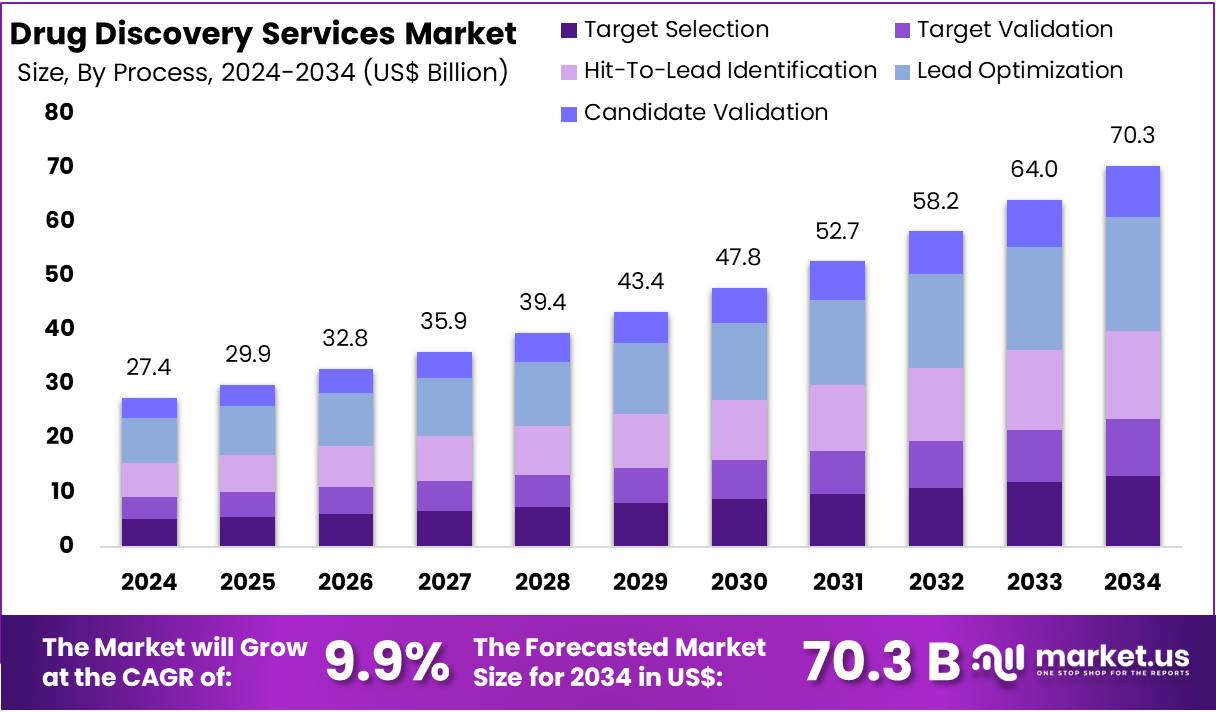
The global drug discovery services market has witnessed significant growth over recent years, driven by increasing demand for new therapeutic solutions and the rising prevalence of chronic diseases, including cancer, diabetes, and neurological disorders.
- In 2020, the International Agency for Research on Cancer (IARC) estimated that there were approximately 19.3 million new cancer cases and 10 million cancer-related deaths worldwide.
- By 2022, approximately 828 million adults worldwide were living with diabetes, representing 14% of the adult population. The highest prevalence rates are observed in regions such as the Pacific Islands, the Caribbean, the Middle East, North Africa, Pakistan, and Malaysia. India, China, and the United States have the largest number of individuals with diabetes.
- In 2021, more than 3 billion people globally were living with a neurological condition, accounting for 43% of the world’s population. The most prevalent neurological disorders include tension headaches (approximately 2 billion cases) and migraines (about 1.1 billion cases).
Drug discovery services encompass a range of activities, from early-stage research to preclinical and clinical trials, aiding pharmaceutical and biotechnology companies in developing novel drugs. These services are provided by specialized contract research organizations (CROs), academic institutions, and in-house teams within pharmaceutical companies.
The market is fueled by the growing need for efficient, cost-effective, and faster drug development processes. With the complexities involved in discovering and developing new drugs, companies often outsource their drug discovery services to benefit from the expertise of CROs and reduce overhead costs. Key services include drug screening, hit identification, lead optimization, in vitro and in vivo testing, bioinformatics, and medicinal chemistry. These services are critical in ensuring that only the most promising drug candidates proceed to clinical trials.
Technological advancements have played a pivotal role in shaping the landscape of the drug discovery services market. High-throughput screening (HTS), artificial intelligence (AI), and machine learning (ML) technologies have revolutionized the drug discovery process, improving the accuracy and efficiency of identifying drug candidates. Furthermore, the integration of bioinformatics and computational chemistry tools has enhanced the drug design process, enabling more precise targeting of specific diseases.
Geographically, North America holds a dominant position in the drug discovery services market, primarily due to the presence of leading pharmaceutical companies, robust healthcare infrastructure, and significant investments in R&D. Europe and Asia-Pacific are also witnessing rapid growth, driven by expanding pharmaceutical industries in countries like China and India, where the availability of skilled labor and cost-effective services attracts global clients.
The global drug discovery services market is also characterized by increasing collaborations between pharmaceutical companies and CROs. Partnerships help expedite the drug discovery process while minimizing costs and improving the success rate of drug development. With the growing complexity of diseases and the need for personalized medicine, the demand for specialized drug discovery services is expected to continue rising.









