


Report Overview
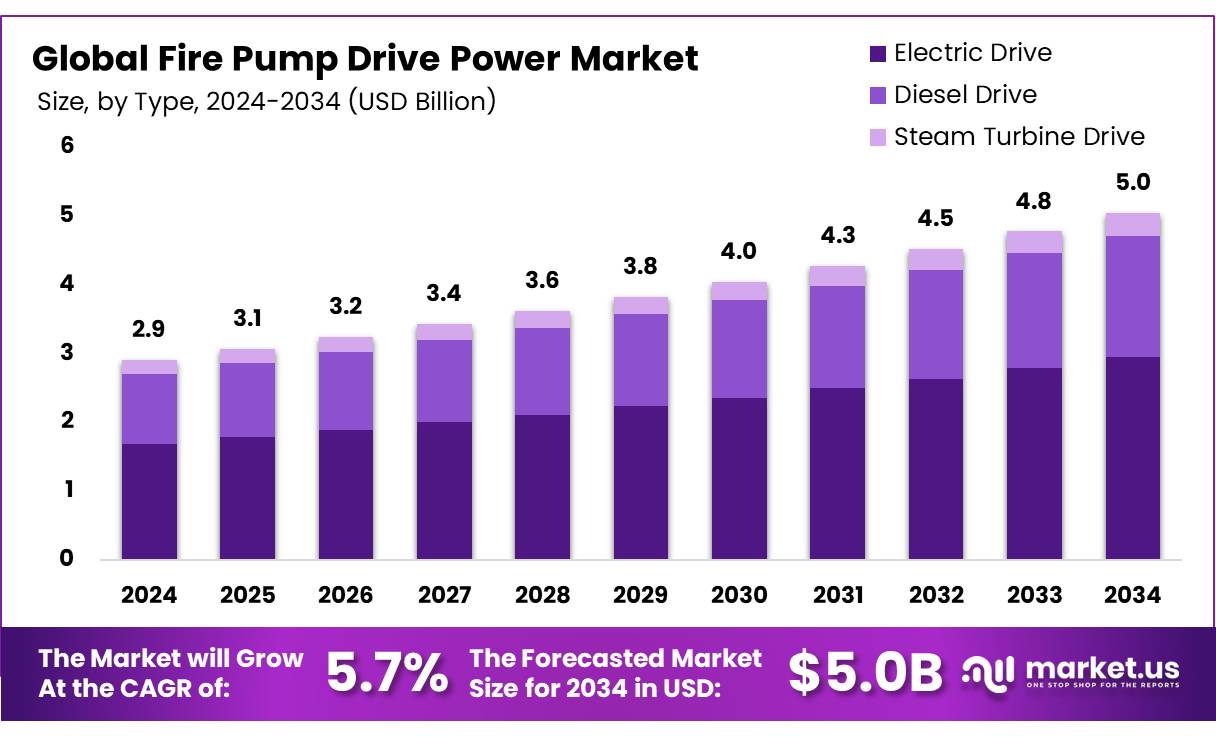
The Global Fire Pump Drive Power Market size is expected to be worth around USD 5.0 Bn by 2034, from USD 2.9 Bn in 2024, growing at a CAGR of 5.70% from 2025 to 2034.
Fire pump drive power is the source of energy that drives the pump, which is essential for providing a high-pressure water supply to fire suppression systems, such as sprinklers, standpipes, and hoses. These pumps are typically powered by either electric motors or diesel engines. Both types of pumps are designed to ensure fire safety by providing continuous water flow for firefighting purposes.
The growing market for fire pump drive power is driven by increasing demand for reliable, efficient, and environmentally friendly fire protection systems in industrial, commercial, and residential buildings. Furthermore, Electric fire pumps are gaining popularity due to their cost-effectiveness, low maintenance requirements, and energy efficiency, while diesel fire pumps remain crucial in areas with unreliable power sources or for critical infrastructure that requires uninterrupted operation during power outages.
The integration of advanced technologies, such as automation, IoT, and renewable energy sources, is also contributing to market growth by enhancing the efficiency and sustainability of fire pump systems. As fire safety standards continue to strengthen and more buildings incorporate advanced fire protection systems, the fire pump drive power market is expected to see continuous expansion, with the demand for both electric and diesel-powered pumps increasing across industries worldwide.
Key Takeaways
- The global fire pump drive power market was valued at USD 2.9 billion in 2024.
- The global fire pump drive power market is projected to grow at a CAGR of 5.70% and is estimated to reach USD 5.0 billion by 2034.
- Among types, electric drive accounted for the largest market share of 58.3%.
- Among products, centrifugal pumps accounted for the majority of the market share at 58.1%.
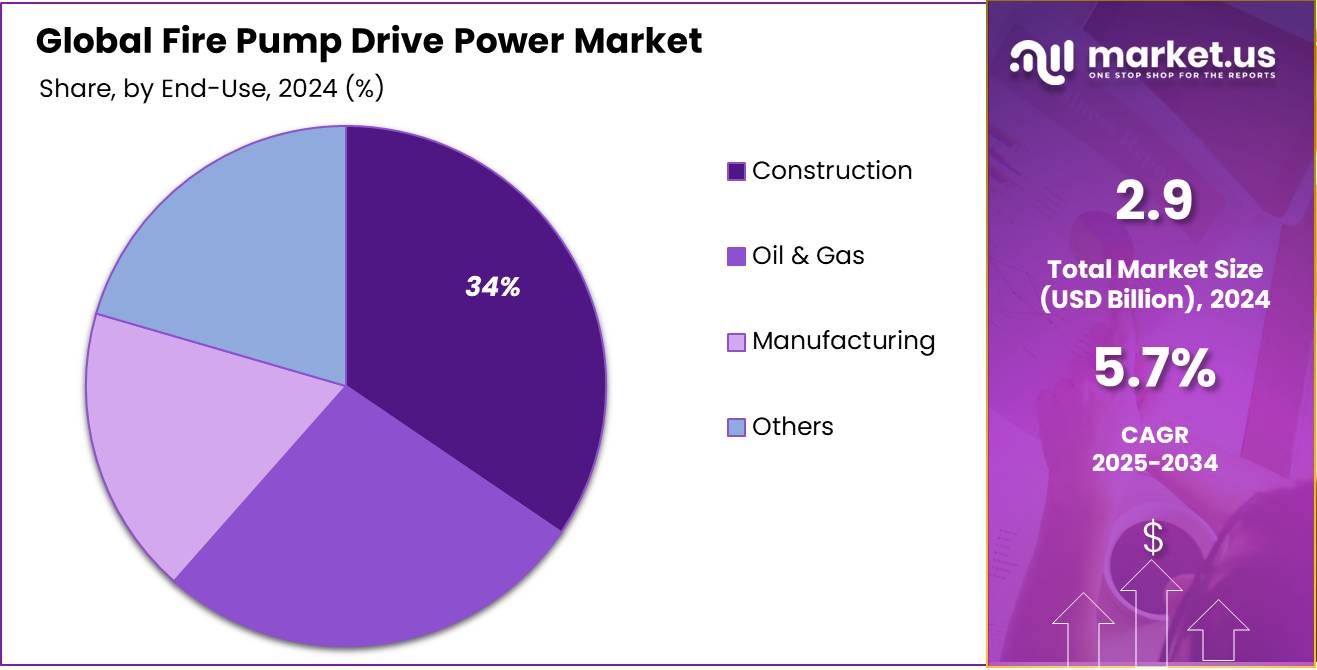
- By End-Use, oil & gas accounted for the largest market share of 34.2%.
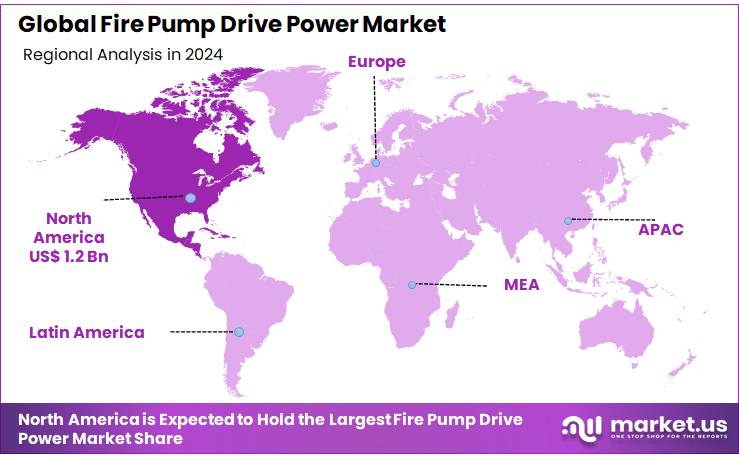
- North America is estimated as the largest market for fire pump drive power with a share of 42.2% of the market share.
Type Analysis
The fire pump drive power market is segmented based on type into electric drive, diesel drive, and steam turbine drive. In 2024, the electric drive segment held a significant revenue share of 58.3%. Due to its cost-effectiveness, lower maintenance requirements, and the growing demand for energy-efficient and environmentally friendly fire protection systems. The increasing emphasis on green energy and the integration of renewable power sources further contribute to the popularity of electric fire pumps, especially in urban areas and commercial buildings.
Additionally, the rise in urbanization and construction activity, especially in commercial and residential sectors, further boosts the demand for electric fire pumps. These pumps are ideal for use in modern infrastructure, where reliable and efficient fire safety systems are required to meet stringent regulations. The growing use of renewable energy sources such as solar and wind also supports the shift toward electric-driven fire pumps, making them a popular and long-term solution in fire protection systems.
Product Analysis
Based on product, the market is further divided into centrifugal pumps and positive displacement pumps. The predominance of the centrifugal pumps, commanding a substantial 58.1% market share in 2024. Due to their ability to generate high pressure and flow with minimal energy consumption, they are ideal for large-scale fire suppression systems. Their design involves a rotating impeller that increases water velocity and offers more efficient water distribution, making them suitable for both residential and industrial applications.
The lower operational costs and longer lifespan further contribute to their dominance, while their widespread use in high-rise buildings, industrial plants, and commercial complexes also support their market share. Additionally, advancements in pump technology, including improved materials and energy-efficient designs, continue to enhance the performance and reliability of centrifugal pumps in firefighting applications.
End-Use Analysis
Based on end-uses, the market is further divided into construction, manufacturing, oil & gas, and others. The oil and gas sector is a major user of fire pump drive powers as such it held a substantial 34.2% market share in 2024, due to its critical need for reliable fire protection systems in hazardous environments. Oil and gas facilities, such as refineries, drilling rigs, and offshore platforms, require robust fire suppression systems to safeguard against the risk of fires caused by flammable materials and volatile processes. These industries often operate in remote locations where access to emergency services is limited, making fire pump systems essential for safety.
The high demand for fire protection in these high-risk environments, combined with stringent safety regulations, drives the substantial market share of the Oil and Gas segment. Additionally, the growing expansion of oil and gas projects in emerging markets further contributes to this sector’s dominance in the fire pump drive power market.
Key Market Segments
By Type
- Electric Drive
- Diesel Drive
- Steam Turbine Drive
By Product
- Centrifugal Pumps
- Positive Displacement Pumps
By End-Use
- Construction
- Oil & Gas
- Manufacturing
- Others
Drivers
Adoption of Fire Prevention And Mitigation Technologies In High-Rise Buildings
The adoption of fire prevention and mitigation technologies in the construction of high-rise buildings is one of the important key drivers for the growth of the global fire pump drive power market. With rapid urbanization, industrialization, and the increasing focus on infrastructure development, especially in high-density urban areas, the need for effective fire safety measures fueling the demands of fire pump drive power systems.
The rise in population in urban centers and the growing awareness of safety standards in building construction have heightened the demand for advanced fire prevention systems. Moreover, the growing regulatory frameworks across the globe to reduce fire-related incidents and ensure safety standards, have accelerated the adoption of fire pumps as integral components in fire safety infrastructure.
Furthermore, fire pumps are crucial for maintaining adequate water pressure for fire suppression systems such as sprinklers and hose standpipes, making them an essential safety feature in high-rise buildings, manufacturing facilities, hospitals, schools, airports, and other commercial structures. As fire incidents in high-rise buildings can lead to severe loss of life, economic damage, and social consequences, governments and building owners are increasingly investing in advanced fire safety technologies, including reliable fire pump systems. The fire pump drive power market is experiencing growth as a result of this heightened focus on fire safety, which has become a fundamental requirement in the construction and retrofitting of high-rise buildings, ensuring greater protection against the dangers posed by fire.
- For instance, reports published by the U.S. Fire Administration in 2023 state that the United States experienced 344,600 fires across residential buildings, resulting in 2,890 deaths, 10,400 injuries, and a loss of $11.27 billion. These frequent fire incidents in the residential sector highlight the critical need for efficient fire protection systems, further boosting the demand for fire pump safety power solutions.
Restraints
High Cost of Fire Pump Drive Power
The high cost of fire pump drive power is a key factor restraining the growth of the global market, particularly in the industrial and construction sectors. Fire pump systems, powered by either diesel or electric motors, often come with substantial initial investment costs. Diesel-driven fire pumps, while reliable during power outages, incur higher fuel costs and require frequent engine maintenance, making them less cost-effective in the long run.
On the other hand, electric fire pumps, although having lower operational costs, can face significant expenses if backup power systems are needed, adding to their overall cost burden. These financial considerations limit the widespread adoption of fire pump drive systems, especially in high-rise buildings and large industrial facilities where budget constraints are more prevalent.
Furthermore , the maintenance and installation of fire pump systems are also significant cost factors limiting their growth in market adoption. Diesel fire pumps require regular checks on fuel levels and engine performance, while hybrid diesel/electric fire pump systems demand maintenance for both power sources, leading to increased complexity and higher costs. These factors collectively inhibit the market’s growth by creating financial barriers, especially for businesses that may find it difficult to justify such expenses despite the need for reliable fire protection systems.
Opportunities
Technological innovation in pump design
The advancements in fire pump design have provided favorable environments for the growth of the global fire pump drive power market. Technological innovations in pump systems have provided efficient, compact, and environmentally sustainable fire pump systems. Enhanced hydraulic efficiency allows these pumps to deliver the required flow and pressure with reduced energy consumption, providing both economic and environmental benefits.
Additionally, the integration of advanced sensing technologies has significantly improved the monitoring capabilities of fire pump systems. These sensors can detect critical parameters such as pressure and temperature with high precision, enabling early detection of anomalies and facilitating rapid intervention to prevent system failures.
The growing emphasis on energy efficiency and sustainability is pushing manufacturers to develop fire pumps that are not only more efficient but also use cleaner energy sources, such as solar power, and generate less smoke, contributing to a greener environment. Furthermore, the evolution of next-generation fire pump systems represents a significant opportunity for the fire pump drive power market. The increasing integration of smart technologies, such as Internet of Things (IoT) connectivity and remote monitoring, allows for real-time monitoring and predictive maintenance.
This technological progression is pivotal in ensuring optimal performance, reducing the likelihood of unexpected breakdowns, and minimizing costly emergency repairs. By enabling seamless communication between fire pump systems and other fire safety devices, the interconnected network facilitates quicker response times and enhances overall system reliability.
Trends
Integration of renewable energy to fire power pumps
The rise of electric fire pump drive power is becoming a prominent trend in the global fire pump drive market, driven by the increasing demand for efficient and cost-effective fire suppression systems. Electric fire pumps, powered by motors that use electricity from renewable sources such as solar, wind, thermal, or hydroelectric energy, offer significant advantages, including reliable performance and easy installation. These pumps are particularly favored in residential buildings and high-rise structures due to their efficiency, lower maintenance costs, and quiet operation.
The integration of renewable energy sources into fire pump systems is contributing to the growth of the market, as it aligns with the global transition to cleaner energy and reduces the carbon footprint of firefighting infrastructure. Additionally, the growing emphasis on sustainability and the reduction of carbon emissions is pushing the fire pump drive power market towards greener solutions. Electric fire pumps, which are powered by renewable energy, ensure consistent and reliable water flow to fire protection systems without the need for fuel-based power sources.
With fewer moving parts compared to diesel pumps, electric pumps require less maintenance and offer a longer operational lifespan, making them an attractive option for both residential and commercial buildings. As governments and industries continue to prioritize environmental responsibility, the adoption of electric fire pumps is expected to rise, further driving market growth while contributing to greener, more sustainable building operations.
Geopolitical Impact Analysis
Geopolitical Factors, Trade Barriers, Conflicts, And Environmental Policies, Impact The Fire Pump Drive Power Market By Disrupting Supply And Affecting Prices.
Geopolitical tensions and trade disputes between major economies can lead to shifts in trade policies and tariffs. Higher tariffs on imports of fire pumps or their components, including sprinklers and other firefighting apparatus, can increase manufacturing costs and impact pricing in the market. On the other hand, trade agreements and reduced tariffs can promote international trade, expanding market access for manufacturers.
Geopolitical events such as political instability, ongoing conflicts, and sanctions imposed by countries, including the US and China, can disrupt the supply chain for critical materials and resources used in the production of fire pump drive power. For instance, sanctions or conflicts in regions with significant reserves of essential elements for fire pump manufacturing can result in supply shortages and increased costs for manufacturers.
Additionally, changing environmental regulations and fire safety standards also play a crucial role in influencing the global fire pump drive power market. Governments may implement stricter fire control regulations or safety standards, impacting the design and features of fire protection devices. Manufacturers must adapt to these changes to remain compliant and competitive in the evolving market.
Regional Analysis
North America Held the Largest Share of the Global Fire Pump Drive Power Market
In 2024, North America dominated the global fire pump drive power market, accounting for 48.5% of the total market share, driven by stringent building regulations, increasing urbanization, and advancements in fire safety technology. The growing demand for advanced fire safety systems in residential, commercial, and industrial sectors is fueled by the expansion of the construction industry and the need to meet safety codes.
The U.S. and Canada are key markets, with the U.S. leading due to its large-scale industrial activities, high-rise construction, and extensive infrastructure projects. Urban areas such as New York, Chicago, and Los Angeles, as well as wildfire-prone regions like California, further boost demand for reliable fire pump solutions.
- For instance, the report published by the National Fire Protection Association states that from 2017 to 2021, United States local fire departments responded to an estimated average of 344,600 fires in structures under construction per year. These fires caused an annual average of five civilian deaths, 59 civilian injuries, and $370 million in direct property damage this factor raised the need for efficient fire pump drive power systems for the high rise, commercial, and residential buildings.
Additionally, the shift toward more energy-efficient and environmentally sustainable solutions in industries is another important factor supporting the growth of the fire pump drive power market in North America. The increasing adoption of electric fire pumps, which can be powered by renewable energy sources like solar and wind, is helping to reduce operational costs and minimize environmental impact. This transition aligns with North America’s broader focus on sustainability and clean energy, further accelerating the growth of the fire pump drive market in the region.
Moreover, the increasing integration of smart technology, such as IoT-enabled monitoring and remote diagnostics, is boosting the adoption of advanced fire pump systems in the region. As regulatory pressure for safety and sustainability continues to increase, the North American fire pump drive market is poised for continued expansion, driven by both technological advancements and heightened awareness of fire safety in residential and commercial infrastructure.
Key Regions and Countries
- North America
- The US
- Canada
- Europe
- Germany
- France
- The UK
- Spain
- Italy
- Russia & CIS
- Rest of Europe
- APAC
- China
- Japan
- South Korea
- India
- ASEAN
- Rest of APAC
- Latin America
- Brazil
- Mexico
- Rest of Latin America
- Middle East & Africa
- GCC
- South Africa
- Rest of MEA
Key Players Analysis
Key Players In The Global Fire Pump Drive Power Market Are Focusing On Enhancing Efficiency, Reducing Costs, Forming Strategic Partnerships Stregthning Their Position In Emerging Markets
Key players in the global fire pump drive power market focus on enhancing product efficiency and reducing operational costs by leveraging advancements in motor technology and materials. Many are adopting hybrid solutions combining electric and diesel power to offer flexibility and reliability during power outages, addressing diverse customer needs.
Strategic partnerships with construction and industrial sectors, alongside compliance with stringent fire safety regulations, are crucial for expanding market reach. These companies are also investing in R&D to improve energy efficiency and reduce the environmental impact of their systems. Furthermore, players are focusing on strengthening their presence in emerging markets through tailored solutions and local manufacturing facilities to reduce supply chain costs.
Major players in the industry
- American Marsh
- Armstrong Fluid Technology
- Baldor
- Boyidun Power
- Briggs & Stratton
- Brook Crompton
- Caterpillar
- Clarke
- Global Vision Inc.
- Guangxi Yuchai
- Honda
- Jiangsu linhai
- NAFFCO
- Nidec Motor
- Power Industries
- Regal Beloit
- Rosenbauer
- Shanghai Dongfeng
- Techtop
- Universal Electric
- WEG
- Wolong Electric
- Others
Recent Development
- In January 2025 – Armstrong Fluid Technology launched new constant-speed vertical-in-line fire pumps with a 500 USGPM flow and up to 160 PSI pressure. These pumps save space, eliminate the need for offset piping and motor realignment, and feature a smaller motor and reduced environmental footprint. They are UL/ULC and FM-approved.
- In March 2025 – Detectortesters Group acquired Global Vision Inc., a Minneapolis-based company specializing in fire pump test meters. GVI develops FM-approved solutions for the maintenance of fire pumps in sprinkler systems. This acquisition with GVI allows the company to expand their fire pump testing capabilities.
- In October 2024 – Rosenbauer introduced new Fox portable fire pump model featuring with enhanced performance flow rate of 2,050 l/min at 10 bar, fulfilling the PFPN 10-2000 standard for the first time. These pump maintains its lightweight design at 172 kg, combining top performance, user-friendliness, and improved cooling and efficiency.









