


Report Overview
The Global Golf Trolley Market size is expected to be worth around USD 247.7 Million by 2034, from USD 142.3 Million in 2024, growing at a CAGR of 5.7% during the forecast period from 2025 to 2034.
A golf trolley is a device used to carry golf bags and equipment. It helps golfers move their gear easily on the golf course. Golf trolleys can be manual or electric. Manual trolleys are pushed or pulled, while electric ones have a motor. They reduce physical strain for golfers.
The golf trolley market includes the production, distribution, and sale of golf trolleys. It covers manual and electric variants. Market growth is driven by increasing golf participation and demand for lightweight, durable trolleys. Manufacturers focus on ergonomic designs and battery life. The market also sees innovation in folding mechanisms.
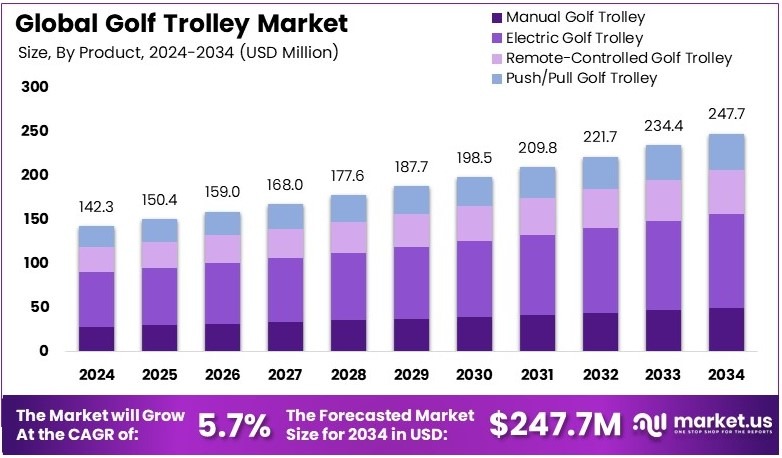
The golf trolley market is experiencing notable growth, primarily driven by the increasing popularity of golf as both a recreational and competitive sport. According to the National Golf Foundation, approximately 45 million Americans aged 6 and above played golf in 2023, indicating a strong base of potential trolley users.
Furthermore, the global golfing community is expanding, with 39.6 million golfers reported in R&A-affiliated markets, reflecting a 15% rise from 34.5 million in previous years. This growing interest highlights the sport’s appeal and suggests a promising outlook for golf-related products, including trolleys.
Electric golf trolleys, in particular, are gaining traction due to their convenience and sustainability. In the United States, federal tax credits ranging from $4,200 to $5,500 are available for purchasing electric vehicles, including golf carts. Consequently, this financial support lowers the cost barrier for consumers, encouraging greater adoption.
Moreover, the preference for eco-friendly transportation solutions on golf courses aligns with broader environmental goals. As such, manufacturers are increasingly investing in lightweight, foldable, and battery-efficient models to cater to evolving consumer expectations.
Another key factor contributing to market growth is the demographic shift within the golfing community. As the number of senior golfers rises, the demand for ergonomic and easy-to-maneuver trolleys increases. In addition, improvements in battery technology are crucial, as users seek longer-lasting and faster-charging options.
For instance, advanced lithium-ion batteries are becoming more popular, providing better performance and longevity. Therefore, brands focusing on such innovations are positioning themselves favorably in the market.
The market is moderately saturated, with leading brands dominating the scene. Nevertheless, emerging companies are attempting to carve out niches by offering specialized features. Consequently, competition is intensifying, especially in the mid-tier segment where affordability and functionality intersect.
In particular, price-sensitive consumers often compare products based on durability and post-purchase support. To differentiate, many brands are enhancing their value propositions with extended warranties and maintenance services. On the other hand, local manufacturers often face pressure from imported products that offer competitive pricing and innovative designs.
Key Takeaways
- The Golf Trolley Market was valued at USD 142.3 million in 2024 and is expected to reach USD 247.7 million by 2034, with a CAGR of 5.7%.
- In 2024, Electric Golf Trolley dominates the type segment with 43.2%, driven by increasing preference for ease of use and battery-powered mobility.
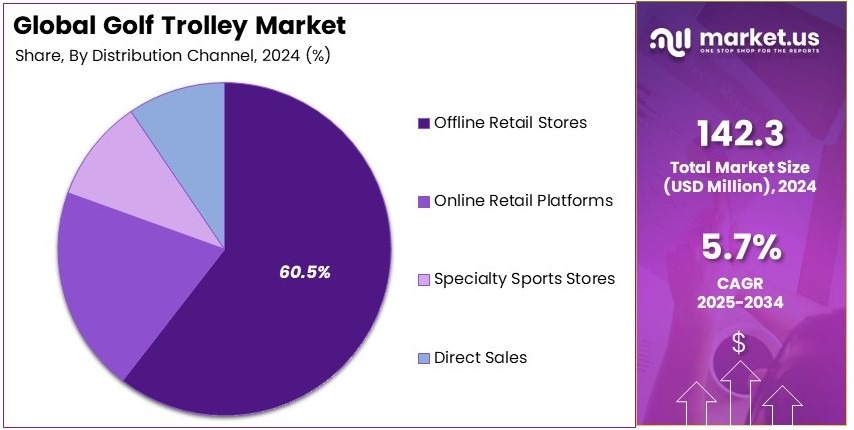
- In 2024, Offline Retail Stores lead the distribution channel with 60.5%, benefiting from hands-on demonstrations and customer trust.
- In 2024, Amateur/Leisure Golfers account for 55.3%, as they seek convenience and comfort while playing.
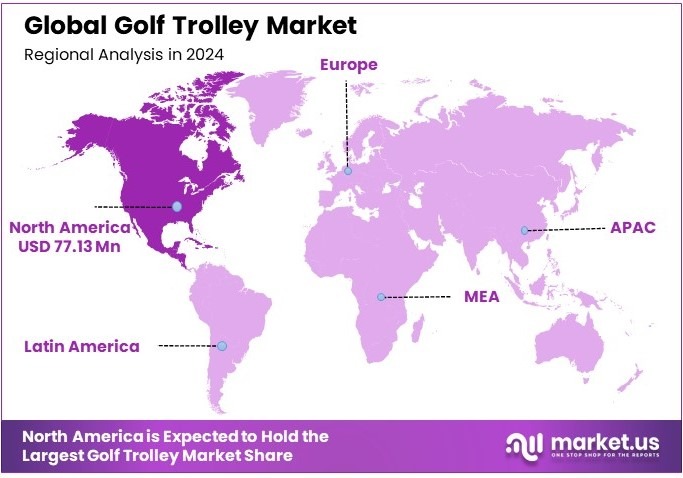
- In 2024, North America holds the largest share at 54.2% and valued at USD 77.13 million, supported by a strong golfing culture and premium product adoption.
Type Analysis
Electric Golf Trolley dominates with 43.2% due to advanced features and convenience.
The golf trolley market is significantly shaped by its product types, with the Electric Golf Trolley segment leading at 43.2%. This dominance can be attributed to the increased demand for convenience and technological advancements in trolleys. Electric Golf Trolleys offer features such as speed control, reduced physical exertion, and efficiency, which appeal to both amateur and professional golfers.
The Manual Golf Trolley, while traditional, holds a smaller market share due to its basic functionality and reliance on manual operation. However, it remains popular among purists and those seeking a more physically active golfing experience.
The Remote-Controlled Golf Trolley, an innovative sub-segment, provides enhanced usability and prestige, catering to tech-savvy and high-income golfers. Push/Pull Golf Trolleys are appreciated for their simplicity and affordability, making them suitable for casual golfers and golf facilities with budget constraints.
Distribution Channel Analysis
Offline Retail Stores dominate with 60.5% due to extensive customer reach and on-spot experience.
In the distribution channel segment, Offline Retail Stores lead with a substantial 60.5% market share. This is primarily because these venues offer tactile experiences, where customers can handle and test various golf trolleys before purchase. The immediacy of acquiring the product without waiting for delivery also appeals to many customers.
Online Retail Platforms, although convenient, face challenges such as the inability to provide a hands-on buying experience, which is crucial in this market. Specialty Sports Stores attract dedicated golfers with expert advice and high-quality equipment but often at higher prices. Direct Sales are minimal, generally appealing to institutional buyers like golf clubs or resorts looking for bulk purchases.
End User Analysis
Amateur/Leisure Golfers dominate with 55.3% due to the broad appeal and accessibility of golf as a leisure activity.
The End User segment of the golf trolley market sees Amateur/Leisure Golfers at the forefront, holding a 55.3% share. This group’s dominance stems from the increasing popularity of golf as a leisure activity among a wide demographic. Golf is perceived as an accessible sport that does not require professional skill levels, which drives the demand for golf trolleys among this segment.
Professional Golfers, though fewer in number, opt for high-end, technologically advanced golf trolleys that enhance their game. Golf Clubs/Facilities are essential consumers that provide trolleys as part of the service to their members and guests, emphasizing quality and durability to handle frequent use.
Each of these segments contributes distinctly to the growth and transformation of the golf trolley market, influenced by changing consumer preferences, technological advancements, and varying levels of economic activity across regions.
Key Market Segments
By Product Type
- Manual Golf Trolley
- Electric Golf Trolley
- Remote-Controlled Golf Trolley
- Push/Pull Golf Trolley
By Distribution Channel
- Offline Retail Stores
- Online Retail Platforms
- Specialty Sports Stores
- Direct Sales
By End User
- Amateur/Leisure Golfers
- Professional Golfers
- Golf Clubs/Facilities
Driving Factors
Increasing Golf Participation and Technological Advancements Drive Market Growth
The golf trolley market is expanding due to rising participation in golf tournaments and recreational golfing. As more people take up the sport, both for leisure and competition, the need for efficient and convenient equipment grows.
Electric and remote-controlled golf trolleys are particularly popular as they reduce the physical strain on players, allowing them to focus more on their game. For instance, professional golfers often prefer electric trolleys for their ability to carry heavy bags effortlessly.
In addition, there is a growing preference for lightweight and foldable golf trolleys. These models offer easy transport and storage, especially for those who travel frequently for golfing events. This convenience appeals to both amateur and seasoned players alike.
Another key driver is the introduction of smart golf trolleys equipped with features like GPS, distance tracking, and battery management. These technological innovations cater to modern golfers who value data-driven performance insights.
Consequently, the combination of increased golfing activities and advanced trolley features is fostering consistent market growth. As the golfing community continues to expand, manufacturers are capitalizing on these trends by launching more versatile and user-friendly trolley models. This ongoing evolution in product design aligns with the growing demand for efficient and technologically advanced golfing equipment.
Restraining Factors
High Costs and Market Alternatives Restrain Market Growth
The golf trolley market faces challenges primarily due to the high initial cost of electric and advanced models. Many golf enthusiasts, especially casual players, find the price prohibitive.
For example, high-tech trolleys with smart features often come with a significant price tag, making them less accessible to the broader golfing community. Moreover, traditional golf carts and manual push carts continue to compete with electric trolleys. These alternatives are more affordable and are often preferred by players who are not looking for advanced features.
Additionally, the availability of high-tech trolleys is limited in emerging markets, where traditional equipment still dominates. This lack of awareness about the benefits of advanced trolleys restricts their market penetration.
Furthermore, battery performance issues also impact user satisfaction. Some electric trolleys require frequent charging or have limited battery life, reducing their practicality for long games.
As a result, these factors collectively hinder the widespread adoption of advanced golf trolleys. To overcome these barriers, manufacturers need to focus on cost reduction, improved battery technology, and targeted marketing in regions with low awareness. Addressing these issues could enhance the market appeal of innovative golf trolley models.
Growth Opportunities
Innovation and Customization Provide Opportunities for Market Expansion
The golf trolley market holds significant potential, driven by innovations like AI-enabled models and solar-powered designs. AI-enabled trolleys with automated follow mode and obstacle detection appeal to tech-savvy golfers seeking convenience. These features reduce manual handling and enhance the user experience.
For instance, automated trolleys can navigate uneven terrain independently, allowing golfers to focus solely on their game. Additionally, the trend towards solar-powered golf trolleys supports eco-friendly practices, appealing to sustainability-conscious consumers. These models offer prolonged usage without frequent charging, particularly in sunny regions.
Customization options also present new opportunities. Golfers increasingly prefer ergonomic and personalized trolley designs to match their comfort and style. This trend is driving demand for customizable features, from handle height adjustments to color and branding options.
Furthermore, online sales and direct-to-consumer channels are gaining traction. These platforms offer wider reach and cost savings, attracting consumers who value convenience and competitive pricing.
Manufacturers leveraging these channels can tap into a broader customer base. As more players seek personalized and eco-friendly solutions, the market is poised to grow, driven by innovative product offerings and enhanced consumer engagement through digital platforms.
Emerging Trends
Smart Features and Portability Are Latest Trending Factor
The golf trolley market is witnessing a surge in demand for compact and ultra-lightweight models. Modern golfers, particularly those who travel frequently, value trolleys that are easy to transport.
Foldable and lightweight designs fit seamlessly into car trunks, making them ideal for on-the-go players. Additionally, Bluetooth and app-connected trolleys are becoming increasingly popular. These trolleys allow golfers to track performance metrics, including distance covered and pace, directly from their smartphones.
For instance, some models sync with fitness apps, providing a comprehensive overview of golfing activity. Another significant trend is the preference for all-terrain and waterproof trolleys. These models cater to golfers who play in varying weather conditions and on different course types.
Durable wheels and robust construction make them reliable in wet and uneven terrain. Furthermore, luxury golf trolleys featuring premium materials and brand collaborations are gaining traction among affluent golfers. These high-end models not only offer superior performance but also make a style statement on the course.
The combination of portability, smart connectivity, and rugged design is shaping consumer preferences. As a result, manufacturers are focusing on developing trolleys that balance functionality with style, appealing to both casual and professional golfers.
Regional Analysis
North America Dominates with 54.2% Market Share
North America leads the Golf Trolley Market with a 54.2% share, equating to approximately USD 77.13 Million. This dominance is supported by a high rate of golf participation and a substantial number of golf courses across the region.
The area’s robust economic conditions and the high purchasing power of consumers facilitate the adoption of advanced golfing equipment, including premium electric and remote-controlled trolleys. The region’s focus on sports and outdoor activities further amplifies the demand for such products.
Looking ahead, North America’s influence in the global Golf Trolley Market is expected to persist. The continuing trend towards healthy lifestyles and outdoor sports, coupled with technological advancements in golf equipment, will likely drive further growth and innovation in this sector.
Regional Mentions:
- Europe: Europe maintains a significant presence in the Golf Trolley Market, supported by its rich golfing heritage and host of world-renowned golf courses. The market here benefits from strong club memberships and a focus on golf tourism.
- Asia Pacific: Asia Pacific shows rapid growth in the Golf Trolley Market, driven by increasing leisure expenditure and the rise of golf as a popular sport among the emerging middle class. Countries like Japan and South Korea are pivotal in this expansion.
- Middle East & Africa: The Middle East and Africa are slowly expanding in the Golf Trolley Market, with investments in luxury golf resorts and sports tourism. The region is leveraging its climate and developing infrastructure to attract golf enthusiasts.
- Latin America: Latin America is witnessing modest growth in the Golf Trolley Market. Improvements in sports facilities and increasing interest in golf among the youth are expected to stimulate market growth in the coming years.
Key Regions and Countries Covered in the Report
- North America
- US
- Canada
- Europe
- Germany
- France
- The UK
- Spain
- Italy
- Rest of Europe
- Asia Pacific
- China
- Japan
- South Korea
- India
- Australia
- Rest of APAC
- Latin America
- Brazil
- Mexico
- Rest of Latin America
- Middle East & Africa
- South Africa
- Saudi Arabia
- UAE
- Rest of MEA
Competitive Landscape
The Golf Trolley Market is highly competitive with several prominent players contributing to the market’s dynamics. Among them, Clicgear, Motocaddy, THE PROACTIVE SPORTS GROUP, and PowaKaddy stand out as the top four leaders.
Clicgear is renowned for its innovative designs and durable products, holding a significant position in the market due to its strong brand loyalty among consumers. The company’s focus on quality and the continuous introduction of technologically advanced features in its trolleys enhances its market appeal.
Motocaddy is another major player, known for its electric golf trolleys that combine style with functionality. The company has been successful in capturing a large market share through its extensive distribution channels and marketing strategies that emphasize the technological aspects of its products.
THE PROACTIVE SPORTS GROUP offers a range of golf trolleys that cater to diverse consumer needs, from manual push models to high-end electric systems. The company’s commitment to customer satisfaction and its broad product range help maintain its competitiveness.
PowaKaddy specializes in electric golf trolleys and is popular for its cutting-edge designs and reliability. Its focus on research and development allows it to introduce products that consistently meet the evolving demands of golf enthusiasts.
These companies drive the Golf Trolley Market through innovation, quality assurance, and strategic market expansion activities, ensuring their products meet the high expectations of golf players worldwide.
Major Companies in the Market
- Clicgear
- Motocaddy
- THE PROACTIVE SPORTS GROUP
- PowaKaddy
- Spitzer Industrial Products
- Axglo International Inc.
- Cart Tek
- Club Car
- Stewart Golf
- Bag Boy Company
Recent Developments
- Yamaha: March 2025, Yamaha introduced two new five-seater electric golf carts, the G30Es and G31EPs, featuring lithium-ion batteries and vehicle control units developed internally. These models are set to launch in Japan in June 2025, coinciding with Yamaha’s 50th anniversary in the golf cart business.
- Massimo Group: February 2025, Massimo Group announced the transfer of its MVR Golf Cart production to Garland, Texas. This move aims to enhance quality control and adapt to recent U.S. trade tariffs on Chinese imports, underscoring Massimo’s commitment to strengthening its U.S. market position.









