


Report Overview
The Global Packaged Substation Market size is expected to be worth around USD 65.1 Billion by 2034, from USD 23.3 Billion in 2024, growing at a CAGR of 13.3% during the forecast period from 2025 to 2034.
The package substation is a compact, pre-assembled electrical system that combines medium voltage switchgear, a transformer, and a low voltage (LV) switchboard in separate, partitioned compartments for enhanced personnel safety. These substations are designed to efficiently supply and distribute power to large facilities such as office buildings, data centers, and industrial campuses, where high power demand is required. Their key advantages include reduced installation time, customizable configurations, enhanced safety features, and a compact design that is ideal for space-constrained environments.
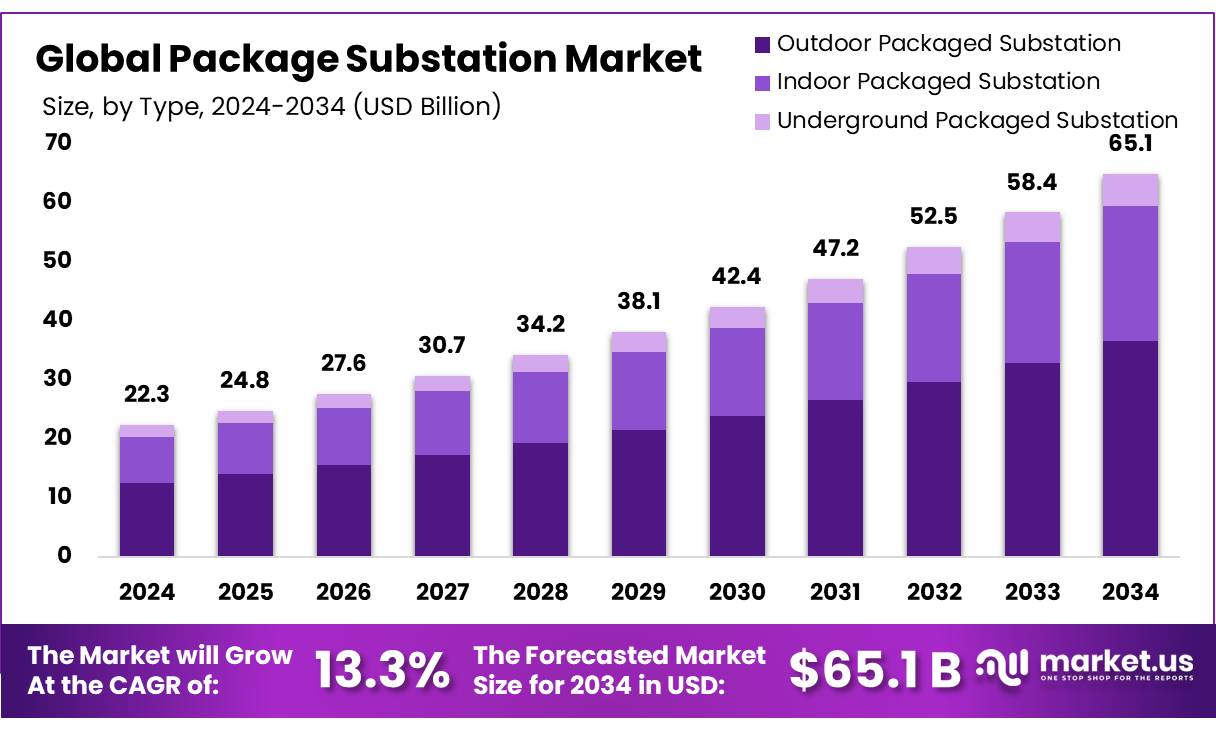
Furthermore, package substations are widely used across industrial and commercial sectors for their reliability, ease of maintenance, and ability to provide a stable, safe power supply in applications such as large commercial buildings, manufacturing plants, data centers, and renewable energy integration projects. The market for package substations is growing due to the increasing demand for efficient power distribution in urban infrastructure, manufacturing plants, and renewable energy projects, As industries expand globally, especially in emerging economies, the need for customized, energy-efficient substations further boosts the market growth.
Key Takeaways
- The global packaged substation market was valued at US$ 23.3 billion in 2024.
- The global packaged substation market is projected to grow at a CAGR of 13.3% and is estimated to reach US$ 65.1 billion by 2034.
- Among types, outdoor packaged substations accounted for the largest market share of 56.4%.
- Phase, three phase accounted for the majority of the market share at 78.2%.
- By voltage, 161-250 kVA accounted for the largest market share of 43.3%.
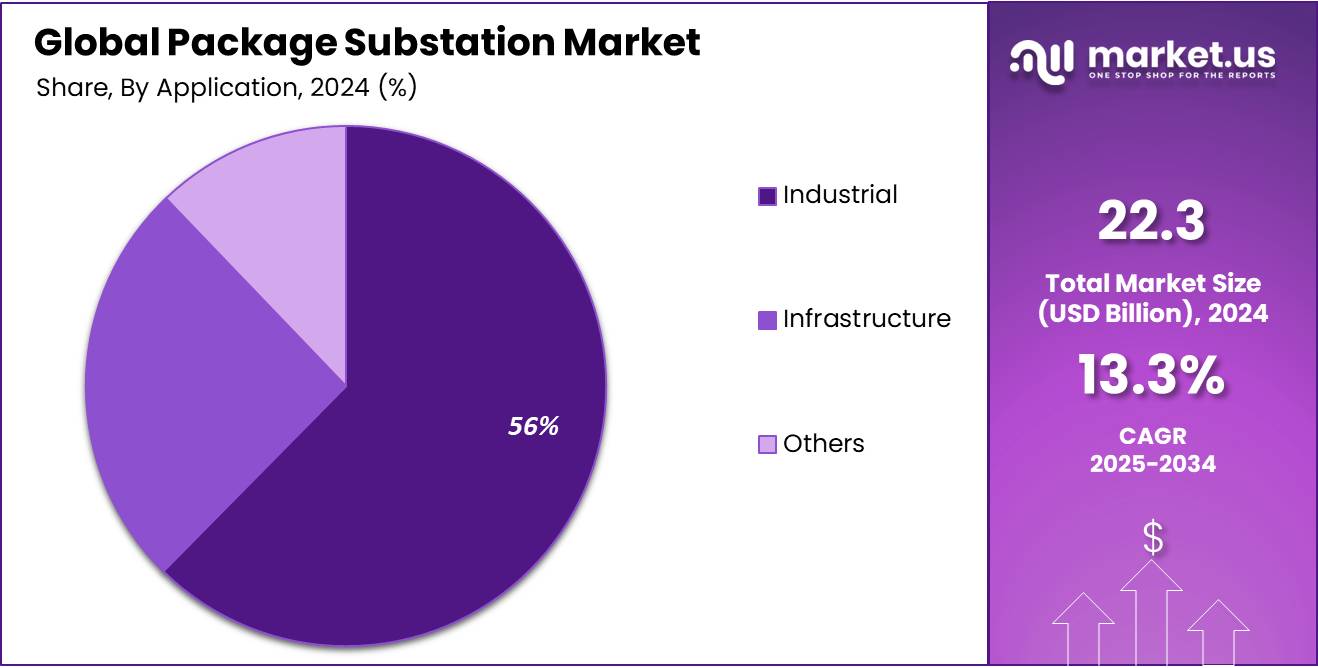
- By application, industrial accounted for the majority of the market share at 56.4%.
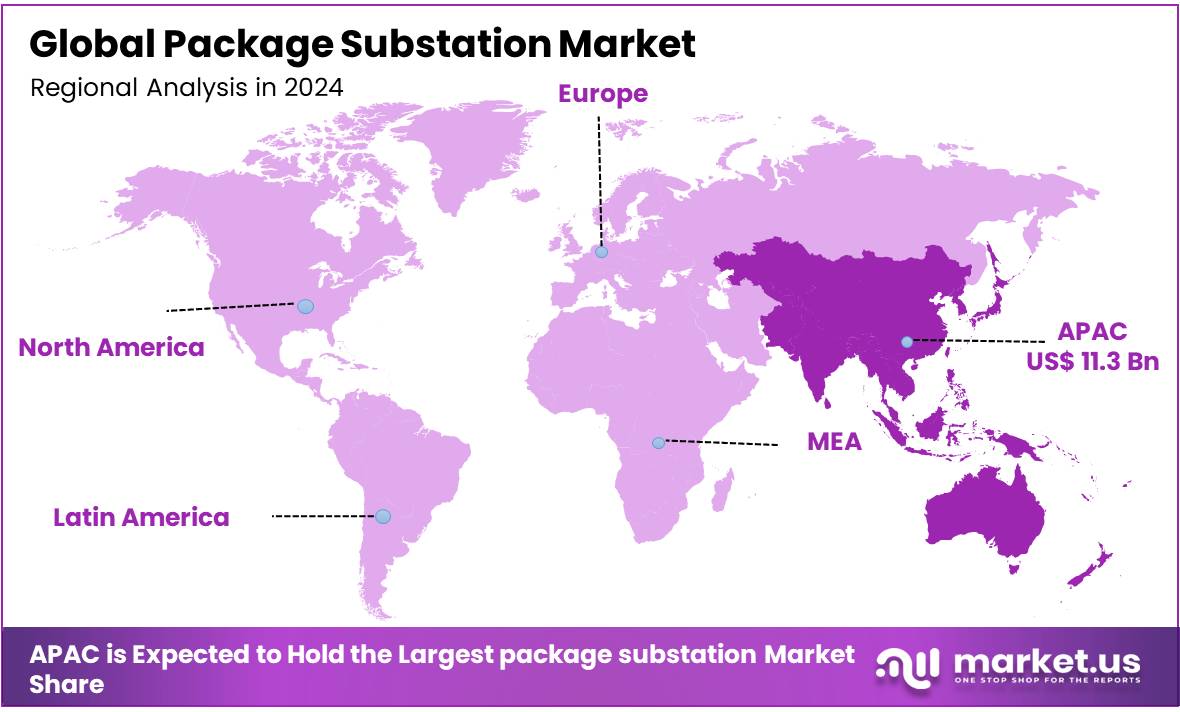
- Asia Pacific is estimated as the largest market for packaged substations with a share of 49.5% of the market share.
- Packaged substations are revolutionizing power distribution by offering a reliable, cost-effective solution for the growing energy demands of urbanization and industrialization.
Type Analysis
Outdoor Packaged Substations Leading Package Substation Market Share In 2024 Due To Durability and Flexibility.
The packaged substation market is segmented based on type indoor packaged substation, outdoor packaged substation, and underground packaged substation. In 2024, the outdoor packaged substation segment held a significant revenue share of 56.4%.
Due to its ability to withstand harsh environmental conditions, ease of installation, and suitability for large-scale industrial and infrastructure applications. These substations are preferred for their durability, cost-effectiveness, and flexibility in deployment, making them ideal for urban and rural areas with expansive energy demands.
Phase Analysis
Three-Phase Power Systems are the Backbone Of Efficient Power Distribution, Providing Reliable And Continuous Electricity For Large-Scale Applications.
Based on phase, the market is further divided into a single phase and three phases. The predominance of the three phases, commanding a substantial 78.2% market share in 2024. Due to their superior efficiency, reliability, and capacity to support large-scale applications. Their characteristics include balanced power delivery, reduced energy losses, and the ability to handle high power loads efficiently.
They are commonly used in industrial, commercial, and infrastructure applications where continuous and consistent power is required. Three-phase substations are ideal for powering heavy machinery, large commercial buildings, data centers, and high-demand industrial processes due to their capacity to supply high volumes of electricity stably and efficiently.
Voltage Analysis
The 161-250 kVA range dominated the market in 2024, making it ideal for medium-sized commercial, industrial, and infrastructure projects.
Based on voltage, the market is further divided into up to 160 kVA, 161-250 kVA, and above 250 kVA. The predominance of the 161-250 kVA, commanding a substantial 43.3 % market share in 2024. This range is ideal for medium-sized commercial, industrial, and infrastructure projects that require reliable and stable power distribution.
It is commonly used in manufacturing plants, office buildings, data centers, and small to medium-sized commercial facilities. The 161-250 kVA packaged substations offer flexibility and scalability to meet diverse power needs, making them a preferred choice for applications that demand consistent power supply without compromising on space or cost.
Application Analysis
The rise of industrial applications is driving the demand for packaged substations, providing reliable power solutions to support heavy industries.
Based on application, the market is further divided into infrastructure, industrial, and others. The predominance of the industrial commanding a substantial 56.4 % market share in 2024. Due to the increasing demand for reliable and efficient power distribution solutions in manufacturing, processing plants, and heavy industries.
As industrialization continues to expand, particularly in emerging economies, the need for robust power systems to support energy-intensive operations drives the dominance of this segment. Packaged substations offer a compact and reliable solution, ideal for powering large-scale industrial applications while ensuring system efficiency and reducing operational downtime.
Key Market Segments
By Type
- Indoor Packaged Substation
- Outdoor Packaged Substation
- Underground Packaged Substation
By Phase
- Single Phase
- Three Phase
By Voltage
- Up to 160 kVA
- 161-250 kVA
- Above 250 kVA
By Application
- Infrastructure
- Industrial
- Others
Drivers
Growing Demand For Electricity
The growing global demand for electricity, driven by economic development, population growth, and technological advancements, is fueling the expansion of the packaged substation market. Rising temperatures and increased demand for cooling systems further boost electricity consumption. Additionally, the electrification of transport and industrial growth, along with the rise of data centers and AI, intensifies the need for efficient power distribution systems, positioning packaged substations as a reliable solution to meet these needs with flexibility, compactness, and scalability.
- In 2024, global electricity consumption surged by 4.3% (1,100 terawatt-hours), nearly doubling the average growth of the past decade, driving the demand for efficient power distribution systems like packaged substations.
Additionally, Rapid urbanization and industrialization are key factors fueling the growth of the packaged substation market. As urban areas expand, the demand for reliable power for residential, commercial, and transportation needs increases. Further, rapid industrialization, especially in emerging economies, drives higher electricity consumption as manufacturing facilities, data centers, and infrastructure projects require stable and efficient power distribution. This growing energy demand makes packaged substations essential for meeting the power needs of rapidly developing regions and industries.
Furthermore, technological advancements, especially in renewable energy, require flexible and efficient solutions for power distribution, making packaged substations important. These substations, equipped with transformers, circuit breakers, and other electrical components, ensure the stable transmission of electricity over long distances. They are vital for integrating renewable energy sources into the grid while maintaining its stability, addressing the increasing global electricity demand, and supporting the transition to cleaner, more sustainable energy systems.
Restraints
High Initial Investment Cost
The high initial capital expenditure associated with the installation of packaged substations presents a significant barrier to market growth. The substantial high investment required for infrastructure, including power conversion systems, energy storage solutions, and grid integration, may deter railway operators, particularly in emerging markets.
Furthermore, the adoption of packaged substations in existing rail networks faces significant challenges due to the added complexity and high costs associated with retrofitting. While these systems offer long-term benefits such as enhanced energy efficiency and reduced operational costs, the financial burden of integration poses a barrier to widespread adoption. These cost-related challenges may slow market growth, especially in regions with limited budgets, potentially limiting the widespread adoption of advanced packaged substations in critical infrastructure sectors such as rail.
Opportunity
Electrification Drives Growth in Expanding Rail Networks
The electrification of rail networks offers a significant growth opportunity for the packaged substation market as countries transition from diesel to electric-powered trains to reduce emissions and improve efficiency. Packaged substations are essential for converting and distributing electrical power, ensuring the reliable and sustainable operation of electric trains, and supporting the shift to greener transportation. As the demand for high-speed rail and infrastructure modernization increases, the need for advanced energy solutions such as packaged substations becomes critical to ensure stable and efficient power distribution across rail networks.
- According to the International Energy Agency (IEA), the global rail network is expected to expand from 1.6 million kilometers in 2016 to 2.1 million kilometers by 2050, a 34% increase.
- The UK has invested in over 1,250 miles of rail electrification since 2010, with major projects such as the Transpennine Route Upgrade and Midland Main Line, alongside a £1bn investment for the North Wales Mainline, driving demand for packaged substations to support the growing electrified infrastructure.
Furthermore, the adoption of renewable energy sources, such as solar and wind, in the electrification of rail networks further boosts the need for advanced packaged substations. Renewable energy integration requires flexible, high-performing substations capable of handling varying power sources and maintaining grid stability. As rail networks continue to expand and modernize, especially with the development of high-speed rail and metro systems, packaged substations are integral to ensuring the efficient transmission and distribution of power, preventing grid overload, and enhancing the overall reliability of electric rail services.
- According to international energy agency reports state that more than 20 countries have developed nearly 60,000 km of high-speed rail, with China leading 70% of the global network. By 2030, high-speed rail is set to grow by 75% globally, increasing the demand for reliable power solutions, such as packaged substations, to support electrified systems.
- The NZ$137.2m investment in upgrading Wellington’s metro rail substations by the New Zealand government highlights the crucial role of packaged substations in enhancing efficiency, supporting new trains, and ensuring service reliability in electric rail networks.
Trends
Gas-Insulated Switchgear Substations
Gas-insulated switchgear (GIS) is increasingly becoming an important trend in the global packaged substation market due to its compact design, high reliability, and efficient performance in space-constrained environments. As cities and industrial areas expand, GIS provides an ideal solution for power distribution, offering improved dielectric strength, arc-quenching capabilities, and reduced footprint. These features make GIS particularly suitable for urban and high-density applications, driving growth in the packaged substation market, especially in regions with growing power demands.
The demand for GIS is also accelerating due to its role in supporting critical infrastructure, such as railways, metro systems, and renewable energy projects. As countries shift towards electrified transportation systems and sustainable energy sources, GIS plays a crucial role in ensuring reliable and efficient power distribution. This trend is expected to continue, with GIS becoming a key component in the design of modern, high-performance packaged substations, contributing to the overall growth of the global market.
Geopolitical Impact Analysis
Geopolitical Tensions Disrupt Supply Chains, Delaying Packaged Substation Adoptions.
The global packaged substation market faces significant challenges due to geopolitical factors, particularly trade restrictions and sanctions that disrupt supply chains. Trade tensions between countries can result in delays in sourcing critical materials such as transformers, switchgear, and SF6 gas, essential for manufacturing packaged substations. These disruptions can escalate costs, extend project timelines, and create uncertainty regarding the availability of key components.
Additionally, regions heavily reliant on imports may experience delays in deploying new substations, potentially hindering market growth. This geopolitical impact underscores the importance of diversifying supply sources and localizing production to mitigate risks and ensure steady market development.
- The US government has announced a 25% tariff on all steel and aluminum imports, set to take effect on March 4, 2025. These impositions will affect the package substation production and supply as these systems’ transformers and switchgear are specially designed with steel and aluminum material.
Regional Analysis
Asia Pacific Held the Largest Share of the Global Packaged Substation Market
In 2024, Asia Pacific dominated the global packaged substation market, accounting for 49.5% of the total market share, driven by rapid urbanization and industrialization in key countries such as China, India, and Japan. These regions are witnessing significant infrastructure growth, creating a high demand for reliable and efficient power distribution systems to support large-scale projects. As urban centers and industries expand, the need for uninterrupted and stable power supply increases, making packaged substations an essential solution.
The rise of smart cities, data centers, and manufacturing facilities further accelerates this demand. Additionally, the growing adoption of renewable energy sources, such as solar and wind power, necessitates flexible and stable electrical systems, driving the demand for packaged substations to integrate and manage these power sources effectively. Furthermore, favorable government initiatives support the modernizing power infrastructure, enhancing grid stability, and expanding electricity access are also contributing to packaged substation market growth. These factors strengthen the Asia-Pacific region’s position as a dominant force in the global packaged substation market.
Key Regions and Countries
- North America
- The US
- Canada
- Europe
- Germany
- France
- The UK
- Spain
- Italy
- Russia & CIS
- Rest of Europe
- APAC
- China
- Japan
- South Korea
- India
- ASEAN
- Rest of APAC
- Latin America
- Brazil
- Mexico
- Rest of Latin America
- Middle East & Africa
- GCC
- South Africa
- Rest of MEA
Key Players Analysis
Key players in the packaged substation market are focusing on strategies such as expanding their product portfolios with innovative and energy-efficient solutions. They are also increasing their geographical reach through strategic partnerships, collaborations, and acquisitions. Additionally, investing in research and development (R&D) for advanced technologies like smart grid integration and sustainable power distribution is essential for maintaining a dominant position.
The major players in the industry
- ABB Ltd.
- Alstom
- Asia Electrical Power Equipment Co, Ltd.
- CGG
- Eaton Corporation
- General Electric Company
- Kirloskar Electric Company
- Larsen & Toubro Ltd
- Littlefuse Inc.
- Lucy Electric
- Schneider Electric
- Siemens
- Toshiba Corporation
- Trafo Power Solutions
- Others
Recent Development
- November 2024 – The National Transmission Company of South Africa (NTCSA) has signed long-term agreements with 28 local companies for substation construction services as part of its Transmission Development Plan (TDP). These partnerships aim to accelerate infrastructure delivery, with NTCSA prioritizing two major programs to boost transmission capacity.
- January 2024 – Trafo Power Solutions supplied 40 dry-type mini-substations and seven ring main units to a major copper operation in the DRC. These units, designed for both surface and underground use, feature advanced safety and remote monitoring capabilities, ensuring reliability and minimal maintenance in the mining sector.









