


Report Overview
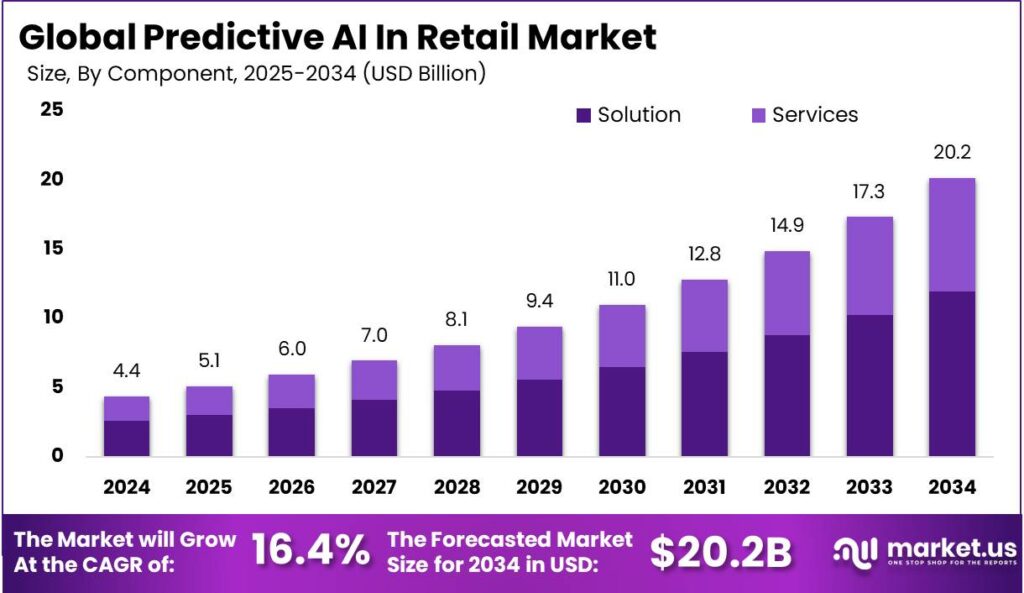
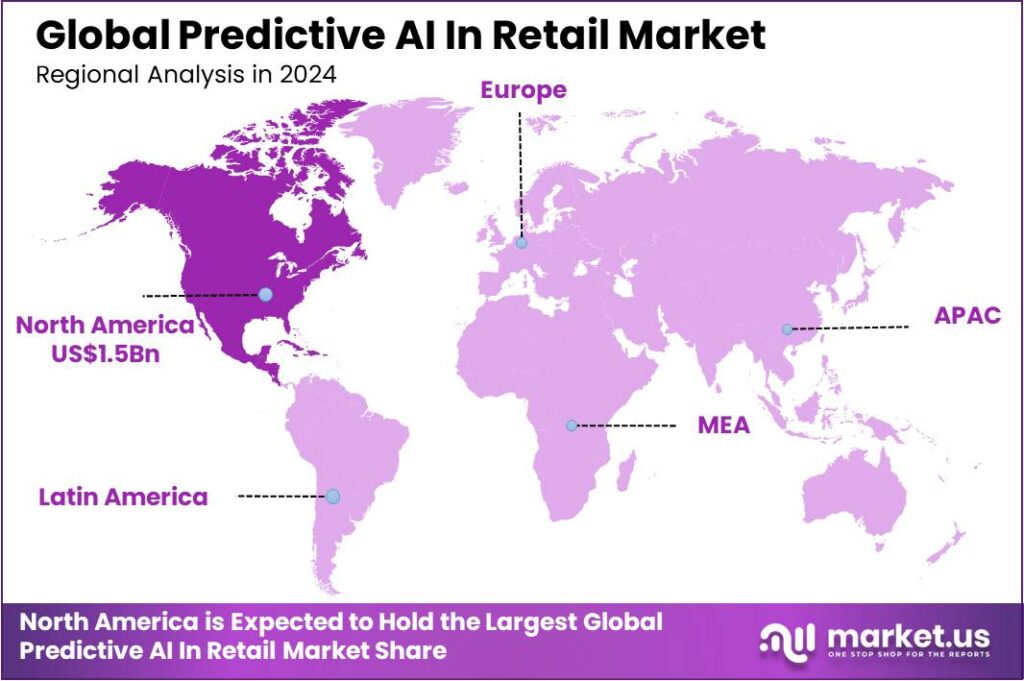
The Global Predictive AI In Retail Market size is expected to be worth around USD 20.2 Billion By 2034, from USD 4.42 Billion in 2024, growing at a CAGR of 16.4% during the forecast period from 2025 to 2034. North America had a significant presence in the predictive AI retail market in 2024, holding more than 34.1% of the market share and generating revenues of USD 1.5 billion.
Predictive AI in retail uses AI technologies to forecast trends and consumer behavior based on historical data and real-time inputs. By leveraging machine learning and big data analytics, retailers can predict purchasing patterns, inventory demands, and pricing strategies. It improves decision-making, optimizes operations, and personalizes experiences through applications like demand forecasting, customer segmentation, recommendations, and dynamic pricing.
The demand for predictive AI in retail is driven by the need for more accurate demand forecasting and personalized customer experiences. Retailers are increasingly adopting these technologies to improve their operational efficiencies and align their inventory with actual market demand. This trend is particularly pronounced in sectors where customer preferences rapidly change, requiring a dynamic approach to inventory and marketing strategies.
Key drivers for the adoption of predictive AI in retail include the reduction of inventory costs, enhancement of customer satisfaction through personalized experiences, and the overall increase in operational efficiency. These factors contribute significantly to the heightened competitiveness of retailers in a market increasingly dominated by digital and data-driven business models.
Emerging trends in predictive AI for retail include the growing importance of real-time data processing for quick decision-making, the integration of AI with IoT and AR to enhance shopping experiences, and the role of AI in supporting sustainability by reducing waste and improving supply chain efficiency.
Technological advancements such as machine learning, big data analytics, and cloud computing are facilitating the widespread adoption of predictive AI in retail. These technologies provide the necessary infrastructure and analytical capability to process large volumes of data, making predictive insights more accessible and actionable for retailers.
The top factors impacting the predictive AI market in retail include technological innovation, consumer demand for personalized shopping experiences, and the competitive landscape. Retailers that can effectively integrate predictive AI into their operations are likely to achieve a competitive advantage in the market.
Retailers are motivated to adopt predictive AI technologies primarily to enhance customer engagement and operational efficiency. The ability to predict trends with greater accuracy allows for better stock management, targeted marketing, and improved customer service, all of which are critical components in maximizing sales and building customer loyalty.
Key Takeaways
- The Global Predictive AI in Retail Market is projected to reach USD 20.2 billion by 2034, growing from USD 4.42 billion in 2024. This represents a CAGR of 16.4% during the forecast period from 2025 to 2034.
- In 2024, the Solution segment held a dominant market position in the predictive AI in retail sector, capturing over 59.2% of the market share.
- The Customer Experience Management (CEM) segment also led the market in 2024, holding more than 24.3% of the global predictive AI in retail market share.
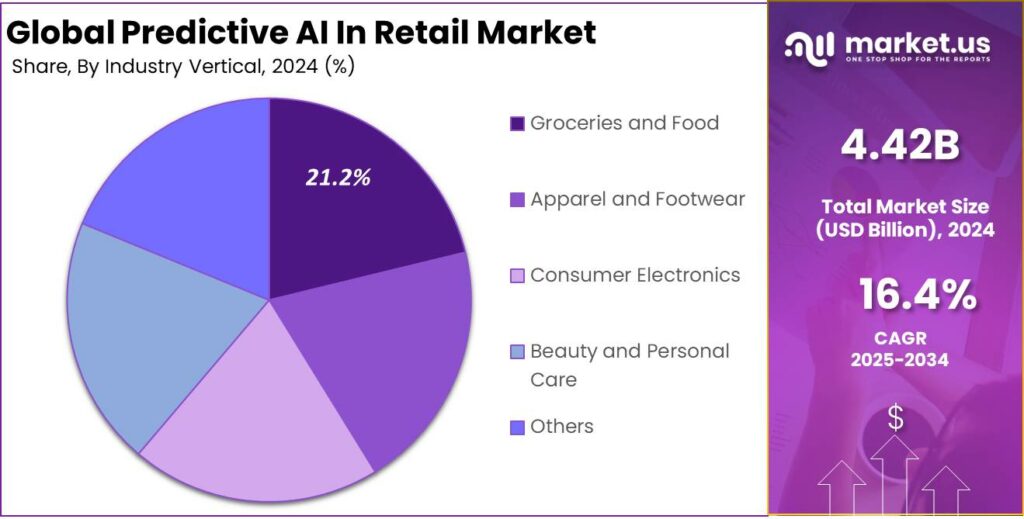
- In 2024, the Groceries and Food segment dominated the predictive AI retail market, with a share of over 21.2%.
- North America had a significant presence in the predictive AI retail market in 2024, holding more than 34.1% of the market share and generating revenues of USD 1.5 billion.
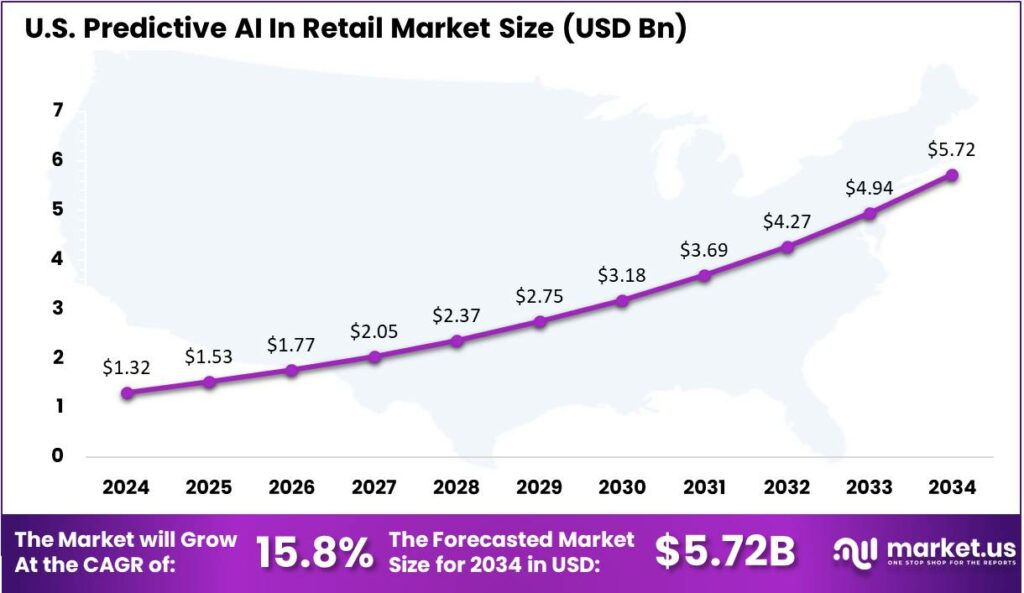
- The U.S. market for predictive AI in robotics was valued at USD 1.32 billion in 2024 and is expected to grow at a CAGR of 15.8%.
Business Benefits
By predicting demand fluctuations, predictive AI helps retailers optimize inventory levels and streamline supply chain processes. This optimization reduces waste, prevents stockouts, and ensures timely product availability. Predictive analytics helps retailers optimize stock levels, preventing overstocking and shortages. According to Algolia report, this reduces warehousing costs by 5-10% and cuts administrative costs by 25-40%.
Predictive AI helps retailers understand individual customer preferences, allowing for personalized recommendations and targeted marketing. The Folio3 report reveals that 62% of top retailers say predictive analytics has boosted their understanding of customer behavior, driving more targeted marketing and stronger loyalty. This tailored approach enhances the shopping experience, fostering customer loyalty.
Accurate demand forecasts enable retailers to streamline supply chain operations, reduce excess inventory, and minimize storage costs. This efficiency leads to significant cost savings and better resource allocation. According to a report from Shopify, 44% of retailers are leveraging AI for predictive analytics, while 41% use it to analyze and segment customers. Both of these AI-driven tools play a crucial role in shaping sales strategies and refining demand forecasts.
Impact Of AI
- Enhanced Personalization and Customer Engagement: AI-driven personalization is revolutionizing retail by delivering tailored product recommendations and marketing messages based on individual behavior and preferences, boosting engagement, conversion rates, and customer loyalty.
- Improved Inventory and Supply Chain Management: AI technologies are being employed to optimize supply chain processes and inventory management. Predictive analytics improves demand forecasting, reducing overstock and stockouts while boosting supply chain efficiency, leading to cost savings and agile business operations.
- Operational Efficiency and Employee Empowerment: AI tools provide retail employees with data-driven insights, improving decisions at the point of sale, optimizing staffing, and enhancing customer service, leading to a more efficient work environment and better organizational performance.
- Fraud Detection and Security Improvements: Retailers are increasingly using AI to improve security measures. AI-powered systems can detect fraudulent activities and potential security threats in real-time, ensuring safer shopping environments for customers and more secure operations for retailers.
- Dynamic Pricing and Market Responsiveness: AI is enabling retailers to implement dynamic pricing strategies that adjust in real-time based on market conditions, demand, and competitor actions.This agility enables retailers to optimize pricing for maximum profitability while remaining competitive.
U.S. Market Growth
In 2024, the U.S. market for predictive AI in robotics was valued at $1.32 billion. This sector is experiencing robust growth, with a projected compound annual growth rate (CAGR) of 15.8%. This significant growth rate highlights the increasing integration of artificial intelligence technologies in robotic systems across various industries.
The market’s growth is driven by rising demand for automation in manufacturing, logistics, and supply chain management. Predictive AI improves robot performance by anticipating failures, optimizing operations, and adapting to changing environments. Advancements in machine learning and AI algorithms further enhance robotic capabilities, boosting adoption across industries.
Predictive AI is transforming industries like healthcare, automotive, and consumer electronics. In healthcare, it’s used for precise surgeries and patient care. The automotive sector benefits from faster assembly and fewer errors, while consumer electronics manufacturers improve component assembly for higher quality.
The market is expected to experience sustained growth in the coming years as predictive AI becomes more advanced, with improved learning capabilities and wider integration across robotic applications. This evolution will create new opportunities and markets, driving further growth in the U.S. robotics sector.
In 2024, North America held a dominant market position in the predictive AI retail sector, capturing more than a 34.1% share, with revenues amounting to USD 1.5 billion. This region’s leadership in the market can primarily be attributed to several key factors.
The widespread adoption of advanced technologies by North American retailers has accelerated the growth of predictive AI. Retailers are using AI to improve customer experiences, optimize supply chains, and enhance inventory management. Additionally, the strong presence of major tech companies investing in AI research and development further supports robust market growth.
The region benefits from a mature digital infrastructure, enabling seamless AI integration in retail operations. High internet penetration and widespread use of digital payment methods allow retailers to gather extensive data, essential for AI systems to provide accurate predictions.
Moreover, North America’s regulatory environment is conducive to AI adoption. Governments and regulatory bodies have proactively created frameworks that foster innovation while ensuring consumer data protection. This balance between encouraging innovation and safeguarding privacy boosts retailers’ confidence, driving their investment in AI technologies.
Component Analysis
In 2024, the Solution segment held a dominant market position in the predictive AI in retail sector, capturing more than a 59.2% share. This leadership can be attributed to several pivotal factors.
The demand for predictive AI solutions in retail is fueled by the need for advanced analytics that can process vast amounts of data to predict consumer behavior, product demand, and supply chain trends. Tools like demand forecasting models, customer behavior analytics, and inventory optimization software are essential for retailers seeking to improve operational efficiency and customer satisfaction.
Retailers that adopt these solutions can tailor their marketing strategies, optimize their stock levels, and provide personalized customer experiences more effectively than those relying on more traditional methods. This has spurred a rapid adoption rate among forward-thinking retailers, further bolstering the growth of the Solution segment.
Technological advancements and innovations in machine learning and data analytics have made predictive AI solutions more accessible and effective. The development of user-friendly interfaces and decreased technology costs allow even small to medium-sized retailers to implement sophisticated AI tools, expanding the market base for this segment.
Application Analysis
In 2024, the Customer Experience Management (CEM) segment held a dominant market position, capturing more than a 24.3% share in the global predictive AI in retail market. This leadership can be attributed to the increasing prioritization of personalized experiences in the retail sector.
As customer expectations evolve, retailers are increasingly investing in predictive AI tools to understand consumer behavior, preferences, and purchase patterns. AI-driven personalization enhances customer engagement, boosts satisfaction, and fosters brand loyalty – leading to higher sales conversions and long-term retention.
The dominance of the CEM segment is driven by its ability to provide real-time, data-driven insights, enabling retailers to offer personalized promotions, product recommendations, and dynamic pricing. Predictive analytics helps businesses anticipate customer needs, enhancing the shopping experience. This approach works effectively in both online and offline settings, as AI algorithms adapt to evolving consumer trends.
A key driver of CEM growth is its integration with omnichannel platforms. As consumers shop across various touchpoints, predictive AI tools help retailers ensure consistent communication and experience. Advanced CEM platforms manage seamless customer journeys, identify friction points, and offer insights to optimize service, providing a competitive edge in a market with low switching costs and high expectations.
Industry Vertical Analysis
In 2024, the Groceries and Food segment held a dominant position in the predictive AI retail market, capturing more than a 21.2% share. This leadership can be attributed to several pivotal factors that uniquely position this sector at the forefront of AI integration.
A key driver for dominance in the groceries and food industry is the need for inventory optimization. Retailers are turning to predictive AI to accurately forecast demand, reduce waste, and maintain optimal stock levels. This is especially important in an industry with limited product shelf life and fluctuating demand driven by seasonal and dietary trends.
Another key driver is the use of predictive AI to gain insights into consumer purchasing patterns. By analyzing data from various touchpoints, AI helps retailers understand consumer preferences and behavior, allowing them to personalize offerings and enhance customer satisfaction and retention.
Predictive AI enhances operational efficiency in logistics and supply chain management by anticipating disruptions and adapting strategies, crucial for perishable goods. The Groceries and Food segment leads the predictive AI retail market due to its need for advanced solutions in demand forecasting, inventory management, and operational agility. As retailers continue leveraging AI, this segment will remain dominant, turning challenges into growth opportunities.
Key Market Segments
By Component
- Solution
- Services
By Application
- Customer Experience Management
- Inventory Management
- Sales and Marketing
- Fraud Detection and Prevention
- Others
By Industry Vertical
- Groceries and Food
- Apparel and Footwear
- Consumer Electronics
- Beauty and Personal Care
- Others
Key Regions and Countries
- North America
- US
- Canada
- Europe
- Germany
- France
- The UK
- Spain
- Italy
- Rest of Europe
- Asia Pacific
- China
- Japan
- South Korea
- India
- Australia
- Singapore
- Rest of Asia Pacific
- Latin America
- Brazil
- Mexico
- Rest of Latin America
- Middle East & Africa
- South Africa
- Saudi Arabia
- UAE
- Rest of MEA
Driver
Enhanced Customer Personalization
The integration of predictive artificial intelligence (AI) in retail has significantly advanced customer personalization. By analyzing individual consumer behaviors, purchase histories, and browsing patterns, AI enables retailers to offer tailored product recommendations and marketing messages. This personalized approach not only enhances the shopping experience but also increases customer satisfaction and loyalty.
For instance, AI-driven personalization has become a cornerstone of modern retail, with systems designed to analyze individual consumer behavior, thereby delivering tailored recommendations that align with each customer’s preferences. Such strategies have been shown to boost sales conversions, as customers are more likely to engage with and purchase products that resonate with their preferences.
Restraint
Data Privacy and Security Concerns
The deployment of predictive AI in retail raises significant data privacy and security concerns. The effectiveness of AI models hinges on access to vast amounts of consumer data, including sensitive personal information. This necessitates stringent data governance policies and compliance with regulations such as the General Data Protection Regulation (GDPR).
Retailers must implement robust security measures to protect against data breaches and unauthorized access. Additionally, transparency in data collection and usage practices is essential to maintain consumer trust.
Failure to address these concerns can lead to reputational damage and legal repercussions. Therefore, while predictive AI offers substantial benefits, retailers must navigate the complex landscape of data privacy and security to fully leverage its potential.
Opportunity
Inventory Optimization
Predictive AI presents a significant opportunity for retailers to optimize inventory management. By leveraging historical sales data, market trends, and external factors such as weather patterns, AI models can forecast demand with high precision. This enables retailers to maintain optimal stock levels, reducing instances of overstocking and stockouts.
The system factors in data from events, weather patterns, promotions, and past sales to enhance supply chain efficiency by alerting suppliers in advance. This approach ensures that stores have adequate stock, particularly around key events like New Year’s Eve and Christmas, thereby improving customer satisfaction and reducing inventory holding costs. Effective inventory optimization through predictive AI not only streamlines operations but also contributes to increased profitability.
Challenge
Integration with Legacy Systems
Integrating predictive AI into existing retail infrastructures poses a considerable challenge, particularly when dealing with legacy systems. Many retailers operate on outdated platforms that may not be compatible with modern AI technologies. This incompatibility can hinder the seamless implementation of AI solutions, leading to increased costs and extended timelines for system overhauls.
Furthermore, the integration process often requires significant changes to existing workflows and employee training programs. Retailers need to evaluate their technology and invest in upgrading legacy systems to fully leverage predictive AI. This requires a strategic approach that balances AI’s potential benefits with the costs and practicalities of system modernization.
Emerging Trends
Predictive AI is reshaping the retail industry by helping businesses better anticipate customer needs, streamline operations, and improve the overall shopping experience. A key trend is the use of AI for demand forecasting.
Retailers use predictive models to predict product demand across various seasons, regions, and customer segments, allowing them to maintain optimal inventory levels and minimize both overstocking and stockouts.
Another emerging trend is personalized marketing. Predictive analytics helps retailers create tailored marketing campaigns by analyzing customer preferences, purchase history, and browsing behavior. This approach allows for grouping consumers into segments based on purchase behavior and enables hyper-local marketing campaigns based on localized trends .
Dynamic pricing is on the rise, with AI allowing retailers to adjust prices in real-time based on demand, competition, and market conditions to boost competitiveness and profits. AI-powered virtual assistants and chatbots are also enhancing online platforms, offering personalized recommendations and instant customer support, improving the overall shopping experience.
Key Player Analysis
Several major technology companies have emerged as key players in the predictive AI space within the retail market.
NVIDIA Corporation is one of the most influential companies in the AI and machine learning sector. Its GPUs power a range of AI applications, including predictive analytics used in retail. With deep learning capabilities and high-performance computing, NVIDIA’s technology enables retailers to process vast amounts of data and generate accurate predictions about consumer behavior, supply chain demand, and market trends.
Microsoft Corporation plays a pivotal role in predictive AI through its cloud computing platform, Azure. By offering advanced AI services like Azure Machine Learning, Microsoft helps retailers integrate predictive models into their business strategies. The company’s AI-driven tools enable retailers to optimize pricing, enhance customer service through chatbots, and predict demand trends with high accuracy.
Google LLC, a leader in AI and data analytics, has made significant contributions to the retail market through its powerful AI tools, including Google Cloud AI and machine learning frameworks. Google’s predictive AI models are widely used by retailers to enhance customer experience, personalize marketing efforts, and optimize product placement.
Top Key Players in the Market
- NVIDIA Corporation
- Microsoft Corporation
- Google LLC
- IBM Corporation
- SAP SE
- Oracle Corporation
- Appen Limited
- Intel Corporation
- Salesforce, Inc.
- Amazon Web Services (AWS)
- Cognizant
- Intellias
- Other Major Players
Top Opportunities Awaiting for Players
Predictive AI is poised to revolutionize various aspects of the retail industry, offering significant opportunities for market players to enhance efficiency, personalize customer experiences, and optimize operations.
- Predictive Analytics for Inventory Management: AI-driven predictive analytics can significantly improve inventory accuracy by forecasting demand based on historical sales data and market trends. This capability helps retailers maintain optimal stock levels, preventing both overstocking and stock shortages, thus ensuring that customer demands are met efficiently.
- Personalized Shopping Experiences: Utilizing AI to offer personalized shopping experiences can drastically enhance customer engagement and satisfaction. By analyzing individual customer behaviors and preferences, AI enables retailers to deliver tailored recommendations and promotions, thereby increasing conversion rates and fostering customer loyalty.
- AI-Enhanced Customer Support: Implementing AI-powered customer support, such as chatbots and virtual assistants, allows for round-the-clock customer service. These tools can handle inquiries and provide accurate responses quickly, enhancing the overall customer experience while reducing the workload on human staff.
- Dynamic Pricing Strategies: AI can dynamically adjust pricing based on various factors such as demand, inventory levels, and competitor pricing. This capability not only helps in maintaining competitive prices but also plays a crucial role in maximizing profits and enhancing customer satisfaction during price-sensitive scenarios.
- Augmented Reality (AR) for Enhanced Shopping: AR technology, integrated with AI, offers customers an immersive shopping experience by allowing them to visualize products in a real-world context via their mobile devices. This technology not only reduces the likelihood of product returns but also boosts customer confidence in their purchasing decisions, leading to higher sales conversions.
Recent Developments
- In January 2024, Salesforce introduced new data and AI-powered tools to transform shopping experiences. By integrating generative AI into Commerce Cloud and Marketing Cloud, retail merchandisers and marketers can optimize customer interactions, increasing loyalty and driving revenue.
- In March 2025, AWS introduced Nova Act, an AI agent capable of performing tasks such as online shopping directly within a web browser. Initially available to developers as a research preview, Nova Act can conduct web searches, make purchases, and schedule tasks. This launch is part of Amazon’s broader investment in AI initiatives.
- In March 2025, Oracle’s Retail Suite was recognized as a leader in the IDC MarketScape for AI-driven Retail Assortment Planning Solutions. The suite offers advanced SKU prioritization and assortment optimization capabilities, supporting complex retail planning processes and delivering personalized customer experiences.









