


Report Overview
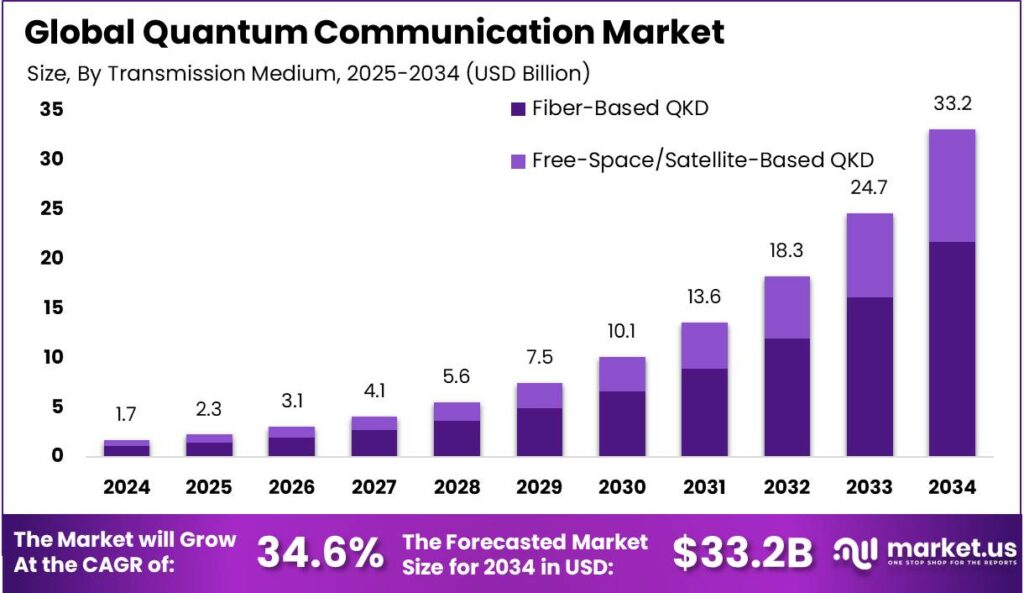
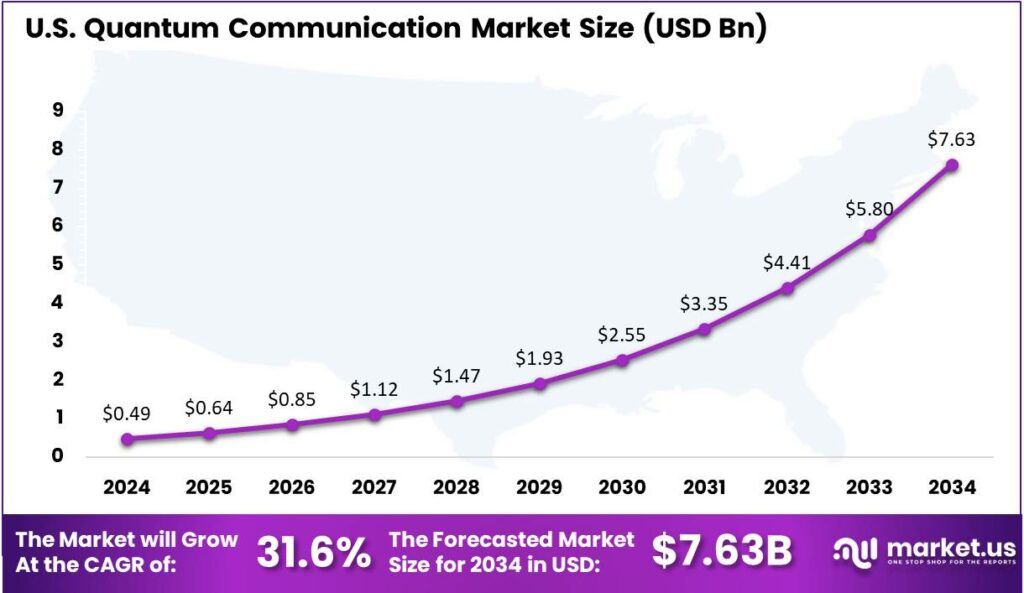
The Global Quantum Communication Market size is expected to be worth around USD 33.2 Billion By 2034, from USD 1.7 Billion in 2024, growing at a CAGR of 34.60% during the forecast period from 2025 to 2034. In 2024, North America led the quantum communication market with over 36.4% market share and revenues of approximately USD 0.6 billion. The United States alone was valued at USD 0.49 billion, projected to grow at a CAGR of 31.6%.
The quantum communication market is experiencing robust growth, driven by the increasing need for secure communication systems amidst rising cyber threats and the potential vulnerabilities of classical encryption methods against quantum computing. The market’s expansion is bolstered by substantial investments from leading nations like the United States and China and from private sectors looking to pioneer this revolutionary technology.
The primary driving factor behind the growth of the quantum communication market is the unparalleled security feature offered by quantum key distribution (QKD). This method allows the creation of cryptographic keys that cannot be intercepted without detection, providing a level of security that is fundamentally unachievable with traditional cryptographic approaches.
Additionally, the increasing number of cyber threats and the anticipated vulnerability of conventional cryptography in the age of quantum computing further accelerate the demand for quantum communication technologies.
The demand for quantum communication technologies is driven by sectors that require high levels of data security, such as financial services, military, and government communications. The promise of unhackable communication systems makes quantum communication appealing across these sectors, and ongoing technological advancements continue to expand its applicability and reliability.
Currently, the quantum communication market is witnessing a trend towards the integration of quantum technologies with existing communication infrastructures, aiming to enhance the performance and security of these systems. The adoption of quantum communication is also facilitated by developments in related technologies such as quantum computing and the broader research into quantum physics.
The main reasons for adopting quantum communication technologies include the need for secure data transmission, protection against the future threat posed by quantum computers to current encryption methodologies, and the strategic advantage it provides in securing communications from potential eavesdroppers.
Key Takeaways
- The Global Quantum Communication Market size is expected to be worth around USD 33.2 Billion by 2034, growing from USD 1.7 Billion in 2024, at a compound annual growth rate (CAGR) of 34.60% during the forecast period from 2025 to 2034.
- In 2024, the Solutions segment held a dominant market position in the global quantum communication market, capturing more than 65.4% of the market share.
- The Fiber-Based QKD (Quantum Key Distribution) segment dominated the global quantum communication market in 2024, accounting for more than 65.6% of the total market share.
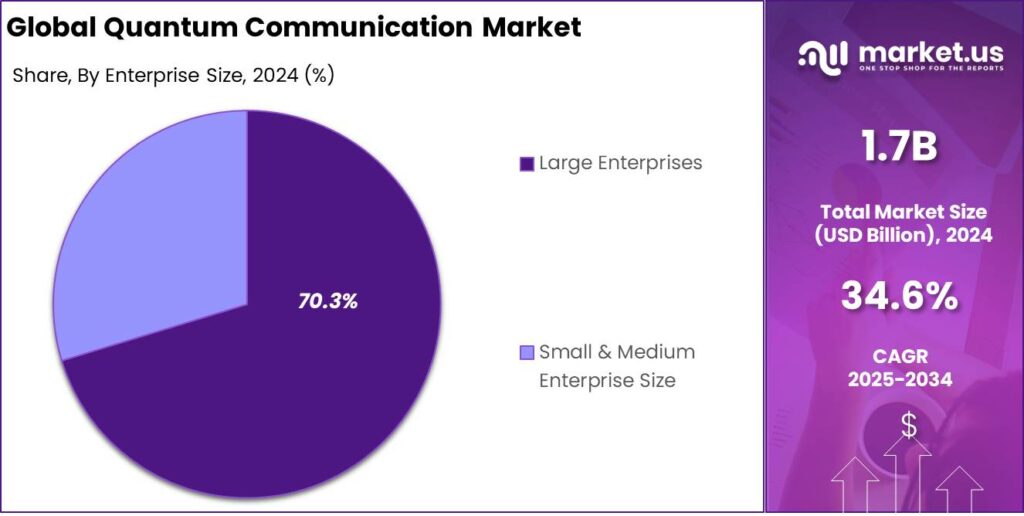
- In 2024, Large Enterprises captured more than 70.3% of the global quantum communication market share.
- The BFSI (Banking, Financial Services, and Insurance) sector held a dominant position in the quantum communication market in 2024, with more than 30.4% of the market share.
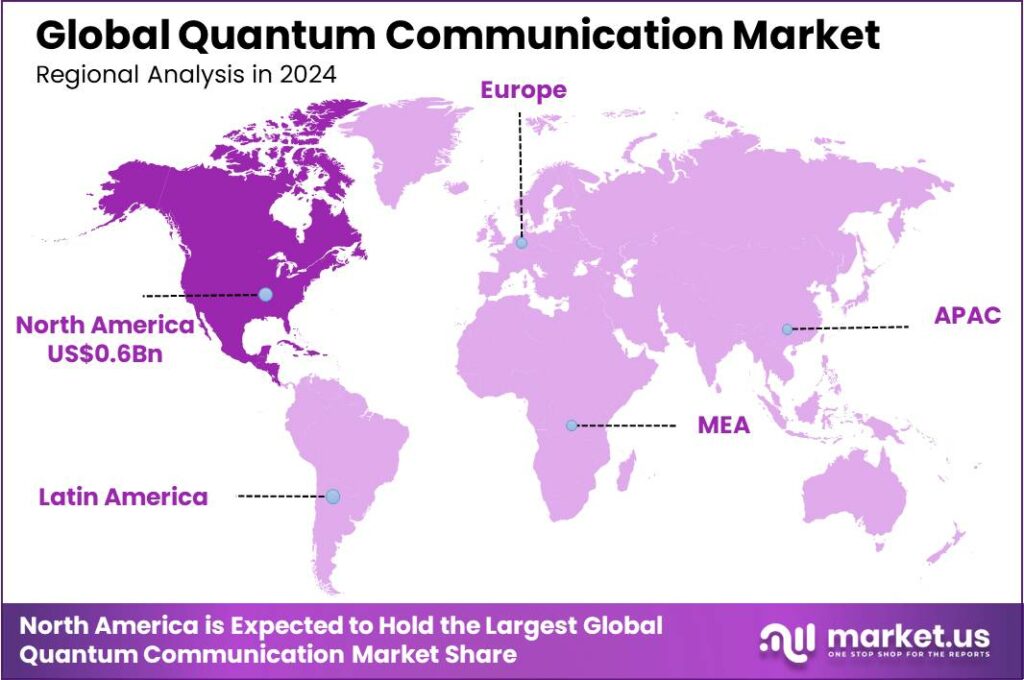
- North America was the leading region in the quantum communication market in 2024, holding more than 36.4% of the market share, with revenues reaching approximately USD 0.6 billion.
- In 2024, the quantum communication market in the United States was estimated to be worth USD 0.49 billion, with projections indicating a compound annual growth rate (CAGR) of 31.6%.
U.S. Quantum Communication Market
In 2024, the quantum communication market in the United States was estimated to be worth $0.49billion. The market is projected to expand at a compound annual growth rate (CAGR) of 31.6%. Quantum communication uses quantum mechanics to enhance data transmission security.
With the rise in cyberattacks and data breaches, its ability to provide near-unbreakable encryption has attracted interest from governments, financial institutions, and healthcare organizations aiming to protect sensitive information.
The growth of the U.S. quantum communication market can be attributed to several factors. Significant investments in research and development by both public and private entities are propelling advancements in quantum technologies. Additionally, the U.S. government’s strategic initiatives to enhance national security infrastructures are fostering a conducive environment for market expansion.
The market is expected to maintain a robust growth trajectory, driven by continuous technological innovations and growing demand for enhanced security solutions in critical sectors. As the technology matures and becomes more accessible, its adoption across various industries is anticipated to increase, further stimulating market growth.
In 2024, North America held a dominant market position in the quantum communication sector, capturing more than a 36.4% share, with revenues reaching approximately USD 0.6 billion. This leadership can be attributed to a confluence of technological innovation, robust government support, and a strong presence of leading industry players in the region.
The North American market benefits from significant investments in quantum technologies by the U.S. and Canada, focusing on national security and global competitiveness. U.S. government initiatives fund quantum research, driving the region’s leadership in the field, supported by collaborations between universities, research institutions, and private companies.
North America’s advanced R&D infrastructure, backed by a skilled workforce in quantum physics and engineering, is key to advancing quantum communication. Stringent cybersecurity regulations further boost demand for secure systems, making quantum communication essential for sectors like finance, healthcare, and defense.
North America is set to maintain its leadership in the global quantum communication market, driven by technological innovations, growing sector adoption, and sustained investments from both government and the private sector. The expansion of quantum networks and the rising demand for secure communications will ensure the region stays at the forefront of the field.
Offering Analysis
In 2024, the Solutions segment held a dominant market position in the global quantum communication market, capturing more than a 65.4% share. This leadership can be primarily attributed to the growing demand for advanced hardware and software components that enable secure and high-speed quantum data transmission.
Among the key components within the Solutions segment, photon sources, quantum detectors, and quantum repeaters remain fundamental to the functioning of quantum communication networks. These components are critical in enabling the generation, detection, and transmission of quantum signals over long distances without compromising security.
Furthermore, Quantum Key Distribution (QKD) solutions have emerged as the most commercially deployed and validated form of quantum communication technology. With rising concerns over the vulnerability of classical encryption systems in the face of quantum computing, enterprises and governments are turning to QKD to ensure long-term data security.
The Quantum Random Number Generator (QRNG) and quantum-safe cryptographic solutions are boosting the Solutions segment’s market dominance by enhancing cryptographic integrity and randomness, making them resistant to both classical and quantum attacks. As quantum threats rise, organizations are adopting quantum-resilient technologies, boosting the growth and dominance of the Solutions segment in the quantum communication market.
Transmission Medium Analysis
In 2024, the Fiber-Based QKD (Quantum Key Distribution) segment held a dominant market position, capturing more than a 65.6% share of the global quantum communication market. This leadership can be attributed primarily to its compatibility with existing fiber-optic infrastructure, allowing smoother integration without requiring entirely new systems.
Fiber-based systems’ reliability has also bolstered their dominance, as they are less vulnerable to weather disruptions and environmental interference than satellite alternatives. Fiber-based QKD ensures stable, high-fidelity quantum key transmission over moderate distances, making it perfect for urban and inter-city communications that require secure, uninterrupted connectivity.
In addition, continued advancements in fiber-optic QKD hardware such as quantum repeaters and photon detectors have enabled longer-distance transmission with reduced signal loss. These technical improvements have increased operational efficiency and cost-effectiveness, further reinforcing market preference toward fiber-based models.
Regulatory support and pilot programs for secure fiber-based quantum networks have been crucial. Countries focusing on cybersecurity in sectors like finance, defense, and critical infrastructure have largely adopted fiber-based QKD for its real-world readiness. This has allowed the segment to set the standard for security-focused quantum communication systems, solidifying its leadership in the market.
Enterprise Size Analysis
In 2024, the Large Enterprises segment held a dominant market position, capturing more than a 70.3% share of the global quantum communication market. This dominance can be primarily attributed to the substantial financial resources available to large organizations, which enable significant investments in emerging technologies such as quantum communication.
Moreover, large enterprises often manage vast volumes of sensitive data, including proprietary information, customer records, and strategic communications. The heightened risk associated with potential data breaches or cyberattacks has increased the urgency among these organizations to adopt secure communication infrastructures.
The leadership of large enterprises in this market is also supported by their early involvement in quantum technology research and partnerships with specialized vendors and academic institutions. Many multinational corporations are actively collaborating in pilot projects and quantum network deployments, giving them first-mover advantages.
In contrast, small and medium enterprises (SMEs) face challenges such as limited budgets, infrastructure, and awareness of advanced communication technologies. Despite growing interest, high initial costs, limited internal capabilities, and the need for specialized knowledge hinder adoption. As a result, the quantum communication market is expected to remain primarily driven by large enterprises in the near term until more cost-effective, scalable solutions emerge.
Vertical Analysis
In 2024, the BFSI segment held a dominant market position within the quantum communication market, capturing more than a 30.4% share. The BFSI sector’s prominence in adopting quantum communication stems from its need for advanced security against sophisticated cyber threats. Financial institutions are integrating quantum technologies to protect sensitive data from potential quantum computing attacks that could compromise traditional encryption.
The significant investment in quantum-safe cryptography and QKD systems by banks, insurance companies, and financial services firms highlights the BFSI segment’s leadership. These technologies are essential for securing transactions, preventing data breaches, and ensuring compliance with stringent regulations, thereby maintaining consumer trust.
The BFSI sector’s rapid digital transformation requires robust security frameworks, and quantum communication offers a future-proof solution that supports long-term digital security strategies. This alignment is vital for enabling innovations in mobile banking, online transactions, and personalized financial services.
The global push towards enhanced data protection laws and financial regulations has also played a pivotal role in driving the adoption of quantum communication technologies within the BFSI sector. Institutions are proactively deploying these advanced technologies to stay ahead of regulatory curves and to equip themselves against future technological disruptions.
Key Market Segments
By Offering
- Solutions
- Quantum Communication Components
- Photon Sources
- Quantum Memory
- Quantum Detectors
- Quantum Modulators and Transceivers
- Quantum Repeaters
- Quantum Key Distribution (QKD) Solutions
- Quantum Random Number Generator (QRNG)
- Quantum-Safe Cryptographic Solutions
- Quantum Communication Components
- Services
By Transmission Medium
- Fiber-Based QKD
- Free-Space/Satellite-Based QKD
By Enterprise Size
- Large Enterprises
- Small & Medium Enterprises (SMEs)
By Vertical
- BFSI
- Government & Defense
- Healthcare
- Aerospace
- IT & Telecom
- Energy & Utilities
- Others
Key Regions and Countries
- North America
- US
- Canada
- Europe
- Germany
- France
- The UK
- Spain
- Italy
- Rest of Europe
- Asia Pacific
- China
- Japan
- South Korea
- India
- Australia
- Singapore
- Rest of Asia Pacific
- Latin America
- Brazil
- Mexico
- Rest of Latin America
- Middle East & Africa
- South Africa
- Saudi Arabia
- UAE
- Rest of MEA
Driver
Escalating Demand for Secure Communication Systems
In today’s digital landscape, the proliferation of cyber threats has heightened the need for robust security measures. Traditional encryption methods are increasingly vulnerable to sophisticated attacks, necessitating advanced solutions.
Quantum Key Distribution (QKD), a cornerstone of quantum communication, offers a paradigm shift by leveraging quantum mechanics principles to establish theoretically unbreakable encryption keys. This ensures that any interception attempts are detectable, providing unparalleled security for sensitive data.
Industries such as finance, healthcare, and defense, which handle confidential information, are particularly motivated to adopt QKD to safeguard against data breaches and maintain trust. The growing emphasis on data privacy regulations further propels the demand for quantum communication technologies, positioning them as essential tools in the modern cybersecurity arsenal.
Restraint
High Implementation Costs
The deployment of quantum communication systems entails substantial financial investment. Technologies like QKD require specialized hardware, including single-photon detectors and sources, which are costly and resource-intensive. Additionally, the integration of quantum networks demands significant infrastructural modifications and specialized expertise.
These high initial and maintenance expenses pose a barrier, especially for organizations with limited budgets. Consequently, the widespread adoption of quantum communication technologies is tempered by economic considerations, necessitating further advancements and cost reductions for broader market acceptance.
Opportunity
Integration with Emerging Technologies
The convergence of quantum communication with emerging technologies such as 5G and the Internet of Things (IoT) presents significant growth opportunities. As 5G networks aim to provide high-speed, low-latency connectivity, integrating quantum communication can enhance security protocols, ensuring data integrity across expansive networks.
Similarly, the proliferation of IoT devices, which are often susceptible to cyber threats, can benefit from quantum-enhanced encryption methods. This integration not only fortifies security but also fosters trust in the adoption of these technologies across various sectors, including smart cities, autonomous vehicles, and industrial automation.
Challenge
Regulatory and Standardization Hurdles
The nascent stage of quantum communication technologies brings forth challenges related to regulatory frameworks and standardization. The absence of universally accepted standards complicates interoperability and integration efforts, potentially hindering widespread adoption.
Governments and international bodies are in the process of formulating regulations, but the dynamic nature of quantum technologies poses difficulties in establishing comprehensive guidelines. This regulatory uncertainty can deter investment and slow down commercialization efforts. Achieving harmonized standards and clear regulatory pathways is imperative to facilitate the seamless deployment and scalability of quantum communication solutions globally.
Emerging Trends
QKD is gaining attention for its ability to provide ultra-secure communication, making it essential for national security and data protection. Efforts are underway to develop satellite-based quantum communication networks for long-distance secure communication.
Researchers are optimizing global quantum communication through satellite constellations, tackling challenges in quantum key distribution over large distances. Integrating quantum communication with existing classical networks is a focus area.
Researchers have demonstrated the feasibility of integrating quantum communication into existing networks by teleporting a quantum state of light over 30 km of fiber optic cable carrying conventional internet traffic.
With the potential of quantum computers to break current encryption methods, there is a push towards developing and standardizing PQC algorithms to safeguard data against future quantum attacks. The U.S. National Institute of Standards and Technology (NIST) has released finalized PQC standards.
Business Benefits
Early adoption of quantum communication technologies positions businesses as leaders in innovation, attracting clients and partners who prioritize security and technological advancement. Collaborations between companies like Telefónica Germany and Amazon Web Services (AWS) to test quantum technologies in mobile networks exemplify this trend.
Investing in quantum communication prepares businesses for the advent of quantum computing, ensuring that their communication infrastructure remains secure against future threats. The development of post-quantum cryptography standards by NIST highlights the importance of this preparation.
Quantum communication opens avenues for new products and services, such as secure communication solutions for clients requiring high levels of data protection. Startups like LevelQuantum, developing encryption terminals using quantum key distribution, are examples of businesses capitalizing on these opportunities.
Key Player Analysis
As the demand for ultra-secure data transfer grows, several companies are at the forefront of developing quantum communication technologies.
Toshiba is a leading player in the quantum communication sector, recognized for its groundbreaking work in quantum key distribution (QKD) systems. The company’s strong R&D focus on creating secure communication networks has led to the development of advanced quantum technology that enables ultra-secure transmission over fiber optics and free space.
ID Quantique is a Swiss-based company that has established itself as a pioneer in quantum-safe security solutions. It specializes in QKD systems and is one of the first companies to commercialize quantum cryptography. ID Quantique’s unique approach to secure communication focuses on integrating quantum technologies with existing infrastructure to provide a smooth transition to a quantum-secure world.
Thales, a global technology leader, has become a significant player in quantum communication through its work in cybersecurity and quantum technology. The company is focused on developing quantum-safe solutions that can be integrated into current communication systems to ensure long-term security. Thales offers robust quantum key management systems, which are essential for protecting sensitive data across industries.
Top Key Players in the Market
- Toshiba
- ID Quantique
- Thales
- IDEMIA
- QuintessenceLabs
- QuantumCTek
- Qubitekk
- Quantum Xchange
- Arqit
- Aliro Quantum
- Others
Top Opportunities for Players
The quantum communication market is poised for significant growth, driven by several key opportunities that market players can capitalize on.
- Enhanced Security Needs: As the demand for secure communication systems rises, particularly in sectors like government, military, and finance, quantum key distribution (QKD) provides unprecedented security. This method is becoming essential in protecting sensitive information against the potential threats posed by quantum computing advancements.
- Integration with Existing Technologies: There is a substantial opportunity for the integration of quantum communication technologies with current network infrastructures. This includes the adoption of QKD in telecommunications, where companies like AT&T are leading advancements to offer next-generation security solutions across various industries.
- Expansion into New Verticals: Sectors such as healthcare are rapidly adopting quantum communication to secure patient data and telemedicine communications. As quantum technologies become more accessible, even small and medium enterprises (SMEs) are beginning to adopt these solutions, recognizing the need for cost-effective yet secure communication systems.
- Global Infrastructure Development: The development of global quantum communication infrastructures, supported by government funding and international collaborations, is a key opportunity. This includes projects like the Pan-European quantum communication infrastructure, which aims to enhance connectivity and security on a continental scale.
- Technological Advancements and Innovation: Continuous investment in R&D by major corporations and governments is crucial. Innovations in quantum hardware, such as the development of more robust quantum processors and quantum repeaters, are essential to increase the reach and efficiency of quantum networks. These advancements are critical for maintaining the growth momentum of the quantum communication market.
Recent Developments
- In January 2024, Thales Alenia Space and Hispasat commenced the QKD-GEO project, focusing on developing the world’s first quantum key distribution system from geostationary orbit. This 24-month project encompasses the creation of a quantum payload for a geostationary satellite and the associated ground segment.
- In May 2024, ID Quantique introduced the Clarion KX software platform, supporting multi-vendor Quantum Key Distribution (QKD) interoperability. This initiative aims to facilitate the adoption of quantum networks in collaboration with partners such as HEQA Security, LuxQuanta, Quantum Optics Jena, and ThinkQuantum.









