


Report Overview
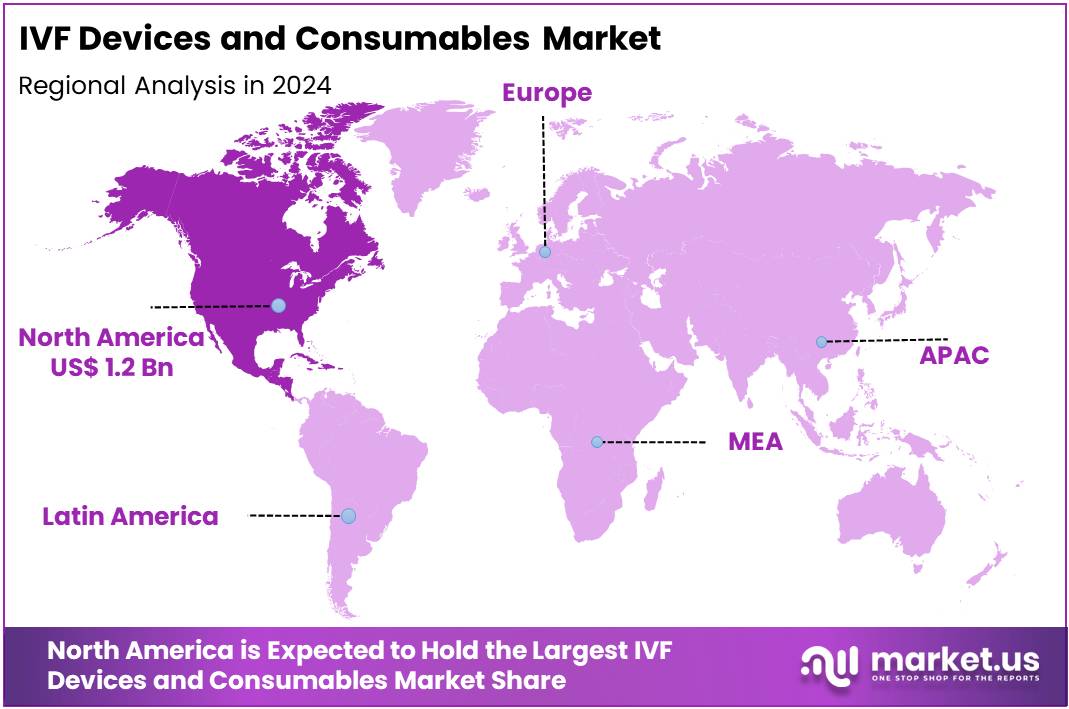
The Global IVF Devices and Consumables Market Size is expected to be worth around US$ 13.2 Billion by 2034, from US$ 2.8 Billion in 2024, growing at a CAGR of 16.8% during the forecast period from 2025 to 2034. North America held a dominant market position, capturing more than a 44.5% share and holds US$ 1.2 Billion market value for the year.
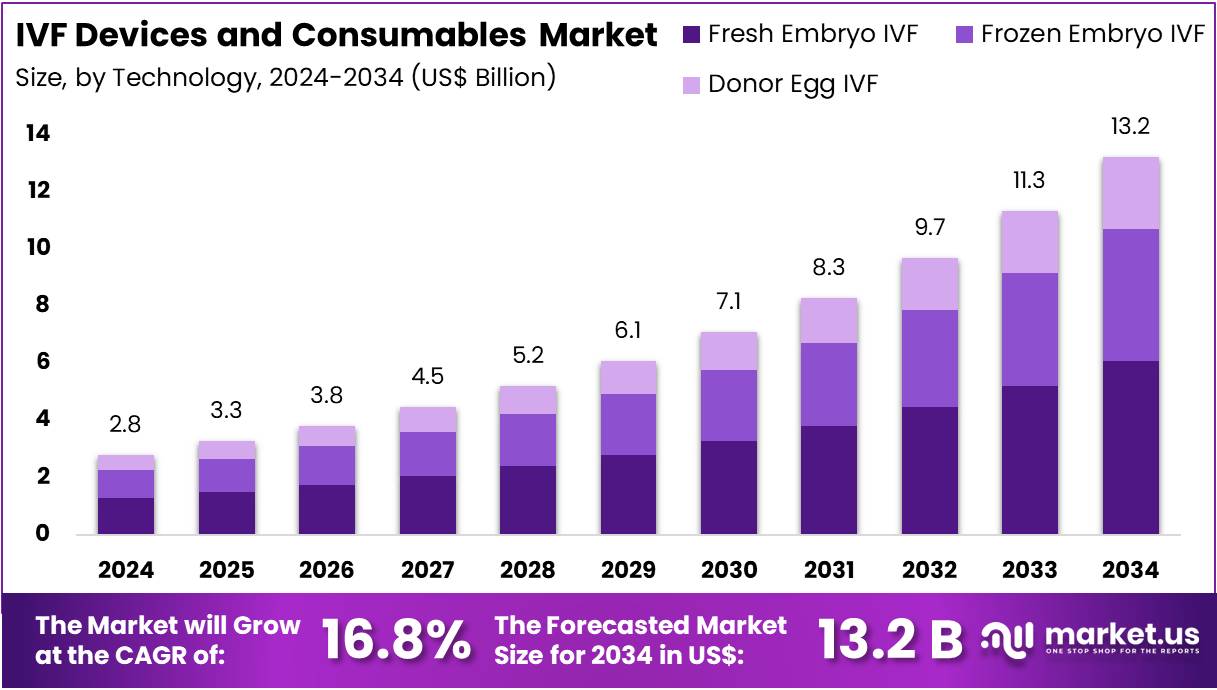
This growth is fueled by ongoing advancements in assisted reproductive technologies (ART), increasing infertility rates, and a rising trend of delayed parenthood, particularly in developed countries. IVF involves the laboratory fertilization of eggs followed by embryo transfer into the uterus and relies on a range of specialized devices such as incubators, micromanipulators, ultrasound machines, and cryopreservation systems as well as consumables such as culture media, needles, catheters, pipettes, and cryo-storage materials.
Europe currently holds a significant market share due to widespread awareness, greater access to advanced technologies, and a robust network of trained professionals. Meanwhile, the Asia-Pacific region is expected to witness the fastest growth, supported by rising infertility cases, improving healthcare infrastructure, growing disposable income, and increased acceptance of fertility treatments. Despite challenges including high treatment costs, ethical concerns, and complex regulatory landscapes, ongoing innovations are enhancing IVF success rates, making procedures more efficient and accessible.
In India, government initiatives to improve the regulation and availability of ART services are contributing to this growth trajectory. For example, in February 2024, the government of Telangana inaugurated the state’s first high-end IVF facility at Gandhi Hospital to support couples facing infertility. As fertility clinics continue adopting precision diagnostic tools and tailored treatment approaches, the integration of advanced IVF technologies is expected to improve clinical outcomes, drive cost-efficiency, and support global market expansion.
Key Takeaways
- In 2024, the market for IVF devices and consumables market generated a revenue of US$ 2.8 billion, with a CAGR of 16.8%, and is expected to reach US$ 13.8 Billion by the year 2034.
- The product type segment is divided into instruments, accessories and disposable reagents and media. Accessories and disposables taking the lead in 2023 with a market share of 43.2%.
- By technology type, fresh embryo IVF, frozen embryo IVF and donor egg IVF. Among these, fresh embryo IVF held a significant share of 38.2%.
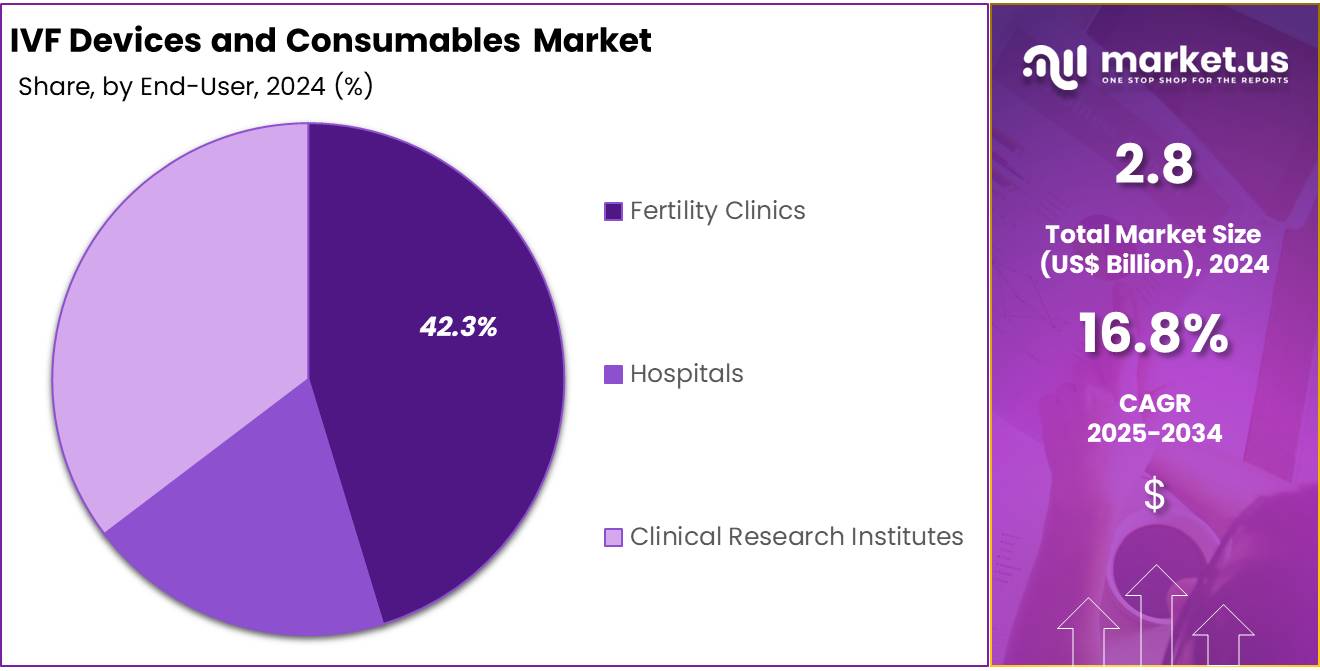
- By end users, the market is segregated into clinical research, fertility clinics, hospitals and surgical centers. The fertility clinics held the largest revenue share of 42.3% in the IVF devices and consumables market.
- North America led the market by securing a market share of 44.5% in 2024.
Product Type Analysis
In 2024, accessories and disposables held a dominant market position in the product type segment of IVF devices and consumables market, and capturing more than a 48.90% share. This dominance is attributed to their essential role throughout every stage of the IVF process and their single-use nature, which ensures sterility and significantly reduces the risk of cross-contamination, thereby maintaining the integrity of gametes and embryos.
These products such as catheters, needles, and culture dishes are consumed at a high rate during each IVF cycle, leading to continuous demand across fertility clinics and laboratories, unlike reusable instruments, which have a longer lifecycle. Their contribution to enhancing procedural efficiency, safety, and consistency underscores their critical importance in modern assisted reproductive techniques.
Furthermore, technological advancements, including the integration of specialized algorithms, are enhancing the analysis of reproductive health conditions by improving the interpretation of laboratory data and diagnostic precision in fertility treatments. This evolution is fuelling growth in the software and digital tools associated with IVF, making them increasingly vital in clinical decision-making.
- For instance, in May 2024, Vitrolife AB announced its acquisition of eFertility, a move aimed at expanding its capabilities in digitalizing and standardizing IVF procedures across global clinics, marking a strategic step toward improving outcomes and operational efficiency in reproductive health.
Technology Type Analysis
In 2024, Fresh Embryo IVF held a dominant market position in the technology type segment of IVF devices and consumables market, and capturing more than a 38.2% share. This segment leads assisted reproductive technologies due to its higher implantation potential, quicker time to pregnancy, and natural synchronization with the endometrial lining.
Unlike frozen embryo transfer (FET), fresh embryo IVF eliminates the need for cryopreservation, which removes the risks associated with freezing that could affect embryo viability. The main advantage of fresh embryo IVF is the reduced treatment timeline, as the fertilized embryos are directly transferred to the uterus within the same cycle, avoiding the need for cryopreservation. This process minimizes the potential risks linked to freezing and thawing, thereby preserving the embryos’ quality and viability.
Additionally, the fresh embryo transfer procedure aligns with the body’s natural hormonal environment, which can improve implantation success. Since fresh embryos are used soon after fertilization, the process is more streamlined and straightforward for patients, making it a preferred choice in certain cases. These benefits, coupled with careful monitoring and advanced techniques, contribute to the effectiveness and appeal of fresh embryo IVF in assisted reproduction.
- Data from the Human Fertilisation and Embryology Authority (HFEA) indicate that the pregnancy rate per embryo transferred during fresh IVF cycles is around 41% for women aged 18-34, highlighting its high success rate in younger patients.
End-User Analysis
In 2024, fertility clinics IVF held a dominant market position in the end users segment of IVF devices and consumables market, and capturing more than a 42.3% share. Fertility clinics have a significant role in the IVF market due to their ability to meet the increasing demand for infertility treatments, driven by the rise in the number of clinics and their high success rates. This success is attributed to high patient volumes, specialized expertise, and the growing demand for assisted reproductive technologies.
The rising prevalence of infertility, influenced by factors such as delayed childbearing and medical conditions, has led to an increased need for IVF treatments, further fuelling demand for IVF consumables. Moreover, fertility clinics are adopting advanced technologies, such as time-lapse imaging, preimplantation genetic testing (PGT), and AI-assisted embryo selection, which require high-quality consumables to ensure precision and success.
Collaborations with manufacturers and distributors ensure access to top-tier equipment, while growing awareness and supportive government initiatives make fertility clinics central to the ongoing evolution of IVF technologies. The establishment of new fertility clinics also significantly contributes to the segment’s growth.
- For instance, in August 2023, Reproductive Medicine Associates (RMA), one of the top providers of reproductive services in the U.S., and the U.S. division of IVI-RMA Global, announced that it has acquired Conceptions Reproductive Associates of Colorado (Conceptions). With this acquisition, RMA expanded its network, including Colorado among its 25 fertility centers across New Jersey, Pennsylvania, Florida, Texas, California, and Washington.
- Also, in January 2025, IVI RMA North America, announced the acquisition of three well-known fertility clinics in Southern California from Global Premier Fertility: Reproductive Health and Wellness Center (RHWC), Rise Fertility, and Halo Fertility.
Key Market Segments
By Product Type
- Instruments
- Incubators
- Cryosystems
- Ovum Aspiration Pumps
- Sperm Separation System
- Imaging Systems
- Cabinets
- Micromanipulators
- Others
- Accessories and Disposables
- Catheters
- Needles
- Culture Dishes
- Reagents and Media
- Embryo Culture Media
- Cryopreservation Media
- Semen Processing Media
- Ovum Processing Media
By Technology
- Fresh Embryo IVF
- Frozen Embryo IVF
- Donor Egg IVF
By End-User
- Fertility Clinics
- Hospitals
- Clinical Research Institutes
Drivers
Increase in Infertility Rates
The IVF devices and consumables market is experiencing significant growth, largely driven by rising infertility rates. The increasing prevalence of infertility, which is influenced by delayed pregnancies, lifestyle changes, stress, and environmental factors, has led to a higher demand for advanced IVF tools that ensure precision and success in treatments. These tools play a crucial role in assisted reproductive technologies, supporting procedures such as egg retrieval, embryo culture, and embryo transfer, ultimately addressing infertility and facilitating successful conception and pregnancy.
Advances in minimally invasive techniques, including micromanipulation tools, have significantly enhanced the efficiency, precision, and patient comfort during IVF procedures, thereby improving overall outcomes. The social and economic impacts of infertility, such as mental health challenges, marital stress, and financial strain, have also intensified.
- The World Health Organization (WHO) reports that infertility now affects one in six people globally, with an estimated 10 million couples likely to face conception difficulties by 2025. Over the last three decades, infertility prevalence has increased by 0.5% annually in men and 0.7% annually in women, with population growth contributing to 65% of the overall burden.
Restraints
High Cost of Devices
The high cost of IVF devices and consumables is a significant barrier to fertility treatment, creating financial burdens that limit access and strain healthcare resources. The rising cost of IVF treatments is driven by the increasing prevalence of infertility, the demand for advanced reproductive technologies, and the expensive medications and specialized equipment required for the procedures. Consequently, this affects the affordability and accessibility of IVF, making it unaffordable for many couples. Moreover, the high prices may trigger a shift toward cost-effective alternatives, prompting scrutiny and fostering the need for more affordable solutions.
- For example, the average cost of an IVF cycle in San Francisco is US$ 24,749, while in New Jersey, it stands at US$ 22,999. Cryolock® Vitrification Device for Oocyte and Embryo Cryopreservation costs around US$ 650.0 and Manual Micromanipulator costs around US$ 1,531.0. Local regulations and policies also play a role in shaping the cost of IVF treatments, further affecting accessibility for potential users.
Opportunities
Innovations in ART and Embryo Monitoring Technologies
The IVF devices and consumables market is experiencing significant growth, driven by innovations in imaging and embryo monitoring technologies. As consumer interest in advanced fertility solutions rises, the demand for effective and personalized assisted reproductive technologies (ART) is increasing. The most promising opportunities in this market are centered on time-lapse imaging systems and AI-based embryo selection tools, which are transforming the way embryos are assessed. These technologies allow for continuous observation and precise analysis of developmental patterns, which significantly enhances success rates.
Additionally, the need for specialized culture media and advanced incubators is growing, as these work in conjunction with imaging systems to provide optimal conditions for embryo development. Innovations such as time-lapse imaging and AI-powered embryo analysis enable non-invasive monitoring of embryo development, ensuring the selection of the most viable embryos, thus improving outcomes. These advancements also support personalized fertility treatments by integrating genomic data, tailoring approaches for individual patients and further boosting success rates.
The integration of these technologies with digital health platforms and telemedicine has the potential to increase accessibility, improve patient engagement, and streamline laboratory workflows by reducing manual interventions. Emerging markets with rising disposable incomes and increased awareness of fertility care represent untapped potential for these innovations.
A notable example of recent technological advancement occurred in April 2023, when researchers at the University of Technology Sydney, in collaboration with NeoGenix Biosciences, developed a ground-breaking microfluidic sperm selection device. This device offers a more reliable method for selecting high-quality sperm, mimicking the natural selection process within the female reproductive tract. These advancements collectively underscore the promising future of IVF and ART, offering new hope to many individuals and couples seeking to overcome infertility.
Impact of Macroeconomic / Geopolitical Factors
Macroeconomic and geopolitical factors significantly influence the IVF devices and consumables market. On the positive side, increasing healthcare investments globally and heightened awareness of fertility treatments are driving the demand for advanced IVF technologies. Growing support for healthcare initiatives, particularly in emerging regions, is improving access to these solutions. However, economic downturns can result in budget constraints, potentially slowing the adoption of IVF treatments, especially in underserved areas.
Geopolitical challenges, such as trade restrictions and political instability, can disrupt the supply chain for essential IVF devices and consumables, leading to higher costs and limited availability. Furthermore, differing regulatory standards across regions may present barriers to market entry and delay product approvals. Despite these challenges, the continued focus on enhancing fertility care accessibility, alongside ongoing advancements in reproductive technologies, is expected to sustain robust demand for IVF devices and consumables, supporting long-term market growth.
Latest Trends
Growth in Fertility Clinics & Medical Tourism
The global expansion of fertility clinics is shaping the in vitro fertilization (IVF) devices and consumables market. This growth is especially visible in emerging markets, where demand for assisted reproductive technologies is increasing. The rise in infertility rates, along with better awareness and improved IVF techniques, is driving this trend. For example, China currently has 539 public and private IVF centers. The National Health Commission aims to expand this network, targeting one facility per 2.3 million people by 2025, potentially increasing the total to over 600.
Medical tourism is also influencing the IVF market. Many patients are traveling abroad to access cost-effective and high-quality fertility treatments. Countries such as India, Thailand, and Mexico are leading destinations due to their advanced healthcare systems and lower treatment costs. This trend is increasing demand for modern IVF devices and consumables. The availability of specialized services in these countries has made them attractive options for individuals and couples seeking reproductive assistance from abroad.
India, in particular, has emerged as a key hub for fertility tourism. The country offers top-tier care, competitive pricing, and fewer legal restrictions for international patients. Donor eggs, sperm, and embryos are readily available. Women can choose to conceive through IVF or opt for a surrogate. Surrogacy is legal and widely practiced. India’s strong infrastructure for medical outsourcing further supports this growth. The number of foreign patients seeking infertility care, including surrogacy, has more than doubled in recent years, making India a global leader in the fertility tourism segment.
Regional Analysis
North America is Leading the IVF Device and Consumables Market
North America dominated the IVF devices and consumables market, largely due to its advanced healthcare infrastructure, which supports the adoption of cutting-edge fertility technologies. The increasing prevalence of infertility, influenced by factors such as lifestyle changes, delayed pregnancies, and stress, has driven a rising demand for IVF treatments in the region. Between 2012 and 2021, the number of ART procedures more than doubled, while the number of infants born through these methods grew by 49%. In 2021, one in every 42 babies born in the US was conceived through these treatments.
Technological advancements, particularly in cryopreservation techniques and embryo culture systems, have significantly improved the success rates of IVF procedures, further boosting market growth. The demand for customized and highly accurate IVF treatments is also on the rise, reinforcing North America’s leadership in the sector. Additionally, favorable government policies, supportive reimbursement frameworks, and health insurance coverage make fertility treatments more accessible, contributing to the expansion of IVF device usage.
- In October 2022, the US Office of Personnel Management announced updated Federal Benefits Open Season details for 2023, extending fertility coverage to nearly 9 million individuals, including employees, annuitants, and their families. Prominent fertility clinics and research centers in the US, particularly in states such as California, New York, Texas, and Massachusetts, continue to drive innovation, ensuring the region remains at the forefront of assisted reproductive technology. These factors collectively highlight North America’s continued dominance in the IVF market.
The Asia Pacific region is expected to experience the highest CAGR during the forecast period
Asia-Pacific region is poised to experience the highest compound annual growth rate (CAGR) during the forecast period, driven by a growing demand for advanced fertility treatments and reproductive technologies. Countries like China and India are making substantial investments in healthcare infrastructure, while a rising middle class with higher disposable incomes is fueling demand for innovative fertility solutions. In India, each year, over 45,000 IVF cycles are performed with a high success rate for international couples from countries such as the USA, Canada, Africa, China, Japan, the UK, and more.
IVF treatment in India has become a preferred destination for foreign couples, with many successfully achieving parenthood through the procedure. The region also faces a high prevalence of infertility, further increasing the need for efficient IVF treatments. Government initiatives to improve healthcare access and support modern reproductive technologies are accelerating market growth, positioning Asia-Pacific as one of the fastest-growing regions for IVF devices and consumables, with substantial opportunities for technological advancements in the future.
Key Regions and Countries
- North America
- US
- Canada
- Europe
- Germany
- France
- The UK
- Spain
- Italy
- Russia
- Netherland
- Rest of Europe
- Asia Pacific
- China
- Japan
- South Korea
- India
- Australia
- New Zealand
- Singapore
- Thailand
- Vietnam
- Rest of APAC
- Latin America
- Brazil
- Mexico
- Rest of Latin America
- Middle East & Africa
- South Africa
- Saudi Arabia
- UAE
- Rest of MEA
Key Players Analysis
The IVF devices and consumables market is witnessing a shift towards the development of advanced and highly efficient solutions aimed at improving success rates and optimizing treatment outcomes. Significant investments are directed towards research and development to innovate precision tools, consumables, and cutting-edge monitoring systems that enhance the effectiveness of IVF procedures.
Strategic collaborations with fertility clinics, healthcare providers, and regulatory bodies are instrumental in expanding the accessibility of IVF technologies and increasing global awareness. Furthermore, many companies are focusing on delivering cost-effective solutions while maintaining adherence to international standards, ensuring the widespread adoption and reliability of their products.
Top Key Players in the IVF devices and consumables Market
- Cook Group
- Merck KGaA
- Thermo Fisher Scientific
- FUJIFILM Holdings Corporation
- Cooper Surgical
- Vitrolife AB
- Hamilton Thorne Inc.
- Genea Biomedx
- Nidacon International
- Esco Medical
- Labotect
- MedGyn
- Memmert GmbH + Co. KG
Recent Developments
- In October 2024: Cook Medical introduced the NestVT Vitrification Device in the United States, offering a dependable solution for the vitrification, cryo-storage, and transport of embryos and oocytes. As part of this product launch, the company also emphasized its role as a comprehensive in-vitro fertilization (IVF) partner by providing simulation-based training and educational programs aimed at supporting professionals throughout the IVF process.
- In July 2023: Thermo Fisher Scientific launched two next-generation sequencing (NGS)-based tools designed to enhance genomic testing capabilities within reproductive health laboratories. The Ion ReproSeq PGT-A Kit and the Ion AmpliSeq Polyploidy Kit are tailored for preimplantation genetic testing for aneuploidy (PGT-A), commonly applied in IVF and intracytoplasmic sperm injection (ICSI) research. These assays are the first of their kind for reproductive health available on the Ion Torrent Genexus Integrated Sequencer, delivering an end-to-end workflow from sample preparation to result interpretation.
- In July 2022: FUJIFILM Irvine Scientific, Inc. unveiled its Heavy Oil for Embryo Culture, a sterile mineral oil developed to support embryo culture procedures. The product features an optimized weight viscosity, combining ease of handling with effective protective properties for enhanced performance in embryology laboratories.









