


Report Overview
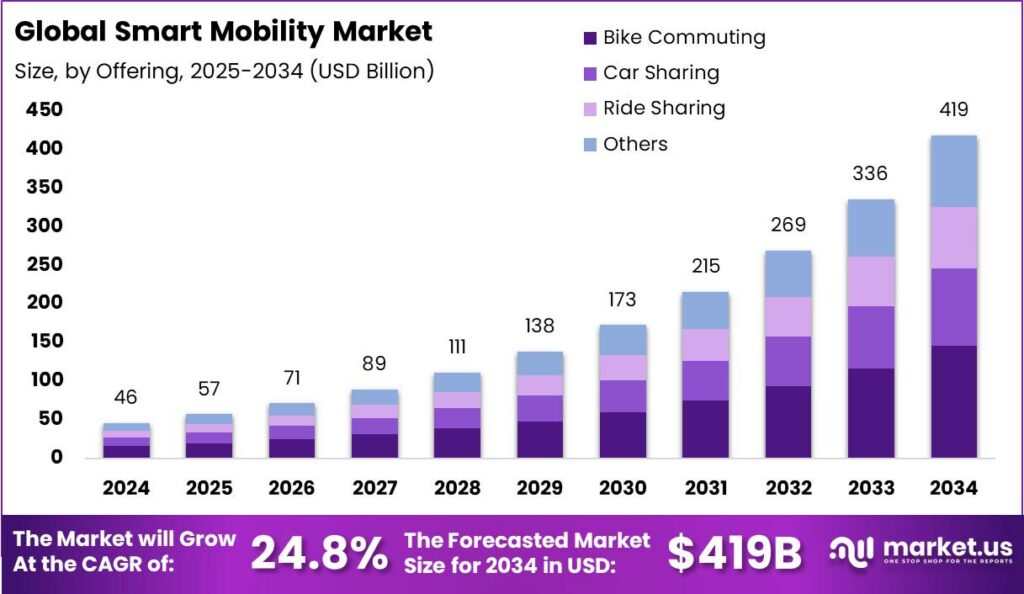
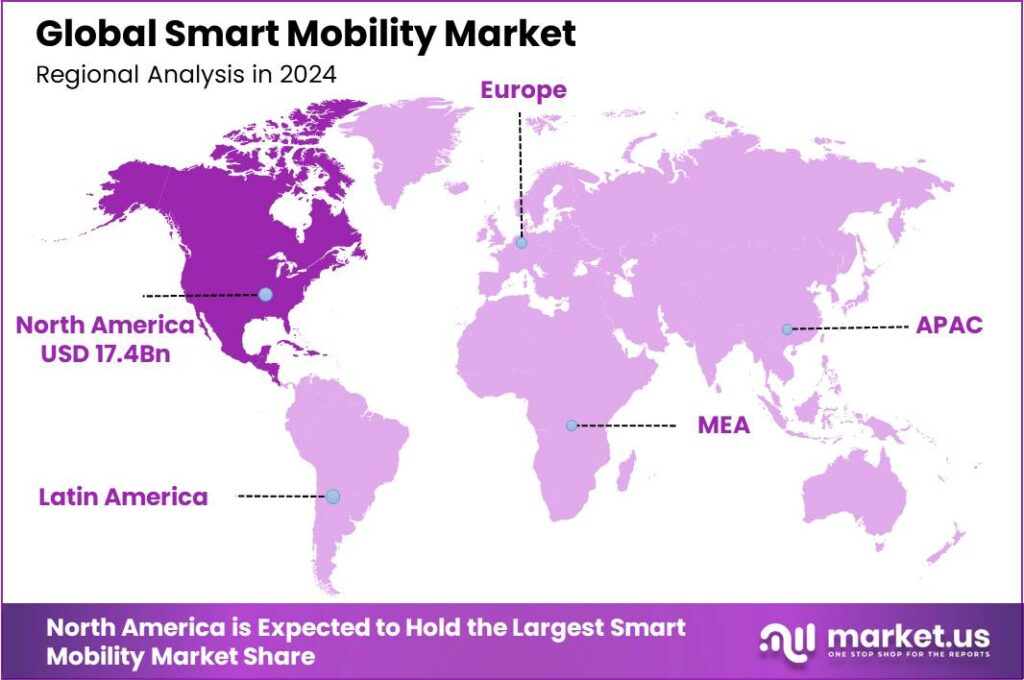
The Global Smart Mobility Market size is expected to be worth around USD 419 Billion By 2034, from USD 45.7 Billion in 2024, growing at a CAGR of 24.80% during the forecast period from 2025 to 2034. North America led the global smart mobility market in 2024, holding more than 38.2% of the market share, with revenues amounting to USD 17.4 billion.
Smart mobility represents a transformative approach to transportation that leverages technology to make moving from one place to another smoother, more efficient, and environmentally friendly. Smart mobility integrates innovations like autonomous vehicles, smart traffic systems, and shared mobility to enhance urban transport’s convenience and sustainability.
The demand for smart mobility is rising as cities tackle transportation inefficiencies and environmental challenges. Urban populations seek faster, greener, and more reliable transport options, driven by environmental awareness, shorter commute times, and better urban living. As a result, both public and private sectors are investing in smart mobility technologies to meet evolving consumer and city needs.
Advancements in technology, such as 5G, AI, and sensor improvements, have made smart mobility solutions more accessible and effective. Additionally, government policies and funding support the development of these projects, further driving market growth and contributing to the sector’s expansion.
AI is central to advancing smart mobility, enhancing traffic flow, managing shared vehicle fleets, and enabling autonomous vehicles. By leveraging machine learning and data analytics, AI can predict traffic patterns, recommend optimal routes, and improve safety features, transforming urban mobility and navigation.
Recent trends in the smart mobility market include the integration of IoT devices for real-time data collection and communication between vehicles and city infrastructure. The electrification of public and private transport is accelerating as part of the sustainability trend. MaaS platforms are growing, offering a unified interface for users to access multiple transport modes, simplifying the experience and encouraging shared transport.
The adoption of smart mobility solutions is primarily fueled by the need to address urbanization challenges, enhance road safety, and minimize environmental impact. Smart transport systems improve efficiency, saving time and reducing commute stress. They also support sustainable urban development by encouraging the use of energy-efficient, low-emission vehicles.
The market is set for continued growth, driven by advances in AI, IoT, and smart city initiatives. As technology evolves, transportation will become smarter, more efficient, and sustainable, aligning with global goals for a greener planet and livable cities. This shift promises to revolutionize urban mobility, making it more adaptive to individual needs and environmental considerations.
Key Takeaways
- The Global Smart Mobility Market size is projected to reach USD 419 Billion by 2034, growing from USD 45.7 Billion in 2024, with a compound annual growth rate (CAGR) of 24.80% during the forecast period from 2025 to 2034.
- In 2024, the Bike Commuting segment dominated the smart mobility market, holding more than 34.8% of the total market share.
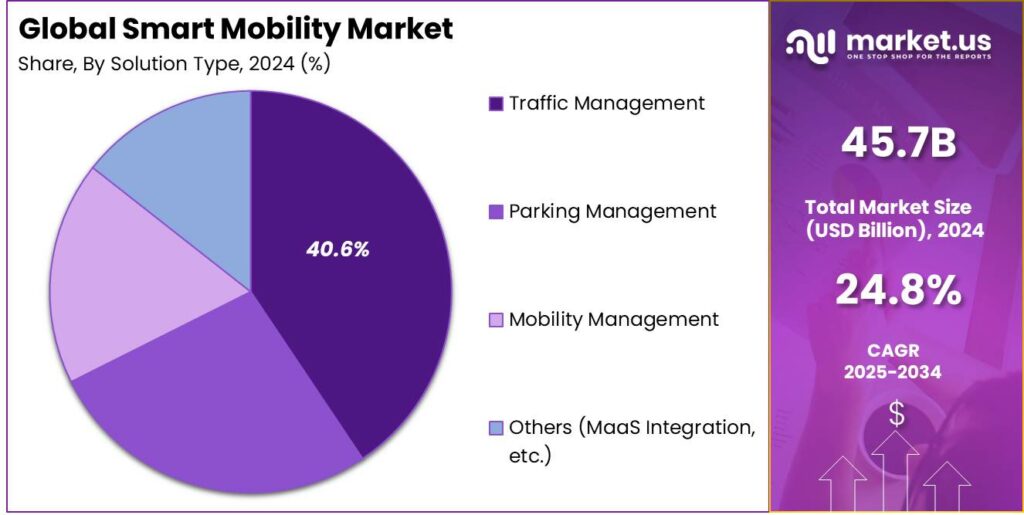
- The Traffic Management segment also held a leading position in 2024, capturing more than 40.6% of the market share.
- The AI & ML segment was a major contributor to the smart mobility market in 2024, accounting for more than 30.0% of the total market share.
- North America led the global smart mobility market in 2024, holding more than 38.2% of the market share, with revenues amounting to USD 17.4 billion.
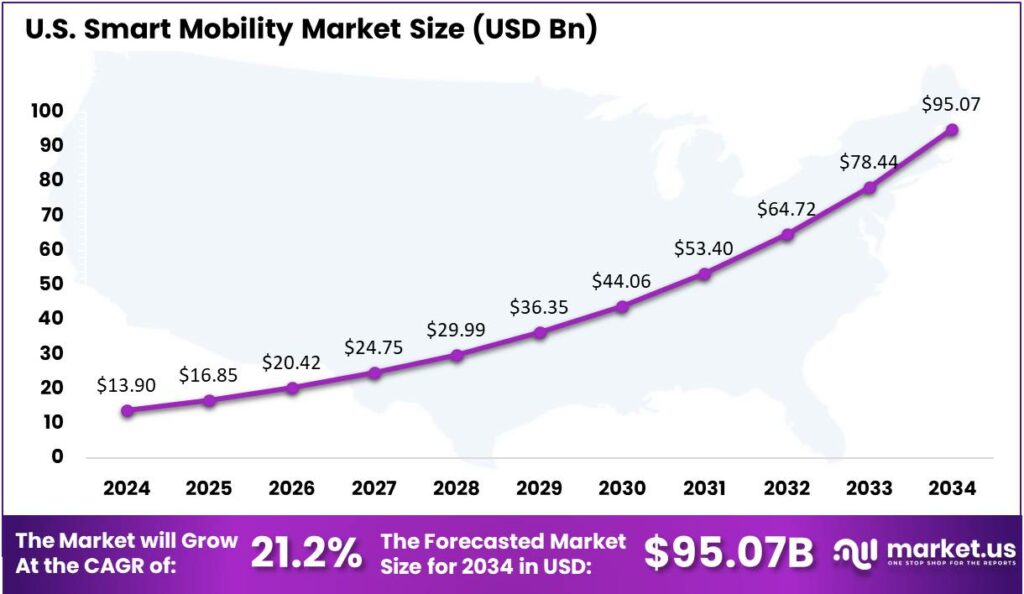
- In 2024, the U.S. Smart Mobility Market was valued at USD 13.9 billion, and it is expected to grow at a CAGR of 21.2%.
Analyst’s Viewpoint
Urbanization and the pressing need for sustainability drive the demand for smart mobility solutions. The integration of technologies such as Artificial Intelligence (AI), Internet of Things (IoT), and advanced sensor technologies like LiDAR and radar enhances the efficiency and safety of transportation systems, influencing market growth positively.
The smart mobility market is evolving rapidly with advancements in AI, blockchain, and 5G. AI optimizes traffic management, while blockchain enhances transaction security in shared mobility services. 5G connectivity supports real-time communication between vehicles and infrastructure, crucial for autonomous vehicle development. Recent partnerships and acquisitions are further driving growth in the sector.
The regulatory landscape for smart mobility is complex, with stringent requirements for safety, privacy, and data security posing challenges to market expansion. Effective management of these regulatory hurdles is crucial for the sustained adoption of smart mobility technologies.
U.S. Smart Mobility Market
In 2024, the U.S. Smart Mobility Market was estimated to be valued at USD 13.9 billion. It is projected to grow at a compound annual growth rate (CAGR) of 21.2%. Smart mobility, driven by IoT, AI, and big data, improves transportation efficiency, reduces environmental impact, and boosts urban connectivity. The market’s growth is fueled by rising urban populations, demand for low-emission transport, and investments in smart city projects.
Government policies and initiatives are vital for the growth of the smart mobility market. Incentives for electric vehicles, smart city grants, and regulations supporting sustainable transportation have accelerated the sector’s expansion. Furthermore, advancements in connectivity and autonomous driving technologies are poised to fuel continued growth.
The future of the smart mobility market looks promising, driven by ongoing technological innovations and a focus on sustainable urban development. As cities face congestion, demand for efficient, scalable, and clean transport options will rise. The integration of AI and machine learning will further enhance these systems, boosting adoption and market growth.
In 2024, North America held a dominant market position in the Smart Mobility Market, capturing more than a 38.2% share with revenues amounting to USD 17.4 billion. This leadership can be primarily attributed to the region’s robust technological infrastructure and the early adoption of advanced mobility solutions.
The strong presence of high-tech companies in the U.S. and Canada has created an ideal environment for the development of smart mobility technologies, including autonomous vehicles, integrated platforms, and IoT-enabled systems. The region’s focus on research and development, backed by both public and private investments, has reinforced its leadership.
Furthermore, stringent environmental regulations and a significant push towards reducing carbon emissions have accelerated the adoption of electric and hybrid vehicles across North America. Government incentives, like tax rebates for electric vehicle buyers and funding for smart city initiatives, have been key in driving the growth of the smart mobility sector.
The need to manage traffic congestion and the presence of advanced highway networks have increased demand for intelligent transportation systems (ITS) in North America. These systems use data analytics and communication technologies to improve traffic flow, safety, and reduce environmental impacts. As innovation and investment continue, North America’s market dominance in smart mobility is expected to grow, driving further advancements in sustainable transportation.
Offering Analysis
In 2024, the Bike Commuting segment held a dominant market position within the smart mobility market, capturing more than a 34.8% share. This substantial market share can be attributed to a growing consumer preference for healthier and more environmentally friendly modes of transportation.
Urban dwellers, in particular, are increasingly adopting bike commuting to avoid the congested traffic and pollution associated with car travel. Additionally, the proliferation of bike-sharing platforms, supported by advancements in technology and infrastructure, has made bike commuting more accessible and convenient for a broader audience.
The leadership of the Bike Commuting segment is strengthened by supportive government policies, including dedicated bike lanes and subsidies for bike purchase and maintenance. These initiatives aim to reduce urban traffic congestion and carbon emissions, aligning transportation policy with public health and environmental sustainability goals.
Economic factors also play a crucial role in the prominence of the Bike Commuting segment. Cycling is a cost-effective alternative to motorized transportation, requiring lower upfront investments and minimal maintenance costs. In the context of rising fuel prices and the ongoing economic instability, cost-conscious consumers are increasingly turning to bicycles as a practical transportation solution.
Solution Type Analysis
In 2024, the Traffic Management segment held a dominant position in the smart mobility market, capturing more than a 40.6% share. This leadership can be attributed to the escalating need for efficient traffic flow and reduced congestion in densely populated urban areas.
Traffic management systems utilize advanced technologies such as AI and IoT to optimize traffic signals, monitor road conditions, and provide real-time data to commuters and city planners. The high adoption rate of these systems by municipal governments seeking to enhance urban mobility and minimize traffic-related emissions has significantly propelled the growth of this segment.
Following traffic management, the Parking Management segment also plays a crucial role in the smart mobility market. As urban congestion grows, the demand for smart parking solutions has increased. Sensor-based guidance and mobile app integrations offer drivers convenience and help reduce traffic caused by searching for parking spaces.
The Mobility Management segment enhances public transport efficiency and user experience through smart ticketing, real-time tracking, and multimodal integration. As urban populations seek to reduce personal vehicle use, this segment grows, promoting accessibility, reducing costs, and encouraging public transport, supporting sustainable urban development.
Technology Analysis
In 2024, the AI & ML segment held a dominant market position in the Smart Mobility Market, capturing more than a 30.0% share. This leadership is largely due to the pivotal role these technologies play in enhancing the intelligence and efficiency of transportation systems.
Artificial Intelligence (AI) and Machine Learning (ML) are at the forefront of transforming transportation through advanced predictive analytics and decision-making capabilities. These technologies enable real-time traffic management, route optimization, and predictive maintenance of vehicles, which improve operational efficiencies and reduce costs.
Moreover, AI and ML contribute to the enhancement of safety in transportation systems. Through the integration of these technologies, vehicles and infrastructure can better predict and react to potential hazards, thus reducing the risk of accidents. The increasing focus on safety by both regulators and the public has propelled the adoption of AI and ML technologies in smart mobility solutions.
Advancements in AI and ML drive ongoing improvements in transportation technology, making systems more adaptive and intelligent. Increased investment by tech companies ensures that AI and ML will continue to shape innovations in the smart mobility sector, solidifying their role as key drivers in its evolution.
Key Market Segments
By Offering
- Bike Commuting
- Car Sharing
- Ride Sharing
- Others (Smart Parking, etc.)
By Solution Type
- Traffic Management
- Parking Management
- Mobility Management
- Others (MaaS Integration, etc.)
By Technology
- AI & ML
- IoT
- Global Positioning System (GPS)
- Radio Frequency Identification (RFID)
- Embedded System
- Others (Cloud Computing, etc.)
Key Regions and Countries
- North America
- US
- Canada
- Europe
- Germany
- France
- The UK
- Spain
- Italy
- Rest of Europe
- Asia Pacific
- China
- Japan
- South Korea
- India
- Australia
- Singapore
- Rest of Asia Pacific
- Latin America
- Brazil
- Mexico
- Rest of Latin America
- Middle East & Africa
- South Africa
- Saudi Arabia
- UAE
- Rest of MEA
Driver
Rapid Urbanization and Population Growth
The swift pace of urbanization and the accompanying surge in population have significantly heightened the demand for efficient and sustainable transportation solutions. As cities become more densely populated, traditional transportation infrastructures are increasingly strained, leading to congestion, longer commute times, and elevated pollution levels.
Smart mobility solutions, encompassing integrated public transit systems, shared mobility services, and non-motorized transport options, have emerged as viable responses to these challenges. By leveraging technology to optimize transportation networks and reduce reliance on private vehicles, these solutions aim to enhance urban livability and environmental sustainability.
Restraint
Inadequate Infrastructure in Developing Regions
The expansion of smart mobility solutions is often hindered by insufficient infrastructure, particularly in developing regions. The effectiveness of services such as ride-hailing and car-sharing is contingent upon robust internet connectivity and widespread smartphone usage.
However, in areas with limited internet penetration and technological adoption, the deployment and utilization of these services face significant obstacles. For instance, many countries exhibit low internet penetration rates, which impedes the adoption of internet-dependent mobility services.
This digital divide not only limits access to smart mobility options but also exacerbates existing transportation challenges, highlighting the need for infrastructural development to support modern mobility solutions.
Opportunity
Integration of Electric Vehicles (EVs) into the Grid
The integration of electric vehicles (EVs) presents a substantial opportunity within the smart mobility landscape. EVs contribute to the reduction of greenhouse gas emissions and decrease reliance on fossil fuels, aligning with global sustainability objectives. Furthermore, advancements in vehicle-to-grid (V2G) technology enable EVs to interact with the power grid, allowing for bidirectional energy flow.
This capability facilitates the stabilization of the grid by enabling EVs to store excess energy and supply it back during peak demand periods, thereby enhancing energy efficiency and providing potential economic benefits to EV owners. China’s pilot V2G projects in cities like Beijing and Shanghai demonstrate its practical use in balancing power supply and demand.
Challenge
Data Privacy and Cybersecurity Concerns
The proliferation of connected vehicles and smart mobility services has raised significant concerns regarding data privacy and cybersecurity. Modern vehicles are equipped with sensors and communication technologies that collect and transmit vast amounts of data, including location information, driving behavior, and personal preferences.
While this data is instrumental in enhancing user experience and optimizing transportation systems, it also poses risks related to unauthorized access and potential misuse. Instances of data breaches or cyberattacks can lead to identity theft, financial fraud, and erosion of consumer trust.
Addressing these challenges necessitates the implementation of robust data protection measures, adherence to privacy regulations, and the development of secure communication protocols to safeguard user information in the smart mobility ecosystem.
Key Growth Factors
- Urbanization and Population Growth: As cities become more populated, the demand for efficient and sustainable transportation solutions increases. This shift encourages the development of smart mobility options to alleviate congestion and improve urban living conditions.
- Environmental Concerns: The need to reduce greenhouse gas emissions has led to the adoption of eco-friendly transportation alternatives. Electric vehicles and improved public transit systems are being integrated to promote cleaner urban mobility.
- Technological Advancements: Innovations such as the Internet of Things (IoT) and artificial intelligence have enhanced transportation systems. These technologies enable real-time data sharing and improved traffic management, contributing to smarter mobility solutions.
- Government Initiatives: Policies and investments aimed at developing smart cities and sustainable transport infrastructure play a crucial role. Supportive regulations and funding facilitate the implementation of smart mobility projects.
- Shift in Consumer Preferences: There is a growing preference for shared mobility services and alternative transportation modes over personal vehicle ownership. This trend is driven by the desire for cost-effective and flexible travel options.
Emerging Trends
The landscape of urban transportation is undergoing significant transformation, driven by technological advancements and evolving societal needs. A prominent trend is the adoption of electric vehicles (EVs), which aim to reduce carbon emissions and promote environmental sustainability. Concurrently, autonomous vehicle technology is advancing, with self-driving cars and trucks poised to enhance safety and efficiency on roads.
The integration of the Internet of Things (IoT) into transportation systems facilitates real-time data exchange between vehicles and infrastructure, leading to improved traffic management and reduced congestion. Additionally, Mobility-as-a-Service (MaaS) platforms are gaining traction by consolidating various transportation modes into a single accessible service, streamlining urban travel.
Micromobility solutions, such as e-scooters and bike-sharing programs, are becoming prevalent in densely populated areas, offering convenient alternatives for short-distance commutes. Smart infrastructure, such as connected traffic signals and autonomous vehicle lanes, supports the smooth operation of these innovations, reshaping urban mobility into more efficient, sustainable, and user-centric systems.
Business Benefits
Smart mobility solutions provide significant benefits for businesses and urban economies. By optimizing transportation systems, they reduce traffic congestion, improving delivery schedules and operational efficiency for logistics-dependent companies. The promotion of EVs and shared transport also lowers carbon emissions, supporting corporate sustainability goals and reducing environmental compliance costs.
Enhanced road safety through autonomous technologies and IoT integration can decrease accident rates, resulting in lower insurance premiums and fewer disruptions. Smart mobility initiatives can drive economic growth by attracting tourism and fostering innovation, making cities with advanced transport networks hubs for tech startups and investors.
Businesses can save costs by reducing vehicle fleets through shared mobility and cutting fuel and maintenance expenses. Embracing smart mobility supports environmental sustainability, enhances economic efficiency, and opens new business development opportunities.
Key Player Analysis
The market has seen several prominent companies making significant contributions, each with unique solutions to tackle global transportation challenges.
Robert Bosch GmbH is a global leader in the smart mobility market, known for its strong focus on automotive technology. The company provides a wide range of products and services that enhance the connectivity and automation of vehicles. Bosch’s innovations in electric mobility, autonomous driving, and mobility services are key drivers.
Cisco Systems, Inc. is another significant player in the smart mobility space. Known for its leadership in networking and communication technology, Cisco leverages its expertise in the Internet of Things (IoT) to enable smarter transportation systems. The company focuses on creating intelligent infrastructure for connected cities and smart traffic management.
Innoviz Technologies Ltd. stands out in the smart mobility sector due to its expertise in LiDAR (Light Detection and Ranging) technology. LiDAR is a crucial component in autonomous driving systems, helping vehicles to “see” their surroundings in 3D. Innoviz’s high-performance LiDAR sensors provide accurate data for self-driving cars, making them safer and more efficient.
Top Key Players in the Market
- Robert Bosch GmbH
- Cisco Systems, Inc.
- Innoviz Technologies Ltd.
- Ford Motor Company
- Mindteck
- Siemens AG
- Excelfore Corporation
- Toyota Motor Corporation
- QuaLiX Information System LLP
- TomTom International BV
- Others
Top Opportunities for Players
The smart mobility market is poised for significant expansion, offering numerous opportunities for industry players.
- Expansion in Bike Commuting: The bike commuting sector is expected to grow robustly due to its eco-friendly and cost-effective nature. This trend is driven by increasing environmental awareness and the development of infrastructure that supports cycling in urban areas.
- Advancements in Parking Management Solutions: There is a growing demand for smart parking management solutions, which utilize advanced technologies to enhance the effectiveness of parking systems. These solutions are increasingly adopted in developed countries and are expected to witness substantial growth, providing lucrative opportunities for businesses specializing in smart mobility technologies.
- Integration of RFID Technology: The use of Radio Frequency Identification (RFID) technology in smart mobility solutions, especially in public transportation for access control and fare collection, is gaining traction. This technology enhances the efficiency of transportation services and is a key driver for the market. The adoption of RFID-based systems presents significant business opportunities in the development and deployment of these technologies.
- Growth in Smart City Initiatives: The development of smart cities that integrate various aspects of smart mobility, including IoT-enabled transportation and autonomous vehicles, is a major opportunity. Regions like North America and Asia-Pacific are leading in the adoption of these technologies, driven by strong governmental support and high levels of technological integration.
- Advancements in Technology and Connectivity: The smart mobility market is greatly benefiting from advancements in technologies such as AI, IoT, and machine learning. These technologies are revolutionizing traffic management, enhancing safety, and providing personalized travel experiences. Companies that can leverage these technologies to improve mobility solutions are likely to see significant growth.
Industry News
- In September 2024, Bosch showcased advanced technologies at the Bosch Mobility Experience 2024, including innovations in electrification, software, and automation, aiming to support evolving consumer needs.
- In March 2025, DENSO, a top mobility supplier, will showcase its smart mobility brand, MobiQ, at the Tennessee Smart Mobility Expo in Nashville on April 2-3. The event offers a prime opportunity to highlight MobiQ’s innovative solutions, strengthen local partnerships, and explore new collaborations with tech, fleet, and government leaders to advance transportation.
- In April 2025, Tata Motors, a key player in India’s auto industry, is gearing up to launch the iconic Tata Sierra. The near-production model, showcased at the Bharat Mobility Expo 2025, has already sparked excitement. With its bold new design, powerful petrol and diesel engine options, and a host of modern features, the Sierra is set for a thrilling comeback.









