


Report Overview
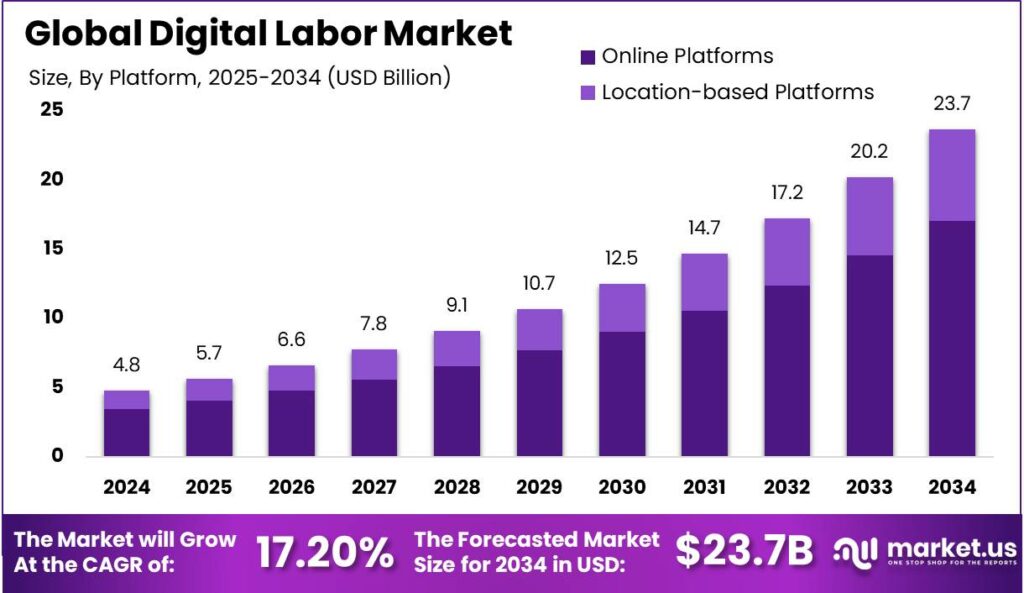
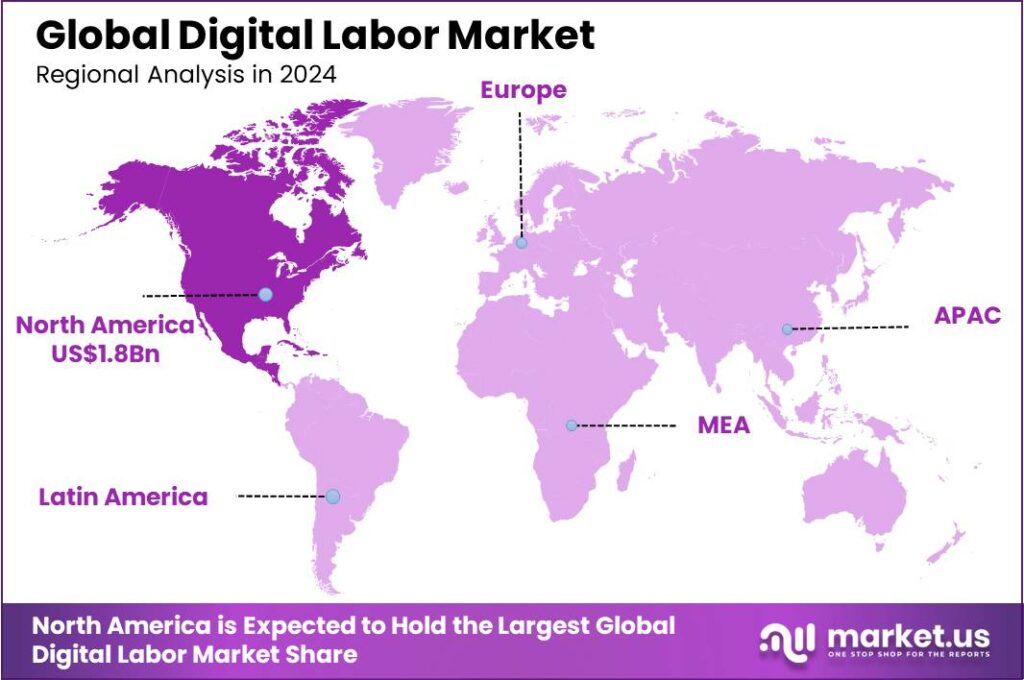
The Global Digital Labor Market size is expected to be worth around USD 23.7 Billion By 2034, from USD 4.84 Billion in 2024, growing at a CAGR of 17.20% during the forecast period from 2025 to 2034. In 2024, North America was the leading region, with a 38.4% market share, generating around $1.8 billion in revenue.
The digital labor market comprises the various platforms and environments where digital work is performed. These platforms, both location-based and online, facilitate the connection between workers and the services they provide remotely or in specific locations. This sector has significantly expanded over recent decades, offering new employment and income opportunities while also presenting challenges in ensuring decent work conditions.
The growth of digital labor platforms has transformed traditional employment structures, reducing entry barriers but also raising concerns about job security and workers’ rights. The expansion of the digital labor market is driven by several key factors including the increasing integration of AI and automation technologies, which enhance productivity and efficiency.
Demand in the digital labor market is rising as organizations aim to cut costs and improve service delivery. Businesses are adopting digital labor to handle repetitive tasks, allowing human employees to focus on more strategic and creative work. This shift optimizes workforce allocation and boosts job satisfaction by reducing mundane tasks.
Recent trends in the digital labor market include the widespread adoption of AI and robotic process automation (RPA), which are being integrated into various business processes to enhance speed and accuracy. These technologies are particularly appealing due to their ability to automate routine tasks, allowing human workers to focus on more complex and strategic activities.
The expansion of the digital labor market is creating significant opportunities for both technology developers and adopters. Developers have the chance to innovate advanced AI and machine learning solutions tailored to specific industries. Meanwhile, businesses can leverage digital labor technologies to improve process efficiency, gain a competitive edge, and respond more agilely to market changes.
Key Takeaways
- The Global Digital Labor Market is projected to be valued at USD 23.7 Billion by 2034, up from USD 4.84 Billion in 2024, representing a CAGR of 17.20% from 2025 to 2034.
- In 2024, the Online Platforms segment held a dominant position, accounting for more than 72.1% of the total market share.
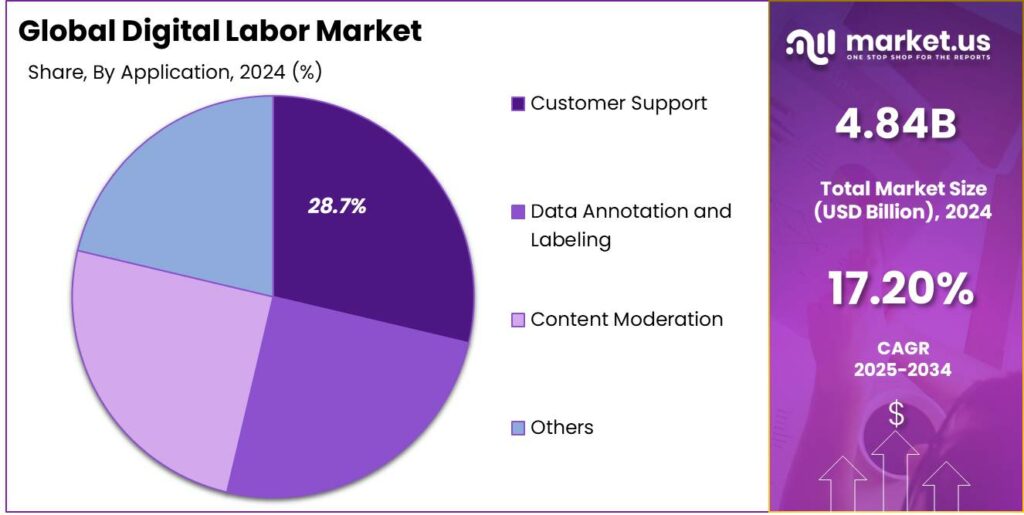
- The Customer Support segment was also a key player in the digital labor market, capturing over 28.7% of the market share in 2024.
- In 2024, North America was the leading region, with a 38.4% market share, generating around $1.8 billion in revenue.
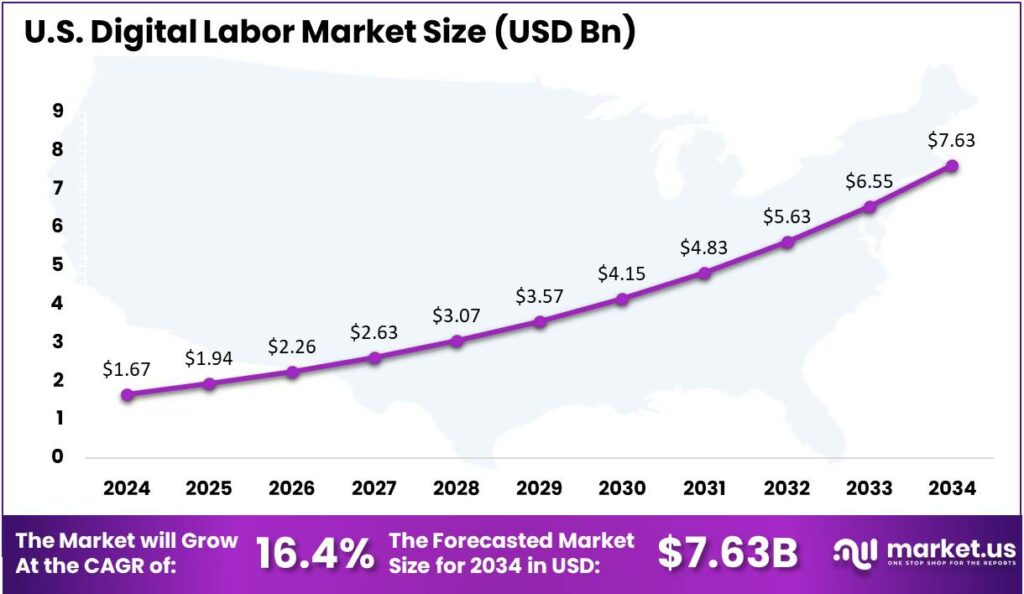
- The U.S. digital labor market alone was valued at $1.67 billion in 2024 and is expected to grow at a CAGR of 16.4%.
Business Benefits
Digital labor significantly enhances productivity by automating routine and repetitive tasks, allowing human employees to focus on more complex and value-added activities. This shift not only speeds up operations but also reduces the potential for human error, making processes more efficient.
According to the Adobe Blog, automation and AI are helping small businesses operate more efficiently and intelligently. Around 85% of small businesses say automation has significantly increased their productivity. Meanwhile, 92% of employees in businesses embracing AI report positive outcomes, with 22% even describing the impact as transformative.
The LumApps report highlights that by offloading routine tasks to digital workers, employees are freed up to focus on more impactful and fulfilling work. In fact, studies show that employees who work remotely at least once a month are 24% more likely to experience greater happiness in their roles.
By automating customer service functions, digital labor can significantly enhance the customer experience. AI-powered agents provide quick and accurate responses to customer queries, reduce waiting times, and are available 24/7, ensuring that customer needs are met promptly.
Impact Of AI On Digital Labor
- Job Creation: Contrary to fears of massive job losses, AI has been a catalyst for creating new job opportunities. Historical trends show that technological advancements, like personal computers, haven’t eliminated jobs but shifted them to roles requiring advanced skills, such as digital marketing and cybersecurity.
- Boosting Productivity: AI significantly enhances productivity across various sectors by automating routine tasks, allowing human workers to focus on more complex and innovative activities. This increase in productivity can lead to economic growth, with estimates suggesting that generative AI could add trillions to the global economy.
- Enhancing Job Quality: AI also improves the quality of jobs by automating the mundane and repetitive aspects, allowing employees to engage in more meaningful and creative work. This shift not only makes jobs more enjoyable but also enhances employee satisfaction and efficiency.
- Skills Development: As the workplace evolves, there is a growing need for new skills. AI drives demand for technical skills like AI development and data analysis, alongside soft skills such as critical thinking and interpersonal communication. This development encourages continuous learning and skill enhancement, which is vital in the modern economy.
- Economic Inclusivity: AI can contribute to more inclusive economic growth by enabling new business models and markets. For instance, AI technologies allow for the creation of virtual work environments and services that can be accessed by a broader range of people, including those in remote or underserved regions.
U.S. Digital Labor Market
The U.S. digital labor market reached a valuation of $1.67 billion in 2024. It is projected to expand at a compound annual growth rate (CAGR) of 16.4%. This robust growth is primarily driven by the increasing adoption of digital platforms across various sectors, including healthcare, finance, and education.
As businesses continue to embrace digital transformation, the demand for skilled digital labor, encompassing areas such as data analysis, software development, and digital marketing, has surged significantly.
The digital labor market’s expansion is also influenced by the government’s supportive policies toward tech-driven initiatives and innovation. High-speed internet infrastructure and STEM education boost digital labor market growth, while the rise of gig and freelance work drives demand for flexible, platform-based jobs.
Looking ahead, the U.S. digital labor market is expected to maintain its growth trajectory, bolstered by ongoing technological advancements and the increasing necessity for businesses to integrate digital operations. This growth indicates not only the resilience but also the dynamic adaptability of the market to changing economic and technological landscapes.
In 2024, North America held a dominant position in the global digital labor market, capturing more than a 38.4% share, with revenue reaching approximately $1.8 billion. This substantial market share is largely attributable to the region’s advanced technological infrastructure and the high concentration of leading tech companies like Google, Microsoft, and Amazon.
The region’s commitment to fostering technological advancements is further supported by significant investments in research and development from both public and private sectors. North America’s robust educational system, particularly in STEM fields, continuously supplies the digital labor market with a skilled workforce adept in handling the complexities of new technologies.
Moreover, North America’s digital labor market benefits from a mature gig economy, where freelance and remote work arrangements are widely accepted and facilitated by legal and infrastructural frameworks. This adaptability in work models attracts a diverse pool of digital talent, catering to the dynamic needs of industries undergoing digital transformation.
North America’s strong technological infrastructure, supportive policies, and innovation-driven culture help it maintain leadership in the digital labor market. As businesses adopt digital solutions and the workforce embraces flexibility, the region is poised to sustain growth and lead the global digital labor market.
Platform Analysis
In 2024, the Online Platforms segment held a dominant position in the digital labor market, capturing more than 72.1% of the market share. This significant dominance can be attributed to several key factors that distinguish online platforms from location-based alternatives.
Online platforms offer unparalleled flexibility and accessibility to both employers and workers. They enable companies to tap into a global talent pool, which is particularly beneficial for businesses seeking specialized skills that are scarce in their local markets. This global reach, coupled with the ability to operate beyond geographical and time zone limitations, substantially drives the preference for online platforms.
These online platforms have been at the forefront of adopting advanced technologies that facilitate efficient matching of job seekers with the right opportunities. Technologies such as AI and machine learning are employed to refine search results and recommendations, improving the fit between project requirements and worker skills. This technology-driven efficiency not only enhances user experience but also increases work productivity.
Moreover, the cost-effectiveness of online platforms plays a crucial role in their dominance. For businesses, the lower operational costs associated with hiring through online platforms, such as reduced overheads and the absence of physical recruitment infrastructure, are highly advantageous. For workers, the ability to engage in multiple projects or gigs without the need to commute further adds to the attractiveness of online platforms.
Application Analysis
In 2024, the Customer Support segment held a dominant market position within the digital labor market, capturing more than a 28.7% share. This prominence can be attributed to the increasing need for businesses to enhance customer experience and maintain competitive advantages in digital spaces.
As companies across sectors continue to prioritize customer satisfaction, the demand for digital tools and personnel capable of managing customer interactions efficiently has surged. This segment benefits from the integration of advanced technologies such as AI-driven chatbots and automated response systems, which help in managing large volumes of inquiries and providing 24/7 support.
Furthermore, the expansion of e-commerce and online services has necessitated robust customer support frameworks that can operate across multiple digital platforms. Companies are investing in digital customer support solutions not only to handle queries but also to gather customer feedback, which is vital for improving products and services.
Additionally, the rise of remote working models has made it easier for companies to employ a geographically dispersed customer support workforce. This flexibility has cut overhead costs and expanded the talent pool, boosting growth. Digital platforms for remote collaboration are key to this expansion, improving efficiency and responsiveness in customer support.
Key Market Segments
By Platform
- Location-based Platforms
- Online Platforms
By Application
- Customer Support
- Data Annotation and Labeling
- Content Moderation
- Others
Key Regions and Countries
- North America
- US
- Canada
- Europe
- Germany
- France
- The UK
- Spain
- Italy
- Rest of Europe
- Asia Pacific
- China
- Japan
- South Korea
- India
- Australia
- Singapore
- Rest of Asia Pacific
- Latin America
- Brazil
- Mexico
- Rest of Latin America
- Middle East & Africa
- South Africa
- Saudi Arabia
- UAE
- Rest of MEA
Driver
Technological Advancements and Increased Internet Penetration
The proliferation of digital labor platforms is significantly driven by rapid technological advancements and widespread internet penetration. The advent of high-speed internet and the ubiquity of smartphones have facilitated seamless connectivity, enabling workers and clients to interact effortlessly across the globe.
This connectivity allows digital platforms to offer a diverse array of services, ranging from software development to graphic design, transcending geographical boundaries. Furthermore, the integration of advanced technologies like artificial intelligence and machine learning has enhanced the efficiency of these platforms, making them more appealing to both workers and employers.
Restraint
Lack of Social Protections and Job Security
Despite the growth of digital labor platforms, a significant restraint is the absence of social protections and job security for workers. Many platforms classify workers as independent contractors, thereby circumventing traditional employment benefits such as health insurance, retirement plans, and paid leave. This classification leaves workers vulnerable, with limited avenues for dispute resolution or collective bargaining.
Additionally, the algorithmic management employed by these platforms can lead to unpredictable work availability and income instability. The lack of regulatory frameworks for digital labor worsens issues like unfair treatment and inadequate compensation, affecting worker well-being and raising concerns about the long-term sustainability of these labor models.
Opportunity
Expansion into Emerging Markets
The expansion of digital labor platforms into emerging markets presents a significant opportunity for economic development and employment generation. In regions where traditional employment opportunities are scarce, these platforms can provide accessible income sources, particularly for women and young people.
Moreover, the global nature of digital platforms allows workers in developing countries to access job opportunities from international clients, potentially leading to skill development and increased earnings. The scalability of digital platforms means they can adapt to various sectors, offering services ranging from microtasks to specialized professional work.
Challenge
Regulatory and Ethical Considerations
A prominent challenge facing digital labor platforms is navigating the complex landscape of regulatory and ethical considerations. The classification of workers as independent contractors raises legal questions about labor rights and protections.
Inconsistent regulations across jurisdictions complicate compliance efforts for platforms operating internationally. Ethically, concerns about algorithmic bias, data privacy, and the potential for exploitation necessitate the development of robust frameworks to protect workers.
The challenge lies in balancing the flexibility that digital platforms offer with the need to uphold labor standards and human rights. Addressing these challenges requires collaborative efforts among policymakers, platform operators, and worker representatives to create equitable and sustainable digital labor ecosystems.
Emerging Trends
Digital labor is rapidly transforming the global workforce, driven by advancements in artificial intelligence (AI) and automation. One significant trend is the rise of AI agents capable of performing tasks independently, making decisions, and collaborating with other agents. This evolution is reshaping industries by enabling scalable operations without proportionally increasing human resources.
Another notable development is the integration of AI into core enterprise systems, necessitating strategic upgrades and robust governance. This integration streamlines workflows and improves forecast accuracy, enabling faster, data-driven decisions. Spatial computing enhances financial planning and customer interactions by providing real-time insights and a comprehensive view of operations.
The proliferation of AI has also led to increased investment in advanced hardware, such as specialized chips and infrastructure, emphasizing the importance of sustainability and energy efficiency. AI-driven automation in IT operations is transforming software development, empowering citizen developers, and highlighting the need for efficient cost and integration management.
Key Player Analysis
Upwork is one of the largest freelancing platforms globally. It offers a wide range of job categories, from tech and creative work to customer service and marketing. What makes Upwork stand out is its focus on professional skills. Freelancers can build detailed profiles, and employers can post projects or hire workers for long-term contracts.
Fiverr differentiates itself by focusing on “gig” work, where freelancers offer specific services at fixed prices. Fiverr’s model caters to small businesses and individuals seeking quick, affordable services like logo design, writing, and digital marketing. Its user-friendly interface, diverse categories, and unique pricing system make it easy for freelancers to showcase their skills and for buyers to find specialized services at budget-friendly rates.
Amazon Mechanical Turk (MTurk) takes a different approach by offering micro-tasking opportunities. It allows businesses to outsource small tasks that require human intelligence, such as data labeling, transcription, and surveys. The platform is unique because it focuses on very low-skill tasks, which can be performed by anyone with basic computer knowledge.
Top Key Players in the Market
- Upwork
- Fiverr
- Amazon Mechanical Turk
- Andela
- WorkMarket
- Deel
- Appen
- Field Nation
- OneForma
- Teemwork.AI
- Workforce.com
- Clickworker
- LiveOps
- Toptal
- Others Major Players
Top Opportunities for Players
In the rapidly evolving digital labor market, several key opportunities have emerged for industry players to capitalize on.
- Adoption of Advanced Cognitive and Analytical Skills: As the workplace integrates more advanced technologies, there is a rising demand for skills that blend analytical thinking with creativity. Employers are increasingly valuing leadership and social influence alongside the ability to leverage technologies like Big Data. This shift indicates a significant opportunity for training and development programs that enhance such cognitive and soft skills.
- Expansion of Digital Labor Platforms: Digital labor platforms have revolutionized how work is conducted, offering greater flexibility, control, and potential income compared to traditional employment. These platforms reduce barriers to entry for many workers, providing a robust area for growth in platform development and support services that enhance user experience and operational efficiency.
- Integration with AI and Automation: With AI and automation becoming integral to many industries, there is a critical need for roles that can bridge the gap between human workers and technological processes. This integration presents opportunities for developing AI-driven solutions, training programs, and consulting services that help businesses adapt to and optimize these technologies.
- Skills-Based Hiring and Micro-Credentials: Companies are moving towards skills-based hiring practices, reducing emphasis on formal educational backgrounds in favor of demonstrable skills and micro-credentials. This trend creates opportunities for educational institutions to offer focused, short-term courses that meet industry demands, leading to faster employment and career growth.
- Focus on Lifelong Learning and Reskilling: As job roles evolve rapidly due to technological advancements, there is a growing importance of continuous learning. Businesses, educational institutions, and governments are investing in lifelong learning and reskilling to keep the workforce adaptable. This trend highlights opportunities for creating flexible, accessible learning platforms and programs.
Recent Developments
- In June 2024, Toptal acquired Growth Collective, a freelancer marketing platform that connects businesses with freelance marketers specializing in digital marketing, SEO, content creation, and social media strategy. This acquisition aligns with Toptal’s strategy to expand its service offerings.
- In December 2024, LXT, an AI training data provider, signed an agreement to acquire Clickworker, a global provider of crowdsourced data with a network of over six million freelancers. This move is intended to enhance LXT’s capabilities in delivering high-quality data for AI applications.









