


Report Overview
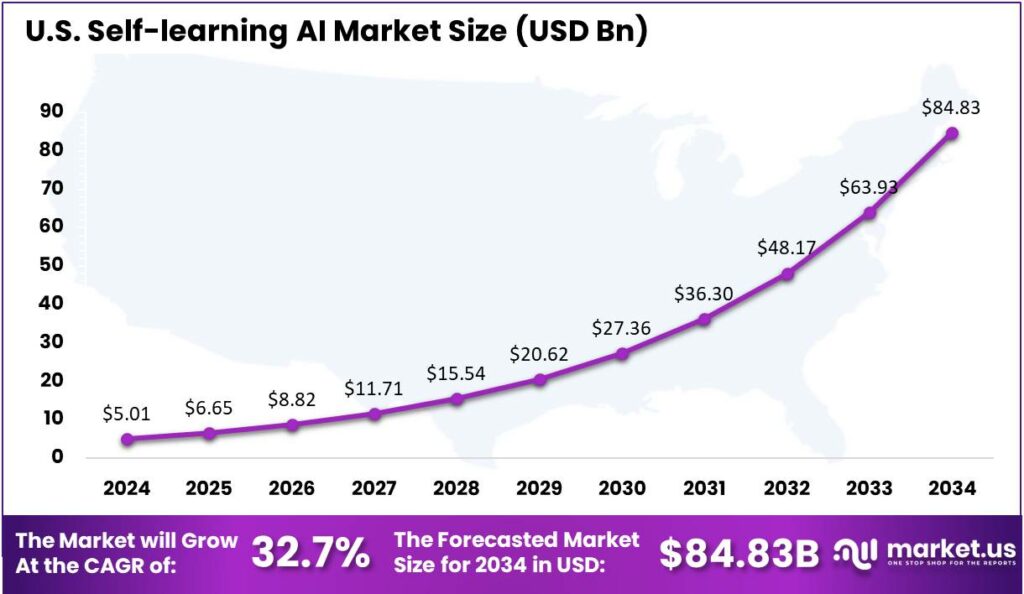
The Global Self-learning AI Market size is expected to be worth around USD 267.6 Billion By 2034, from USD 14.23 Billion in 2024, growing at a CAGR of 34.10% during the forecast period from 2025 to 2034. In 2024, North America dominated the self-learning AI sector, holding over a 39.1% market share and generating approximately USD 5.56 billion in revenue. The U.S. market alone was valued at USD 5.01 billion, growing at a strong CAGR of 32.7%.
Self-learning AI, or autonomous learning AI, is a subset of artificial intelligence that improves through experience without explicit programming. It utilizes machine learning and deep learning algorithms to analyze large data sets and adapt its behavior based on new information. This capability allows the AI to perform complex tasks like natural language processing, pattern recognition, and decision-making with minimal human involvement.
The market for self-learning AI is expanding, driven by its transformative impacts across multiple sectors including healthcare, finance, automotive, and retail. These AI systems significantly enhance operational efficiencies, decision-making processes, and customer personalization through data-driven insights. The growing demand for AI that can adapt and learn independently without human intervention is a major factor boosting this market’s growth.
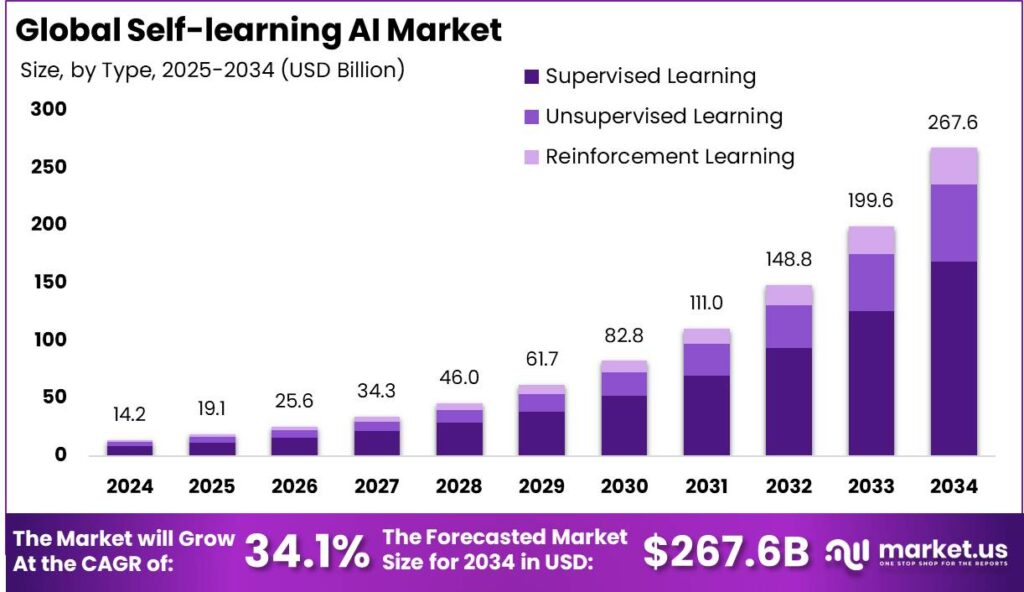
Technological advancements in machine learning and AI, coupled with the increasing volume of data generated across industries, further propel the adoption of self-learning AI technologies. The primary drivers of the self-learning AI market include its ability to improve adaptability, efficiency, and personalization in services and operations.
Businesses benefit from AI’s capability to learn and evolve, which is crucial for maintaining competitiveness in rapidly changing environments. Additionally, the potential to reduce human bias in decision-making processes and the ability to scale solutions without extensive additional programming are key factors fueling the market’s growth.
The demand for self-learning AI is particularly high in industries that handle large amounts of data and require continual improvements in operational processes. For instance, in healthcare, AI systems analyze vast data sets for better diagnostics and patient care, while in finance, they enhance risk management and fraud detection. The trend towards digital transformation and more intelligent, data-driven decision-making frameworks significantly contributes to the demand for self-learning AI.
Key Takeaways
- The Global Self-learning AI Market size is projected to reach USD 267.6 Billion by 2034, up from USD 14.23 Billion in 2024, growing at a CAGR of 34.10% during the forecast period from 2025 to 2034.
- In 2024, the Supervised Learning segment held a dominant position in the self-learning AI market, capturing more than a 63.1% share.
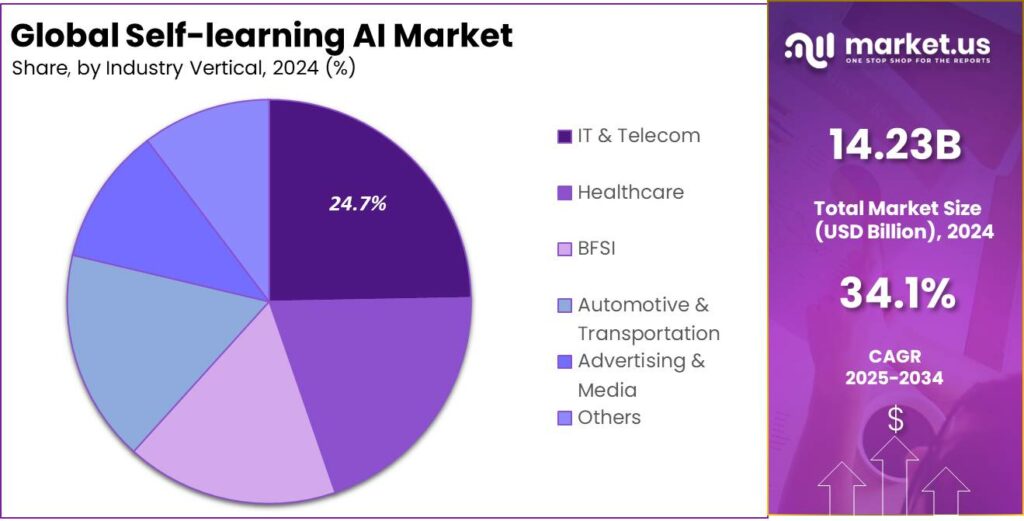
- In 2024, the IT & Telecom segment held a dominant market position in the self-learning AI market, capturing more than a 24.7% share.
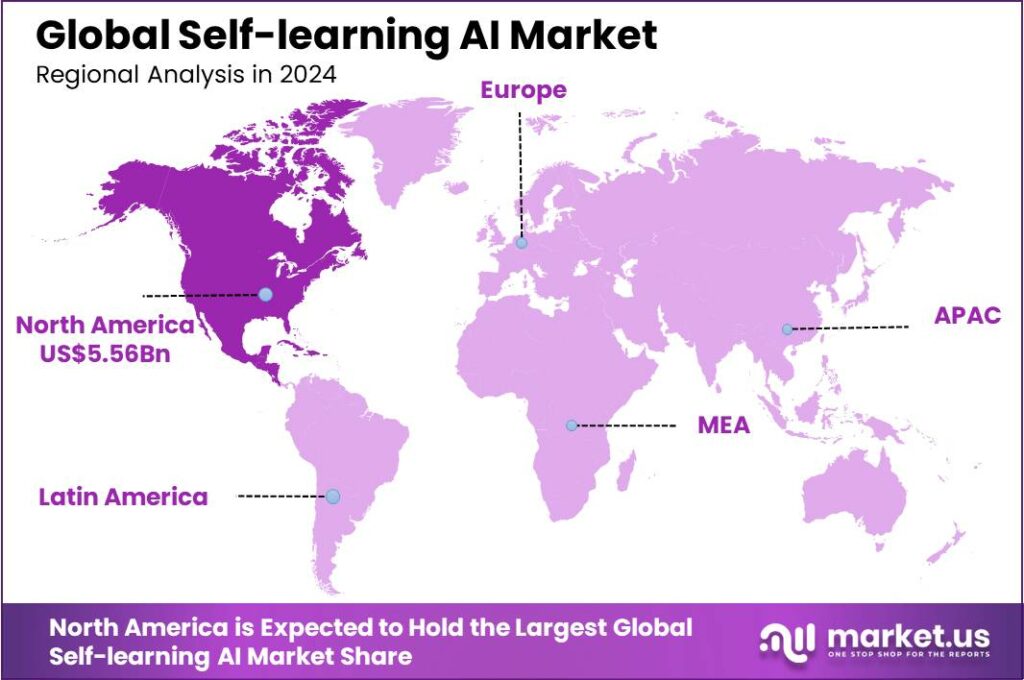
- In 2024, North America held a dominant market position in the self-learning AI sector, capturing more than a 39.1% share, with revenue amounting to approximately USD 5.56 billion.
- In 2024, the U.S. market for self-learning AI systems was valued at USD 5.01 billion, with the sector experiencing a robust CAGR of 32.7%.
Analyst’s Viewpoint
One of the most influential factors driving AI growth is the rising demand from businesses and governments, which is fueling innovation aimed at improving efficiency and public service delivery. Additionally, evolving regulations such as the EU’s groundbreaking AI Act are setting global standards for secure and transparent AI development.
Technological innovation is central to the AI industry’s growth, with key trends like advanced AI reasoning, cloud migration, and custom silicon driving better performance and security for enterprises. The development of specialized processors and AI accelerators is also paving the way for more powerful and efficient AI solutions.
The regulatory landscape is quickly adapting to match the pace of AI advancements. The EU’s AI Act stands out as a landmark, setting a global standard for ethical and trustworthy AI. This framework is reshaping development strategies and influencing global market dynamics, as companies align with these regulations to stay competitive.
Business Benefits
AI can automate complex processes and scale operations without a corresponding increase in expenses. This scalability not only helps manage costs effectively but also supports business growth without the need to proportionally increase the workforce.
Implementing AI and automation tools has led to significant time savings for employees. A survey from IBM, of global IT professionals found that 30% of employees saved time through the use of AI and automation software. Additionally, intelligent automation is projected to reduce costs by an average of 31% within few years as per a Deloitte report.
AI can automate repetitive and time-consuming tasks such as data entry, invoicing, and customer queries, which frees up employees to focus on more strategic activities, thereby increasing overall productivity. According to the Vena Solutions report, AI-driven automation helps 65% of businesses reduce repetitive tasks, freeing employees for creative work.
U.S. Self-learning AI Market
In 2024, the U.S. market for self-learning AI systems was valued at $5.01 billion. The sector is experiencing a robust compound annual growth rate (CAGR) of 32.7%. This significant growth trajectory underscores the increasing adoption and integration of AI technologies across various industries.
Self-learning AI, also known as autonomous learning, represents a pinnacle in machine learning where systems can learn and adapt without human intervention. This capability is particularly valued in applications requiring real-time decision-making and continuous improvement, such as autonomous vehicles, healthcare diagnostics, financial trading, and cybersecurity.
The expansion of the self-learning AI market in the U.S. can be attributed to several key factors. Firstly, there is a growing need for automation and efficient data processing in sectors like healthcare, automotive, and finance. Additionally, the enhancement of computational power and the availability of big data are facilitating more advanced AI capabilities.
The market is poised for continued growth, driven by technological advancements and an expanding range of applications. As industries continue to leverage AI for operational gains and competitive edge, the reliance on self-learning systems is expected to grow, driving higher market valuation and adoption in the coming years.
In 2024, North America held a dominant market position in the self-learning AI sector, capturing more than a 39.1% share with revenue amounting to approximately USD 5.56 billion. This significant market share is primarily driven by the presence of major technology firms and a robust ecosystem supporting AI research and development.
The advanced infrastructure and high adoption rate of cutting-edge technologies in industries such as healthcare, automotive, and finance are pivotal factors enhancing North America’s capacity for deploying self-learning AI systems. Furthermore, the region benefits from a well-established regulatory framework which promotes AI advancements while addressing ethical and privacy concerns, thereby fostering growth in the AI market.
Educational institutions and research centers in North America, particularly in the United States and Canada, are at the forefront of AI research, pushing the boundaries of what self-learning AI systems can achieve. This academic prowess supports a steady stream of innovation and a skilled workforce, essential for the development and implementation of AI technologies.
North America is expected to maintain its lead in the self-learning AI market due to ongoing technological advancements, sustained financial investments, and a growing emphasis on industry-specific AI solutions. This will likely further enhance operational efficiencies and spur new opportunities across various sectors, solidifying the region’s position as a global hub for AI innovation.
Type Analysis
In 2024, the Supervised Learning segment held a dominant position in the self-learning AI market, capturing more than a 63.1% share. This segment’s prominence is primarily attributed to its widespread application in industries that require predictive analytics and classification tasks, such as finance, healthcare, and retail.
The robust growth of the Supervised Learning segment can also be linked to its significant role in enhancing customer experiences through personalization. Industries focused on consumer services utilize supervised learning to tailor product recommendations, optimize search engine results, and automate customer support, thereby increasing efficiency and customer satisfaction.
The integration of AI in regulatory and compliance applications has boosted the Supervised Learning segment. Financial and healthcare sectors use supervised learning to detect fraud, manage risk, and ensure regulatory compliance. These models can adapt to regulatory changes by retraining with new data, making them crucial in compliance-driven industries.
Advancements in neural networks and deep learning have significantly enhanced supervised learning systems, broadening their use in complex environments where traditional AI may struggle. Ongoing research and algorithm improvements ensure that supervised learning stays at the forefront of the self-learning AI market, driving growth and maintaining its dominance.
Industry Vertical Analysis
In 2024, the IT & Telecom segment held a dominant market position in the self-learning AI market, capturing more than a 24.7% share. This sector has led the adoption of self-learning AI technologies due to the critical need for optimizing network operations and improving customer service.
This leading position is further supported by the segment’s drive towards innovation in service offerings, such as personalized customer experiences and automated system maintenance. The IT & Telecom industry’s continuous pursuit of newer, faster, and more efficient communication solutions naturally aligns with the capabilities of self-learning AI, enabling service providers to not only anticipate customer needs but also proactively address service issues before they impact the user.
Moreover, the integration of self-learning AI in IT & Telecom assists in combating security threats, which are becoming increasingly sophisticated. The ability of AI systems to learn and adapt to new threats on their own provides a significant advantage in safeguarding sensitive data and infrastructure, thus promoting trust and reliability among consumers and businesses alike.
The segment’s growth is also propelled by the strategic partnerships between telecommunications companies and AI technology providers. These collaborations are focused on developing cutting-edge solutions that leverage self-learning AI to unlock new possibilities in connectivity and automation, ensuring that the IT & Telecom sector remains at the forefront of technological advancements.
Key Market Segments
By Type
- Supervised Learning
- Unsupervised Learning
- Reinforcement Learning
By Industry Vertical
- IT & Telecom
- Healthcare
- BFSI
- Automotive & Transportation
- Advertising & Media
- Others
Key Regions and Countries
- North America
- US
- Canada
- Europe
- Germany
- France
- The UK
- Spain
- Italy
- Rest of Europe
- Asia Pacific
- China
- Japan
- South Korea
- India
- Australia
- Singapore
- Rest of Asia Pacific
- Latin America
- Brazil
- Mexico
- Rest of Latin America
- Middle East & Africa
- South Africa
- Saudi Arabia
- UAE
- Rest of MEA
Driver
Advancements in Deep Learning and Neural Networks
The rapid progress in deep learning and neural network technologies has significantly propelled the development of self-learning artificial intelligence (AI) systems. These sophisticated algorithms enable machines to process vast amounts of data, recognize intricate patterns, and make autonomous decisions without explicit programming.
Industries such as robotics, autonomous vehicles, personalized marketing, AI-driven customer support, and predictive analytics have been transformed by these capabilities. In the automotive sector, companies like Wayve are using AI-driven software to enable vehicles to learn and adapt to real-world driving conditions.
This integration not only enhances vehicle performance but also improves safety and user experience. As AI technologies continue to mature, the reliance on deep learning and neural networks is expected to deepen, further driving the expansion of self-learning AI applications across various sectors.
Restraint
Lack of Skilled Workforce
The adoption of self-learning AI systems is significantly hindered by a shortage of professionals proficient in machine learning and AI technologies. Developing and implementing self-learning AI solutions require specialized knowledge in areas such as data science, neural networks, and algorithm optimization.
The current educational and training infrastructures are struggling to keep pace with the rapid advancements in AI, leading to a talent gap. This shortage not only slows down the deployment of AI solutions but also impacts the quality and effectiveness of the systems developed. Companies are compelled to invest heavily in training programs or compete for a limited pool of skilled professionals, thereby increasing operational costs and potentially delaying project timelines.
Opportunity
Integration of AI in Autonomous Vehicles
The integration of self-learning AI in autonomous vehicles presents a significant opportunity for market growth. AI enables vehicles to interpret sensor data, learn from driving experiences, and make real-time decisions, thereby enhancing safety and efficiency.
Companies are partnering with automotive manufacturers to incorporate AI-driven autonomous driving software into vehicles. This collaboration aims to develop vehicles capable of adapting to complex driving environments without relying solely on pre-programmed instructions. As the demand for autonomous vehicles increases, the application of self-learning AI in this sector is expected to expand, offering substantial growth prospects for AI technology providers.
Challenge
Ethical and Regulatory Concerns
The deployment of self-learning AI systems raises significant ethical and regulatory challenges. Issues such as data privacy, algorithmic bias, and the potential for unintended consequences necessitate the development of comprehensive regulatory frameworks.
For example, the Bank of England has expressed concerns that autonomous AI systems could manipulate financial markets to create crises for profit. These concerns highlight the need for oversight to prevent AI models from exploiting market vulnerabilities, which could lead to increased volatility and systemic risks. Addressing these ethical and regulatory challenges is crucial to ensure the responsible development and deployment of self-learning AI systems.
Key Growth Factors
- Advancements in Machine Learning Algorithms: Continuous improvements in algorithms, particularly in deep learning and reinforcement learning, have enhanced AI’s ability to learn autonomously from data, leading to more accurate and efficient models.
- Increased Computational Power: The availability of powerful computing resources, including cloud-based platforms, has enabled the processing of complex AI models, facilitating the development and deployment of self-learning systems across various industries.
- Access to Large Datasets: The proliferation of big data has provided AI systems with vast amounts of information to learn from, improving their learning capabilities and performance in tasks such as natural language processing and computer vision.
- Cross-Industry Applications: The versatility of self-learning AI has led to its adoption in diverse sectors, including healthcare, finance, and automotive industries, driving demand and further innovation in the field.
- Supportive Research and Development Environment: Ongoing investments in AI research and development by academic institutions and tech companies have fostered an environment conducive to breakthroughs in self-learning AI technologies.
Emerging Trends
Self-learning artificial intelligence (AI) refers to systems capable of autonomously acquiring knowledge and enhancing their performance without explicit human programming. These systems utilize algorithms that enable them to learn from data, identify patterns, and make decisions with minimal human intervention. This capability has led to significant advancements across various sectors.
AI is revolutionizing education by enabling personalized learning experiences. It supports rapid content creation and customized learning paths, like AI-driven conversational practice, effectively acting as a personal tutor. This approach extends beyond language learning to areas such as math and music, enhancing how students engage with various subjects.
Furthermore, AI’s role in cybersecurity has become increasingly prominent. Self-learning AI systems can analyze vast amounts of data to detect anomalies and potential threats, enabling proactive defense mechanisms against sophisticated cyber attacks. This application underscores AI’s capacity to adapt and respond to evolving security challenges autonomously.
Key Player Analysis
Several companies have emerged as leaders in Self-learning AI Market, each bringing unique approaches to enhance the capabilities of AI.
- Google LLC is a global leader in AI research and development. Through its DeepMind division, Google has made significant strides in self-learning AI, particularly with the creation of AlphaGo, the first AI to defeat a world champion in the complex game of Go. Google’s approach integrates reinforcement learning with vast data processing power, enabling their AI systems to continuously improve and solve complex problems autonomously.
- Monolith AI is an innovative player in the self-learning AI market that focuses on optimizing industrial processes. Unlike traditional AI solutions, Monolith’s platform integrates reinforcement learning with real-time decision-making, helping businesses in sectors like manufacturing, energy, and supply chain management. By combining machine learning with domain expertise, Monolith provides custom-tailored solutions that help businesses make smarter decisions and improve efficiency.
- Wayve Technologies is a pioneer in applying self-learning AI to autonomous vehicles. Rather than relying on pre-programmed rules or massive amounts of hand-labeled data, Wayve’s AI learns how to drive by interacting with its environment in real-time, much like how humans learn to drive. The company uses reinforcement learning to teach its AI to navigate and make decisions based on experience, which makes it an exciting player in the autonomous vehicle space.
Top Key Players in the Market
- Google LLC
- Monolith AI
- Wayve Technologies
- Starmind International
- Squirrel AI Learning
- H2O.ai
- Anthropic
- OpenAI
- DeepL
- Helm.ai
- Virti
- Genius Group Limited
- Fast.ai
- DeepSeek
- Other Major Players
Top Opportunities for Players
The self-learning AI market is rapidly evolving, presenting numerous opportunities for industry players.
- Machine Learning Enhancements: Machine learning, a critical component of AI, continues to evolve, enabling more efficient processing of large data sets and enhancing applications ranging from predictive analytics to personal healthcare management. Innovations in automated machine learning (AutoML), low-code platforms, and deep learning are particularly promising for reducing operational costs and improving decision-making processes.
- Natural Language Processing (NLP): The expansion of NLP is significantly improving how computers understand human language, which is transforming customer service, content creation, and large-scale data analysis. Companies are increasingly integrating NLP to enhance real-time communication tools, automate routine tasks, and provide more personalized user experiences.
- AI-powered Cybersecurity Solutions: As cybersecurity threats evolve, there is a growing demand for AI-driven security solutions that can predict and neutralize threats more efficiently. AI technologies such as pattern recognition and anomaly detection are becoming crucial in developing advanced security measures to protect data and systems.
- Adoption of AI-as-a-Service (AIaaS): With the increasing complexity of AI technologies, AIaaS is emerging as a vital trend. It allows companies to adopt AI functionalities without substantial upfront investment in infrastructure. Major cloud providers are expanding their offerings in this area, enabling businesses of all sizes to leverage AI for enhancing operational efficiency and innovation.
- Ethical and Responsible AI: As AI becomes more embedded in critical applications, there is a heightened focus on developing ethical and transparent AI systems. This includes creating algorithms that are unbiased and adhere to privacy standards, which not only meet regulatory requirements but also build trust with consumers and partners.
Recent Developments
- In June 2024, Helm.ai launched VidGen-1, a generative video model designed to enhance video data for autonomous vehicles and robots.
- In October 2024, Anthropic introduced the “Computer Use” feature in its Claude AI models, enabling the automation of tasks such as mouse movements, clicks, and typing. This advancement aims to assist software developers by automating complex operations.









