


Report Overview
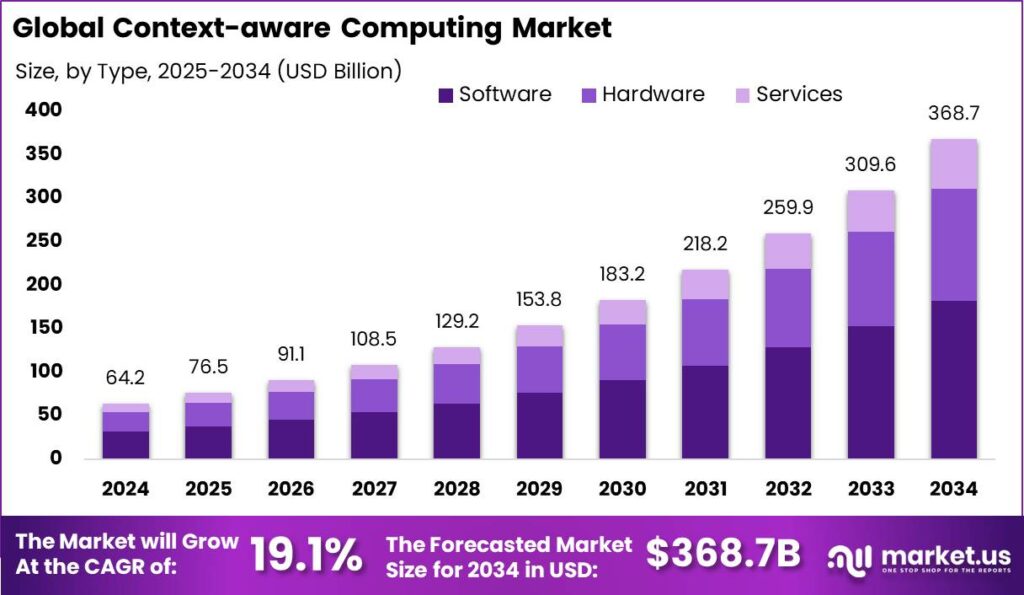
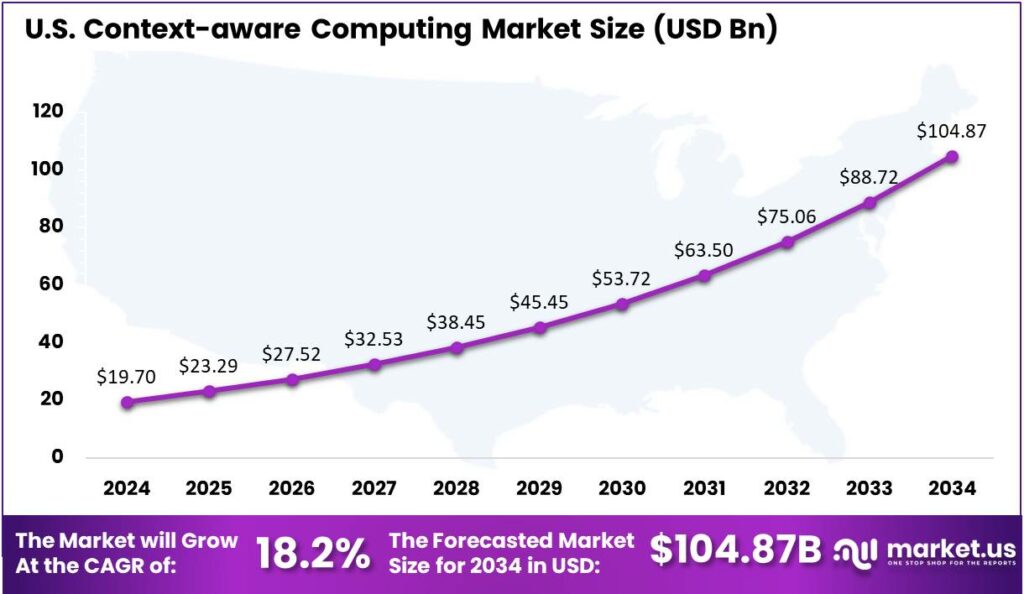
The Global Context-aware Computing Market size is expected to be worth around USD 368.7 Bn By 2034, from USD 64.2 Bn in 2024, growing at a CAGR of 19.10% during the forecast period from 2025 to 2034. In 2024, North America led the global context-aware computing market with 34.1% of the market share, generating USD 21.8 bn in revenue. The U.S. market was valued at USD 19.7 bn and is expected to grow at a CAGR of 18.2%, reflecting strong adoption of digital intelligence across industries.
Context-aware computing refers to systems that adapt their operations to the user’s context, providing more relevant and personalized services. These systems collect and analyze environmental data to make real-time decisions, improving user experience and efficiency. They are widely used in industries like healthcare, automotive, and consumer electronics, fueling market growth.
The context-aware computing market is rapidly growing, fueled by the widespread adoption of mobile devices and wearable technology, which has broadened the potential for context-aware applications in sectors like healthcare, retail, and smart homes. Additionally, advancements in AI and machine learning have enhanced the accuracy and efficiency of these systems, making them more attractive to businesses focused on improving customer experiences.
Key driving factors include the growing penetration of smartphones and the rise of the Internet of Things (IoT), which enable more connected devices to participate in context-aware networks. These factors contribute to a robust ecosystem where personal and environmental data can continuously interact to deliver personalized user experiences.
The demand for context-aware computing is rising due to its ability to provide highly personalized user experiences and improve operational efficiency in various industries. Trends indicate a move towards more immersive and intuitive user interfaces across consumer electronics, automotive, healthcare, and industrial sectors. The technology’s ability to anticipate user needs and make real-time adjustments enhances both consumer satisfaction and system efficacy.
Popularity of context-aware computing is rising as enterprises see its potential to boost customer engagement and operational efficiency. In consumer markets, smartphones and wearables with context-aware features are widely adopted, while business applications like targeted advertising and resource optimization are becoming more common, reflecting the technology’s increasing acceptance.
The integration of AI and IoT is driving growing market opportunities in context-aware computing. The IoT ecosystem, with its wide range of sensors and devices, offers a strong platform for deploying context-aware solutions. Meanwhile, AI enhances predictive capabilities, improving decision-making and creating new avenues for growth.
Innovations in context-aware computing are enhancing context detection and response through advances in machine learning and sensor technology. These improvements enable a deeper understanding of user contexts, including emotions and environment. Innovations like context-aware security applications, which adjust measures based on risk assessments, are setting new standards in personal and enterprise computing.
Key Takeaways
- The Global Context-aware Computing Market is projected to reach a value of USD 368.7 Billion by 2034, growing from USD 64.2 Billion in 2024, with a CAGR of 19.10% during the forecast period from 2025 to 2034.
- In 2024, the Software segment dominated the market, holding more than 49.4% of the total share in the context-aware computing market.
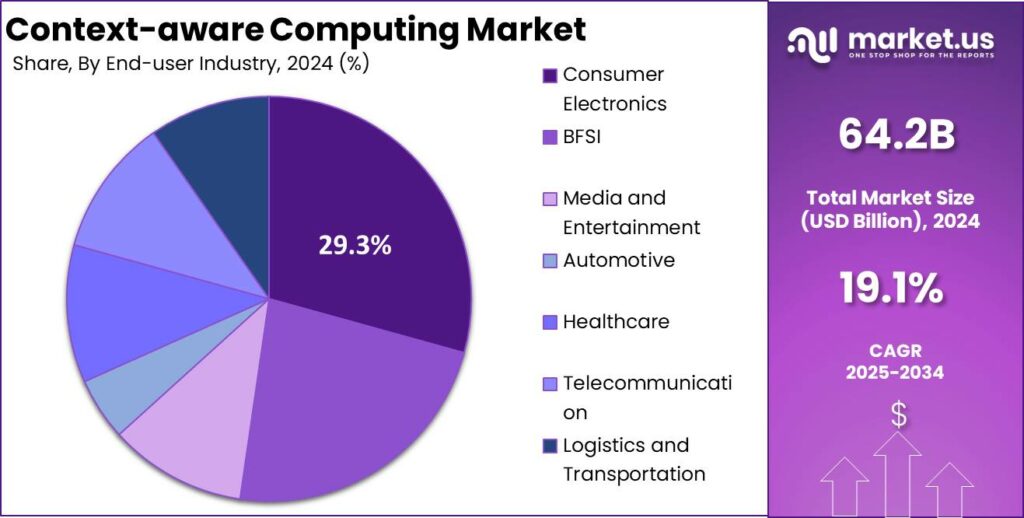
- In 2024, the Consumer Electronics segment also captured a significant market position, accounting for more than 29.3% of the context-aware computing market share.
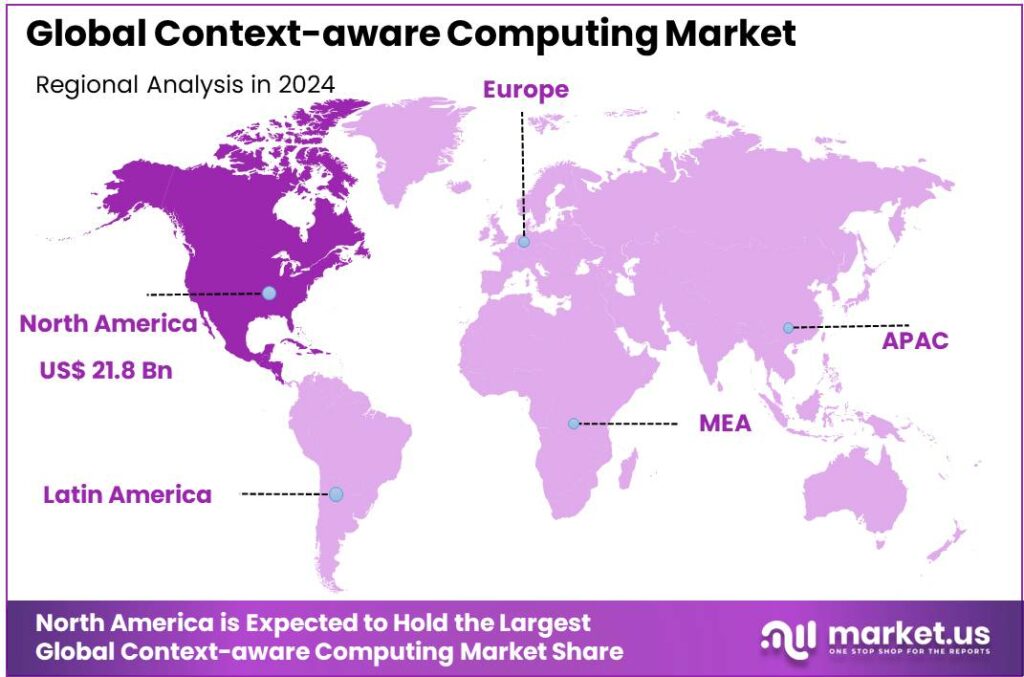
- North America maintained a leading position in the global context-aware computing market in 2024, holding approximately 34.1% of the total market share, generating around USD 21.8 billion in revenue.
- The U.S. Context-aware Computing market in 2024 was valued at approximately USD 19.7 billion, highlighting a strong foundation for the integration of digital intelligence across various industries. The market is projected to grow at a CAGR of 18.2% over the forecast period, indicating continued strong adoption momentum.
US Tariff Impact Analysis
The impact of the 2025 US tariffs on the context-aware computing industry can be understood through five key points:
- Increased Costs for Hardware and Cloud Services: The tariffs have led to higher costs for hardware components like servers and networking equipment, which are crucial for context-aware computing. Companies dependent on overseas hardware may see increased expenses, leading to higher prices for services like cloud computing. This could particularly affect small tech startups and companies relying on thin margins.
- Disruption in Global Supply Chains: The context-aware computing sector, reliant on global supply chains for both hardware and software components, faces potential disruptions. This includes increased costs and delays for imported components essential for building and maintaining context-aware systems.
- Economic Uncertainty and Investment Delays: The uncertainty generated by the tariffs could lead to reduced investments in AI and cloud projects, vital components of context-aware computing. Companies might delay or scale down their technology upgrades or expansions, adversely impacting innovation and market competitiveness.
- Impact on IT Spending and Consumer Demand: Analysts suggest that the tariffs could lead to a downturn in IT spending, particularly affecting consumer demand for technology products. This reduction in spending power may translate into decreased demand for context-aware applications and services, which often rely on consumer engagement and data.
- Strategic Adjustments for Businesses: Businesses might need to adapt by diversifying their supply chains, optimizing cloud usage to reduce costs, and potentially shifting to more local or less impacted sources for technology procurement. These strategic adjustments are necessary to mitigate the impacts of increased costs and supply chain disruptions.
Analysts’ Viewpoint
Key factors driving the context-aware computing market include the rise of mobile devices, advancements in sensor tech, growing demand for personalized experiences and the integration of machine learning. Additionally, the rapid growth of the Internet of Things (IoT) and the integration of advanced machine learning algorithms play a critical role in the market’s expansion.
These technologies enable more intelligent, context-aware applications, enhancing both user interactions and operational efficiency. Technological advancements are at the core of the context-aware computing market’s expansion. Recent developments include enhancements in wireless technologies and on-device AI capabilities, which allow for deeper integration of context-aware systems into everyday devices.
Trends highlight the rising integration of context-aware features in smart homes and enterprise systems to improve efficiency and engagement. Simultaneously, stricter data privacy laws like GDPR in Europe and U.S. frameworks are shaping how these technologies manage sensitive user information securely.
U.S. Market Leadership
In 2024, the U.S. Context-aware Computing market was valued at approximately USD 19.7 billion, demonstrating a robust foundation for digital intelligence integration across industries.This valuation highlights the increasing reliance on intelligent systems that adapt to user behavior, location, preferences, and environmental data.
The market is projected to expand at a Compound Annual Growth Rate (CAGR) of 18.2% over the forecast period, indicating strong momentum in adoption. This growth is being driven by advancements in sensor technologies, IoT integration, AI-driven analytics, and the widespread deployment of mobile and wearable devices.
Context-aware applications are becoming essential in enhancing personalized marketing, real-time navigation, ambient intelligence systems, and predictive maintenance solutions. The demand is further amplified by enterprises seeking to boost efficiency and provide highly tailored services through dynamic computing environments.
The U.S. market thrives with top tech players, strong infrastructure, and digital maturity, driving innovation in smart cities, autonomous vehicles, and connected healthcare through context-aware computing. Government support for AI and edge computing further strengthens this ecosystem. As a result, the U.S. is set to remain a leader, with companies expanding cloud platforms, AI models, and real-time data processing to drive new revenue.
In 2024, North America maintained a dominant position in the global context-aware computing market, capturing approximately 34.1% of the total market share and generating revenue of around USD 21.8billion. This leadership is attributed to the region’s advanced technological infrastructure, widespread adoption of smart devices, and significant investments in artificial intelligence (AI) and machine learning (ML) technologies.
The robust growth in North America is driven by the integration of context-aware solutions across various industries, including healthcare, automotive, and consumer electronics. For instance, the healthcare sector leverages these technologies for patient monitoring and personalized treatment plans, while the automotive industry employs them in developing advanced driver-assistance systems (ADAS).
Government initiatives and funding are vital in advancing the market, particularly through smart city development and digital transformation programs. These encourage the adoption of context-aware computing to enhance urban infrastructure and public services. Additionally, a strong focus on research and development drives ongoing innovation in context-aware technologies.
Applications
- Smart Maps: Maps adapt to your movement and orientation. For example, when you’re driving, the zoom level adjusts based on your speed, and the map rotates to match your direction. This helps you navigate more intuitively.
- Automatic Lighting Systems: At home entrances or hotel hallways, lights turn on when motion is detected in dark conditions and switch off when no motion is sensed. This saves energy and enhances convenience.
- Context-Aware Mobile Guides: Museums use mobile devices that provide tailored information based on your location and interactions. For instance, as you approach an exhibit, the device displays relevant details or guides you to areas of interest based on your preferences.
- Proactive Heating Systems: Smart heating systems detect when you’re headed home and automatically start heating your house. This ensures comfort while reducing unnecessary energy usage.
- Activity-Based Information Retrieval: Computers tag information with context keys, such as time or location, making it easier to retrieve later. For example, a business can store meeting notes tagged with the room where they were created for quick access.
Type Analysis
In 2024, the Software segment held a dominant market position in the context-aware computing market, capturing more than a 49.4% share. The segment’s leadership stems from its key role in enabling intelligent, adaptive functionalities across applications. Software solutions are central to implementing context-aware technologies, offering the algorithms and computational power needed to process and analyze contextual data.
The software segment’s prominence in context-aware computing is driven by the growing demand for personalized user experiences on digital platforms. Sophisticated context-aware software adapts interfaces and content in real-time. Advancements in AI and machine learning have further enhanced these solutions, enabling more effective and relevant user experiences.
Technological innovation, particularly in AI, IoT, and big data analytics, drives growth in the software segment. These advancements enhance context-aware software’s integration with devices and platforms, enabling better context gathering, smarter decision-making, and improved user satisfaction and operational efficiency.
The software segment in the context-aware computing market is expected to grow steadily, fueled by the increasing number of connected devices and ongoing digital transformation across industries. Developers are actively exploring new applications for context-aware solutions in healthcare, automotive, and smart home technologies, which will expand use cases and market reach in the coming years.
End-user Industry Analysis
In 2024, the Consumer Electronics segment held a dominant market position, capturing more than a 29.3% share of the context-aware computing market. This leadership can be attributed primarily to the widespread integration of context-aware technologies in smart devices like smartphones, tablets, smartwatches, and home automation systems.
The growth of the Consumer Electronics segment is driven by innovations in wearable technology and smart home devices, which use context-aware computing to anticipate user needs and improve efficiency, security, and convenience. Consumers seek devices that adapt to their lifestyles, prompting manufacturers to integrate advanced contextual algorithms for better user interaction and functionality.
Moreover, the increasing consumer expectation for seamless and personalized experiences across their devices has compelled electronics manufacturers to invest heavily in context-aware capabilities. For example, smartphones that adjust settings such as brightness and volume based on environmental conditions and user behavior patterns have become particularly popular.
The consumer electronics industry’s large scale and fast product development cycles facilitate the rapid adoption and evolution of context-aware technologies. This quick adaptation keeps the sector at the forefront of context-aware computing, shaping market trends and influencing consumer expectations across other industries.
Key Market Segments
By Type
- Hardware
- Software
- Services
By End-user Industry
- BFSI
- Consumer Electronics
- Media and Entertainment
- Automotive
- Healthcare
- Telecommunication
- Logistics and Transportation
- Others
Key Regions and Countries
- North America
- US
- Canada
- Europe
- Germany
- France
- The UK
- Spain
- Italy
- Rest of Europe
- Asia Pacific
- China
- Japan
- South Korea
- India
- Australia
- Singapore
- Rest of Asia Pacific
- Latin America
- Brazil
- Mexico
- Rest of Latin America
- Middle East & Africa
- South Africa
- Saudi Arabia
- UAE
- Rest of MEA
Driver
Proliferation of Smart Devices and IoT Integration
The rapid expansion of smart devices and the Internet of Things (IoT) has significantly propelled the adoption of context-aware computing. Smartphones, wearables, and home systems now use advanced sensors to gather context like location and activity, enabling real-time adaptation for better user experience and efficiency.
The integration of IoT devices has boosted the importance of context-aware systems across sectors. In healthcare, wearables track vitals and surroundings to offer personalized care. In transportation, real-time traffic and weather data help optimize routes.
The synergy between smart devices and context-aware computing facilitates the development of intelligent environments that respond proactively to user needs. As the number of connected devices continues to grow, the volume and variety of contextual data available for analysis increase, enabling more sophisticated and accurate context-aware applications.
Restraint
Data Privacy and Security Concerns
Despite its benefits, context-aware computing faces challenges related to data privacy and security. These systems depend on continuous collection of sensitive data, such as location, health metrics, and behavior, raising concerns about personal privacy and potential misuse.
The aggregation and processing of such data raise concerns about unauthorized access, data breaches, and potential misuse of personal information. Users may hesitate to share their data due to concerns about privacy and control, which can hinder acceptance and trust in context-aware applications.
The growing regulatory landscape, including laws like GDPR in the EU, imposes strict requirements on data collection, storage, and processing. Organizations must comply with these regulations, which often require substantial administrative and technical efforts.
Opportunity
Advancements in Artificial Intelligence and Machine Learning
The continuous advancements in artificial intelligence (AI) and machine learning (ML) present significant opportunities for the evolution of context-aware computing. These technologies enhance the ability of systems to process and interpret complex contextual data, enabling more accurate and personalized responses.
AI and ML algorithms can process large datasets from diverse sources, uncovering patterns and correlations that traditional methods might miss. This enables context-aware systems to make informed decisions and adapt to dynamic environments and user behaviors in real-time.
The integration of AI and ML enables predictive models that anticipate user needs and offer relevant services proactively. This enhances user experience, boosts operational efficiency, and provides a competitive edge for organizations that utilize these technologies.
Challenge
Integration with Existing Systems and Infrastructure
Integrating context-aware computing into existing systems and infrastructure poses a significant challenge for organizations. Many legacy systems were not designed to handle the dynamic and data-intensive requirements of context-aware applications, leading to compatibility and interoperability issues.
Implementing context-aware systems often requires significant changes to existing hardware and software, including redesigning architectures, data protocols, and user interfaces to support real-time context processing. This can be complex and resource-intensive.
The absence of standardized frameworks for context-aware computing complicates integration, making it harder for organizations to ensure smooth communication between new and existing systems. This can increase development time, costs, and create potential system vulnerabilities.
Emerging Trends
Context-aware computing is evolving rapidly, integrating advanced technologies to enhance user experiences. A significant trend is the fusion of artificial intelligence (AI) with context-aware systems, enabling devices to process data locally and respond intelligently to environmental cues. This integration facilitates real-time decision-making and personalization, particularly in mobile devices and autonomous vehicles.
The proliferation of the Internet of Things (IoT) has expanded the scope of context-aware computing. IoT devices collect and share data, allowing systems to adapt to user needs dynamically. For instance, Smart home tech uses context-aware computing to adjust lighting and temperature based on user presence and preferences.
Advancements in edge computing also contribute to this evolution by processing data closer to the source. This reduces latency and enhances privacy, as sensitive information remains on local devices rather than being transmitted to centralized servers. Such developments are crucial for applications requiring immediate responses, like autonomous driving systems.
Business Benefits
Context-aware computing boosts business by tailoring services to individual needs based on their environment, location, or activity. This personalization leads to higher user satisfaction, increased engagement, and better decision-making, ultimately driving customer loyalty and improving business efficiency.
These systems streamline operations by providing relevant information and automating tasks based on the current context. In professional settings, this might mean delivering pertinent data right when it’s needed, reducing the time spent searching for information and increasing productivity
Context-aware computing can bolster security measures by adapting the security protocols based on the context of use. For example, access to sensitive information can be restricted based on the user’s location or the security level of the network they are connected to, thereby enhancing overall data protection.
Key Player Analysis
IBM is a pioneer in artificial intelligence and has integrated context-aware capabilities into its Watson AI platform. What sets IBM apart is its focus on combining AI with industry-specific solutions. For example, in healthcare and finance, IBM uses context-aware systems to improve decision-making by analyzing real-time data.
Microsoft Corporation leverages its cloud computing platform, Azure, to power context-aware applications. Its uniqueness lies in using AI and machine learning to create smarter digital environments, especially in workplaces and smart cities. Through tools like Azure IoT and Microsoft Graph, the company enables apps and devices to respond intelligently to user behavior and surroundings.
Cisco Systems, Inc., brings a strong network-driven approach to context-aware computing. The company focuses on making smart, connected environments by combining IoT devices with advanced analytics. Cisco’s unique strength is in using real-time network data to optimize how systems react to their surroundings,especially in areas like smart buildings and security.
Top Key Players in the Market
- IBM Corporation
- Microsoft Corporation
- Cisco Systems, Inc.
- Oracle Corporation
- Amazon.com, Inc.
- Samsung Electronics Co. Ltd
- Apple Inc.
- Onapsis Inc.
- Teliasonera
- Verizon Communications Inc.
- Infosys Limited
- Google LLC
- Nokia Corporation
- Others
Top Opportunities Awaiting for Players
Opportunities awaiting players or industries in the Context-aware Computing (CAC) market.
- Integration with Emerging Technologies: There is significant potential for growth in the integration of context-aware computing with other emerging technologies such as blockchain, virtual reality (VR), and augmented reality (AR). This convergence enables innovative apps like decentralized context-sharing or adaptive VR/AR for more personalized, immersive experiences.
- Expansion in Wearable and Smart Home Devices: The integration of context-aware computing capabilities into wearable devices and smart home technology is rapidly increasing. Rising demand for smarter, personalized devices drives growth, with Google, Amazon, and Apple leading the way in context-aware wearables and home tech.
- Advancements in Hardware and AI: The market is witnessing significant developments in context-aware hardware equipped with advanced sensors and AI capabilities. These technologies enable devices to autonomously process and learn from contextual information, thus providing more accurate, reliable, and contextually relevant user experiences. The evolution of hardware and AI not only improves device functionality but also opens up new avenues for context-aware applications across various sectors.
- Wireless Technology Proliferation: The widespread adoption of wireless technologies enhances the capabilities of context-aware systems, allowing for seamless connectivity and context sharing across different devices and platforms without physical constraints. This technological advancement supports the development of more fluid and flexible context-aware services that can operate over broad areas, making them more accessible and effective.
- Growth in Enterprise Adoption: Enterprises are increasingly deploying context-aware systems to optimize operations and enhance decision-making processes.Using real-time context helps businesses boost efficiency, service, and productivity especially in retail, healthcare, and transportation, where it greatly enhances operations and service delivery.
Recent Developments
- In March 2024, Synaptics introduced the Astra AI-Native compute platform for the Internet of Things (IoT). This platform combines scalable, low-power computing with adaptive AI capabilities, facilitating the development of context-aware applications at the edge.
- In May 2024, PROG Holdings, Inc. entered into a strategic collaboration with Infosys to enhance its operations with AI-powered solutions. This partnership allows PROG Holdings to leverage Infosys’ advanced digital services to expedite skill development and accelerate its speed to market
- In February 2024, Wipro Limited announced the launch of its Enterprise Artificial Intelligence (AI)-Ready Platform. This innovative service provides customers with the capability to establish customized, fully integrated AI solutions tailored to their specific business needs.









