


Report Overview
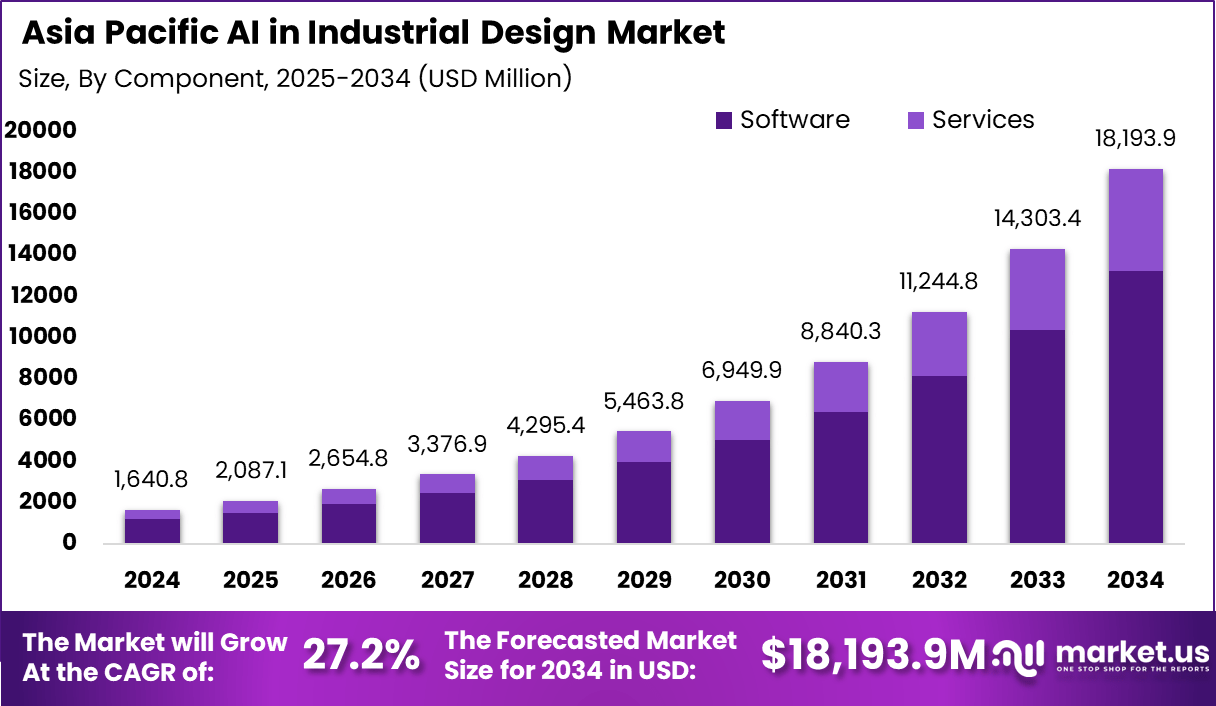
The Asia Pacific AI in Industrial Design Market size is expected to be worth around USD 18,193.9 Million By 2034, from USD 1,640.8 Million in 2024, growing at a CAGR of 27.2% during the forecast period from 2025 to 2034. The China AI in Industrial Design Market Size was exhibited at USD 570.3 Million in 2024 with CAGR of 26.9%.
The Asia-Pacific region holds a commanding position in the artificial intelligence (AI) in industrial design market, with a substantial market share that reflects the region’s strong emphasis on technological innovation and adoption. The market’s growth can largely be attributed to the rapid expansion of industries such as automotive, consumer electronics, aerospace, and healthcare, which are increasingly integrating AI to enhance design processes and operational efficiency.
The expansion of the AI in Industrial Design market in Asia Pacific is propelled by the advancement of smart manufacturing and Industry 4.0, which integrate advanced technologies and automation to enhance operational efficiency and productivity. These technologies are critical in optimizing production processes and improving product quality through real-time data analysis and automation.
AI technologies are being adopted at a rapid pace across various industry verticals within the Asia-Pacific region. The automotive segment, in particular, demonstrates significant use of AI for designing and manufacturing processes. AI applications in this sector facilitate efficient design simulations, predictive maintenance, and automation of routine tasks, which are crucial for reducing costs and enhancing product quality.
As per the latest insights from Market.us, The AI in Industrial Design market is witnessing a transformative shift, driven by increasing demand for faster, smarter, and more efficient product development processes. In 2023, the market was valued at approximately USD 3.7 Billion, and it is projected to grow significantly, reaching an estimated USD 38.3 Billion by 2033. This remarkable growth reflects a CAGR of 26.2% during the forecast period from 2024 to 2033.
The adoption of AI in industrial design is also propelled by the development of user-friendly, intuitive design interfaces which significantly increase the likelihood of successful technology implementation. Furthermore, cloud-based AI solutions are gaining traction due to their scalability and flexibility, which are ideal for the dynamic nature of industrial design needs.
Emerging trends in the AI in Industrial Design sector include the use of AI in generative design, which allows for the creation of multiple design solutions, and the integration with Internet of Things (IoT) and cloud-based design solutions. These advancements facilitate enhanced simulation, testing, and collaborative design platforms.
Key Takeaways
- The market was valued at USD 1,640.8 Million in 2024 and is projected to reach approximately USD 18,193.9 Million by 2034, advancing at a remarkable CAGR of 27.2% during the forecast period.
- China leads the regional surge, holding a significant share of the market. In 2024, the AI in Industrial Design market in China alone was valued at USD 570.3 Million, and it is expected to grow at a robust CAGR of 26.9% through 2034
- By component, the Software segment dominated the Asia Pacific market in 2024, capturing more than 72.7% of the total share
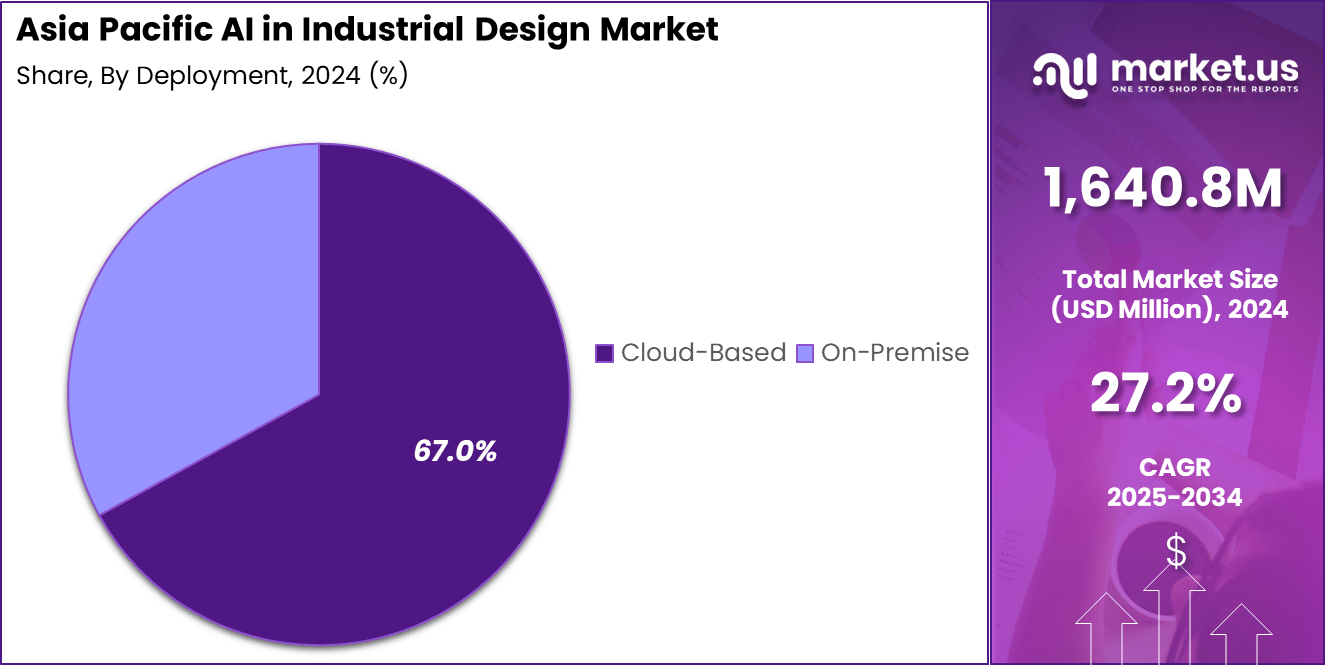
- Deployment-wise, the Cloud-Based segment held a commanding market share of over 67% in 2024. Cloud-based platforms are increasingly favored due to their accessibility, lower infrastructure costs, and ease of integration with existing enterprise systems.
- In terms of end-use industry, the Automotive segment emerged as the dominant sector, accounting for more than 33% of the market share in 2024.
Analysts’ Viewpoint
The continual advancements in AI are opening numerous investment opportunities in Asia-Pacific. Companies are investing in AI-driven software and services that streamline the design process, reduce time-to-market, and improve the customization of products to meet specific customer demands.
The business benefits of adopting AI in industrial design include increased productivity, cost efficiency, and the ability to quickly adapt to market changes and consumer preferences. Moreover, AI enhances the quality of design outcomes and supports the creation of more innovative and complex products.
Technological advancements are rapidly evolving within the AI in industrial design sector. Innovations such as AI-driven CAD tools, generative design software, and AI-powered 3D rendering and visualization tools are becoming standard in the industry.
The regulatory environment in Asia-Pacific is increasingly supportive of AI adoption, with governments implementing policies that encourage the development and integration of AI technologies across various industries. This supportive regulatory framework is crucial for sustaining growth and innovation in the AI in industrial design market.
The top factors impacting the growth of the AI in industrial design market in Asia-Pacific include the increasing digitalization of industries, government support for AI initiatives, and the rising demand for automation and advanced manufacturing capabilities.
US Tariff Impact
The 2025 expansion of U.S. tariffs has significant implications for the Industrial Design Market, as delineated through five key points:
- Increased Costs and Reduced Purchasing Power: The imposition of new tariffs, particularly on imports from China, Canada, and Mexico, has elevated production costs across multiple manufacturing sectors, including industrial design. The tariffs have led to higher prices for electronics, vehicles, and other tech devices crucial for industrial design applications.
- Supply Chain Disruptions: Tariffs have resulted in substantial disruptions to established supply chains, affecting the availability and cost of materials essential for industrial design. This includes steel, aluminum, and electronic components.
- Impact on Manufacturing Output and Employment: The higher costs and supply chain challenges are expected to dampen manufacturing output and could potentially affect employment within the sector. There is a direct correlation between increased tariff rates and reduced economic efficiency, which may stifle innovation and growth in industrial design.
- Shifts in Production and Sourcing Strategies: Companies are increasingly looking to mitigate the impacts of tariffs by reshaping their production and sourcing strategies. This includes increasing domestic production or shifting production to countries not impacted by U.S. tariffs. These strategic shifts are essential for maintaining competitiveness in the industrial design market.
- Long-term Strategic Adjustments: In response to the tariffs, there is a notable trend towards enhancing supply chain resilience and diversification. Companies are investing in new technologies and data management systems to better adapt to the changing tariff landscape and to optimize their operational and financial strategies.
China Market Growth
The China AI in Industrial Design Market is valued at approximately USD 570.3 Million in 2024 and is predicted to increase from USD 723.71 Million in 2025 to approximately USD 6,176.17 Million by 2034, projected at a CAGR of 26.9% from 2025 to 2034.
China’s leadership in the artificial intelligence (AI) sector, particularly within industrial design, is driven by strategic government initiatives, substantial investments, and a robust manufacturing infrastructure. The Chinese government’s commitment is evident through policies like the New Generation Artificial Intelligence Development Plan, aiming to position the country as a global AI leader by 2030.
Market Share By Countrywise (2019-2024) (%)
Component Analysis
In 2024, the Software segment held a dominant market position in the Asia Pacific AI in Industrial Design market, capturing more than a 72.7% share. This leadership can be primarily attributed to the critical role that AI-driven software plays in enhancing the capabilities of industrial designers.
Software solutions in this sector, such as AI-enhanced Computer-Aided Design (CAD) tools, generative design software, and simulation and modeling software, allow for intricate design optimizations that are often beyond the reach of traditional design methods.
These AI-powered software tools enable designers to automate many aspects of the design process, from initial concept to final testing, thus significantly reducing time-to-market and improving product precision and functionality. The integration of AI with CAD tools, for example, has revolutionized how designers approach complex problems, allowing for real-time data analysis and decision-making that improve design accuracy and efficiency.
Market Share by Component Analysis (2019-2024) (%)
| Component | 2019 | 2020 | 2021 | 2022 | 2023 | 2024 |
|---|---|---|---|---|---|---|
| Software | 72.2% | 72.3% | 72.4% | 72.5% | 72.6% | 72.7% |
| Services | 27.8% | 27.7% | 27.6% | 27.5% | 27.4% | 27.3% |
Moreover, the increasing adoption of cloud-based design platforms within the region has made these sophisticated AI tools more accessible to a broader range of businesses, from large enterprises to small and medium-sized enterprises (SMEs). The scalability and flexibility offered by cloud technology enable these firms to utilize advanced AI functionalities without the need for substantial upfront investments in IT infrastructure.
Deployment Mode Analysis
In 2024, the Cloud-Based segment held a dominant market position in the Asia Pacific AI in Industrial Design market, capturing more than a 67% share. This substantial market share can be attributed to the multiple strategic advantages that cloud-based solutions offer to industrial design.
Primarily, the scalability of cloud infrastructure allows businesses of all sizes to access powerful AI tools without the hefty initial investment typically required for on-premise systems. This democratization of advanced technology enables even small and medium-sized enterprises (SMEs) to compete on a level playing field with larger corporations.
Furthermore, cloud-based AI design tools facilitate enhanced collaboration among geographically dispersed teams, as data and resources can be accessed and shared in real-time from any location. This capability is particularly beneficial in a region as vast and diverse as Asia Pacific, where teams often operate across different countries.
Market Share by Deployment Mode Analysis (2019-2024) (%)
| Deployment Mode | 2019 | 2020 | 2021 | 2022 | 2023 | 2024 |
|---|---|---|---|---|---|---|
| Cloud-Based | 65.0% | 65.4% | 65.8% | 66.2% | 66.8% | 67.0% |
| On-Premise | 35.0% | 34.6% | 34.2% | 33.8% | 33.2% | 33.0% |
The agility provided by cloud platforms in handling large datasets effectively and efficiently is critical in speeding up the design processes and improving time-to-market for new products. Additionally, cloud deployment offers superior flexibility in terms of IT resource management, allowing companies to adjust their usage based on current needs and budget constraints.
End-Use Industry Analysis
In 2024, the Automotive segment held a dominant market position in the Asia Pacific AI in Industrial Design market, capturing more than a 33% share. This leading status stems from the automotive industry’s rapid adoption of AI technologies aimed at enhancing design accuracy, reducing production costs, and shortening development cycles.
AI’s role in automotive design is particularly pivotal in advancing areas such as autonomous vehicles, electric cars, and innovative safety features, where precision and efficiency are paramount. The integration of AI in automotive industrial design facilitates the use of advanced simulation and testing techniques, which are essential for developing complex vehicle systems.
These AI-powered tools allow for meticulous optimization of designs before physical prototypes are constructed, thus saving significant resources and enabling quicker responses to market demands. Additionally, AI aids in the customization of vehicle designs, offering manufacturers the capability to tailor products to specific consumer preferences without extensive manual input.
Market Share by End-Use Industry Analysis (2019-2024) (%)
| End-Use Industry | 2019 | 2020 | 2021 | 2022 | 2023 | 2024 |
|---|---|---|---|---|---|---|
| Automotive | 32.3% | 32.4% | 32.6% | 32.8% | 33.0% | 33.0% |
| Consumer Electronics | 23.8% | 23.8% | 23.9% | 23.9% | 23.9% | 24.0% |
| Aerospace & Defense | 12.8% | 12.7% | 12.7% | 12.6% | 12.6% | 12.5% |
| Healthcare | 9.4% | 9.5% | 9.6% | 9.7% | 9.8% | 9.8% |
| Other Industry Verticals | 21.7% | 21.5% | 21.3% | 21.1% | 20.8% | 20.7% |
Moreover, the automotive sector’s emphasis on sustainability has spurred the integration of AI to create more energy-efficient and environmentally friendly vehicles. By leveraging AI, manufacturers can optimize material usage and streamline production processes, effectively reducing waste and energy consumption.
As environmental regulations become stricter and consumer expectations for smarter, safer vehicles continue to grow, the reliance on AI in the automotive design process is expected to increase, further cementing this segment’s position as a key user of AI in industrial design in the Asia Pacific region.
Key Market Segments
By Component
- Software
- Services
By Deployment Mode
- Cloud-Based
- On-Premise
By End-Use Industry
- Automotive
- Consumer Electronics
- Aerospace & Defense
- Healthcare
- Other Industry Verticals
Driver
Integration of AI with Industry 4.0 and Smart Manufacturing
The integration of AI with Industry 4.0 and smart manufacturing technologies is a significant driver for the AI in industrial design market in the Asia Pacific region. This integration enhances operational efficiency, reduces production costs, and improves product quality by optimizing production processes, predicting equipment failures, and facilitating real-time data analysis and automation. The adoption of these technologies has seen substantial growth, demonstrating their impact on the market.
Restraint
High Implementation Costs and Limited Defined Use Cases
Despite the potential benefits, high implementation costs and the limited number of well-defined use cases pose significant restraints. Many organizations in the Asia Pacific are still transitioning from experimental AI projects to fully integrating AI at the core of their business functions, which requires substantial investment. Moreover, defining effective use cases that deliver return on investment remains a challenge for many enterprises.
Opportunity
Advancements in AI for Customization and Sustainable Designs
There is a burgeoning opportunity in utilizing AI to drive customization and sustainable design innovations. AI’s capability to enhance material science and create eco-friendly designs meets the growing consumer demand for sustainability. These technological advancements open new markets and applications, especially in industries that value personalized and environmentally conscious products.
Challenge
Ethical and Privacy Concerns
Ethical and privacy concerns are significant challenges in the adoption of AI in industrial design. The use of AI involves handling massive amounts of data, which raises issues regarding data privacy and security. Moreover, the ethical implications of AI, such as bias and the need for transparency in AI-driven decisions, are critical concerns that need addressing to maintain trust and comply with international regulatory standards.
Growth Factors
Smart Manufacturing and Industry 4.0
The Asia Pacific region’s AI in industrial design market is significantly propelled by the rise of smart manufacturing and Industry 4.0. These movements represent the integration of advanced technologies and automation into manufacturing processes, enhancing efficiency, flexibility, and productivity.
With the increasing need for operational efficiency and reduced production costs, AI plays a pivotal role in optimizing production processes, predicting equipment failures, and enhancing product quality through real-time data analysis and automation.
Emerging Trends
AI-Driven Tools and Sustainability
Emerging trends in the AI in industrial design market include the development of AI-driven tools such as advanced search tools that enhance design efficiency and accuracy. These tools leverage AI-driven image recognition and similarity algorithms to streamline the identification and registration of designs, greatly reducing time-to-market.
Additionally, there is a growing emphasis on sustainability in product design, driven by both regulatory requirements and consumer preferences. AI aids in creating more sustainable designs by optimizing materials usage and reducing waste during the design phase.
Business Benefits
Enhanced Productivity and Innovation
Businesses in the Asia Pacific region are reaping significant benefits from incorporating AI into industrial design. AI enhances productivity and elevates the quality of content, particularly in segments like advertising and media.
In manufacturing, AI’s integration with operations leads to the customization of operational frameworks and augments productivity. Moreover, the software solutions integral to AI implementations allow for complex simulations and automated design processes, which significantly boost innovation and reduce time-to-market for new products.
Key Player Analysis
In early 2024, Siemens took a strong step to improve its influence in the industrial design software market by entering a strategic partnership with Autodesk. This move focused on solving long-standing problems with CAD software compatibility, especially in environments using multiple design systems. The partnership allows Siemens’ software, such as NX, to work more smoothly with Autodesk tools like AutoCAD.
NVIDIA is pushing the limits of AI in industrial design by expanding its Omniverse Cloud services across Asia Pacific in February 2024. This platform allows engineers and designers to work together in real-time on complex 3D models using AI. With this, design teams in regions like Japan, South Korea, and Singapore can create, simulate, and test digital twins faster and more accurately.
In March 2025, PTC made a key acquisition by purchasing CloudMFG, a US-based startup known for its AI-enabled manufacturing process tools. This move is important for the Asia Pacific market because PTC plans to embed CloudMFG’s technology into its flagship platform, Creo+, which is widely used by manufacturers in India, China, and Southeast Asia
Top Key Players in the Market
- Autodesk Inc.
- Dassault Systèmes SE
- Siemens AG
- NVIDIA Corporation
- PTC Inc.
- Ansys Inc.
- Hexagon AB
- Altair Engineering Inc.
- Bentley Systems Incorporated
Recent Developments
- In November 2024, Dassault introduced SIMULIA AI Assistant, an AI-based feature that enhances simulation tasks in industrial design software. It is now integrated into their 3DEXPERIENCE platform, helping engineers in the APAC region automate design validation processes.
- In February 2024, NVIDIA expanded its Omniverse Cloud services across Asia Pacific, enabling industrial designers to collaborate in real-time on AI-driven 3D workflows. This move strengthens digital twin and industrial metaverse capabilities for manufacturers in countries like Japan, South Korea, and Singapore.
- In January 2024, Siemens and Autodesk formed a collaboration to improve CAD interoperability, aiming to reduce the technical barriers between software systems used in industrial design. This will help manufacturers in Asia Pacific save costs and improve design efficiency when using mixed software environments.

- 蓝茶市场(2026—2031)
0评论2026-09-15

- 泡沫材料市场(2026—2031)
0评论2026-09-15

- 重铬酸钠市场(2026—2031)
0评论2026-09-15

- 家族性淀粉样多发性神经病(FAP)市场(2026—2031)
0评论2026-09-15

- 次氯酸钙市场(2026—2031)
0评论2026-09-15

- 海上储能市场(2026—2031)
0评论2026-09-12

- 混凝土市场(2026—2031)
0评论2026-09-12

- 矫形器械市场(2026—2031)
0评论2026-09-12

- 木质素基树脂市场(2026—2031)
0评论2026-09-12

- 聚碳酸酯二元醇市场(2026—2031)
0评论2026-09-12