


Report Overview
The Global Fleet Management Market size is expected to be worth around USD 50.9 Billion by 2033, from USD 18.6 Billion in 2023, growing at a CAGR of 10.6% during the forecast period from 2024 to 2033.
Fleet management refers to the administration of a company’s vehicle fleet. It involves tracking, maintaining, and optimizing vehicles for efficiency and safety. Fleet managers use technology like GPS and software to monitor vehicle performance and ensure compliance with regulations.
The fleet management market includes solutions and services that help businesses manage their vehicle fleets effectively. It covers telematics, vehicle tracking systems, maintenance services, and fuel management tools. This market supports industries like logistics, transportation, and delivery services.

Fleet management is rapidly evolving with a focus on sustainability and efficiency. According to the U.S. General Services Administration, federal fleet purchases will transition to 100% zero-emission vehicles by 2035. This shift is supported by investments in EV charging infrastructure and optimized management systems, driving broader adoption of electric vehicles (EVs).
Furthermore, AI technologies are transforming fleet operations. For example, route optimization has led to 30% annual savings in fuel costs. However, inefficiencies persist, with long-haul trucks wasting 800 million gallons of diesel annually due to idling. Consequently, innovations in fleet management are crucial for reducing operational costs and emissions.
Additionally, the global adoption of electric vehicles continues to accelerate. In 2023, 14 million new EVs were registered, a 35% increase from 2022. Notably, 40 million EVs are now on the roads, with China, Europe, and the U.S. accounting for 95% of sales. This growth demonstrates strong consumer and regulatory support for electrification.
On a local scale, the Postal Service plans to add 45,000 battery-electric delivery vehicles by 2028, bringing its fleet to 66,000 EVs. This initiative is among the largest in the U.S., showcasing the role of government investments in driving sustainability. Consequently, the fleet management market is poised for significant growth through innovation and policy support.
Key Takeaways
- The Fleet Management Market was valued at USD 18.6 billion in 2023 and is expected to reach USD 50.9 billion by 2033, with a CAGR of 10.6%.
- In 2023, Fleet Analytics and Reporting dominate the solution segment, driven by the need for data-driven fleet optimization.
- In 2023, Cloud-Based deployment leads, owing to its scalability and cost-effectiveness, particularly for SMEs.
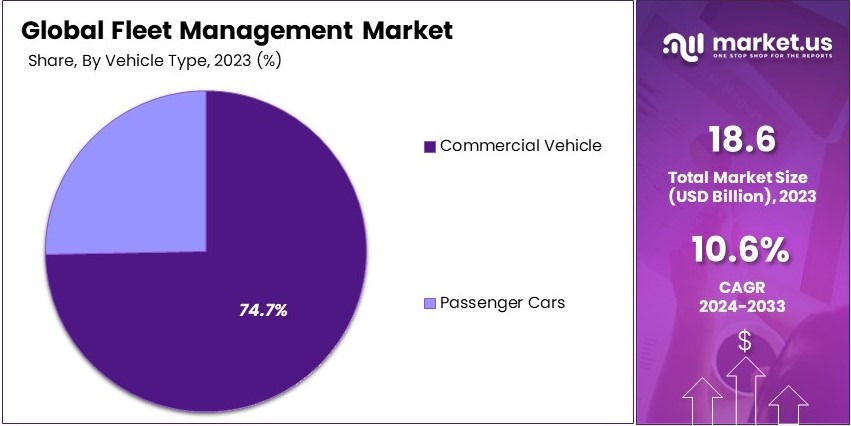
- In 2023, Commercial Vehicles dominate with 74.7%, supported by their critical role in logistics and freight transportation.
- In 2023, Manufacturing Sector leads the end-user segment, leveraging fleet solutions for efficient supply chain operations.
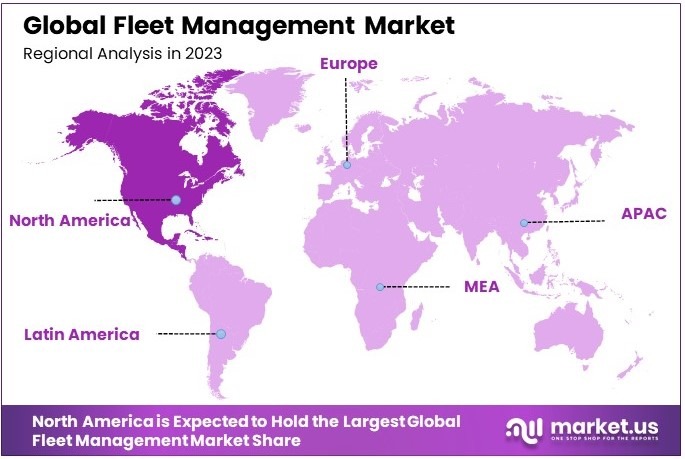
- In 2023, North America dominates, driven by advancements in fleet management technologies and infrastructure.
Business Environment Analysis
As of September 2024, the fleet management market is experiencing increased competition with companies like CarDekho Group investing in Carrum, which now manages over 500 vehicles and plans to expand to 2,000 by 2025. Consequently, market saturation is rising, especially in key regions.
According to Zippa, the target demographic primarily consists of fleet managers who are 83.2% male with an average age of 45 years in North America. Additionally, these professionals typically oversee large fleets, ensuring efficiency and reliability in their vehicle operations.
Product differentiation is driven by innovations such as Stellantis’ MyTasks launched in March 2024, and Autofleet’s Nova introduced in May 2024. These advanced tools offer real-time communication and AI-driven insights, enhancing operational efficiency and setting companies apart in a competitive market.
In the value chain, strategic investments play a crucial role. For example, VB Holdings Ltd invested $10 million in fleet assets to support government contracts in Fiji. Additionally, partnerships like Pacific Equity Partners acquiring SG Fleet for $1.2 billion shows the integration of financial services and technology providers, streamlining operations across the ecosystem.
Investment opportunities remain strong, highlighted by Pacific Equity Partners’ acquisition of SG Fleet at a 31% premium. Furthermore, CarDekho Group’s investment in Carrum and VB Holdings’ asset expansion demonstrate significant investor confidence and the potential for substantial growth within the fleet management sector.
According to the World Bank’s World Integrated Trade Solution (WITS), the global export value of transportation equipment is approximately $2.5 trillion. Germany leads with over $150 billion in commercial vehicle exports, while the United States imports more than $200 billion, driving high demand and influencing fleet management dynamics through extensive domestic consumption.
Solution Analysis
Fleet Analytics and Reporting dominates due to its crucial role in enhancing operational efficiency and data-driven decision-making.
The fleet management market has seen significant growth in the Fleet Analytics and Reporting segment, primarily due to the increasing demand for optimized operational costs and enhanced performance analytics across various industries. This sub-segment is crucial because it provides insights into fleet operations, fuel management, and driver performance, leading to more informed decision-making and improved cost efficiencies.
Other sub-segments like Operations Management, Driver Management, and Vehicle Maintenance Management also contribute to the market but to a lesser extent. Operations Management helps companies streamline their fleet operations through route optimization and load planning, improving overall operational efficiency.
Driver Management focuses on monitoring driver behavior, ensuring compliance with safety regulations, and enhancing driver safety and efficiency. Lastly, Vehicle Maintenance Management is essential for scheduling regular maintenance, reducing downtime, and extending the lifespan of fleet vehicles, all crucial for cost management and operational reliability.
Deployment Model Analysis
Cloud-Based deployment dominates due to its scalability and ease of integration.
In the Deployment Model segment, Cloud-Based solutions are increasingly preferred over On-Premises solutions. The shift towards cloud-based fleet management solutions is driven by their cost-effectiveness, scalability, and ease of integration with other technologies. Businesses are leveraging cloud-based solutions to obtain real-time data access and updates on fleet operations, which enhances responsiveness and operational agility.
The On-Premises deployment model, although less dominant, still plays a critical role in organizations that require enhanced data security and control over their IT infrastructure. This model is particularly relevant in industries where data sensitivity and regulatory compliance are priorities.
Vehicle Type Analysis
Commercial Vehicles dominate with 74.7% due to their extensive use in logistics and transportation.
Within the Vehicle Type segment, Commercial Vehicles significantly lead, mainly driven by the high demand in the logistics and transportation sectors. Commercial vehicles, including Light Commercial Vehicles and Heavy Commercial Vehicles, are crucial for the efficient operation of goods and services distribution channels globally.
Light Commercial Vehicles are primarily used for smaller scale operations and urban logistics, offering agility and cost-efficiency. Heavy Commercial Vehicles, on the other hand, are essential for large-scale goods movement and are extensively used in industries like manufacturing and construction due to their high capacity and robustness.
Passenger Cars, though less dominant in the fleet management market, are increasingly being incorporated into corporate fleets for employee commuting and corporate responsibilities, supporting sustainable mobility and employee benefits programs.
End User Analysis
The Manufacturing sector dominates due to its reliance on efficient logistics and inventory management.
The End User segment of the fleet management market is significantly led by the Manufacturing sector. This sector’s leadership is primarily due to its heavy reliance on timely and efficient logistics and inventory management, which are critical for maintaining production schedules and reducing operational costs.
Other key sectors like Transportation and Logistics, Retail, Construction, and Government also utilize fleet management solutions but with varying focuses. Transportation and Logistics are heavily dependent on fleet management for optimizing delivery times and reducing fuel consumption.
Retail benefits from improved supply chain efficiencies and enhanced delivery capabilities. Construction sector uses fleet management to monitor equipment and heavy vehicles crucial for project timelines, while Government utilizes these solutions to maintain public service fleets and ensure compliance with environmental regulations.
Key Market Segments
By Solution
- Operations Management
- Driver Management
- Vehicle Maintenance Management
- Fleet Analytics and Reporting
By Deployment Model
- Cloud-Based
- On-Premises
By Vehicle Type
- Commercial Vehicle
- Light Commercial Vehicles
- Heavy Commercial Vehicles
- Passenger Cars
By End User
- Transportation and Logistics
- Retail
- Manufacturing
- Construction
- Government
Drivers
AI and Green Tech Integration Drives Market Growth
The integration of AI and predictive analytics is changing how fleets operate. These technologies help plan routes better, saving time and reducing fuel use. Companies like UPS use AI to avoid left turns, which cuts fuel costs and delivery time.
At the same time, the demand for electric and hybrid vehicles is rising fast. Businesses are switching to cleaner fleets to meet emissions goals and save on fuel. In big cities like Los Angeles or London, low-emission zones are pushing this trend.
E-commerce is also growing, especially in last-mile delivery. More online shopping means more packages to deliver, increasing the need for smart fleet solutions. For example, Amazon has invested in electric vans and route optimization software to handle high delivery volumes.
Additionally, companies are now focused on ESG (Environmental, Social, and Governance) compliance. Many large firms are setting sustainability targets and need green fleets to meet them. This shift makes fleet management systems essential, as they help track emissions and promote responsible practices.
Restraints
Modernization Costs and Policy Gaps Restrain Market Growth
Fleet modernization requires significant capital investment. For many businesses, replacing old vehicles with electric ones or upgrading to smart systems is too expensive. Small logistics firms, especially in developing countries, find it hard to afford the upfront costs.
On top of that, there is limited EV charging infrastructure, especially in emerging markets. For instance, many parts of Southeast Asia still lack public charging stations. This limits the adoption of electric fleets.
At the same time, data privacy is a growing concern. Fleet management relies on telematics to track driver behavior and vehicle use. However, companies worry about cybersecurity threats and data misuse. In some cases, drivers also resist being tracked.
Moreover, regulations vary widely across countries and even within regions. Managing fleets across borders becomes complex and costly. For example, compliance requirements in the EU are very different from those in the U.S. or India.
Opportunity
New Models and Untapped Markets Provide Opportunities
The rise of subscription-based fleet services is creating new business models. Companies now prefer paying monthly for vehicles rather than buying them outright. This approach lowers upfront costs and makes fleet management more flexible. Firms like Ryder and Enterprise are already offering such services.
At the same time, rural and tier-2 urban areas are seeing a surge in logistics needs. These regions remain largely untapped, especially in countries like India and Brazil. By expanding into these zones, companies can access new revenue streams.
Another big opportunity lies in partnering with firms that build autonomous vehicles. This can prepare fleet companies for future automation. For instance, FedEx has tested autonomous delivery robots to cut labor costs.
Also, industries now want custom fleet solutions. A healthcare provider may need temperature-controlled vans, while a mining company may require rugged trucks. Fleet managers who offer these custom options can stand out in the market.
Emerging Trends
Digital Innovation Is Latest Trending Factor
Digital tools are changing how fleets operate. Mobility-as-a-Service (MaaS) platforms now combine transport modes into one system. Businesses can manage vehicles, drivers, and routes from a single app. In big cities like Amsterdam, MaaS is already helping firms cut costs and streamline deliveries.
Blockchain is also gaining ground. It helps create secure records of maintenance and vehicle use. This builds trust, especially for firms that lease fleets.
Meanwhile, real-time driver monitoring is becoming more common. These systems give instant feedback to drivers and help improve safety. Some firms even offer rewards for safe driving.
Digital twin technology is another trending tool. It creates a virtual model of a fleet, allowing managers to test changes before applying them in real life. For example, logistics companies use digital twins to simulate delivery routes and reduce delays.
Regional Analysis
North America Dominates with Significant Market Share
North America holds the largest share in the Fleet Management Market. This dominance is due to early adoption of telematics, strong technological infrastructure, and government support for clean energy initiatives. Major companies like Verizon Connect, Geotab, and Trimble have their headquarters in the U.S., boosting innovation and market maturity.
Key drivers include integration of AI and predictive analytics for route optimization, which reduces fuel use and improves delivery times. There’s also a rising demand for electric and hybrid fleet vehicles, pushed by ESG targets and corporate sustainability efforts. E-commerce growth in North America, especially in the U.S., has increased last-mile delivery fleets significantly. For example, Amazon’s investment in Rivian for electric vans is a major regional move.
The region’s advanced highway networks, high EV adoption rates, and smart city developments make it ideal for digital fleet solutions. Strong data policies and cybersecurity frameworks also help telematics adoption. North America’s culture of digitization gives fleet operators the tools to stay efficient and compliant.
Regional Mentions:
- Europe: Europe plays a key role in the Fleet Management Market, driven by strict environmental regulations and a strong push toward EV adoption. Countries like Germany and the Netherlands lead in sustainable transport and smart mobility integration.
- Asia Pacific: Asia Pacific shows fast growth due to rising urbanization, expanding e-commerce, and government support for smart transport. China and India are investing heavily in EV infrastructure and digital fleet systems to handle growing demand.
- Middle East & Africa: Fleet adoption is rising in the Middle East & Africa, mainly in logistics and oil sectors. Investments in smart city projects, like Saudi Arabia’s NEOM, and transport digitalization are boosting regional interest in fleet management tech.
- Latin America: Latin America is growing steadily as businesses modernize their fleets. Brazil and Mexico are leading adoption, with efforts focused on reducing vehicle downtime and improving logistics with digital tools and route optimization software.
Key Regions and Countries covered in the report
- North America
- US
- Canada
- Europe
- Germany
- France
- The UK
- Spain
- Italy
- Rest of Europe
- Asia Pacific
- China
- Japan
- South Korea
- India
- Australia
- Rest of APAC
- Latin America
- Brazil
- Mexico
- Rest of Latin America
- Middle East & Africa
- South Africa
- Saudi Arabia
- UAE
- Rest of MEA
Key Players Analysis
The Fleet Management Market is led by a few top players who are shaping the future of fleet operations through digital transformation, strong product offerings, and global reach. Among them, **Geotab Inc., Verizon Connect, Samsara Inc., and Fleet Complete** are the most influential.
These companies are known for their powerful telematics platforms. They offer solutions for vehicle tracking, route planning, fuel management, and driver behavior monitoring. Their tools help businesses reduce costs, improve safety, and meet regulatory standards. For example, Geotab’s open platform allows easy integration with third-party tools, making it a preferred choice for large fleets.
Verizon Connect benefits from being part of Verizon Communications. Its access to wide network infrastructure enhances its GPS tracking and data services. It serves industries such as transportation, construction, and delivery, with solutions that are scalable for small to large fleets.
Samsara is a newer but fast-growing player. Its strength lies in combining IoT with AI. It provides real-time vehicle diagnostics, video-based safety tools, and mobile-friendly dashboards. These innovations attract tech-savvy businesses aiming to modernize quickly.
Fleet Complete stands out for serving global markets, especially in North America and Europe. It provides flexible, cloud-based solutions for both commercial and government fleets.
Together, these leaders push the industry forward with smart technology, strong partnerships, and customer-focused innovation. Their competitive edge lies in offering user-friendly platforms, high data accuracy, and strong support services. As businesses continue to digitize fleet operations, these key players are expected to expand their market share and influence.
They not only respond to industry trends like electric vehicles and ESG goals but also help shape them. Their consistent R&D investment, global expansion, and scalable solutions make them critical to the future of fleet management.
Top Key Players in the Market
- Geotab Inc.
- Fleet Complete
- Samsara Inc.
- Verizon Connect
- Teletrac Navman
- Fleetcor Technologies
- Wheels, Inc.
- Sierra Wireless
- Omnitracs
- Trimble Inc.
Recent Developments
- Palfinger and AP Fleet Management: In December 2024, Palfinger, a leader in lifting solutions, partnered with AP Fleet Management to launch a bucket truck rental program in the United States. The program is designed to support industries such as electric utilities and telecommunications by enhancing operational efficiency.
- Geotab and BYD Trucks Europe: In July 2024, Geotab, a global IoT and connected transportation solutions provider, collaborated with BYD Trucks Europe to integrate Geotab’s fleet management telematics with BYD’s electric trucks.
- Kia Connect and Geotab: In September 2024, Kia Corporation partnered with Geotab and 42dot to develop a global connected vehicle platform. This collaboration integrates advanced data solutions with in-vehicle technology to enhance safety, sustainability, and efficiency in fleet management.









