


Report Overview
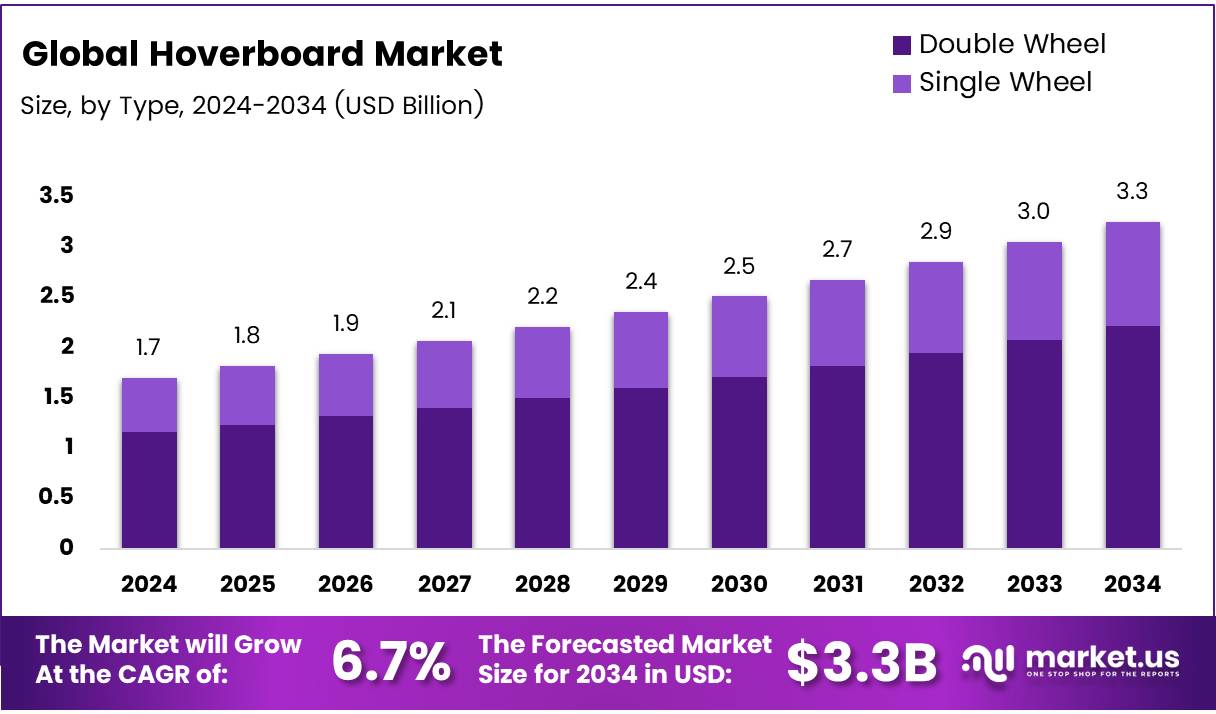
The Global Hoverboard Market size is expected to be worth around USD 3.3 Billion by 2034, from USD 1.7 Billion in 2024, growing at a CAGR of 6.7% during the forecast period from 2025 to 2034.
The hoverboard market, a segment of the broader personal mobility device industry, refers to the commercial landscape surrounding self-balancing scooters. These two-wheeled, electric, portable devices have captured the attention of both leisure and short-distance commuters due to their convenience and eco-friendly attributes.
As urban density increases and the demand for quick, compact transportation solutions rises, the hoverboard market has experienced significant expansion. This market encapsulates a range of products varying in speed, battery life, and weight capacity, meeting diverse consumer needs and preferences.
The hoverboard market is poised for substantial growth, driven by increasing consumer interest in portable and sustainable transportation alternatives. With urban congestion intensifying, hoverboards offer a practical solution for navigating city landscapes efficiently.
According to industry observations, most hoverboards facilitate travel at speeds between 6 and 7 mph, a range deemed safe and manageable for everyday users, including children according to twowheelingtots.
Additionally, the advent of hoverboards with extended battery capacities capable of covering distances between 10 to 15 miles on a single charge cater to those seeking longer commute options according to eridehero. This evolution in product capability could open new markets and expand user demographics.
Government policies and investments play a crucial role in shaping the hoverboard market. Regulatory frameworks designed to ensure safety while accommodating the growing use of hoverboards are critical.
As these devices become more prevalent, government entities are more likely to invest in infrastructure conducive to their use, such as dedicated lanes or updated traffic regulations. Such developments not only enhance user safety but also encourage the adoption of hoverboards as a legitimate mode of transport.
Despite the opportunities, the hoverboard market faces challenges, particularly concerning regulation and safety standards. The maximum weight capacity of hoverboards, typically around 220 pounds, limits their usage among heavier adults, potentially restricting market growth according to electronwheel.
Moreover, stringent safety standards and compliance requirements are essential to mitigate risks associated with battery malfunctions and operational failures. Navigating these regulations while innovating product features is a critical challenge for manufacturers aiming to sustain growth and profitability in the hoverboard market.
Key Takeaways
- Global Hoverboard Market size expected to reach USD 3.3 Billion by 2034, from USD 1.7 Billion in 2024, growing at a CAGR of 6.7% from 2025 to 2034.
- Double Wheel segment leads in the By Type Analysis with a 67.3% market share in 2024, driven by enhanced stability and balance.
- 6.5 Inches wheel size dominates the By Wheel Size Analysis with 62.9% market share in 2024, favored for portability, maneuverability, and affordability.
- Recreational segment holds 53.2% share in By Application Analysis in 2024, boosted by teen and young adult adoption for leisure purposes.
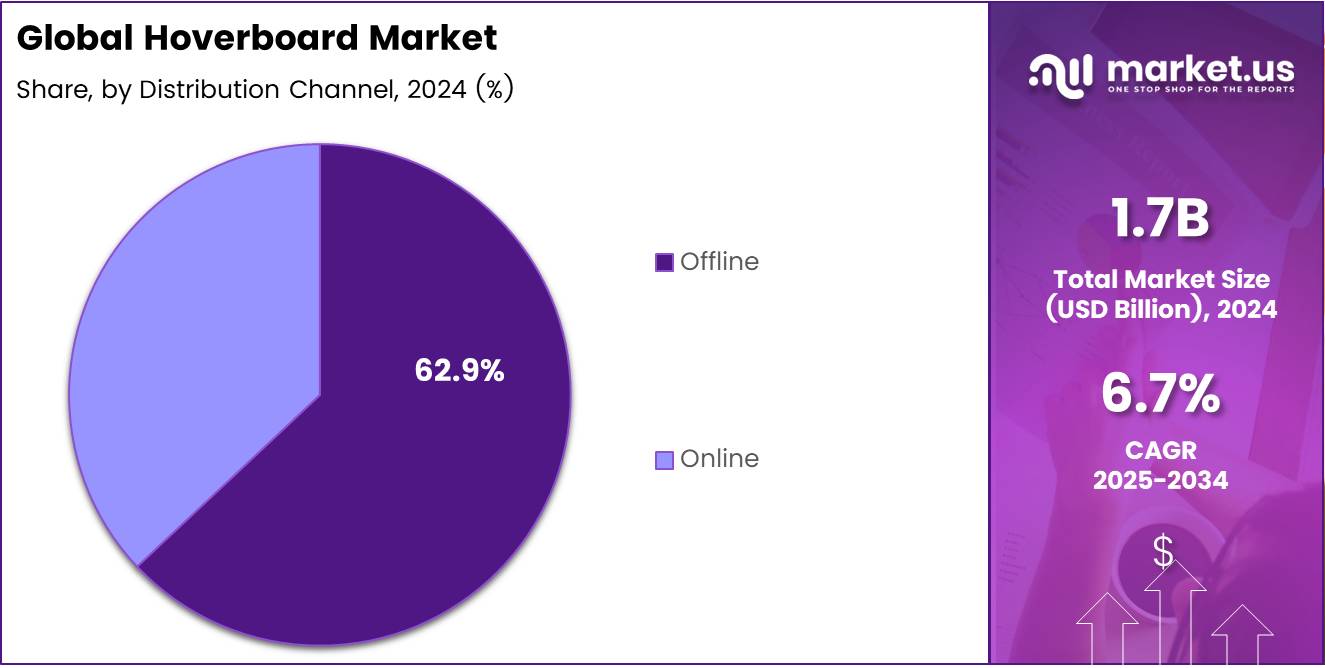
- Offline distribution channels lead with 62.9% market share in 2024, as consumers prefer physically testing hoverboards before purchasing.
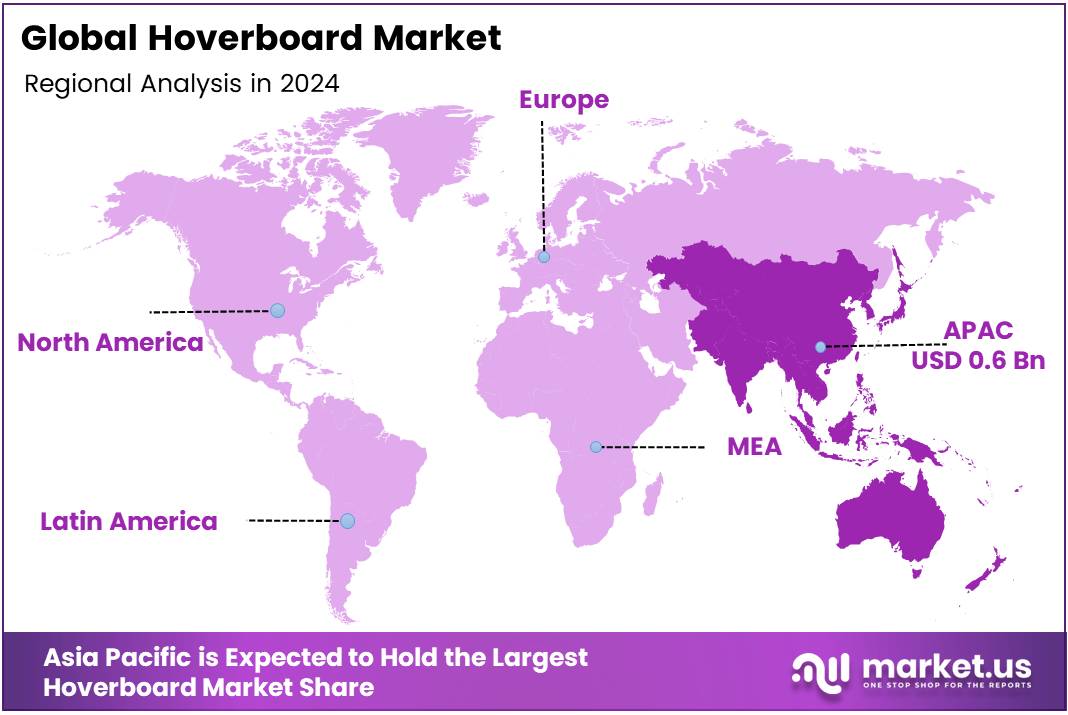
- Asia Pacific region holds 35.1% of the global market share in 2024, valued at approximately USD 0.6 billion, driven by high population density, urban development, and personal mobility solutions.
Type Analysis
Double Wheel dominates with 67.3% due to superior balance and ease of use
In 2024, Double Wheel held a dominant market position in the By Type Analysis segment of the Hoverboard Market, with a 67.3% share. The dominance of this segment is primarily attributed to the enhanced stability and balance offered by double-wheel hoverboards, making them more appealing to beginners and casual users. These models are widely preferred for their user-friendly controls and safer riding experience.
Single-wheel hoverboards, while appealing to enthusiasts seeking adventure or unique mobility options, still represent a niche user base. Their steep learning curve and reduced balance make them less favorable among the general public, especially those using hoverboards for short-distance commuting or recreational riding. However, they continue to gain traction in specific urban markets and among tech-savvy consumers looking for innovative designs.
Wheel Size Analysis
6.5 Inches dominates with 62.9% due to its compact size and affordability
In 2024, 6.5 Inches held a dominant market position in the By Wheel Size Analysis segment of the Hoverboard Market, with a 62.9% share. The popularity of this wheel size is largely driven by its portability, ease of maneuverability, and affordability, making it ideal for everyday use in urban environments. It is especially favored by younger consumers and first-time buyers due to its lightweight design and cost-effective price point.
The 8 Inches category is slowly gaining traction, offering a balanced compromise between compactness and ride comfort. These are preferred by users seeking better shock absorption on uneven terrain without moving to bulkier models.
Meanwhile, the 10 Inches and Above segment, while offering the best ride quality and off-road capabilities, remains less dominant due to its higher price and bulkier frame, which makes portability and indoor storage more challenging.
Application Analysis
Recreational dominates with 53.2% owing to growing youth interest and lifestyle appeal
In 2024, Recreational held a dominant market position in the By Application Analysis segment of the Hoverboard Market, with a 53.2% share. This dominance is fueled by the increasing adoption of hoverboards among teens and young adults for leisure purposes. The sleek design, vibrant color options, and social media appeal have made hoverboards a popular lifestyle product.
Personal Mobility is a growing segment, especially in urban centers where individuals are seeking alternative modes of transportation for short-distance commuting. This application is driven by rising traffic congestion and the need for efficient last-mile connectivity.
The Commercial segment, including applications in large warehouses, airports, and theme parks, is still in its nascent stage but shows promising growth potential. Meanwhile, the Others category remains limited, consisting of experimental or less conventional applications that haven’t yet gained widespread market acceptance.
Distribution Channel Analysis
Offline dominates with 62.9% thanks to hands-on experience and immediate availability
In 2024, Offline held a dominant market position in the By Distribution Channel Analysis segment of the Hoverboard Market, with a 62.9% share. Brick-and-mortar stores remain the preferred purchase point due to the consumer preference for physically testing the product before buying. Many consumers value the ability to inspect the hoverboard’s build quality, test ride, and seek guidance from sales staff.
Additionally, offline retailers often provide bundled deals, after-sales support, and service warranties that build customer trust. Physical presence in malls and electronics outlets has also contributed to increased impulse purchases.
The Online channel, while growing steadily, continues to face barriers such as customer concerns over product authenticity, lack of trial opportunities, and high return logistics. However, it remains an essential platform for tech-savvy consumers who prioritize convenience, comparison shopping, and access to wider product ranges.
Key Market Segments
By Type
- Double Wheel
- Single Wheel
By Wheel Size
- 6.5 Inches
- 8 Inches
- 10 Inches and Above
By Application
- Recreational
- Personal Mobility
- Commercial
- Others
By Distribution Channel
- Offline
- Online
Drivers
Rising Urbanization and Traffic Congestion Fuels the Demand for Hoverboards
As cities become more crowded and traffic congestion gets worse, people are looking for smarter, smaller, and faster ways to get around. Hoverboards have emerged as a convenient personal transport solution, especially for short distances in urban settings.
Their compact size allows users to easily avoid traffic, save time, and even reduce carbon emissions. Moreover, the youth population is playing a big role in driving the market. Hoverboards are seen as a fun, trendy, and exciting gadget—especially among teenagers and young adults—adding to their popularity.
In addition, technology is making hoverboards even more attractive. Manufacturers are improving battery life, adding smart features like Bluetooth connectivity and mobile app control, and enhancing safety with better balancing systems. These innovations not only improve user experience but also increase the product’s appeal to tech-savvy buyers.
As a result, the hoverboard market is experiencing a steady boost in demand from both commuters and recreational users, especially in urban regions.
Restraints
Short Battery Life and High Costs Remain Key Challenges for Hoverboard Adoption
Despite growing popularity, there are certain issues that are holding back the hoverboard market. One of the major restraints is the limited battery life. Most hoverboards can only run a short distance before needing a recharge, and the charging process itself can take several hours. This makes them less practical for users who want reliable transport for daily commutes.
Another concern is the price. High-quality hoverboards with advanced features—such as stronger motors, better safety tech, or waterproofing—can be quite expensive. This limits access for price-sensitive consumers who might otherwise be interested in buying one.
Moreover, the risk of low-cost, poorly made alternatives on the market adds to safety concerns, especially for parents buying for their children. Overall, battery limitations and high costs are key factors slowing down the market’s full potential.
Growth Factors
Smart City Integration and Tourism Use Unlock Future Growth Potential
As cities around the world adopt smart mobility solutions, hoverboards have the chance to become part of this transformation. With IoT and mobile app integration, hoverboards can fit into public transport ecosystems, giving users more options for the last mile of their journey. This makes them a valuable tool for urban mobility in smart cities.
There is also strong growth potential in rental and sharing models. Just like e-scooters, hoverboards can be offered for rent in busy urban areas, university campuses, or large corporate parks. This gives users the convenience of using them without the cost of ownership.
Additionally, the tourism industry presents another opportunity. Hoverboards can be used in resorts, theme parks, and sightseeing tours, offering visitors a fun and efficient way to explore large areas. These new use cases show that the hoverboard market still has room to grow through innovation and strategic expansion.”
Emerging Trends
Off-Road Hoverboards and Custom Designs Are Winning Consumer Attention
One of the latest trends in the hoverboard market is the rising demand for off-road models. Consumers are now looking for more rugged hoverboards that can handle rough terrains, not just smooth city streets. This trend is expanding the customer base beyond just urban users to adventure seekers and outdoor enthusiasts.
At the same time, personalization is becoming very popular, especially among younger users. Custom color choices, LED lights, and even themed skins are allowing users to express their style through their hoverboards. Social media and influencer marketing also play a huge role in boosting hoverboard sales.
Many brands are leveraging platforms like TikTok and Instagram to showcase creative content, which attracts attention and drives consumer interest. This combination of design trends, adventurous use cases, and digital promotion is keeping the hoverboard market fresh and appealing, particularly to the younger generation.
Regional Analysis
Asia Pacific Leads the Global Hoverboard Market with 35.1% Share, Valued at USD 0.6 Billion in 2024
The Asia Pacific region is at the forefront of the global hoverboard market, commanding 35.1% of the total market share with a valuation of approximately USD 0.6 billion in 2024. This leadership is driven by high population density, rapid urban development, and the rising popularity of personal mobility solutions.
China, as a major manufacturing hub, plays a crucial role in driving innovation and affordability, making hoverboards widely accessible across the region. Additionally, countries such as India and Japan are seeing growing adoption, supported by a young, tech-savvy demographic and increasing interest in smart transportation alternatives.
Regional Mentions:
North America remains a strong market, buoyed by consumer enthusiasm for cutting-edge gadgets and recreational technologies. The region benefits from a mature retail ecosystem and a favorable environment for product innovation.
Europe shows steady growth, with widespread consumer awareness and supportive regulatory frameworks encouraging the use of electric mobility devices in urban settings.
In the Middle East & Africa, the market is gaining traction due to increasing urbanization and interest in high-tech lifestyle products. Wealthier nations in the Gulf region are witnessing growing adoption, especially among younger consumers.
Latin America, particularly Brazil and Mexico, is experiencing gradual growth with improving internet penetration and e-commerce channels aiding product availability.
Key Regions and Countries
- North America
- US
- Canada
- Europe
- Germany
- France
- The UK
- Spain
- Italy
- Rest of Europe
- Asia Pacific
- China
- Japan
- South Korea
- India
- Australia
- Rest of APAC
- Latin America
- Brazil
- Mexico
- Rest of Latin America
- Middle East & Africa
- South Africa
- Saudi Arabia
- UAE
- Rest of MEA
Key Players Analysis
2024, the global hoverboard market is experiencing steady growth, driven by increasing demand for personal mobility solutions and recreational devices. Key players are leveraging technological advancements and strategic positioning to capture market share.
Razor USA LLC continues to be a dominant force in North America, offering a diverse range of hoverboards that appeal to both beginners and experienced riders. Their focus on safety features and user-friendly designs has solidified their reputation in the market.
TOMOLOO Technology Industrial Co. Ltd. has made significant strides by integrating innovative features such as app connectivity and customizable LED lighting into their products. Their commitment to quality and affordability has expanded their global footprint, particularly in Asia and Europe.
Hangzhou Chic Intelligent Technology Co. has maintained a strong presence by emphasizing research and development. Their products are known for durability and performance, catering to both casual users and enthusiasts.
HaloBoard has distinguished itself with high-performance models like the Halo Rover X, which features advanced ride-assist technology and robust build quality. Their focus on premium offerings has attracted a niche segment seeking top-tier hoverboards.
JIALIKE Electronic Company Ltd. has targeted budget-conscious consumers by providing reliable and cost-effective hoverboards. Their strategy of balancing affordability with essential features has resonated in emerging markets.
Airwheel Technology Co. Ltd. has diversified its product line to include various personal transportation devices, with hoverboards remaining a key component. Their emphasis on innovation and design has kept them relevant in a competitive landscape.
Top Key Players in the Market
- Razor USA LLC
- TOMOLOO Technology Industrial Co. Ltd.
- Hangzhou Chic Intelligent Technology Co.
- HaloBoard
- JIALIKE Electronic Company Ltd.
- Airwheel Technology Co. Ltd.
- Ninebot Inc.
- SURFUS
- Segway Inc.
- Shenzhen Rooder Technology Co. Ltd.
Recent Developments
- In October 2023, the inventor of the hoverboard unveiled a groundbreaking parallel, two-wheeled electric car designed to redefine urban mobility. This futuristic vehicle promises enhanced balance, compact design, and eco-friendly transportation, challenging traditional four-wheeled models.
- In March 2025, Laka acquired French insurtech company Luko in a strategic move to expand its portfolio. With this acquisition, Laka enters the e-scooter insurance market for the first time, targeting the growing micromobility sector.









