


Report Overview
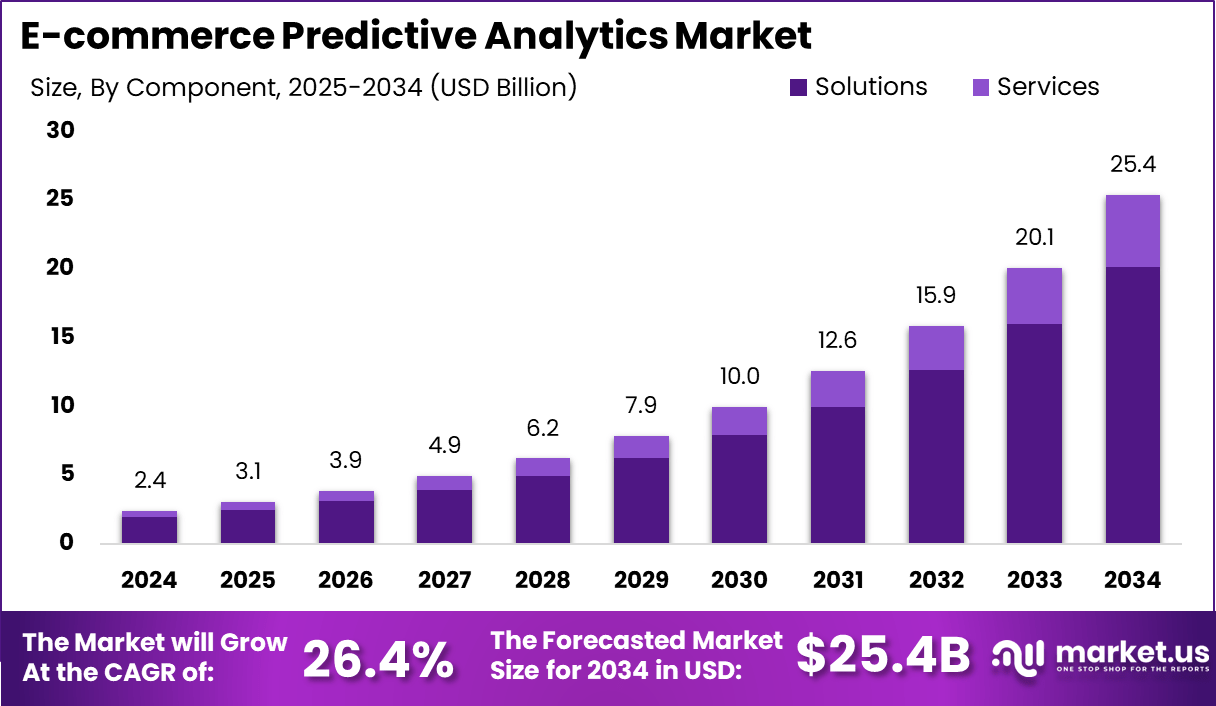
The Global E-commerce Predictive Analytics Market size is expected to be worth around USD 25.4 Billion By 2034, from USD 2.4 billion in 2024, growing at a CAGR of 26.4% during the forecast period from 2025 to 2034. In 2024, North America held a dominant market position, capturing more than a 32.9% share, holding USD 0.76 Billion revenue.
E-commerce predictive analytics is an advanced technology approach that utilizes machine learning, AI, and data mining to predict future trends, customer behaviors, and potential outcomes. By analyzing historical data, e-commerce platforms can forecast consumer buying patterns, optimize inventory management, and enhance the personalization of customer experiences.
The market for e-commerce predictive analytics is growing rapidly, fueled by the proliferation of data and the increasing sophistication of AI technologies. Businesses leverage these analytics to drive strategic decision-making, improve operational efficiencies, and increase customer retention rates. This technology is becoming essential for companies that want to maintain competitive advantage in the digital marketplace.
The primary drivers for the adoption of e-commerce predictive analytics include the need for improved customer insights, enhanced decision-making capabilities, and operational efficiency. The integration of AI and machine learning technologies has enabled deeper insights into customer behavior, leading to more effective marketing strategies and inventory management.
Demand for predictive analytics in e-commerce is soaring due to its capability to improve the accuracy of forecasts and inventory needs, leading to reduced costs and improved customer satisfaction. Companies use these tools to anticipate market trends and adapt their strategies accordingly, which is crucial in the fast-paced e-commerce sector.
The major reason boosting the demand for e-commerce predictive analytics is the increasing volume of data generated by online platforms. Retailers are looking to harness this data to gain actionable insights that drive conversions and enhance customer engagement.
Current trends in the market include the adoption of real-time analytics, the use of AI for personalized customer experiences, and the integration of analytics with other business operations like supply chain management and customer service. These trends are reshaping how companies approach e-commerce, making operations more data-driven and efficient.
Key Takeaways
- The Global E-commerce Predictive Analytics Market is projected to expand significantly from USD 2.4 billion in 2024 to around USD 25.4 billion by 2034. This growth represents a remarkable CAGR of 26.4% during the forecast period from 2025 to 2034, driven by increasing adoption of data-driven decision-making tools across the e-commerce sector.
- North America maintained its leadership position in 2024, accounting for more than 32.9% of the global market share, with revenues reaching approximately USD 0.76 billion.
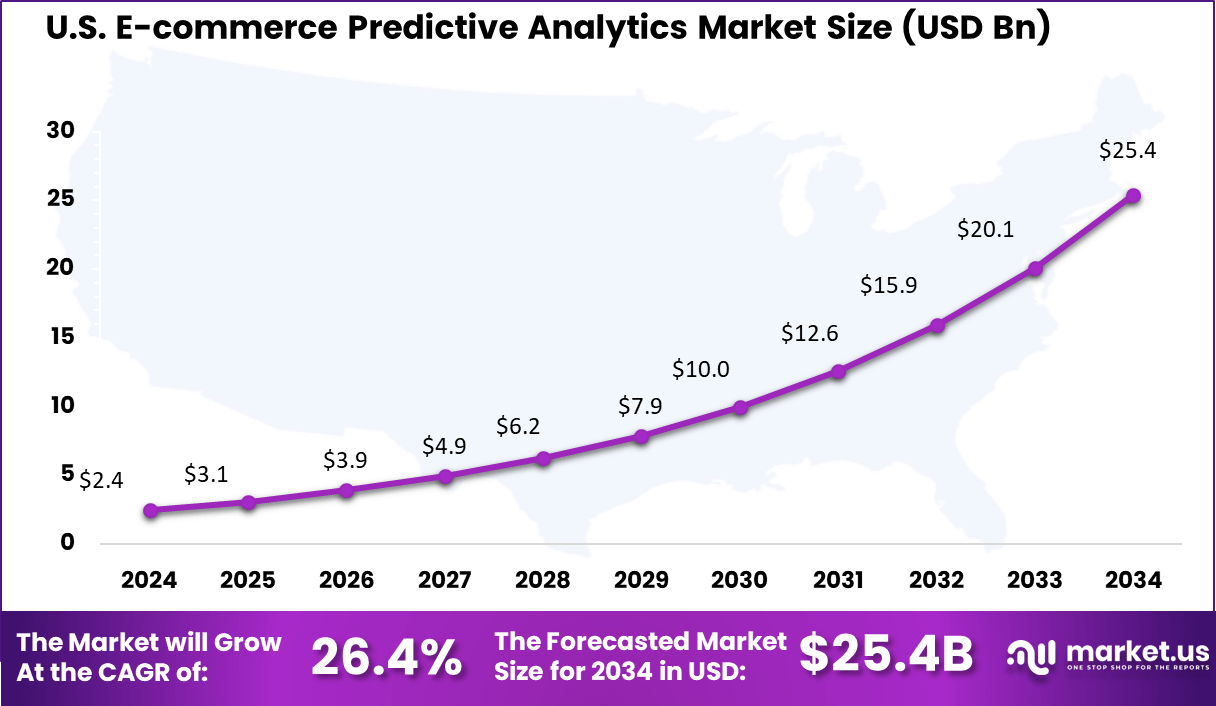
- The United States market shows robust growth potential, with a valuation of about USD 2.4 billion in 2024. It is forecasted to rise sharply, reaching close to USD 25.4 billion by 2034, supported by a strong CAGR of 26.4% from 2025 to 2034, reflecting high demand for predictive insights to optimize online retail operations.
- In terms of components, the Solutions segment led the market in 2024, securing more than 79.5% of the total market share.
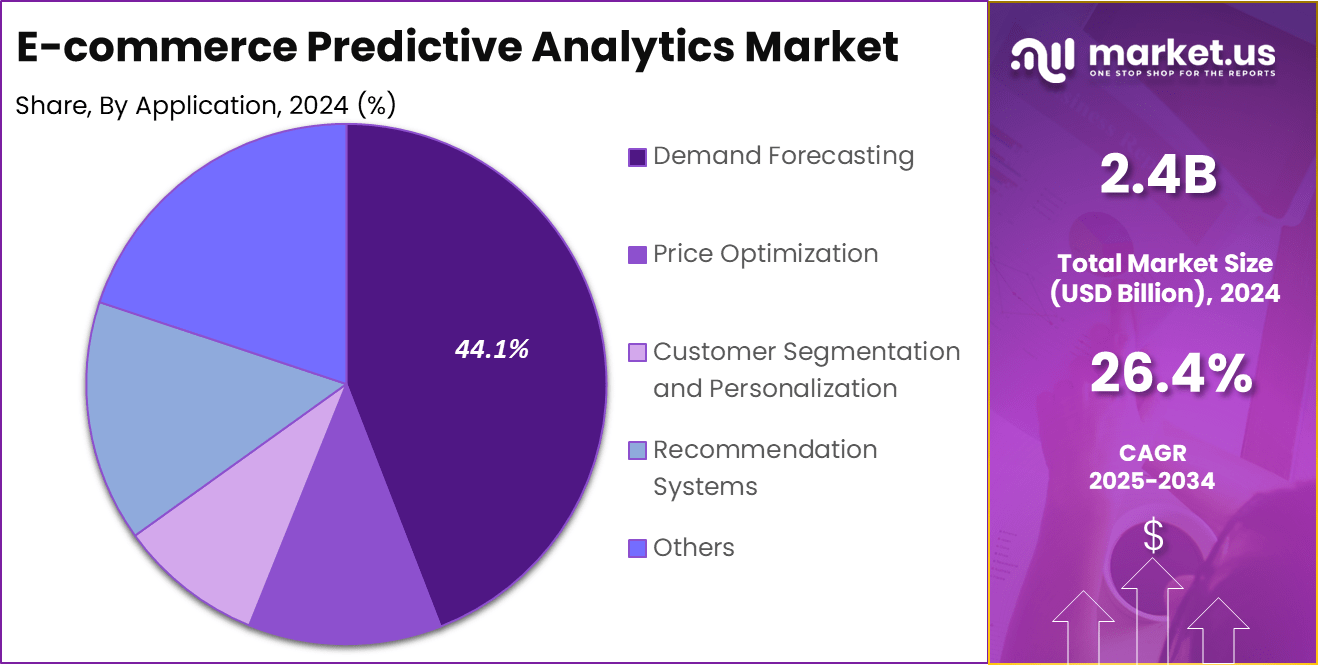
- Among application areas, Demand Forecasting held a dominant position, contributing more than 44.1% to the global market share in 2024.
Analysts’ Viewpoint
Investment opportunities in e-commerce predictive analytics are abundant, particularly in developing personalized shopping experiences and optimizing logistical operations. Investors are particularly interested in startups that innovate in AI and analytics, as these are seen as key differentiators in the competitive e-commerce landscape.
The business benefits of implementing predictive analytics in e-commerce include increased operational efficiency, enhanced customer loyalty, and improved profitability. By predicting customer behaviors, companies can optimize their marketing efforts and inventory management, leading to cost savings and increased sales.
The regulatory environment around data privacy and protection is tightening, which impacts how e-commerce businesses can use predictive analytics. Companies must ensure compliance with regulations such as GDPR, which governs how personal data is collected, stored, and used.
US Market Growth
The US E-commerce Predictive Analytics Market is valued at approximately USD 2.4 Billion in 2024 and is predicted to increase from USD 3.1 Billion in 2025 to approximately USD 25.4 Billion by 2034, projected at a CAGR of 26.4% from 2025 to 2034.
Firstly, the U.S. benefits from a highly developed digital infrastructure and a mature e-commerce ecosystem. This environment is conducive to the deployment and scaling of advanced analytics solutions. American companies are pioneers in harnessing big data and machine learning technologies to optimize customer journeys and improve operational efficiencies.
Retail giants like Amazon and Walmart, along with tech firms such as Google and IBM, drive innovations that set global standards for analytics in retail and e-commerce. Furthermore, the U.S. market is characterized by a robust entrepreneurial spirit and a strong venture capital presence, which supports a thriving startup ecosystem focused on e-commerce innovation.
This is evident in the continuous emergence of cutting-edge technologies and analytics platforms designed to enhance predictive capabilities in areas such as customer behavior forecasting, inventory management, and personalized marketing.
Component Analysis
In 2024, the Solutions segment of the E-commerce Predictive Analytics market held a dominant position, capturing more than a 79.5% share. This significant market share can primarily be attributed to the escalating demand for cloud-based predictive analytics solutions among e-commerce businesses.
These cloud solutions offer several advantages, such as scalability, cost-efficiency, and the ability to manage vast volumes of data, which are critical for deriving actionable insights and enhancing decision-making processes in e-commerce.
The leadership of the Solutions segment is further reinforced by its role in enabling real-time data integration and processing, which is vital for e-commerce platforms operating across multiple channels. By leveraging AI-driven analytics, e-commerce businesses can automate and streamline their data integration, thereby enhancing efficiency and accuracy in forecasting customer behavior and market trends.
Moreover, the surge in digital transformation initiatives across the retail sector has spurred the adoption of on-premise solutions, which are tailored to offer enhanced security and control over data. This is particularly crucial for large enterprises that handle sensitive customer information and require robust data security measures.
The combination of cloud and on-premise solutions within the Solutions segment thus provides a comprehensive analytics framework that caters to the diverse needs of the e-commerce industry, from small enterprises to large conglomerates
Application Analysis
In 2024, the Demand Forecasting segment of the E-commerce Predictive Analytics market held a dominant market position, capturing more than a 44.1% share. This leadership can be attributed to the critical role of demand forecasting in optimizing inventory management and enhancing customer satisfaction.
E-commerce businesses leverage demand forecasting to predict future customer demands accurately, thereby ensuring they can manage stock levels effectively to meet consumer expectations without overstocking or understocking. The prevalence of AI and machine learning technologies has significantly bolstered the effectiveness of demand forecasting tools.
These technologies enable the analysis of large datasets to identify patterns and predict future trends with high accuracy. This capability is essential for e-commerce platforms as it allows them to adapt to dynamic market conditions and consumer behaviors swiftly, ensuring they maintain a competitive edge by aligning their business strategies with anticipated market demands.
Furthermore, the integration of demand forecasting within broader predictive analytics frameworks supports strategic marketing and pricing decisions, which are crucial for maximizing profitability in the highly competitive e-commerce landscape. By predicting peak demand periods, businesses can adjust their pricing strategies and promotional activities to optimize revenue generation, thereby driving the substantial market share of this segment.
Key Market Segments
By Component
- Solutions
- Cloud
- On-Premise
- Services
- Deployment/ Installation
- Support & Maintenance
- Training & Consulting
By Application
- Demand Forecasting
- Price Optimization
- Customer Segmentation and Personalization
- Recommendation Systems
- Others
Driver
The Surge of Mobile Connectivity and E-commerce Engagement
The burgeoning growth of smartphone penetration and enhanced connectivity infrastructures, such as 4G and 5G networks, are principal drivers for the adoption of predictive analytics in e-commerce. These technologies ensure a seamless online experience, encouraging more consumers to engage in online shopping.
The accessibility of mobile internet has expanded the consumer base able to participate in e-commerce, leading to increased data collection. This influx of data is vital for predictive analytics, which thrives on large datasets to forecast consumer behavior and optimize e-commerce operations. As more people use mobile devices for shopping, the more refined the insights predictive analytics can offer, fueling a cycle of growth and enhancement in e-commerce strategies.
Restraint
Technical and Infrastructural Limitations
Despite the advantages, the deployment of predictive analytics in e-commerce faces significant hurdles in regions with underdeveloped digital infrastructure. In many developing areas, the lack of reliable internet connectivity and the limited spread of technology hinder the consistent collection of consumer data, which is crucial for powering predictive analytics engines.
Additionally, cybersecurity concerns, such as data breaches and hacking, pose substantial risks. These security challenges can deter e-commerce platforms from fully adopting advanced data-driven technologies due to the potential threats to sensitive customer information.
Opportunity
Enhanced Customer Experience through Personalization
Predictive analytics presents a substantial opportunity to transform the e-commerce landscape by personalizing the shopping experience. By analyzing vast amounts of data, e-commerce platforms can predict customer preferences and shopping behavior, allowing for the customization of product recommendations and user interfaces.
This level of personalization not only improves customer satisfaction but also significantly boosts conversion rates and customer loyalty. Brands like IKEA and Sephora leverage predictive analytics to forecast demand and tailor product offerings, ensuring that customers find precisely what they need, potentially before they even search for it.
Challenge
Managing the Intricacies of Data Privacy and Consumer Trust
One of the most significant challenges facing e-commerce predictive analytics is navigating the complex terrain of data privacy and consumer trust. As predictive tools delve deeper into personal data to enhance accuracy, e-commerce companies must tread carefully to maintain consumer trust.
The increasing scrutiny on data privacy practices and the rise of regulations like GDPR pose a challenge to how e-commerce entities collect, store, and utilize data. Ensuring compliance while still leveraging the benefits of predictive analytics requires a balanced approach that respects consumer privacy and promotes transparency.
Key Regions and Countries
- North America
- US
- Canada
- Europe
- Germany
- France
- The UK
- Spain
- Italy
- Rest of Europe
- Asia Pacific
- China
- Japan
- South Korea
- India
- Australia
- Singapore
- Rest of Asia Pacific
- Latin America
- Brazil
- Mexico
- Rest of Latin America
- Middle East & Africa
- South Africa
- Saudi Arabia
- UAE
- Rest of MEA
Growth Factors
- Advent of AI and Machine Learning: The integration of artificial intelligence (AI) and machine learning (ML) into e-commerce platforms has significantly propelled the growth of predictive analytics. These technologies enhance personalization, optimize marketing efforts, and streamline operations by analyzing vast amounts of data to predict customer behaviors and preferences.
- Increased Mobile Commerce: The surge in mobile commerce is another pivotal growth factor. As smartphones become ubiquitous, more consumers are using their devices for shopping, making mobile platforms rich sources of data for predictive analytics. This trend allows businesses to tailor their marketing and sales strategies directly to mobile users, enhancing the shopping experience and driving sales.
- Global E-commerce Expansion: The ongoing expansion of e-commerce globally, especially in emerging markets, fuels the demand for predictive analytics. As e-commerce becomes a dominant retail channel worldwide, understanding and anticipating global consumer trends and preferences through predictive analytics is key to maintaining competitive advantage.
Emerging Trends
- Social Commerce: Leveraging social media platforms for e-commerce, known as social commerce, is an emerging trend that integrates shopping with the daily social media experience of consumers. This trend reduces the barriers to purchasing, allowing for more spontaneous buys directly from social media feeds, thus necessitating sophisticated predictive models to forecast trends and consumer behavior on these platforms.
- Sustainability and Ethical Practices: Consumers are increasingly favoring brands that demonstrate sustainability and ethical practices. Predictive analytics helps businesses align their operations with these values by optimizing supply chains and reducing waste. This not only caters to consumer preferences but also improves operational efficiency and brand loyalty.
- Augmented Reality (AR) and Virtual Reality (VR): AR and VR are transforming e-commerce by improving how consumers interact with products online. Predictive analytics plays a role in enhancing these technologies by helping businesses understand which products are likely to resonate most with consumers, thus providing a more engaging and personalized shopping experience.
Business Benefits
- Enhanced Customer Experience: At the core of predictive analytics’ benefits is the enhancement of the customer shopping experience. By analyzing customer data, businesses can offer personalized recommendations, optimize their website interfaces, and ensure that marketing strategies are more effectively aligned with consumer preferences.
- Improved Inventory Management: Predictive analytics significantly improves inventory management by forecasting demand more accurately. This allows businesses to maintain optimal stock levels, reduce overhead costs, and minimize the risk of overstocking or stockouts, which can negatively impact customer satisfaction.
- Dynamic Pricing Strategies: By employing predictive analytics, e-commerce businesses can dynamically adjust prices based on consumer demand, competition, and market conditions. This not only maximizes profitability but also ensures pricing strategies are fair and competitive, attracting more customers and boosting sales.
- Increased Operational Efficiency: Predictive analytics streamline various aspects of e-commerce operations, from marketing to customer service and logistics. This integration leads to reduced costs, improved response times, and more effective allocation of resources across the business.
Key Player Analysis
In the E-commerce Predictive Analytics market, several key players are utilizing acquisitions, product launches, and mergers to solidify their market positions and enhance their predictive analytics capabilities. Here are insights into three major companies that have been prominent in the landscape:
BigCommerce has strategically enhanced its platform by integrating advanced predictive analytics capabilities. This includes tools for customer personalization, optimized marketing strategies, and improved operational efficiency. These innovations are aimed at helping e-commerce businesses anticipate customer needs and manage inventory more effectively.
SPD Technology, At the forefront of integrating Generative AI with E-commerce analytics, SPD Technology focuses on creating hyper-personalized shopping experiences and automated content creation. Their use of Generative AI has enabled real-time product recommendations and dynamic product bundling, which significantly enhance the customer shopping experience and optimize marketing strategies.
pdata.ai, Known for its robust predictive modeling and AI-powered analytics, pdata.ai aids e-commerce businesses in anticipating future customer behaviors, improving sales optimization, and enhancing overall customer experience. The company’s tools enable e-commerce platforms to make data-driven decisions that are crucial for competitive advantage.
Top Key Players in the Market
- Session AI
- Granify
- DataToBiz
- SoluLab
- Indium
- Data Never Lies
- Datadwip
- Saxon AI
- Valiotti Analytics
- EDITED
- Synerise
- Jungle Scout
- Other Major Players
Recent Developments
- Graas, a leading e-commerce analytics company, launched a new predictive analytics platform in April 2024. This tool uses artificial intelligence (AI) to help online stores predict customer behavior, manage inventory, and optimize marketing strategies. The platform integrates data from different sources in real time, making it easier for businesses to make smart, data-driven decisions and boost sales.
- By 2025, predictive analytics tools in e-commerce are being used more for fraud detection and risk management. Companies like ClearSafe have developed systems that combine human expertise with AI to spot suspicious transactions quickly, protecting both the business and customers from fraud.









