


Report Overview
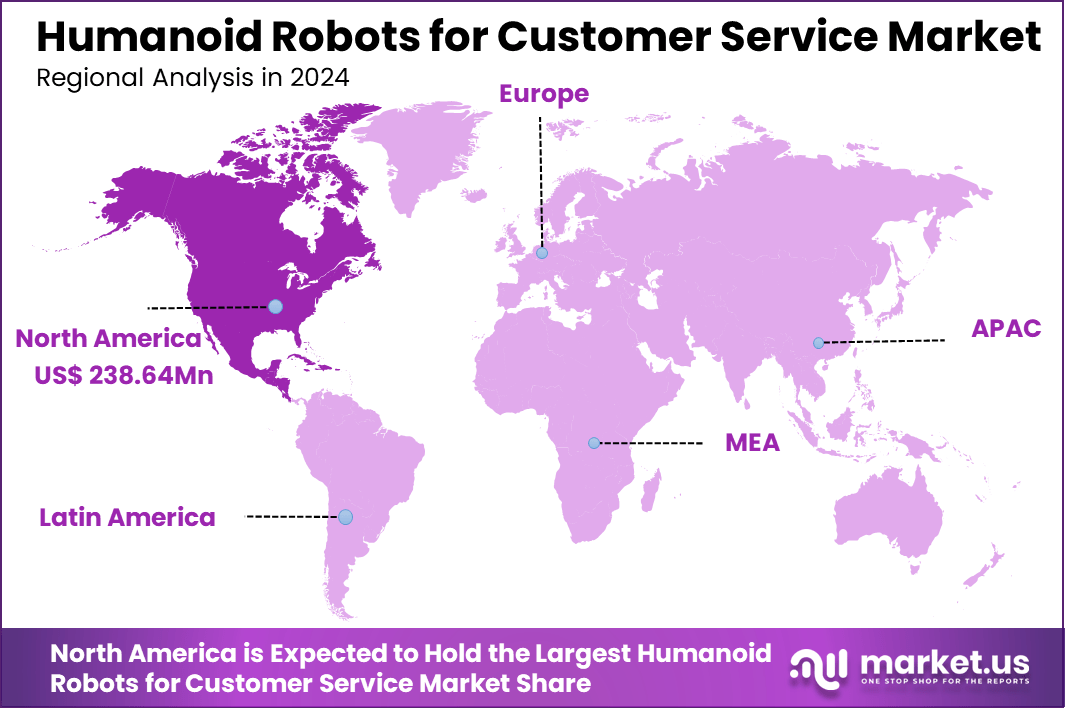
The Global Humanoid Robots for Customer Service Market size is expected to be worth around USD 15,837.6 Million By 2034, from USD 465.2 Million in 2024, growing at a CAGR of 42.3% during the forecast period from 2025 to 2034. In 2024, North America held a dominant market position, capturing more than a 51.3% share, holding USD 238.6 Million revenue.
Humanoid robots for customer service are advanced robotic systems designed to interact with humans in various service environments. These robots are equipped with artificial intelligence (AI) and machine learning capabilities, allowing them to perform tasks that typically require human intelligence and interaction. They often mimic human appearance and behaviors, facilitating a more natural interaction with people.
The market for humanoid robots in customer service is expanding significantly due to their ability to enhance customer experience and operational efficience. The primary drivers for the humanoid robots market include the advancements in AI and robotics technology, labor force shortages, and the growing need for personal assistance and automation in customer service roles.

The demand for humanoid robots in customer service is bolstered by their proven effectiveness in enhancing customer engagement and streamlining service operations. Retailers and hospitality providers leverage these robots for their ability to engage customers dynamically and personally, which not only improves the customer experience but also increases operational efficiency.
The primary reasons for increased demand include the integration of AI that enables robots to understand and respond to human emotions, improvements in robotic mobility, and speech recognition technologies that allow for more natural interactions with customers.
As reported by Market.us, The global humanoid robot market is poised for significant expansion, with the market size projected to reach approximately USD 29.12 billion by 2033, rising sharply from USD 1.49 billion in 2023. This remarkable growth is expected to occur at a compound annual growth rate (CAGR) of 34.62% during the forecast period from 2024 to 2033
Technological advancements in humanoid robotics include the development of more sophisticated AI algorithms, improved sensor and perception technologies, and enhanced human-robot interaction capabilities. These advancements make humanoid robots increasingly capable of handling complex and varied customer service tasks.
Key Takeaways
- The Global Humanoid Robots for Customer Service Market is projected to reach USD 15,837.6 Million by 2034, growing at a strong CAGR of 42.3% from 2025 to 2034, reflecting rising automation needs in customer-facing operations.
- In 2024, North America led the market, holding over 51.3% share with revenue of approximately USD 238.6 Million, driven by early adoption of robotics across industries.
- The United States alone contributed around USD 214.1 Million in 2024 and is forecasted to grow significantly to USD 6,373.1 Million by 2034, supported by a steady CAGR of 40.4%.
- The Hardware segment remained dominant in 2024, accounting for more than 71.1% share, due to high demand for advanced robotic components and sensors.
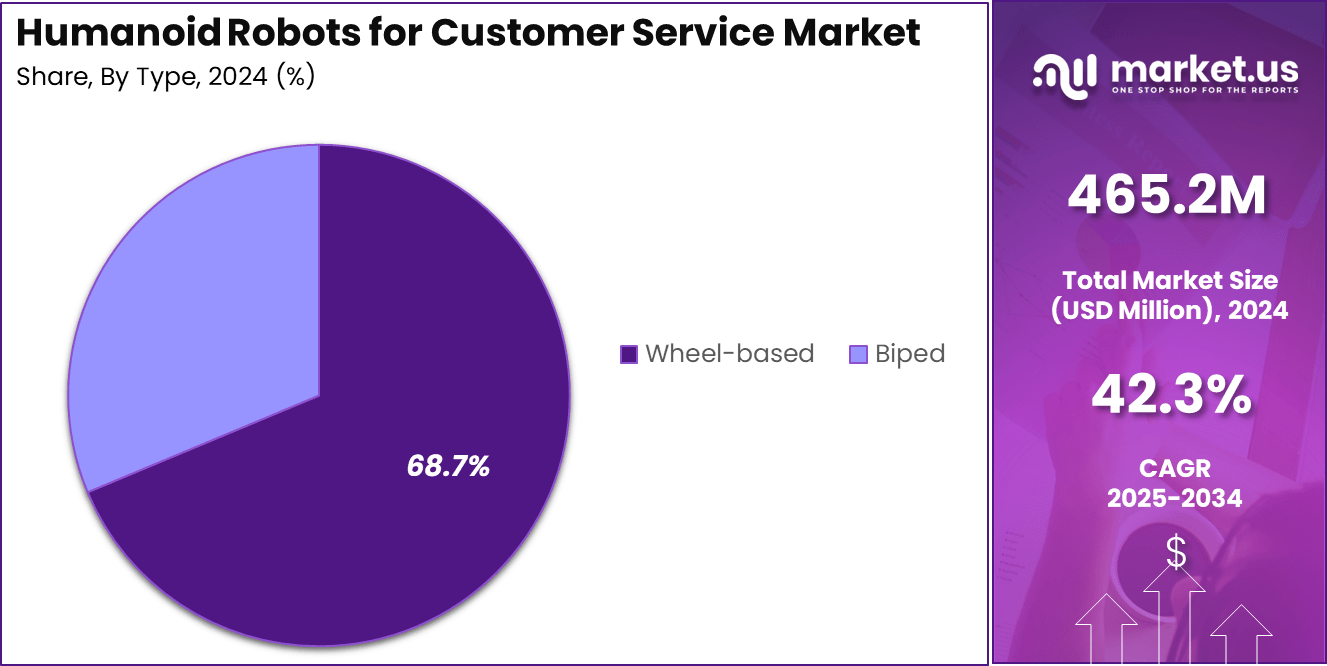
- Among robot types, Wheel-based humanoid robots captured over 68.7% share in 2024, preferred for their stability and cost-effectiveness in service tasks.
- The Enterprise segment secured the leading position with more than 61.3% share in 2024, as businesses increasingly deploy humanoid robots to enhance customer interaction and reduce operational costs.
Analysts’ Viewpoint
Investing in humanoid robots for customer service presents significant opportunities for businesses looking to innovate and improve their service offerings. These robots can lead to considerable cost savings over time, provide a unique selling point in competitive markets, and adapt to various customer interaction scenarios without the need for extensive training.
The regulatory environment for humanoid robots is still developing, with significant attention on privacy, safety, and ethical considerations. Top impacting factors include the pace of technological innovation, societal acceptance of robots in service roles, and the evolving legal frameworks governing robot interaction in public and private settings.
Top impacting factors include technological innovations, cost reductions in robotics manufacturing, and increased societal acceptance of robots in service roles. These factors collectively drive market growth and the broader integration of humanoid robots into customer service settings.
US Market Growth
The US Humanoid Robots for Customer Service Market is valued at approximately USD 214.1 Million in 2024 and is predicted to increase from USD 300.6 Million in 2025 to approximately USD 6,373.1 Million by 2034, projected at a CAGR of 40.4% from 2025 to 2034.
Firstly, the U.S. benefits from a robust ecosystem of technology companies and research institutions that are at the forefront of artificial intelligence (AI) and robotics. Major players such as Boston Dynamics, Tesla, and Figure AI are investing heavily in the development of advanced humanoid robots capable of performing complex tasks in customer service settings.
Secondly, the growing demand for automation in customer service is driving the adoption of humanoid robots. These robots offer consistent and efficient service delivery, addressing challenges such as labor shortages and the need for 24/7 customer support. Their human-like appearance and ability to interact naturally with customers enhance the overall service experience, making them valuable assets in retail, hospitality, and other service-oriented industries.

In 2024, North America held a dominant market position in the Humanoid Robots for Customer Service sector, capturing more than a 51.3% share with USD 238.6 million in revenue. This leadership can be attributed to several factors that uniquely position North America at the forefront of the humanoid robotics market.
Firstly, the region’s advanced technological infrastructure and the presence of leading robotics and AI companies provide a solid foundation for the development and deployment of humanoid robots. Innovators and tech giants in Silicon Valley and other technology hubs continue to push the boundaries of what humanoid robots can do, focusing particularly on enhancing their roles in customer service.
Furthermore, North America’s service-oriented economy presents vast opportunities for the application of humanoid robots. Industries such as retail, hospitality, and healthcare are increasingly adopting these technologies to improve customer interaction and operational efficiency. The cultural readiness to adopt new technologies also plays a crucial role, as businesses and consumers alike are generally enthusiastic about integrating advanced robotics into daily activities.
Component Analysis
In 2024, the Hardware segment held a dominant market position in the Humanoid Robots for Customer Service Market, capturing more than a 71.1% share. The leading status of the hardware segment can be attributed to several pivotal factors.
Primarily, the extensive integration of advanced sensors, actuators, and power systems that constitute the core of humanoid robots has driven this dominance. These hardware components are crucial for enabling humanoid robots to perform complex movements and interactions that closely mimic human behaviors, which are essential in customer service settings.
Moreover, the continuous innovation in material science and mechanical design has significantly enhanced the durability and efficiency of these robots, making them more appealing for widespread deployment in dynamic environments like retail and hospitality. The hardware’s capability to adapt to various customer interactions, from greeting guests to providing information, further underscores its utility and drives market demand.
Additionally, the hardware advancements have facilitated the integration of more sophisticated software solutions, which in turn boosts the hardware demand. As software capabilities expand to include deeper learning algorithms and more intuitive customer interaction protocols, the hardware must evolve to support these advanced functions, thus maintaining the hardware segment’s market lead.
Type Analysis
In 2024, the Wheel-based segment held a dominant market position in the Humanoid Robots for Customer Service Market, capturing more than a 68.7% share. This prominence is largely due to the practical advantages that wheel-based humanoid robots offer over their biped counterparts.
Primarily, wheel-based robots provide greater stability and efficiency in movement within various service environments, such as shopping malls, airports, and hospitals. Their design allows for faster mobility and the ability to navigate crowded spaces with ease, which is critical in dynamic customer service settings.
Furthermore, the maintenance and operational costs associated with wheel-based humanoid robots are generally lower compared to bipeds, which often require more complex and costly mechanical components to mimic human gait. This cost-effectiveness makes wheel-based robots a preferred choice for businesses aiming to implement robotic solutions without substantial financial outlays.
Additionally, the adaptability of wheel-based robots in integrating with existing digital infrastructure, like automated doors and elevators, enhances their utility in indoor environments. This seamless integration supports a wide range of customer service tasks, from guiding customers to carrying items, thereby enhancing the overall customer experience.
End User Analysis
In 2024, the Enterprise segment held a dominant market position in the Humanoid Robots for Customer Service Market, capturing more than a 61.3% share. This substantial market share is primarily driven by the widespread adoption of humanoid robots across various industries within the enterprise sector, including retail, hospitality, and entertainment.
These sectors increasingly utilize humanoid robots to enhance customer interaction, automate service tasks, and provide entertainment, which significantly improves operational efficiency and customer satisfaction. In retail, humanoid robots are deployed to assist customers by providing information, guiding them through store layouts, and handling simple queries, which streamlines customer service operations and reduces wait times.
In the hospitality industry, these robots enhance guest experiences by performing as concierges, handling check-ins and check-outs, and delivering room service, thereby elevating the standard of service provided. Moreover, in entertainment, humanoid robots engage audiences with interactive performances and information dissemination, adding a novel element to the experience.
The integration of advanced technologies such as AI and machine learning further enables these robots to deliver personalized customer service, adapt to various scenarios, and interact in a more human-like manner, making them invaluable assets within the enterprise segment. This trend is supported by increasing investments from businesses in robotic technologies to stay competitive, which underpins the strong growth and dominant position of the enterprise segment in the market.
Key Market Segments
By Component
- Hardware
- Software
By Type
- Biped
- Wheel-based
By End User
- Residential
- Enterprise
- Retail
- Hospitality
- Entertainment
- Others
Key Regions and Countries
- North America
- US
- Canada
- Europe
- Germany
- France
- The UK
- Spain
- Italy
- Rest of Europe
- Asia Pacific
- China
- Japan
- South Korea
- India
- Australia
- Singapore
- Rest of Asia Pacific
- Latin America
- Brazil
- Mexico
- Rest of Latin America
- Middle East & Africa
- South Africa
- Saudi Arabia
- UAE
- Rest of MEA
Driver
Advancements in Artificial Intelligence and Robotics
The continuous advancements in artificial intelligence (AI) and robotics technology have emerged as a primary driver for the adoption of humanoid robots in customer service. These advancements have enhanced the capabilities of humanoid robots, making them more efficient, responsive, and capable of handling complex interactions with humans.
The integration of AI allows these robots to process natural language, recognize emotions, and respond in a manner that mimics human-like understanding, which significantly improves customer engagement and satisfaction. This has led to their increased deployment in sectors such as retail, hospitality, and entertainment where human-robot interaction is valuable.
Restraint
High Development and Maintenance Costs
One of the major restraints in the market for humanoid robots is the high cost associated with their development, implementation, and maintenance. The production of humanoid robots involves complex and costly components like advanced sensors, actuators, and high-capacity power sources.
Moreover, the software that enables sophisticated cognitive functions in these robots requires ongoing development and updates, which adds to the total cost of ownership. These factors make the wide-scale deployment of humanoid robots financially challenging for many businesses, particularly small and medium-sized enterprises.
Opportunity
Expansion into New Industries
Humanoid robots present significant opportunities for expansion into new industrial sectors such as healthcare and domestic environments. In healthcare, humanoid robots can be utilized for tasks ranging from routine administrative duties to support in surgical procedures, potentially transforming patient care delivery.
Additionally, the domestic use of humanoid robots for personal assistance and caregiving is poised to grow, driven by the aging global population and the increasing need for supportive care. These robots can perform daily tasks, interact socially, and provide companionship, thereby enhancing the quality of life for many individuals.
Challenge
Technical and Ethical Challenges
Technical challenges, particularly those related to safety, reliability, and ethical concerns, pose significant obstacles to the widespread adoption of humanoid robots. Ensuring the safety of these robots in diverse and unpredictable human environments remains a complex issue, with risks related to malfunction or erroneous behavior.
Additionally, ethical concerns regarding privacy, autonomy, and the potential displacement of human jobs create resistance towards adopting humanoid robots. These challenges require ongoing research, regulatory frameworks, and societal dialogue to address effectively.
Growth Factors
The market for humanoid robots in customer service is poised for significant growth, propelled by several key factors. One of the most prominent drivers is the ongoing advancement in artificial intelligence and robotics technology, which enhances the functionality and efficiency of humanoid robots, making them capable of performing complex tasks and interactions.
This technological progression allows robots to better mimic human behaviors and handle customer service tasks more effectively, thereby improving customer experiences in various sectors such as retail, hospitality, and entertainment.
Moreover, the increasing adoption of humanoid robots is also driven by their ability to operate continuously without breaks, which significantly reduces labor costs and increases service availability, especially in industries facing labor shortages. These industries include healthcare, logistics, and retail, where humanoid robots can perform repetitive and physically demanding tasks, filling in gaps where human workforce is insufficient.
Emerging Trends
Emerging trends in the humanoid robot sector underscore the rapid integration of these technologies into daily operations across various industries. A notable trend is the growing incorporation of humanoid robots in smart homes and entertainment settings.
In smart homes, humanoid robots interact with other smart devices to perform security checks, manage household tasks, and provide companionship, thus enhancing the living experience. In the entertainment industry, humanoid robots are becoming popular attractions, engaging audiences with interactive performances and demonstrations, adding a new dimension to public entertainment and events.
Business Benefits
Humanoid robots offer a myriad of business benefits, particularly in enhancing customer service operations. They provide a futuristic interaction experience, which can attract more customers and improve the brand image of businesses. By handling routine inquiries and customer interactions, these robots allow human employees to focus on more complex and nuanced customer service tasks, thereby increasing overall operational efficiency.
Furthermore, the use of humanoid robots can lead to significant cost savings in the long run. They reduce the need for extensive human labor, especially in 24/7 operational settings such as hospitals and customer service centers, where they can deliver consistent service without fatigue. Their ability to learn and adapt to new tasks through AI also means that they can improve over time, providing long-term value to companies that invest in them.
Key Player Analysis
In the rapidly evolving sector of humanoid robots for customer service, three companies have demonstrated significant market leadership through strategic acquisitions, product innovations, and mergers:
Hanson Robotics is renowned for its advanced humanoid robots, which are distinguished by their lifelike appearances and capabilities. In recent years, the company has focused on enhancing its robots’ interactive abilities, making them more suitable for roles in customer service environments. Their continuous investment in AI and facial recognition technologies ensures their robots remain at the forefront of human-robot interaction.
SoftBank Robotics has consistently expanded its product line and global reach. Known for robots that can handle various customer service tasks, the company has fortified its market presence through international partnerships and continuous technological upgrades. SoftBank’s robots are equipped with features that enable them to engage effectively with customers, providing information and assistance in real-time.
Engineered Arts has made a name for itself by launching highly interactive robots tailored for entertainment and customer service. The company has pioneered the use of modular robotic systems, which allow for greater customization based on client needs. Recent developments include enhancements in natural language processing and motion technology, broadening their applicability in diverse customer service settings.
Top Key Players in the Market
- KAWADA Robotics Corporation
- SoftBank Robotics
- Sanbot Co
- ROBOTIS
- Willow Garage
- Toshiba Corporation
- HYULIM Robot Co., Ltd
- HANSON ROBOTICS LTD
- Engineered Arts Limited
- Honda
- Other Major Players
Recent Developments
- In October 2024, KAWADA Robotics Corporation introduced the NEXTAGE Fillie humanoid robot at the ‘Monozukuri World Osaka’ exhibition. This robot is designed to enhance manufacturing efficiency and is suitable for customer service applications in industrial settings.
- In 2024, SoftBank Robotics deployed nearly 100 autonomous cleaning robots across approximately 15 customer locations in the United States, demonstrating their commitment to integrating robotics into customer service environments.









