


Report Overview
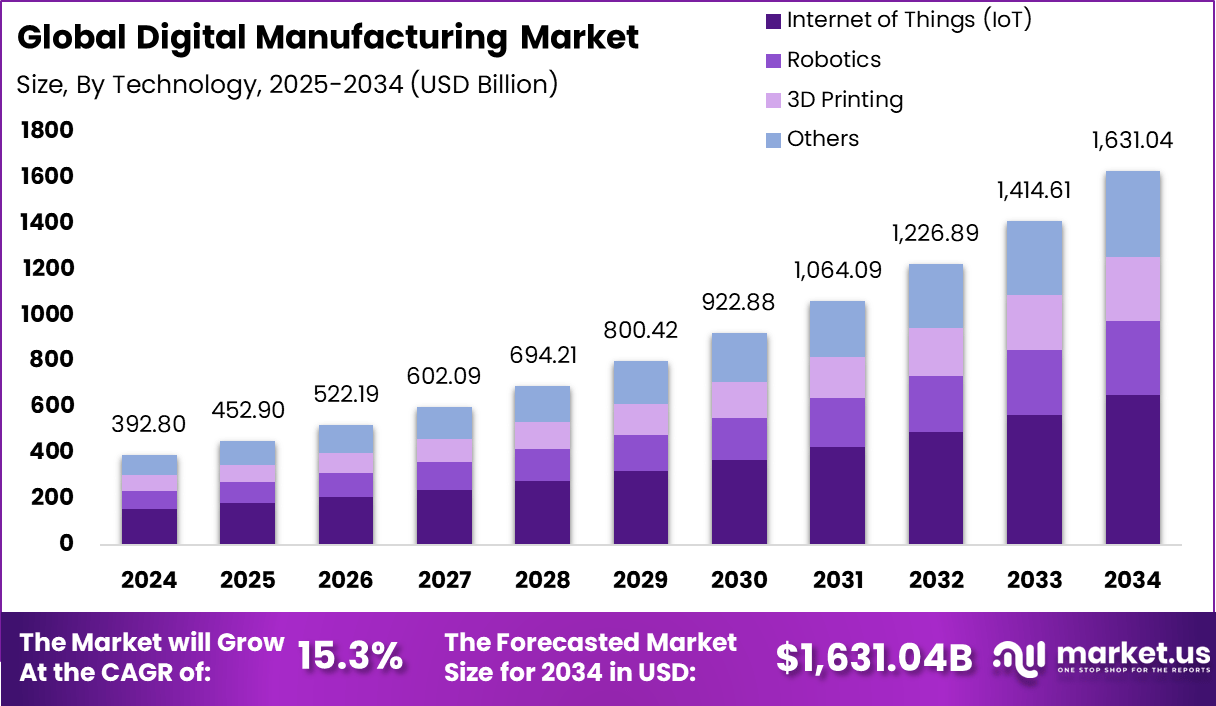
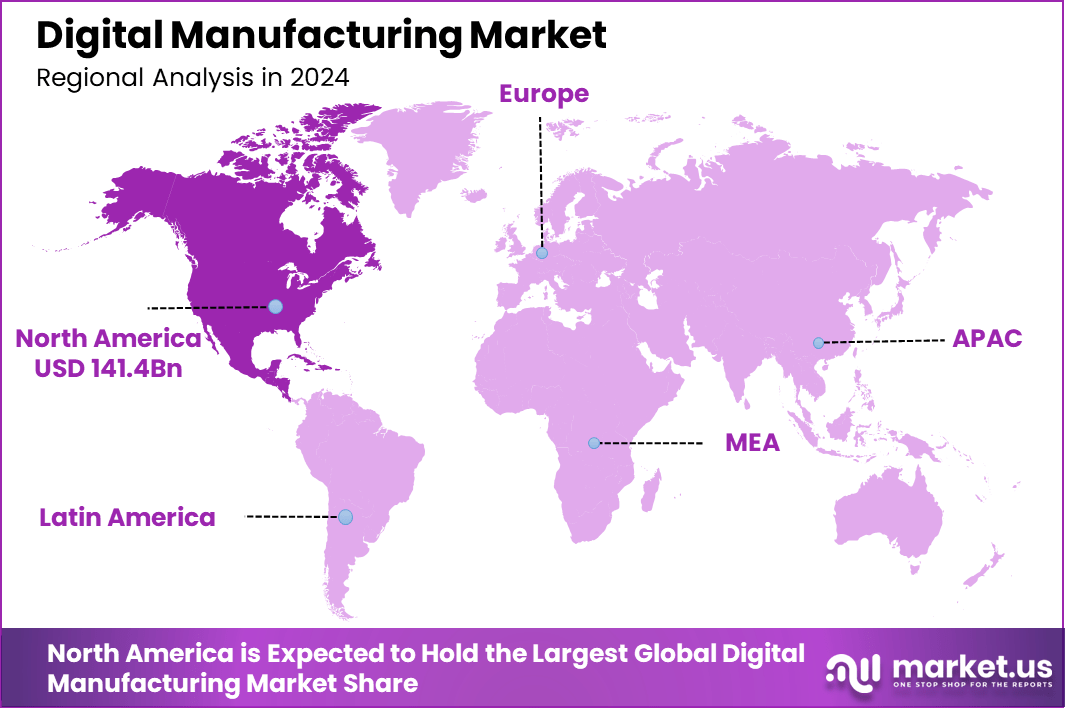
The Global Digital Manufacturing Market size is expected to be worth around USD 1,631.04 Billion By 2034, from USD 392.80 billion in 2024, growing at a CAGR of 15.3% during the forecast period from 2025 to 2034. In 2024, North America held a dominant market position, capturing more than a 36% share, holding USD 141.4 Billion revenue.
Digital Manufacturing (DM) is a modern approach to manufacturing that leverages computer systems and other digital technologies to enhance various aspects of the production process. This includes the integration of digital tools for designing, analyzing, and managing manufacturing operations. Advanced technologies such as CAD, CAM, 3D printing, and robotics are commonly used to streamline the production process, increase efficiency, and reduce errors.
The digital manufacturing market is characterized by rapid growth due to the adoption of technologies that enhance connectivity and data exchange in manufacturing environments. This market incorporates various technologies like AI, IoT, and cloud computing to optimize production processes, reduce operational costs, and increase overall efficiency.
The primary drivers of the digital manufacturing market include the need for enhanced supply chain management, increased efficiency in production processes, and the demand for reduced operational costs. Companies are investing in digital manufacturing to gain real-time insights into their operations, which helps in making informed decisions and reducing time to market.
Demand for digital manufacturing solutions is growing as companies seek to improve product quality and production efficiency. The integration of digital twins, real-time data monitoring, and predictive maintenance are key technologies stimulating this demand. These tools help manufacturers minimize downtime and optimize production workflows, thus driving the adoption of digital manufacturing solutions.
The research conducted by KPMG, involving 2,450 executives across 26 countries, underscores the industrial manufacturing (IM) sector’s robust engagement with cutting-edge technology. Notably, 76% of leaders within this sector have demonstrated a strong willingness to adopt advanced technologies. This enthusiasm is reflected in the substantial AI adoption rates within the industry, where 34% of these organizations have reported achieving a return on investment (ROI) from multiple AI applications.
The major reasons for increased demand in digital manufacturing include the ability to simulate manufacturing processes before actual production and the capacity to integrate systems across different stages of the manufacturing process. This integration helps in reducing errors and enables efficient resource management, significantly boosting demand for digital manufacturing technologies.
Current trends in the digital manufacturing market emphasize sustainability and customization. Manufacturers are increasingly adopting digital solutions to create environmentally friendly production processes and meet specific customer demands. Additionally, the use of AI and machine learning for enhancing decision-making processes is becoming more prevalent.
Key Takeaways
- The Global Digital Manufacturing Market is projected to reach USD 1,631.04 Billion by 2034, expanding at a healthy CAGR of 15.3% from 2025 to 2034, driven by the rapid adoption of smart factories and automation technologies.
- In 2024, North America dominated the market with over 36% share, generating approximately USD 141.4 Billion in revenue, supported by advanced industrial infrastructure and early digitalization initiatives.
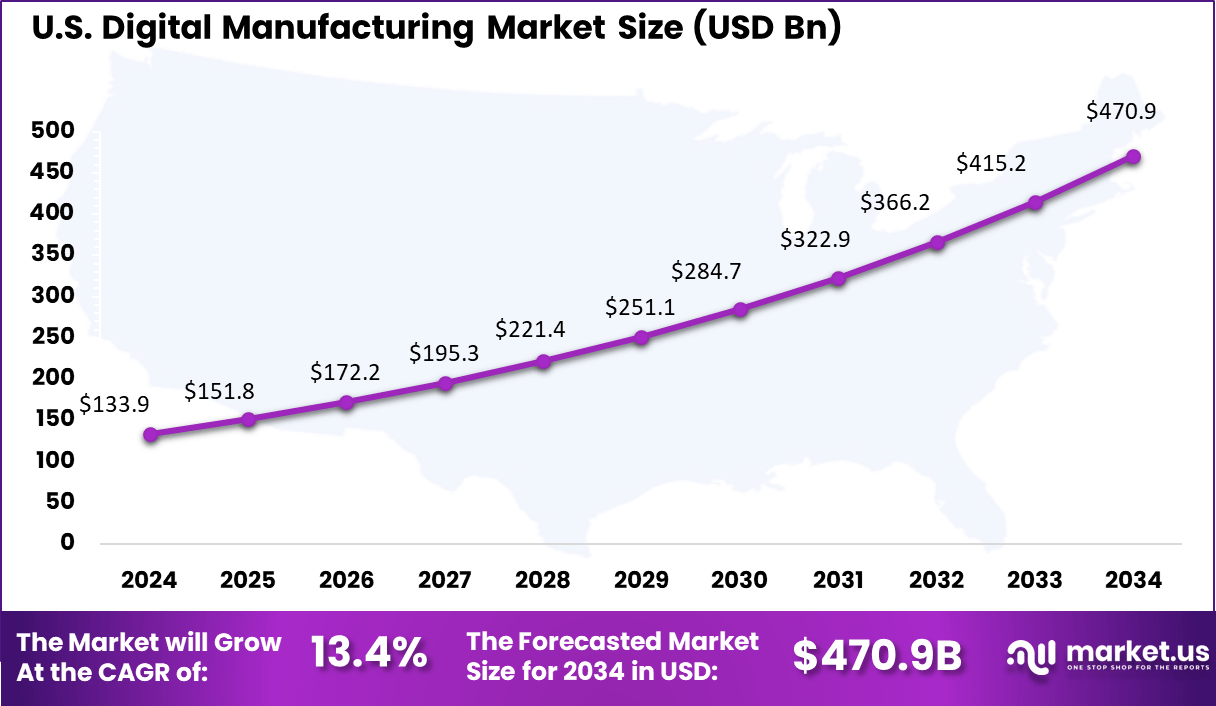
- The United States alone contributed around USD 133.9 Billion in 2024 and is forecasted to grow to nearly USD 470.9 Billion by 2034, reflecting a steady CAGR of 13.4%, as manufacturers continue to invest in digital transformation.
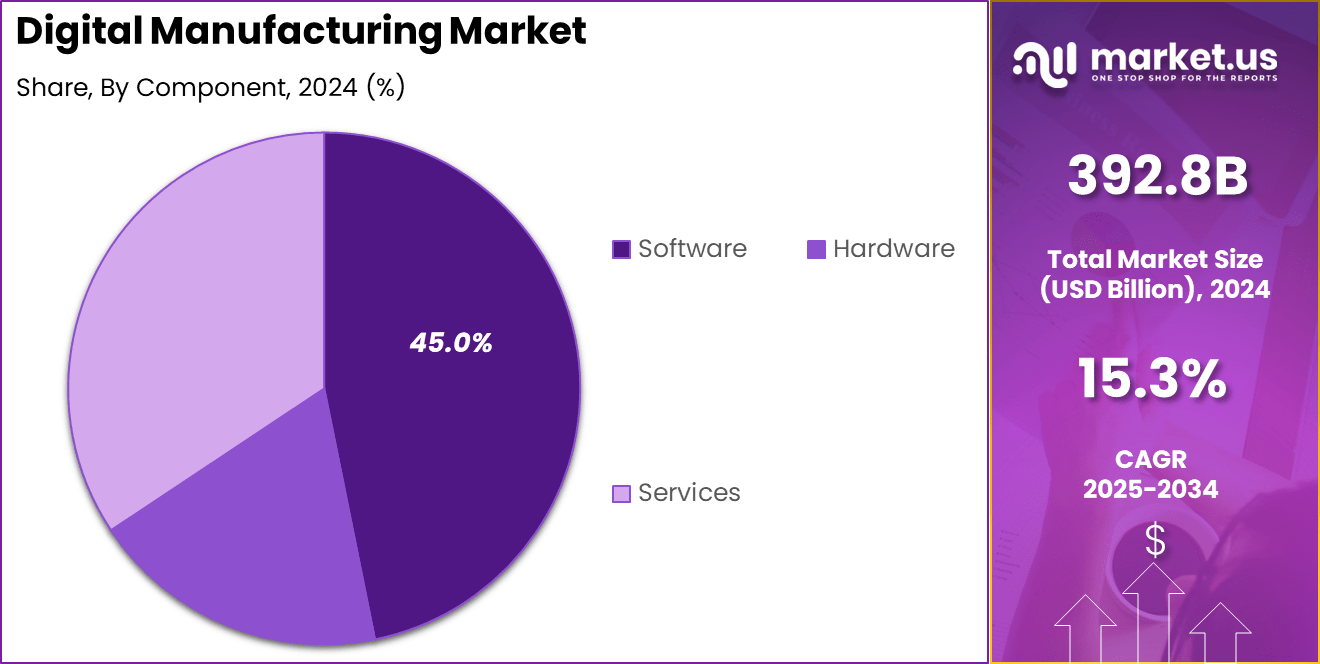
- The Software segment led the market in 2024, accounting for more than 45% share, as digital twins, simulation tools, and design automation solutions become integral to modern manufacturing processes.
- Among technologies, Internet of Things (IoT) remained the leading segment with over 40% share in 2024, driven by the need for real-time data monitoring, predictive maintenance, and interconnected manufacturing systems.
- The Automotive and Transportation segment secured the top position in 2024, holding more than 32% share, as the sector increasingly relies on digital technologies for design optimization, production efficiency, and supply chain management.
Analysts’ Viewpoint
Investment opportunities in digital manufacturing are abundant, particularly in sectors like automotive, aerospace, and electronics where the demand for precision and efficiency is high. Investors are particularly interested in startups and established firms that integrate advanced digital technologies into their manufacturing processes.
Recent technological advancements in digital manufacturing include the development of more sophisticated digital twins, enhanced AI algorithms for predictive maintenance, and more integrated IoT systems that provide deeper insights into machine performance and operational efficiency.
The regulatory environment for digital manufacturing is evolving, with increased focus on data security, privacy, and safety standards. Manufacturers must comply with strict regulations concerning data handling and machine safety, which are becoming more stringent as technology advances.
Impact of AI
The influence of Artificial Intelligence (AI) on the Digital Manufacturing market is profound and multifaceted. By integrating AI technologies, the sector is witnessing significant transformations that enhance productivity, efficiency, and innovation.
Here are five critical impacts of AI on the Digital Manufacturing market:
- Enhanced Productivity through Predictive Maintenance: AI-driven predictive maintenance solutions are revolutionizing how manufacturing equipment is managed. By analyzing data from sensors and using machine learning algorithms, AI predicts when maintenance is needed, thereby reducing downtime.
- Improved Quality Control: AI technologies have the capability to analyze vast amounts of data from the manufacturing process to identify anomalies or defects that might not be visible to the human eye. Automated visual inspection systems powered by AI improve defect detection rates by up to 90%. This not only ensures a higher quality of products but also reduces waste and rework costs.
- Optimized Supply Chain Management: AI enhances supply chain management in digital manufacturing by providing real-time insights and predictive analytics. This leads to better demand forecasting, inventory management, and logistics planning.
- Customization and Personalization: AI enables manufacturers to offer customized and personalized products without disrupting the mass production process. By utilizing AI to analyze customer data and preferences, manufacturers can produce items tailored to individual needs.
- Workforce Augmentation: AI does not merely automate tasks but also augments the capabilities of the human workforce. By providing workers with real-time data and analytics, AI supports better decision-making and increases operational efficiencies.
US Market Growth
The US Digital Manufacturing Market is valued at approximately USD 133.9 Billion in 2024 and is predicted to increase from USD 151.8 Billion in 2025 to approximately USD 470.9 Billion by 2034, projected at a CAGR of 13.4% from 2025 to 2034.
The prominence of the United States in the digital manufacturing sector can be primarily attributed to several interconnected factors that drive technological innovation and market leadership. Initially, the U.S. benefits from a robust technological infrastructure and a strong culture of innovation, which are critical for the development and integration of digital manufacturing technologies.
These technologies include additive manufacturing, advanced robotics, and the Internet of Things (IoT), all of which are substantially supported by heavy investments in research and development from both public and private sectors. Moreover, the presence of leading technology firms and a competitive business environment fosters a conducive ecosystem for the growth of digital manufacturing.
U.S. companies are at the forefront of developing new technologies and are quick to adopt innovative manufacturing processes that enhance efficiency and productivity. This rapid adoption is facilitated by favorable government policies aimed at promoting digitalization of the manufacturing sector, such as tax incentives for technology upgrades and strong intellectual property protections.
In 2024, North America held a dominant market position, capturing more than a 36.2% share, holding USD 141.0 Billion revenue. This leading position can be attributed to several pivotal factors that underscore the region’s advanced technological capabilities and strategic industry investments.
Predominantly, North America’s strong performance in digital manufacturing stems from its integrated ecosystem that combines leading technological firms, robust infrastructure, and supportive governmental policies. These elements foster an environment conducive to innovation and implementation of advanced manufacturing technologies.
Additionally, North America benefits from a highly skilled workforce specialized in digital technologies and engineering, which is continuously nurtured by world-renowned academic institutions and significant corporate training investments. The focus on fostering STEM education and digital literacy ensures a steady supply of talent capable of driving the industry forward.
Component Analysis
In 2024, the Software segment held a dominant market position in the digital manufacturing sector, capturing more than a 45% share. This leadership is primarily driven by the increasing need for comprehensive data and operation management solutions that can streamline manufacturing processes, enhance productivity, and reduce operational costs.
Software solutions such as analytics tools, connectivity solutions, and remote management systems are integral to modern manufacturing environments, enabling businesses to leverage real-time data for improved decision-making and operational efficiency.
The demand for these software solutions is bolstered by the growing integration of IoT and AI in manufacturing, which requires sophisticated platforms to manage and analyze large volumes of data generated by factory operations. These technologies facilitate predictive maintenance, quality control, and supply chain management, all of which are crucial for enhancing the efficiency and reliability of production processes.
Additionally, safety and security systems within the software segment have become essential as manufacturers prioritize the protection of their digital and physical assets against increasing cybersecurity threats. Moreover, the rise of Industry 4.0 technologies has prompted companies to invest in digital solutions that can integrate seamlessly with existing hardware and services, driving the need for system integration and consulting services.
Technology Analysis
In 2024, the Internet of Things (IoT) segment held a dominant market position in the digital manufacturing landscape, capturing more than a 40% share. This significant market presence is attributed to IoT’s pivotal role in enhancing manufacturing efficiency through connected devices and systems that provide real-time data and analytics.
IoT technologies enable manufacturers to optimize production processes, reduce downtime, and enhance maintenance protocols, thereby significantly improving operational efficiency and reducing costs. IoT’s impact is further magnified by its integration with other digital technologies, such as cloud computing and advanced analytics.
This integration allows for the seamless flow of information across various components of the manufacturing process, from the supply chain to the production line to the end consumer. This connectivity not only speeds up the production process but also enhances product quality by enabling more precise monitoring and control over manufacturing operations.
Moreover, the adoption of IoT solutions is driven by their ability to support sustainable manufacturing practices. By enabling more efficient use of resources and reducing waste through enhanced monitoring and predictive maintenance, IoT contributes to more environmentally friendly manufacturing processes. This is increasingly important as businesses around the world face pressure to meet regulatory requirements and societal expectations for sustainable operations.
Application Analysis
In 2024, the Automotive and Transportation segment held a dominant market position in the digital manufacturing landscape, capturing more than a 32% share. This sector’s leadership is primarily driven by its rapid adoption of digital technologies to meet the increasing demand for manufacturing efficiency and vehicle innovation.
Automotive manufacturers utilize digital manufacturing solutions to streamline production lines, reduce waste, and accelerate the design and testing of new vehicle models through technologies like 3D printing and robotics. Furthermore, the push towards electric vehicles (EVs) and autonomous driving systems has necessitated the integration of more complex electronic components and software, which are dependent on sophisticated digital manufacturing processes.
This has led to a greater reliance on connected IoT devices and advanced data analytics to optimize supply chains and improve production outcomes. The ability to rapidly prototype and iterate design changes with high precision allows the automotive sector to reduce time-to-market for new innovations and respond more effectively to consumer preferences.
Moreover, the automotive industry’s focus on sustainability has also propelled the adoption of digital manufacturing techniques that support energy-efficient production practices and waste reduction. The integration of these technologies helps automotive companies not only meet stringent environmental regulations but also gain competitive advantage by developing more sustainable and technologically advanced vehicles.
Key Market Segments
By Component
- Hardware
- RFID Tags
- Sensor
- Intelligent System
- Others
- Software
- Data and Operation Management Software
- Safety and Security Systems
- Connectivity solutions
- Analytics Solutions
- Remote Management & logistic solutions
- Asset Management Solutions
- Services
- Support and maintenance
- System Integration
- Consulting Services
By Technology
- Robotics
- 3D Printing
- Internet of Things (IoT)
- Others
By Application
- Automotive and Transportation
- Aerospace and Defense
- Consumer Electronics
- Industrial Machinery
- Others
Key Regions and Countries
North America
- US
- Canada
Europe
- Germany
- France
- The UK
- Spain
- Italy
- Russia
- Netherlands
- Rest of Europe
Asia Pacific
- China
- Japan
- South Korea
- India
- Australia
- Singapore
- Thailand
- Vietnam
- Rest of APAC
Latin America
- Brazil
- Mexico
- Rest of Latin America
Middle East & Africa
- South Africa
- Saudi Arabia
- UAE
- Rest of MEA
Driver
Automation and Connectivity Driving Market Growth
The digital manufacturing market is being significantly propelled by advancements in automation and the increasing integration of Internet of Things (IoT) technologies. Automation, especially through robotics, is streamlining production processes, reducing human error, and increasing overall operational efficiency.
Similarly, IoT enhances manufacturing operations by enabling real-time monitoring and predictive maintenance, which minimizes downtime and optimizes production flow. This dual thrust of automation and connectivity is essential for manufacturers aiming to boost productivity and maintain competitive advantage in a rapidly evolving industry.
Restraint
High Implementation Costs and Complexity
While digital manufacturing offers substantial benefits, its adoption is hindered by high implementation costs and complexity. Small to medium-sized enterprises (SMEs) in particular face significant challenges, as the initial investment required for new machinery, software upgrades, and digital system integrations can be prohibitively expensive.
Additionally, the need for a skilled workforce to manage and maintain these advanced technologies adds to the ongoing operational costs, making it difficult for smaller players to fully embrace digital manufacturing solutions.
Opportunity
Sustainability and Eco-Friendly Manufacturing
There is a growing opportunity in digital manufacturing to leverage technologies for sustainable and eco-friendly practices. Manufacturers are increasingly adopting digital tools that not only enhance operational efficiency but also promote resource conservation and waste reduction.
This shift is driven by both regulatory pressures and a market that favors environmentally responsible manufacturing practices. As companies invest in sustainable technologies, they not only comply with global standards but also appeal to environmentally conscious consumers, creating a significant competitive edge.
Challenge
Cybersecurity Risks in Interconnected Systems
The increased connectivity inherent in digital manufacturing systems introduces significant cybersecurity risks. As manufacturing operations become more integrated with IoT and cloud technologies, they become more vulnerable to cyberattacks that can disrupt production and compromise sensitive data.
The challenge for manufacturers is to implement robust cybersecurity measures that protect their operations and maintain trust with customers and partners. This requires continuous investment in security technologies and training, which adds another layer of complexity and cost to digital manufacturing initiatives.
Growth Factors
The digital manufacturing sector is experiencing substantial growth, driven by several pivotal factors. Firstly, the integration of artificial intelligence (AI) and the Internet of Things (IoT) is revolutionizing manufacturing processes. These technologies enable real-time monitoring, predictive maintenance, and optimized resource management, substantially increasing operational efficiency and reducing downtime.
For instance, AI-driven predictive maintenance can decrease production interruptions by preemptively identifying equipment needs, thereby saving costs and enhancing productivity. Secondly, the adoption of smart factories and hyper-automation is becoming increasingly prevalent.
These advanced manufacturing setups utilize robotics and autonomous systems to increase productivity and lower operational costs, fostering a new industrial standard where digital precision and automation lead to faster, more cost-effective production lines. This shift is not merely about adopting new technologies but transforming the entire production landscape to be more resilient and adaptive to market demands.
Emerging Trends
Several emerging trends are shaping the future of digital manufacturing. One significant trend is the shift towards more localized and resilient supply chains, a response to past disruptions like those seen during the COVID-19 pandemic. This trend involves reshoring and nearshoring activities, where manufacturing processes are moved closer to the consumer markets to mitigate risks and improve supply chain agility.
Such strategies enhance the ability of manufacturers to respond more swiftly to market changes and reduce dependencies on extensive, often vulnerable global supply chains. Additionally, sustainability is becoming a core component of manufacturing strategies. Manufacturers are increasingly pressured by both regulatory requirements and consumer expectations to adopt eco-friendly and sustainable practices.
This includes the utilization of renewable energy sources, implementation of circular economy principles, and the development of low-carbon supply chains. These practices not only comply with environmental standards but also offer a competitive advantage in a market that values green manufacturing processes.
Business Benefits
Adopting digital manufacturing technologies offers numerous business benefits, enhancing competitiveness in a fast-evolving marketplace. First and foremost, digital manufacturing leads to improved efficiency and productivity through automation and data integration. For example, companies implementing AI and IoT can see reductions in downtime and enhanced quality control, which directly contribute to higher output and better product quality.
Moreover, digital manufacturing enables businesses to achieve higher flexibility and faster time-to-market. By leveraging digital twins and simulation technologies, companies can prototype and test in virtual environments, reducing the time and cost associated with physical trials. This not only speeds up the development process but also allows for greater innovation and customization, meeting the specific needs of customers more effectively.
Finally, the shift towards digital manufacturing facilitates better decision-making and strategic planning. With comprehensive data analytics and real-time visibility across operations, businesses can make informed decisions that optimize production and distribution, align with market trends, and anticipate future challenges.
Key Player Analysis
In the rapidly evolving Digital Manufacturing market, key players such as Siemens AG, Autodesk Inc., and Dassault Systèmes are leading the way through strategic innovations and collaborations:
Siemens AG has been very active in integrating advanced technologies into their offerings. In January 2024, Siemens launched a suite of AI-powered digital manufacturing tools. These tools are designed to enhance production processes through advanced machine learning algorithms, focusing on optimizing production and maintenance. The aim is to boost efficiency and streamline operations across the board.
Autodesk Inc. is also making significant strides by forming strategic partnerships to enhance digital manufacturing capabilities. A notable development came in April 2024, when Autodesk announced a partnership with a leading robotics company. This collaboration focuses on developing integrated solutions that aim to increase productivity and flexibility in smart factories, leveraging automation and digital workflows.
Dassault Systèmes continues to innovate in the sector by expanding their software solutions that support comprehensive digital manufacturing processes. Their efforts are particularly focused on enhancing 3D design and manufacturing simulations, which are critical for modern manufacturing environments aiming for high efficiency and precision.
Top Key Players in the Market
- Siemens AG
- Dassault Systemes SE
- PTC Inc.
- Aras Corp.
- AVEVA Group Plc
- Bentley Systems Inc.
- Capgemini Service SAS
- Cisco Systems Inc.
- DREAMZTECH SOLUTIONS INC.
- Durr AG
- Hewlett Packard Enterprise Co.
- Intel Corp.
- Microsoft Corp.
- Oracle Corp.
- PTC Inc.
- QAD Inc.
- SAP SE
- Others
Recent Developments
- In February 7, 2025, Accenture, a global consulting and technology company, acquired Staufen AG, a German consulting firm specializing in manufacturing and supply chain excellence. This move will help Accenture offer better digital manufacturing solutions, including AI, digital twins, and advanced supply chain management, especially for industries like automotive and aerospace.
- In April 2, 2025, Nano Dimension, a leader in digital manufacturing, completed the acquisition of Desktop Metal, a company known for advanced 3D printing solutions. This deal, valued at $179.3 million, creates a global leader in high-value electronics, mechanical, and medical manufacturing.









