


Report Overview
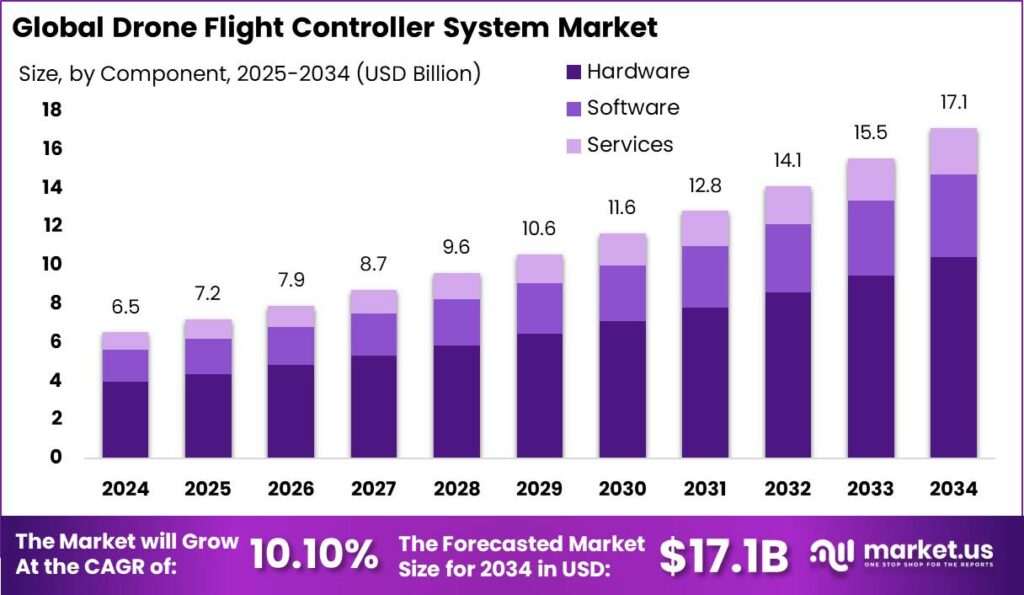
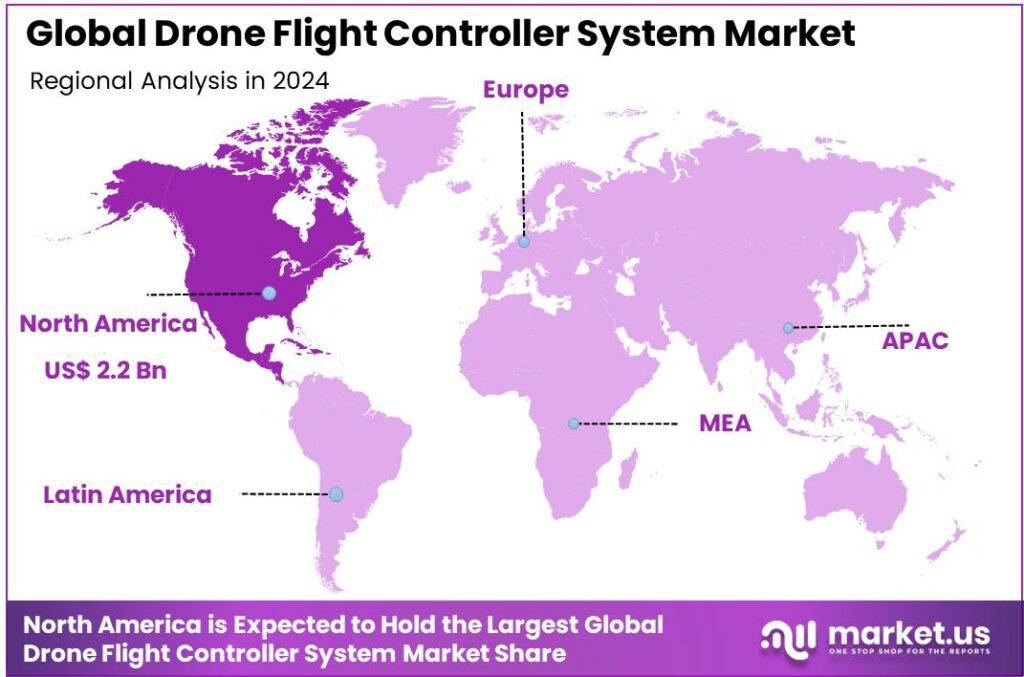
The Global Drone Flight Controller System Market size is expected to be worth around USD 17.1 Billion By 2034, from USD 6.54 Billion in 2024, growing at a CAGR of 10.10% during the forecast period from 2025 to 2034. In 2024, North America dominated the market with over 35% share, generating USD2.2 billion in revenue. The U.S. market reached USD 2.16 billion and is projected to grow at a CAGR of 8.4%.
A drone flight controller system ensures stability and direction by using sensors like gyroscopes, accelerometers, and GPS. It adjusts motor speeds based on sensor data and operator commands, enabling the drone to hover, change directions, or perform maneuvers. This system is essential for safe and efficient drone operations in tasks such as aerial photography and industrial inspections.
The drone flight controller system market is growing rapidly, driven by rising demand for UAVs across commercial, military, and recreational sectors. Drones are seen as cost-effective and efficient solutions for tasks like delivery, surveying, and surveillance, leading to a higher need for advanced flight controllers that ensure precision and reliability.
The key driving factors for the drone flight controller system market include the rising demand for autonomous drones across multiple sectors, advancements in sensor technology, and the increasing affordability of drone components. These elements facilitate more sophisticated and accessible drone applications, broadening their utility and effectiveness across various operational contexts.
The demand for drone flight controller systems is propelled by their crucial role in enhancing drone operations, making tasks like aerial photography, agricultural monitoring, and infrastructure inspection more efficient and precise. The ability to customize flight paths and ensure compliance with regulatory standards also contributes significantly to their increased adoption.
Integrating advanced drone flight controllers can significantly enhance operational efficiency and safety. For businesses, this translates into reduced operational costs, improved data collection accuracy, and the ability to access difficult terrains. Additionally, these systems enable more robust compliance with aviation regulations, which is crucial for commercial operations.
New opportunities are emerging as technology advances, such as the integration of AI and machine learning in drone flight controllers. These technologies can improve autonomous operations and decision-making in real-time, opening up further applications in complex environments like urban areas or disaster zones.
Recent trends in the drone flight controller market include the integration of electric propulsion systems, which offer enhanced efficiency and environmental benefits. Additionally, the incorporation of AI and machine learning technologies is becoming commonplace, enabling drones to perform more complex tasks independently and react adaptively to their surroundings.
The global expansion of the drone flight controller market is propelled by increasing technological innovations and the expansion of drone applications beyond traditional boundaries. Regions such as Asia-Pacific are experiencing rapid growth due to the surge in drone activities, supported by favorable government initiatives and investments in drone technology.
Key Takeaways
- The Global Drone Flight Controller System Market size is expected to reach USD 17.1 Billion by 2034, up from USD 6.54 Billion in 2024, with a CAGR of 10.10% during the forecast period from 2025 to 2034.
- In 2024, the Hardware segment of the drone flight controller system market held a dominant position, capturing more than 61% share.
- In 2024, the Commercial segment dominated the drone flight controller system market, capturing over 39% share.
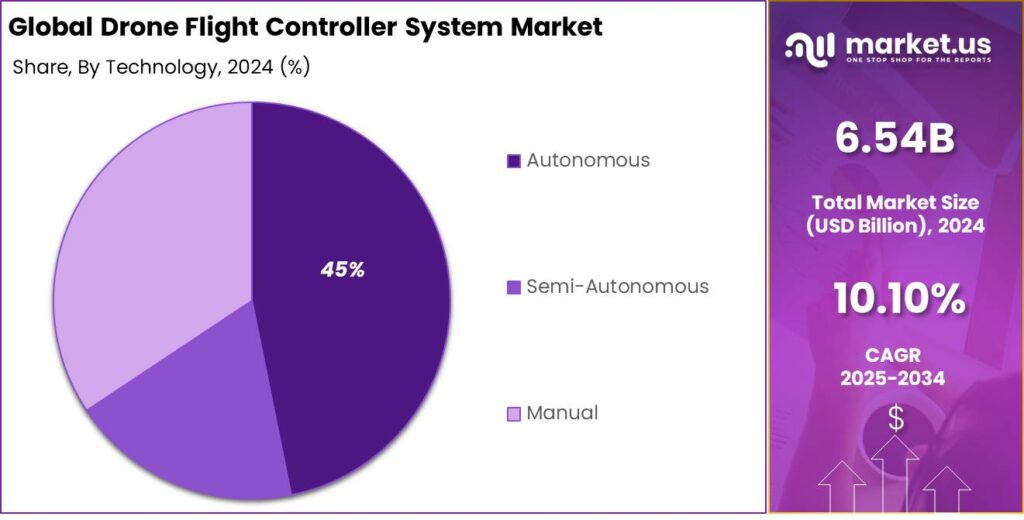
- The Autonomous segment in 2024 held a dominant market position, accounting for more than 45% share.
- The Agriculture segment in 2024 was the leading sector in the Drone Flight Controller System market, capturing more than 25% share.
- In 2024, North America held a dominant position in the market, with a share of over 35% and generating USD 2.2 billion in revenue.
- The U.S. Drone Flight Controller System market had a substantial valuation in 2024, reaching USD 2.16 billion, and is projected to grow at a CAGR of 8.4%.
AI Impact On The Market
- Improved Flight Stability and Control: AI helps drones maintain balance even in difficult weather conditions by processing sensor data in real-time. Machine learning algorithms allow flight controllers to quickly adjust motor speeds, reducing the chances of crashes and ensuring smooth flight operations.
- Smarter Obstacle Detection and Avoidance: With the help of AI-powered vision systems, drone controllers can now detect and avoid obstacles more accurately. Deep learning models help the system recognize moving objects like birds or other drones, improving safety during flight missions.
- Enhanced Autonomous Navigation: AI enables drones to plan and follow routes without human intervention by using advanced path-planning algorithms. This technology helps drones make real-time decisions, like rerouting when facing unexpected barriers, increasing their autonomy and efficiency.
- Faster Data Processing for Real-Time Decisions: AI integration allows drone flight controllers to process large amounts of sensor and camera data instantly. This helps in making quicker flight decisions, improving responsiveness and mission success rates, especially in defense and agriculture applications.
- Predictive Maintenance and Health Monitoring: AI supports predictive maintenance by analyzing drone performance data and identifying possible issues before they become serious. This helps reduce downtime and maintenance costs, ensuring drones are ready for their next flight.
Business Benefits
Drone flight controllers act as the drone’s brain, processing sensor data to maintain balance and stability, ensuring smoother operations and reducing accident risks in challenging environments. By maintaining consistent flight paths, businesses can rely on drones for precise tasks like inspections and deliveries.
Flight controllers can be customized to suit various applications, from agriculture to emergency response. For instance, in agriculture, drones equipped with specialized flight controllers can monitor crop health, while in emergency situations, they can assist in search and rescue operations. This adaptability makes them valuable assets across multiple sectors.
Advanced flight controllers enable drones to integrate cameras and sensors, providing real-time data for instant decision-making. This helps businesses monitor surveying, detect equipment faults, and perform proactive maintenance for better results. According to Coolest Gadgets, year 2023 saw Mapping and Surveying dominate the field, emerging as the largest application segment with a market share surpassing 35%.
U.S. Market Size
The U.S. Drone Flight Controller System market exhibited a substantial valuation in 2024, reaching USD2.16 billion. This market is projected to grow at a compound annual growth rate (CAGR) of 8.4%.
This growth can be attributed to several key factors, including advancements in drone technology, increased adoption in various sectors such as agriculture, real estate, and surveillance, and supportive government regulations. The increasing use of drones for commercial purposes, coupled with technological innovations in flight control systems, has significantly driven the market forward.
The market is expected to maintain a robust growth trajectory. The integration of AI and machine learning technologies into drone flight controllers is likely to offer new business opportunities and enhance operational efficiency. Moreover, the ongoing expansion of application areas for drones, such as delivery services and traffic monitoring, is anticipated to further propel market growth over the coming years.
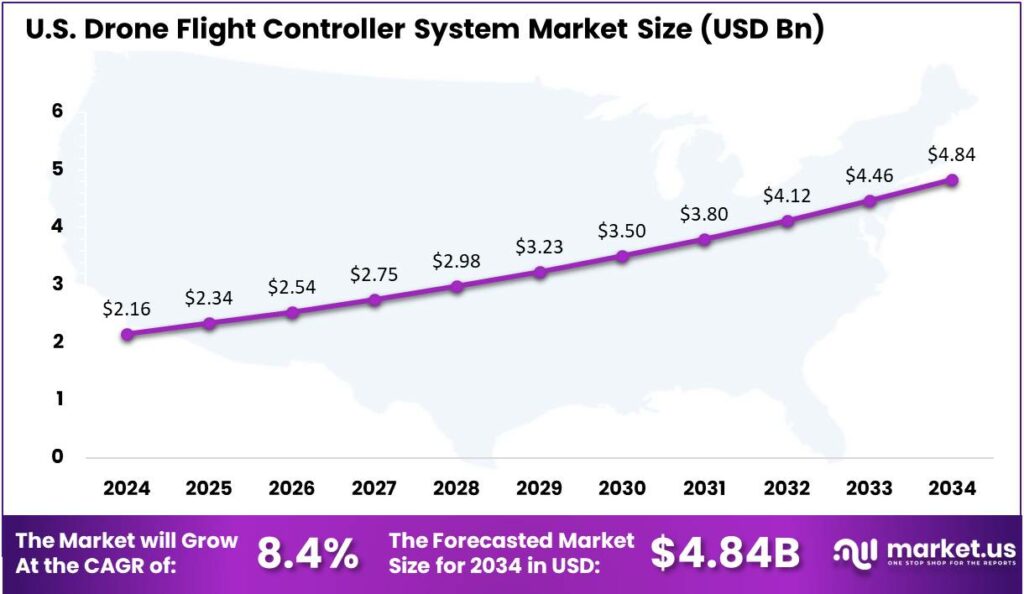
In 2024, North America held a dominant market position in the Drone Flight Controller System market, capturing more than a 35% share and generating revenue of USD 2.2 billion. This leadership can be attributed to several pivotal factors.
North America’s strong tech infrastructure and significant R&D investments have accelerated advanced drone technology development. Leading companies are pioneering cutting-edge flight control systems, boosting drone performance and drawing further investment, reinforcing the region’s market leadership.
North America benefits from supportive government policies that encourage drone innovation and operations. The U.S. and Canada have implemented robust regulatory frameworks that ensure safety and privacy while enabling commercial drone use in sectors like agriculture, real estate, and emergency response. These regulations lower operational risks and enhance the viability of drone applications, fueling regional market growth.
Furthermore, North America’s leading drone manufacturers and tech companies play a vital role in maintaining the region’s dominant market share. Their constant innovation sets global standards and draws in supporting industries like component manufacturing and software development, forming a synergistic ecosystem that fuels ongoing growth.
Component Analysis
In 2024, the Hardware segment of the drone flight controller system market held a dominant market position, capturing more than a 61% share. This segment leads primarily due to the essential role of physical components like sensors, GPS modules, and onboard processors in the functionality of flight controllers.
Hardware components are critical for the real-time execution of flight tasks and stability operations, which are vital for the precise and efficient control of drones in various applications. The increasing complexity of missions that drones are deployed for, such as long-distance deliveries and precise aerial surveying, further drives the demand for advanced and reliable hardware.
The Software segment is vital in the drone flight controller system market, enabling the integration of sensor data into control commands that direct drone behavior. As drones grow more autonomous, the need for advanced software for flight path programming, data processing, and user interfaces increases, driving its market share.
The Services segment, covering installation, maintenance, and updates of flight controller systems, plays a crucial support role as drone adoption grows across industries. With rising demand for compliance and optimal performance, this segment though smaller remains essential for sustaining functionality and reliability.
Application Analysis
In 2024, the Commercial segment held a dominant market position in the drone flight controller system market, capturing more than a 39% share. This prominence can be attributed to the escalating demand for drones in various commercial applications such as aerial photography, agricultural monitoring, and industrial inspections.
Furthermore, the expansion of commercial drone applications into areas like package delivery and expanded aerial coverage for telecommunications firms also contributes to this segment’s growth. As regulations become more favorable and technology advances, commercial entities are poised to further integrate drones into their operations, driving the need for advanced flight controllers.
Additionally, the ongoing innovation in drone technology, particularly in terms of automation and endurance, necessitates sophisticated flight control systems that can handle complex operations and data streams. This is especially crucial in environments that require precise navigational capabilities and operational reliability.
Investment in R&D by major tech companies is driving the growth of commercial drones, with improvements in connectivity, battery life, and IoT integration. These advancements make drone operations more efficient and commercially viable, reinforcing the dominance of the commercial segment in the drone flight controller system market.
Technology Analysis
In 2024, the Autonomous segment held a dominant market position in the Drone Flight Controller System market, capturing more than a 45% share. This segment’s leadership is primarily due to the increasing demand for fully automated drones, which require minimal human intervention and are capable of executing complex flight operations with high precision.
The Semi-Autonomous segment holds a significant market share, offering a blend of manual control and automation. This makes it ideal for applications that require human decision-making, enhanced by automation. It’s especially valuable in scenarios like disaster response and live event coverage, where drones must adapt to changing conditions in real time.
The Manual segment, while smaller compared to autonomous systems, remains vital in areas where direct human control is preferred or required due to regulatory or safety concerns. Manual flight controllers are commonly used in drone racing, hobbyist flying, and training programs where the pilot’s skill directly influences drone operation.
Overall, each technology segment meets distinct market needs, from full automation for efficiency and scalability to manual control for precision and engagement. As technology advances, the integration between these systems is expected to become more seamless, broadening their applications and driving further market growth.
End-User Analysis
In 2024, the Agriculture segment held a dominant market position in the Drone Flight Controller System market, capturing more than a 25% share. This leading position can be attributed to several key factors that underscore the segment’s significance and potential for further expansion.
The integration of drones in agriculture has transformed farming by enabling precision agriculture, optimizing resource use like water and fertilizers. Equipped with advanced flight controllers, drones provide critical data for crop monitoring and yield predictions. This technology is driven by the need to meet growing global food demands, propelling the agricultural segment to the forefront of the drone market.
Economic incentives are key to the adoption of drone technology in agriculture. Governments around the world offer subsidies and financial support for innovative farming technologies, including drones. These incentives lower the investment barrier for farmers and agricultural enterprises, encouraging the adoption of advanced technologies and driving growth in the segment.
Technological advancements in drone flight controllers tailored for agriculture such as longer battery life, better data sensors, and user-friendly interfaces have made drones more accessible and efficient for farmers. These improvements are especially valuable in regions with large farmlands, where traditional monitoring methods are time-consuming and labor-intensive.
Key Market Segments
By Component
- Hardware
- Software
- Services
By Application
- Commercial
- Military
- Consumer
- Others
By Technology
- Autonomous
- Semi-Autonomous
- Manual
By End-User
- Agriculture
- Construction
- Logistics
- Media & Entertainment
- Defense
- Others
Key Regions and Countries
- North America
- US
- Canada
- Europe
- Germany
- France
- The UK
- Spain
- Italy
- Rest of Europe
- Asia Pacific
- China
- Japan
- South Korea
- India
- Australia
- Singapore
- Rest of Asia Pacific
- Latin America
- Brazil
- Mexico
- Rest of Latin America
- Middle East & Africa
- South Africa
- Saudi Arabia
- UAE
- Rest of MEA
Driver
Expanding Industrial Applications of Drones
The proliferation of drones across various industries has significantly propelled the demand for advanced flight controller systems. In agriculture, drones equipped with sophisticated flight controllers are utilized for precision farming, enabling efficient crop monitoring and resource management.
The construction sector leverages drones for site surveying and progress tracking, enhancing project management efficiency. In logistics, drones facilitate rapid delivery services, particularly in remote areas, necessitating reliable flight control systems for safe navigation.
Moreover, emergency services employ drones for search and rescue operations, where advanced flight controllers ensure stability and maneuverability in challenging environments. These diverse applications underscore the critical role of flight controller systems in enabling drones to perform complex tasks with precision and reliability.
Restraint
Regulatory Challenges and Airspace Management
The integration of drones into national airspace presents significant regulatory challenges that impede the growth of the flight controller system market. Governments worldwide are grappling with the development of comprehensive frameworks to ensure the safe operation of drones alongside manned aircraft.
Stringent regulations, including mandatory registration and operational limitations, raise the complexity and cost of deploying drones, especially for commercial use. These hurdles can deter investment and innovation in drone technologies. Additionally, the lack of standardized regulations across jurisdictions creates uncertainty, limiting scalability and the adoption of advanced flight control systems.
Opportunity
Integration of AI and Machine Learning in Flight Controllers
The incorporation of artificial intelligence (AI) and machine learning (ML) into flight controller systems presents a significant opportunity for market growth. AI-enabled flight controllers can process vast amounts of data in real-time, allowing drones to make autonomous decisions, adapt to dynamic environments, and optimize flight paths.
This advancement boosts drone capabilities in areas like autonomous delivery, environmental monitoring, and infrastructure inspection. AI integration also enables predictive maintenance by analyzing performance data to prevent issues, reducing downtime and costs. The development of intelligent flight controllers aligns with the trend of automation and smart technologies, driving significant improvements in efficiency and functionality within the drone industry.
Challenge
Technical Complexity and Skill Requirements
The increasing sophistication of flight controller systems introduces technical complexities that pose challenges for both manufacturers and operators. Developing advanced flight controllers requires expertise in various domains, including control theory, embedded systems, and sensor integration.
The complexity of configuring and managing advanced drones requires specialized training, which can limit adoption, especially among small businesses and individual users. The fast pace of technological advancements further demands continuous learning, straining resources. To overcome these challenges, efforts in education, user-friendly design, and support systems are essential for effective utilization of advanced flight controller technologies.
Emerging Trends
A key trend is the integration of AI and ML into flight controllers, allowing drones to process complex environmental data in real-time for autonomous decision-making and better navigation. AI-powered systems help drones counter electronic warfare tactics, enabling them to function effectively in GPS-denied environments.
Another significant development is the adoption of fiber-optic communication in drone operations. Unlike traditional radio frequency controls, fiber-optic systems are immune to electronic jamming, ensuring secure and uninterrupted communication between drones and operators. This technology is especially valuable in military applications, where maintaining control in contested environments is crucial.
The concept of modular and customizable flight controllers is gaining momentum, with manufacturers designing systems that can be tailored to specific missions like agriculture, surveillance, or delivery. This flexibility boosts the versatility and scalability of drone operations, enabling rapid adaptation to various tasks.
Key Player Analysis
As Drone Flight Controller System Market expands, several key players stand out, providing a range of products with unique features, technological innovations, and global reach.
DJI is undeniably the leading player in the drone industry, dominating the market for consumer and commercial UAVs.The company has a vast range of drones catering to both hobbyists and professionals, making it a key player in drone flight controller systems. DJI’s systems are widely recognized for their reliability, ease of use, and cutting-edge innovation, setting high standards in the industry.
Parrot Drones is another significant player in the drone market, known for producing drones that are both affordable and high-performance. Based in France, Parrot’s flight controller systems are characterized by their stability and adaptability across various drone models. Their focus on professional and consumer markets with easy-to-use, robust controllers has helped them maintain a strong position in the industry.
3D Robotics has established itself as a strong contender in the drone market, especially in the commercial and industrial sectors. Their flight control systems are known for their high precision, customization, and integration with software that allows businesses to automate aerial tasks.Their flight controller systems stand out for their open-source architecture, which gives users more flexibility and control over the drone’s operation.
Top Key Players in the Market
- DJI
- Parrot Drones
- 3D Robotics
- Yuneec International
- Lockheed Martin
- Northrop Grumman
- Thales Group
- Boeing
- BAE Systems
- AeroVironment
- Elbit Systems
- Textron Systems
- Saab AB
- Leonardo S.p.A.
- General Atomics
- Israel Aerospace Industries
- FLIR Systems
- Autel Robotics
- Kespry
- Insitu Inc.
- Other Key Players
Top Opportunities for Players
The drone flight controller system market presents several burgeoning opportunities that are shaping the industry’s landscape.
- Expansion into High-Growth Sectors: The application of drones equipped with advanced flight control systems is rapidly expanding in high-growth sectors such as agriculture, construction, and infrastructure inspection. These sectors are adopting drones to enhance productivity and operational efficiency, presenting substantial opportunities for market growth.
- Advancements in Technology: The ongoing advancements in sensor technology, AI-powered navigation, and electric propulsion systems are creating new opportunities for the development of more sophisticated drone flight controllers. These innovations enhance the capabilities of drones, making them more efficient and easier to control, which can expand their use in various applications.
- Regulatory Developments: As governments worldwide continue to refine drone operation regulations, there is a growing need for flight controllers that can meet stringent safety and compliance standards. This regulatory landscape is fostering a conducive environment for the adoption of advanced drone technologies, encouraging industries to invest in sophisticated drone systems.
- Customization Needs: There is an increasing demand for customized flight controller systems that can cater to the specific needs of different industries. By providing tailored solutions that ensure drones can perform specialized tasks efficiently and safely, companies can capture a significant market share and differentiate themselves from competitors.
- Global Market Expansion: The global nature of the drone market offers extensive opportunities for expansion into new geographical areas, especially in emerging markets where drone technology adoption is just beginning to take off. This expansion is supported by improvements in global supply chains and increased international trade in drone technology.
Recent Developments
- In November 2024, in collaboration with the U.S. Navy, Lockheed Martin demonstrated live control of an uncrewed air vehicle using the Unmanned Carrier Aviation Mission Control Station (UMCS), showcasing advanced drone control capabilities.
- In December 2024, Elbit Systems secured contracts totaling approximately $40 million to supply advanced drones and autonomous systems, enhancing the operational capabilities of the Israeli Defense Forces.









