Report Overview
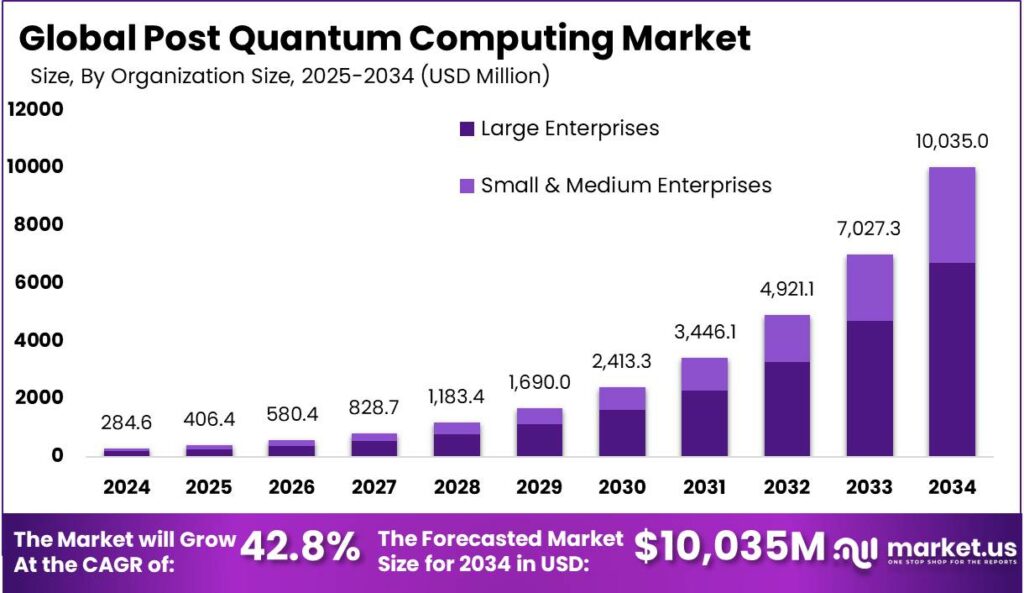
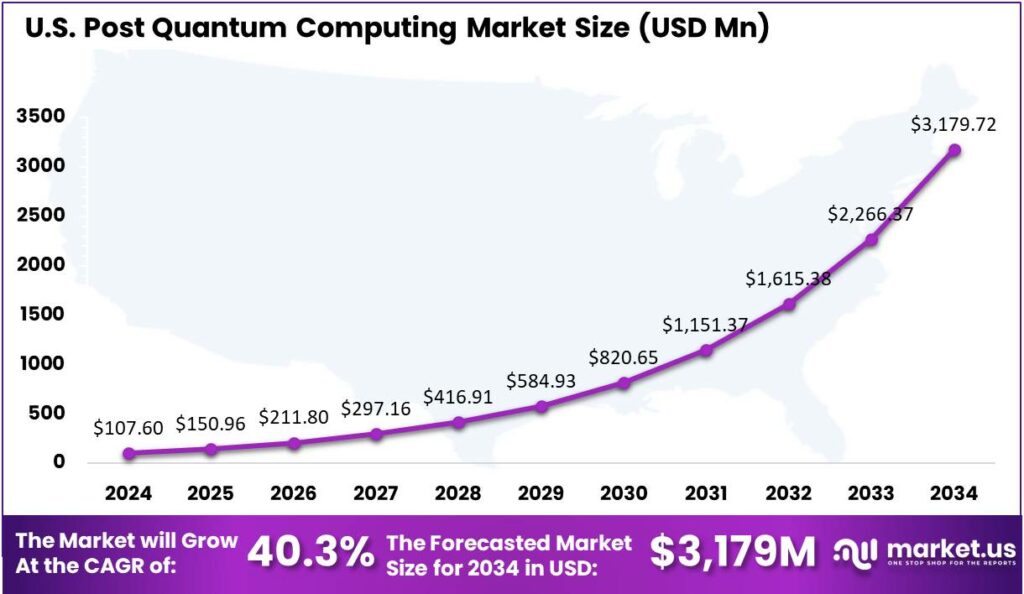
The Global Post Quantum Computing Market size is expected to be worth around USD 10,035 Million By 2034, from USD 284.6 Million in 2024, growing at a CAGR of 42.80% during the forecast period from 2025 to 2034. In 2024, North America held over 40% of the market, generating USD 113 million in revenue. The U.S. market was valued at USD 107.6 million and is expected to grow at a CAGR of 40.3% during the forecast period.
Post-quantum computing involves cryptographic algorithms designed to withstand quantum computer attacks. As traditional methods like RSA and ECC may be vulnerable to quantum algorithms like Shor’s, post-quantum cryptography aims to create secure alternatives. The market is growing rapidly as quantum computing advances and the need for secure cryptographic systems intensifies.
The Post Quantum Computing market is poised for significant growth, driven by the urgent need for secure cryptographic standards that can withstand quantum computing capabilities. As industries and governments recognize the potential threats posed by quantum decryption capabilities, the demand for quantum-safe encryption solutions is accelerating.
Key drivers of the Post Quantum Computing market include the rapid advancements in quantum computing technology, increasing awareness of quantum threats, and the global push towards maintaining data security in sensitive sectors such as national defense, finance, and healthcare.
The demand for post-quantum computing is growing due to rising awareness of quantum attacks and the need to protect sensitive data. Industries are seeking solutions to withstand quantum decryption, ensuring long-term security and regulatory compliance. Post-quantum computing is gaining traction among tech leaders, cybersecurity experts, and researchers for its role in advancing cyber defense.
Current trends in the post-quantum computing market include the development of quantum-resistant algorithms and the integration of these technologies into existing security frameworks. Additionally, there is a noticeable increase in partnerships between academic institutions and tech companies to accelerate the commercialization of post-quantum cryptographic solutions.
The adoption of post-quantum computing offers significant business benefits, including enhanced data protection against future quantum threats, maintaining customer trust, and staying ahead in compliance with data security standards. It also provides a competitive edge to businesses by demonstrating foresight in cybersecurity measures.
The expansion of the post-quantum computing market is facilitated by governmental initiatives and investments in quantum-resistant research. As quantum computers approach practical deployment, the market is poised for substantial growth, with industries increasingly adopting solutions to mitigate the risks posed by quantum advancements.
Key Takeaways
- The Global Post Quantum Computing Market size is projected to reach USD 10,035 Million by 2034, up from USD 284.6 Million in 2024, growing at a CAGR of 42.80% during the forecast period from 2025 to 2034.
- In 2024, the Solution segment dominated the post-quantum computing market, accounting for more than 72% of the market share.
- The large enterprises segment held a significant position in the post-quantum computing market in 2024, capturing more than 67% of the market share.
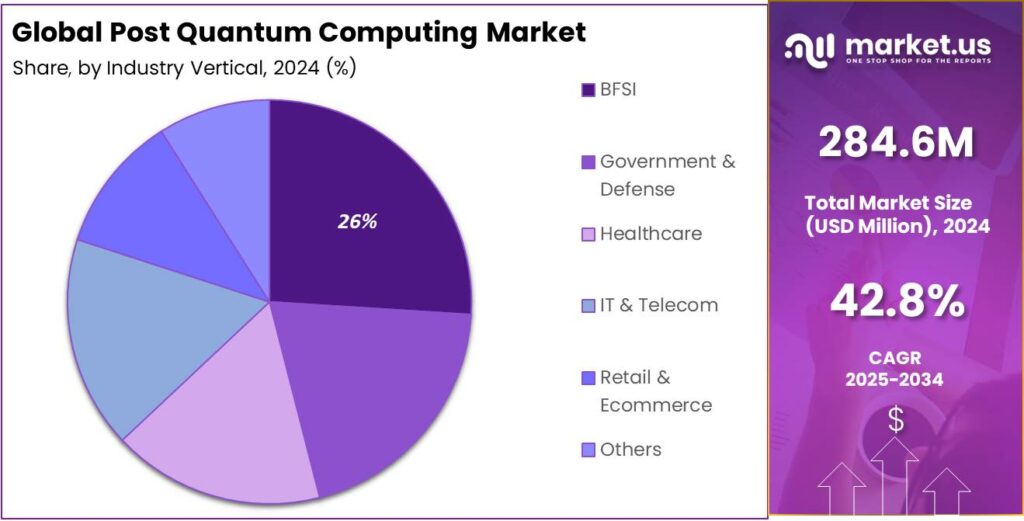
- The BFSI (Banking, Financial Services, and Insurance) segment was the leading sector within the Post Quantum Computing market in 2024, commanding over 26% of the market share.
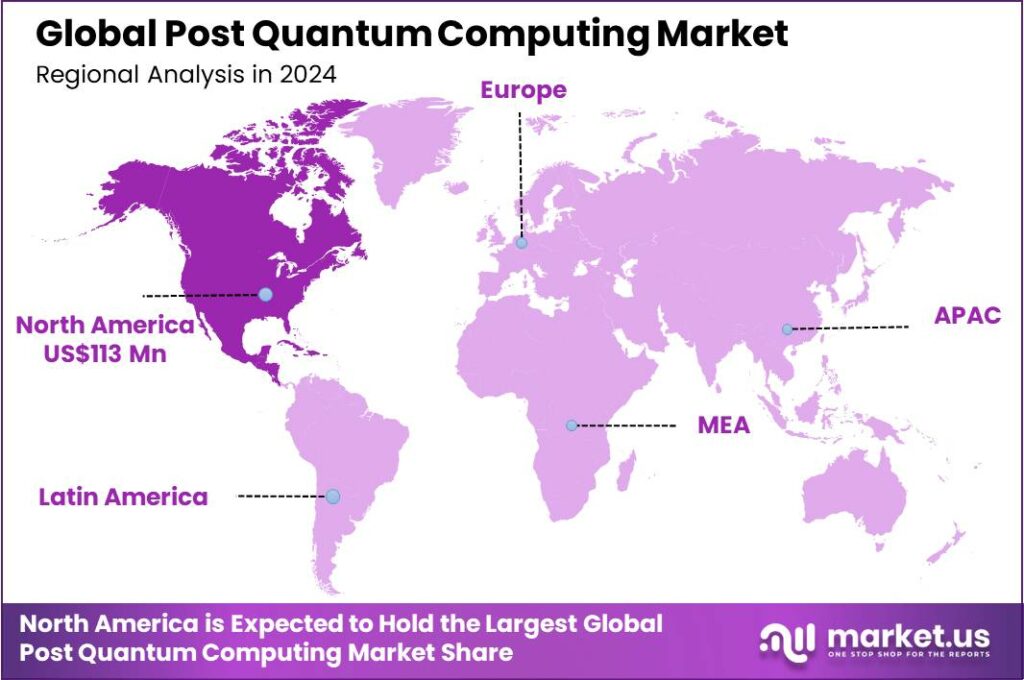
- In 2024, North America held a dominant position in the Post Quantum Computing market, making up more than 40% of the market share, with a revenue of USD 113 million.
- The U.S. market for Post Quantum Computing was valued at USD 107.6 million in 2024, and it is expected to grow at a CAGR of 40.3% during the forecast period.
Funding Overview
Finding observations based on data from Research AI Multiple.
- D-Wave Systems emerges as the most funded private quantum computing company globally with $216 million across 19 rounds, reflecting strong investor confidence in its quantum annealing approach.
- Rigetti Computing follows closely with $198.5 million in 9 rounds, indicating significant backing for its superconducting qubit-based quantum hardware development.
- Among public institutions, the University of Oxford (UK) stands out with $117.59 million awarded through 62 public grants, emphasizing the importance of academic research in quantum technologies.
- Other notable players like Silicon Quantum Computing and IonQ have also attracted considerable funding, suggesting growing investor interest across different quantum technology platforms including photonics, trapped ions, and silicon-based qubits.
- Cambridge Quantum Computing (CQC) and 1QBit represent strong positions in quantum software and quantum-ready algorithms, with robust funding levels supporting their R&D initiatives.
- IQM Quantum Computers, despite being a younger company, has secured €29 million, highlighting Europe’s strategic focus on quantum innovation.
Impact of AI
- Enhancing Quantum Algorithms: AI assists in designing and optimizing quantum algorithms. By leveraging machine learning techniques, researchers are better able to identify efficient algorithms that could potentially solve complex problems faster than classical computers.
- Error Correction: AI plays a crucial role in developing error correction methods for quantum computers. Given the instability of qubits and the high error rates in quantum computations, AI-driven techniques are essential for creating more reliable and stable quantum systems.
- Quantum Control Systems: AI helps in the development of advanced quantum control systems. These systems are necessary to manage the operation of quantum bits and to ensure that quantum computers perform as expected despite their underlying complexities.
- Hybrid Quantum-Classical Systems: There’s a growing trend towards hybrid systems that integrate both classical computing elements and quantum computing elements. AI helps bridge these technologies, facilitating seamless integration and leveraging the strengths of both to solve problems more efficiently.
- Simulation and Modeling: AI is instrumental in simulating quantum behaviors and processes, which is crucial for the advancement of quantum computing technologies. This allows researchers to test and refine quantum approaches in a virtual environment before implementing them in real-world systems.
U.S. Market Leadership
In 2024, the U.S. market for Post Quantum Computing was valued at USD 107.6 million. This market is projected to expand at a compound annual growth rate (CAGR) of 40.3% over the forecast period. The substantial growth rate highlights the increasing awareness and integration of quantum-resistant cryptographic technologies among U.S. industries and government entities.
The surge in market value is driven by the growing need for cybersecurity solutions resistant to quantum attacks. As quantum computing advances, traditional encryption methods become vulnerable, boosting investment in post-quantum cryptography (PQC) to secure data. U.S. industries like finance, healthcare, and government are leading the adoption of these advanced security measures.
The U.S. Post Quantum Computing market is set for significant growth, driven by government initiatives to strengthen cyber infrastructure against quantum threats and growing investments in quantum computing research. This growth highlights the strategic need for developing quantum-resistant technologies to protect critical information in the quantum computing era.
In 2024, North America held a dominant market position in the Post Quantum Computing sector, capturing more than a 40% share with revenue amounting to USD 113 million. This leading position is largely due to the region’s robust technological infrastructure and the early adoption of quantum-safe cybersecurity measures.
North American firms and government entities have been proactive in integrating post-quantum cryptographic solutions to safeguard sensitive information against potential quantum threats. The region’s commitment to maintaining a competitive edge in cybersecurity is further evidenced by significant investments in research and development.
Academic and governmental research institutions in North America, such as the National Institute of Standards and Technology (NIST), have been pivotal in developing and standardizing quantum-resistant cryptographic algorithms. This leadership in standardization efforts has not only spurred regional growth but has also set a global benchmark in quantum-safe practices.
North America benefits from leading technology companies in advanced computing and post-quantum cryptography, driving innovation and large-scale implementation. This contributes to the region’s strong market share. As quantum computing advances, North America is expected to maintain its leadership, fueled by technological progress and strategic collaborations between government and the private sector.
Component Analysis
In 2024, the Solution segment held a dominant market position within the post-quantum computing market, capturing more than a 72% share. This dominance stems from the growing need for quantum-safe solutions as quantum computing threatens existing cryptographic standards. Industries and governments are investing in quantum-safe hardware, quantum-resistant algorithms, and cryptographic libraries to protect sensitive data from future quantum risks.
Quantum-safe hardware and quantum-resistant algorithms form the core of this segment, providing the foundational technology needed to develop secure systems resistant to both classical and quantum computing threats. These technologies are crucial for creating a secure infrastructure that can withstand the impending quantum era.
Additionally, the demand for quantum-safe cryptographic libraries and tools like quantum-safe VPNs, email, and messaging systems is rising. These tools are essential for everyday business operations, requiring immediate attention to prevent potential data breaches in the future.
Quantum-safe blockchain and authentication methods enhance this segment, providing vital security for digital transactions and identity verification in a post-quantum world. The broad range of solutions in this category contributes to its significant market share and highlights its key role in the shift to quantum-resistant technologies.
Organization Size Analysis
In 2024, the large enterprises segment held a dominant market position in the post-quantum computing landscape, capturing more than a 67% market share. This dominance is driven by large enterprises’ financial resources and strategic foresight, enabling them to invest in advanced technologies, including cybersecurity measures against potential quantum threats.
Enterprises in sectors like finance, healthcare, and government contracting require robust security due to the sensitive nature of their data. Their early adoption of post-quantum cryptographic solutions is driven by the need to maintain trust and comply with evolving data protection laws as quantum computing becomes more widespread.
Large enterprises, with extensive IT infrastructures, require advanced security solutions to protect vast data across global locations. Their leadership in adopting post-quantum computing is driven by the need to secure complex network architectures against evolving cyber threats, including those posed by quantum computers.
Large enterprises, as trendsetters in technology adoption, influence broader market dynamics. Their early adoption of post-quantum computing sets an industry benchmark, encouraging smaller companies to follow suit. By successfully implementing quantum-resistant solutions, they drive market acceptance and expansion, solidifying their leadership position.
Industry Vertical Analysis
In 2024, the BFSI (Banking, Financial Services, and Insurance) segment held a dominant market position within the Post Quantum Computing sector, capturing more than a 26% share. This stance is driven by the critical need for strong cybersecurity in the financial sector to protect sensitive data and ensure transaction security.
Financial institutions are prioritizing investment in quantum-safe technologies to protect data encryption from potential quantum attacks. This proactive strategy is vital for maintaining customer trust, meeting strict regulatory data security requirements, and ensuring the confidentiality of client transactions and communications through PQC solutions.
Moreover, the BFSI sector’s emphasis on innovation and technology integration for competitive advantage further drives its leadership in the post-quantum computing market. By incorporating advanced cryptographic solutions, banks and financial services can not only secure their existing infrastructures but also pave the way for the adoption of next-generation banking technologies.
The BFSI segment’s growth and dominance in the post-quantum computing market are expected to continue as quantum computing advances and the need for quantum-resistant solutions grows. The sector’s ongoing development of cryptographic technologies will set a benchmark for other industries, highlighting the crucial role of PQC in modern cybersecurity frameworks.
Key Market Segments
By Component
- Solution
- Quantum-Safe Hardware
- Quantum-Resistant Algorithms
- Quantum-Safe Cryptographic Libraries
- Quantum-Dafe VPN, Email Service, and Messaging Systems
- Quantum-Safe Blockchain Solutions
- Quantum-Safe Authentication Solutions
- Quantum-Resistant Encryption Solutions
- Service
- Design, Implementation, and Consulting
- Migration Services
- Quantum Risk Assessment
By Organization Size
- Small & Medium Enterprises
- Large Enterprises
By Industry Vertical
- BFSI
- Government & Defense
- Healthcare
- IT & Telecom
- Retail & Ecommerce
- Others
Key Regions and Countries
- North America
- US
- Canada
- Europe
- Germany
- France
- The UK
- Spain
- Italy
- Rest of Europe
- Asia Pacific
- China
- Japan
- South Korea
- India
- Australia
- Singapore
- Rest of Asia Pacific
- Latin America
- Brazil
- Mexico
- Rest of Latin America
- Middle East & Africa
- South Africa
- Saudi Arabia
- UAE
- Rest of MEA
Driver
Urgency to Replace Vulnerable Cryptographic Systems
The adoption of post-quantum cryptography (PQC) is driven by the imminent threat quantum computers pose to current cryptographic systems like RSA and ECC. Quantum algorithms, such as Shor’s, can break these systems, leading organizations to transition to quantum-resistant solutions to safeguard secure communications.
The National Institute of Standards and Technology (NIST) is leading the effort to standardize post-quantum cryptography (PQC) algorithms to protect against quantum attacks. Their work ensures future cryptographic systems remain secure against both classical and quantum threats. The “harvest now, decrypt later” strategy, where adversaries collect encrypted data for future decryption, highlights the urgent need for timely adoption of PQC to protect sensitive information.
Restraint
Complexity and Cost of Migration
The need for PQC is clear, but transitioning from existing cryptographic systems presents significant challenges. Organizations face the daunting task of overhauling established infrastructures, which involves not only replacing algorithms but also ensuring compatibility across diverse systems and applications. This process demands substantial financial investment, technical expertise, and time.
Moreover, the lack of widespread knowledge and experience with PQC technologies exacerbates the situation. Many organizations struggle with understanding quantum-resistant algorithms and their implementation, causing hesitancy in adopting PQC solutions. The lack of universally accepted standards and best practices further complicates the migration, leaving organizations unsure of the best approach.
Opportunity
Development of Quantum-Resistant Technologies
The looming quantum threat has catalyzed innovation in the field of cryptography. Researchers and technologists are actively developing new algorithms and protocols designed to be resilient against quantum attacks. This surge in innovation presents opportunities for organizations to pioneer advanced security solutions, potentially gaining a competitive edge in the market.
Proactively adopting PQC can position organizations as cybersecurity leaders, boosting their reputation and trustworthiness. By investing in quantum-resistant technologies now, businesses can future-proof their operations, ensuring data confidentiality and integrity in the quantum era. This approach not only mitigates risks but also fosters opportunities for collaboration, research, and development in quantum-safe technologies.
Challenge
Ensuring Interoperability and Standardization
A key challenge in adopting PQC is ensuring interoperability across different systems. As multiple organizations create their own quantum-resistant solutions, fragmentation may occur, preventing seamless communication and integration. This lack of standardization could result in inefficiencies, higher costs, and potential security vulnerabilities.
Governments, industry leaders, and standardization bodies must work together to establish universally accepted protocols and standards for PQC. This collective effort will help ensure that organizations transition to quantum-resistant systems in a way that promotes compatibility, security, and efficiency across the global digital landscape.
Emerging Trends
Recent advancements have made quantum computing more accessible and scalable, with post-quantum computing shifting from a theoretical idea to a practical technology. Notably, Microsoft’s Majorana 1 chip, which utilizes topological qubits, is designed to improve error resilience in quantum systems, signaling significant industry transformations.
The rise of quantum computing has prompted the development of post-quantum cryptography (PQC). NIST has introduced new encryption standards to resist quantum attacks, encouraging organizations to adopt them. Companies like Cloudflare are already integrating PQC into their services to safeguard against future quantum threats.
Furthermore, the quantum computing industry is addressing potential talent shortages by investing in education and training programs. Companies such as IBM, Google, and Microsoft are partnering with academic institutions to develop curricula and certifications, preparing a skilled workforce to meet the growing demand in this field .
Business Benefits
Quantum algorithms offer the ability to model complex market dynamics more accurately than classical computers. This capability can lead to more effective risk management and financial forecasting, providing a competitive edge in the volatile finance industry.
In the pharmaceutical sector, quantum computing can significantly speed up the process of drug discovery. This technology enables the simulation of molecular interactions at unprecedented levels, potentially reducing the time and cost associated with bringing new drugs to market.
With its ability to simulate and analyze large, complex datasets, quantum computing can drive innovations in material science. Industries reliant on advanced materials, such as manufacturing and aerospace, stand to benefit from new materials that improve product performance and durability.
Key Player Analysis
The Post Quantum Computing Market is attracting various key players who are developing technologies to ensure data security in a quantum-enabled world.
NXP Semiconductors has positioned itself as a significant player in the post-quantum computing sector, leveraging its expertise in embedded security and cryptography. NXP is developing hardware-based solutions to ensure security against future quantum threats, aiming to protect sensitive data in a post-quantum computing world.
Thales is another major player that is leading innovation in the post-quantum computing market. The company is known for its strong focus on cybersecurity and data protection solutions. Thales has been working on developing post-quantum cryptographic algorithms and solutions that can secure critical infrastructures against quantum-based attacks.
Amazon Web Services (AWS) is one of the global leaders in cloud computing, and it is also making strides in the post-quantum computing space. AWS has taken a forward-thinking approach by investing in quantum computing research and developing services to help businesses transition to quantum-safe cryptography.
Top Key Players in the Market
- NXP Semiconductors
- Thales
- Amazon Web Services
- IDEMIA
- Palo Alto Networks
- DigiCert
- PQ Shield
- Entrust
- IBM Corporation
- Utimaco
- Others
Top Opportunities for Players
The post-quantum computing market is poised for transformative growth and offers significant opportunities for market players and industries.
- Advancement in Quantum Processors: The rapid progress in quantum processor technology, driven by substantial investments from major tech companies like Google, IBM, and Intel, is creating a lucrative opportunity for businesses specializing in quantum hardware. This advancement enables faster problem-solving than classical computers, providing a strategic edge in fields like finance, logistics, and drug discovery.
- Quantum Applications Development: As quantum technology matures, the development of quantum applications is becoming increasingly feasible. These applications span various industries, including cryptography, healthcare, and financial services, where they can offer unprecedented computational capabilities for encryption and simulations.
- Quantum Cloud Services: The rise of quantum cloud computing platforms by companies such as IBM and Amazon is lowering the entry barriers for other businesses to explore quantum solutions. These platforms provide access to quantum computing resources over the cloud, enabling companies to experiment and innovate without the heavy initial investment in quantum infrastructure.
- Growing Supply Chain for Quantum Components: The expansion of the quantum computing supply chain is an emerging opportunity, particularly in the production of specialized quantum components such as control electronics and cryogenic systems. This growth is anticipated to address potential bottlenecks and foster a robust market for quantum-specific materials and technologies.
- Increased Collaborative Investments: There is a notable increase in collaborative efforts and investments among tech giants, startups, and government bodies aimed at advancing quantum computing technology. This collaboration strengthens quantum computing’s tech foundation and fuels growth in the ecosystem, making it a key area for investment and innovation.
Recent Developments
- In January 2024, Entrust launched the first commercially available Post-Quantum Ready PKI-as-a-Service (PKIaaS PQ) platform. This platform enables organizations to issue both composite and pure quantum-safe certificates, facilitating a smoother transition to quantum-resistant security infrastructures.
- In April 2024, The IDEMIA company launched a crypto-agility solution enabling service providers to continuously upgrade to more secure cryptographic algorithms, offering long-term protection against quantum threats .