Report Overview
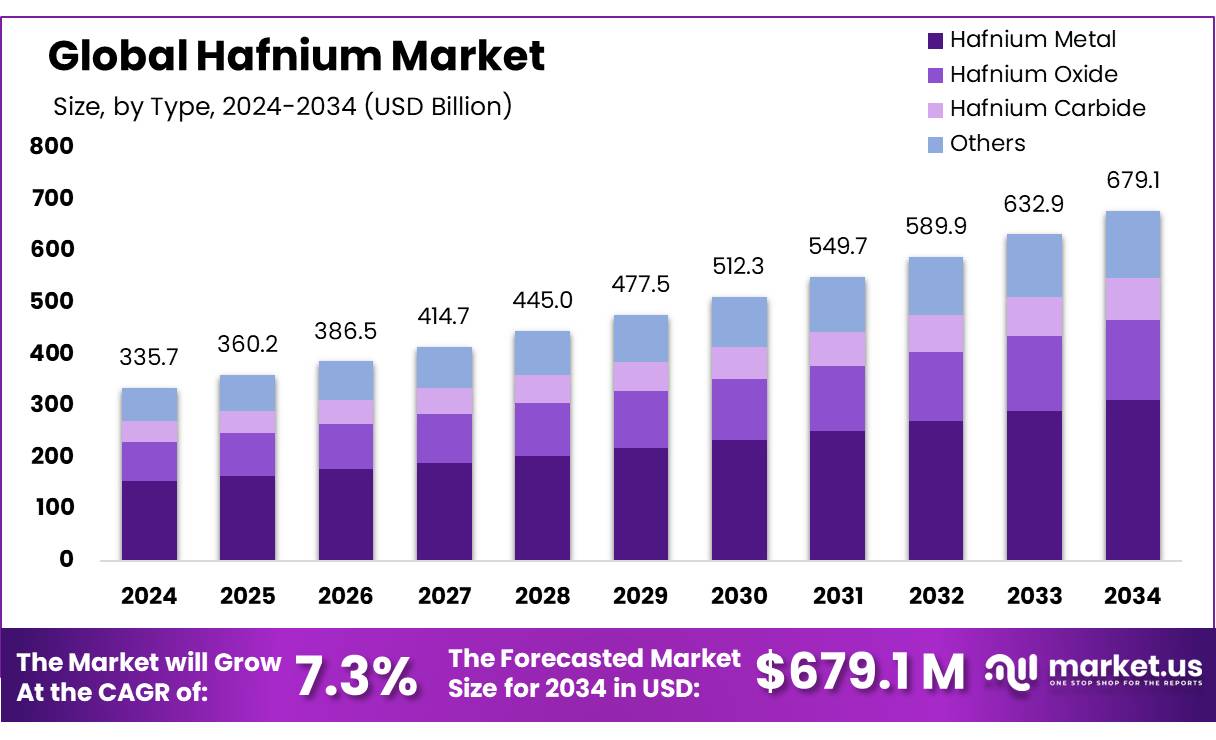
The Global Hafnium Market size is expected to be worth around USD 679.1 Billion by 2034, from USD 335.7 Mn in 2024, growing at a CAGR of 7.3% during the forecast period from 2025 to 2034.
Hafnium (Hf), a lustrous, silvery-gray metal, is primarily obtained as a byproduct of zirconium refining. Its unique properties, such as high neutron absorption cross-section and excellent corrosion resistance, make it indispensable in various high-technology and energy applications. The global hafnium market is relatively niche, with production closely tied to zirconium extraction processes.
According to the U.S. Geological Survey (USGS), global hafnium production is not reported separately but is estimated based on zirconium production, as hafnium is typically extracted during zirconium processing. The primary producers include France, the United States, and China. The demand for hafnium is driven by its applications in nuclear reactors, where it serves as a control rod material due to its ability to absorb neutrons effectively. Additionally, hafnium is used in aerospace applications, particularly in superalloys for jet engines, and in the electronics industry for high-k dielectrics in semiconductors.
Driving factors for the hafnium market include the expansion of nuclear energy programs, advancements in semiconductor technology, and the growth of the aerospace industry. For instance, the U.S. Department of Energy (DOE) has been investing in advanced nuclear reactor designs, some of which may utilize hafnium components. Additionally, the global push for cleaner energy sources has led to renewed interest in nuclear power, potentially increasing hafnium demand.
Future growth opportunities for hafnium lie in its potential applications in quantum computing and advanced electronics. Research is ongoing into hafnium-based materials for resistive random-access memory (ReRAM) and other next-generation memory devices. Moreover, as nations aim to achieve carbon neutrality, the role of nuclear energy—and by extension, hafnium—is expected to become more prominent.
Government initiatives also play a crucial role in shaping the hafnium market. For example, the U.S. has identified hafnium as a critical material, emphasizing the need for secure and reliable supplies. Policies aimed at strengthening domestic production and reducing reliance on imports could impact the hafnium supply chain.
Key Takeaways
- Hafnium Market size is expected to be worth around USD 679.1 Billion by 2034, from USD 335.7 Mn in 2024, growing at a CAGR of 7.3%.
- Hafnium Metal held a dominant market position, capturing more than a 45.8% share in the global hafnium market.
- Rods held a dominant market position, capturing more than a 47.3% share in the global hafnium market by product form.
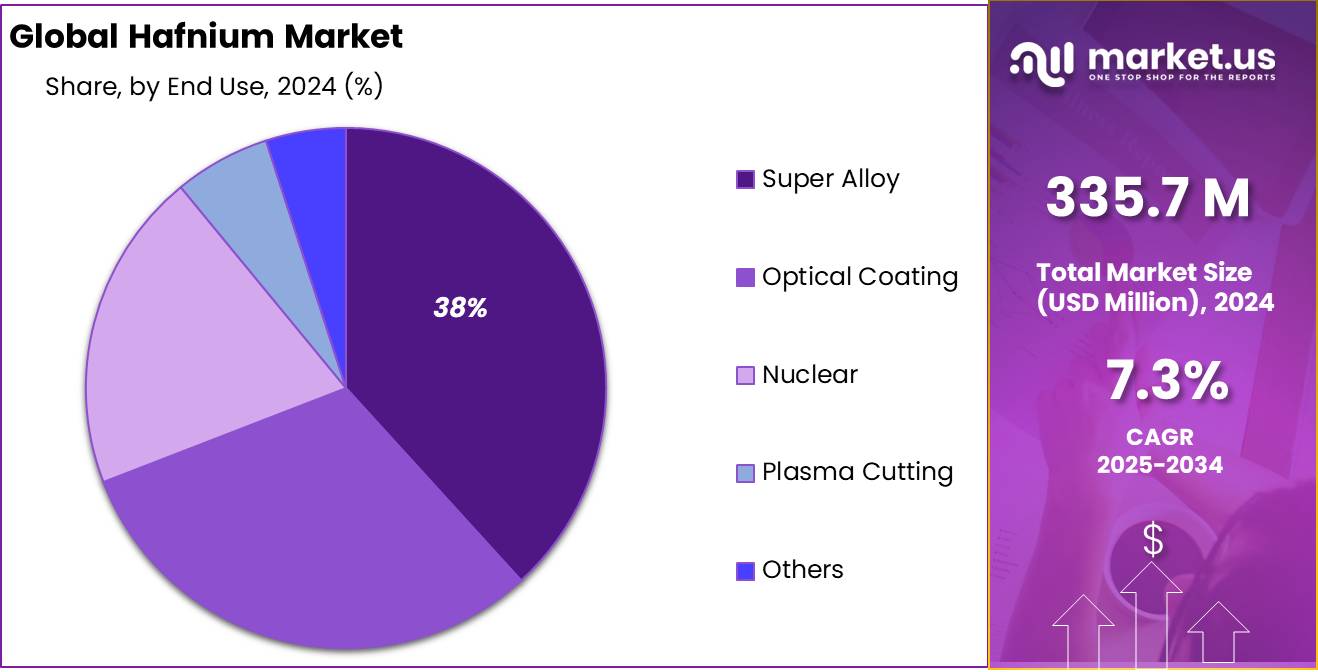
- Super Alloy held a dominant market position, capturing more than a 38.4% share in the global hafnium market by application.
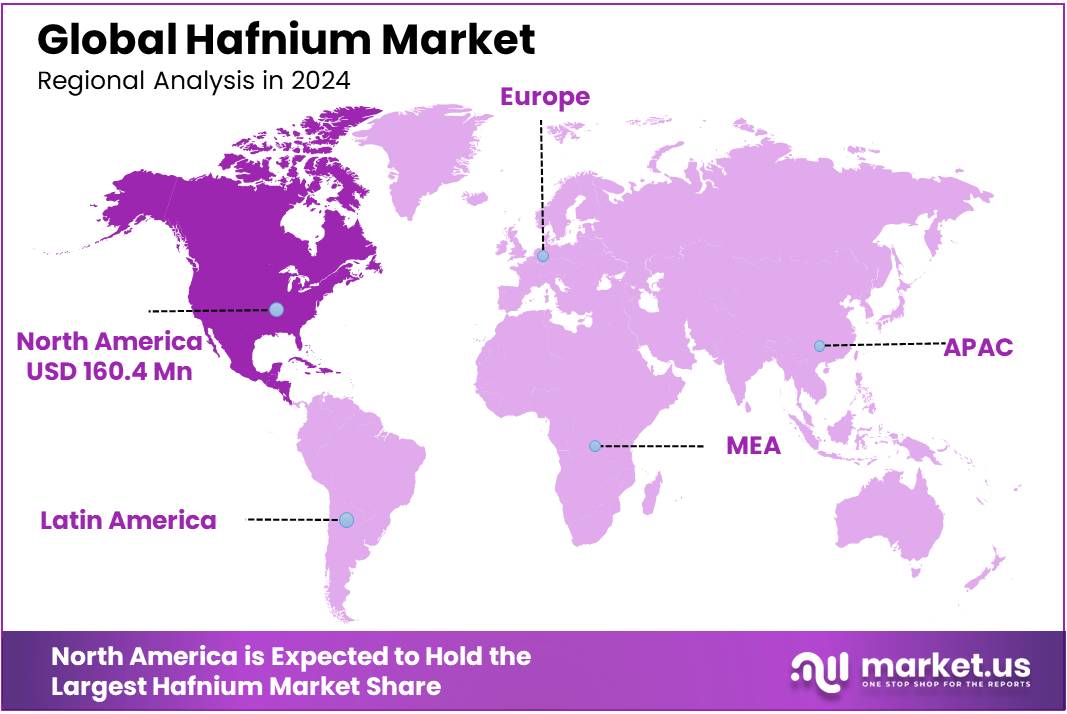
- North America emerged as the dominant region in the global hafnium market, capturing 47.8% of the market share and generating approximately USD 160.4 million in revenue.
By Type
Hafnium Metal Dominates with 45.8% Share Amidst Strong Demand
In 2024, Hafnium Metal held a dominant market position, capturing more than a 45.8% share in the global hafnium market. The rising demand for hafnium in aerospace, nuclear reactors, and high-temperature alloys has significantly bolstered its market dominance. With its superior heat resistance and exceptional neutron absorption properties, hafnium metal is increasingly utilized in the production of control rods and turbine blades, further solidifying its market share.
Additionally, the robust expansion of the aerospace and defense sectors, particularly in the U.S. and China, has driven substantial consumption of hafnium metal, further strengthening its position as the leading segment. The sustained focus on advanced materials in semiconductor manufacturing and nuclear applications is expected to maintain the dominance of hafnium metal through 2025.
By Product Form
Rods Lead with 47.3% Share Driven by Robust Industrial Demand
In 2024, Rods held a dominant market position, capturing more than a 47.3% share in the global hafnium market by product form. The extensive use of hafnium rods in nuclear reactors, aerospace components, and industrial applications has significantly contributed to their market leadership. Hafnium rods, known for their remarkable corrosion resistance and thermal stability, are increasingly favored in advanced manufacturing processes, including control rods and turbine blades.
The rising investments in nuclear power plants, especially in the U.S. and China, have further boosted the demand for hafnium rods, securing their top spot in the market. The trend is anticipated to persist through 2025, with continued industrial adoption and technological advancements driving growth in the segment.
By Application
Super Alloy Commands 38.4% Share Amidst Aerospace and Defense Expansion
In 2024, Super Alloy held a dominant market position, capturing more than a 38.4% share in the global hafnium market by application. The extensive utilization of hafnium-based super alloys in aerospace and defense industries has been a key factor driving their market prominence. With superior heat resistance and exceptional mechanical strength, hafnium super alloys are increasingly employed in turbine blades, jet engines, and nuclear reactors, ensuring enhanced operational efficiency under extreme conditions.
The surging demand for advanced materials in aerospace manufacturing and the ongoing modernization of defense systems across the U.S. and Europe have further fueled the growth of this segment. The upward trajectory is expected to continue in 2025, driven by increased spending on high-performance materials and cutting-edge defense applications.
Key Market Segments
By Type
- Hafnium Metal
- Hafnium Oxide
- Hafnium Carbide
- Others
By Product Form
- Rods
- Plates
- Sheets
- Powders
By Application
- Super Alloy
- Optical Coating
- Nuclear
- Plasma Cutting
- Others
Drivers
Soaring Hafnium Prices Reflect Tight Supply and Growing Demand
In 2024, the hafnium market experienced a significant surge in prices, with the cost of unwrought hafnium reaching approximately $6,200 per kilogram. This sharp increase, from $1,590 per kilogram in 2022, underscores the growing demand and constrained supply of this critical metal.
Hafnium’s unique properties, such as its high melting point and excellent corrosion resistance, make it indispensable in various high-tech applications. It’s extensively used in superalloys for aerospace components, nuclear control rods, and high-temperature ceramics. As industries like aerospace and nuclear energy continue to expand, the reliance on hafnium intensifies, further driving up its demand.
However, the supply of hafnium remains limited. It’s primarily obtained as a byproduct during the processing of zirconium minerals. The extraction process is complex and yields relatively small quantities of hafnium, making its availability susceptible to fluctuations in zirconium production. In 2024, the global production of zirconium mineral concentrates was estimated at 1.5 million tons, a modest 4% increase from the previous year.
The combination of escalating demand and limited supply has led to a tight hafnium market. This imbalance not only affects pricing but also raises concerns about the long-term availability of hafnium for critical industries. To address these challenges, there’s a growing emphasis on developing alternative sources and enhancing recycling efforts to ensure a stable supply chain for this vital metal.
Restraints
Environmental Regulations and Supply Chain Constraints Hamper Hafnium Market Growth
In 2024, the hafnium market faced significant challenges due to stringent environmental regulations and supply chain constraints. Hafnium, primarily obtained as a byproduct of zirconium processing, requires the extraction of approximately 50 tonnes of zirconium to produce just one tonne of hafnium. This complex extraction process not only limits hafnium availability but also raises environmental concerns. The European Union’s Critical Raw Materials Act, effective from May 2024, includes hafnium among 34 critical raw materials, emphasizing the need for sustainable sourcing and processing practices.
The environmental impact of hafnium extraction has led to increased regulatory scrutiny. In the United States, for instance, delays in permitting procedures, waste management issues, and challenges in obtaining specialty materials have hindered the expansion of hafnium production facilities. Two primary producers in Oregon and Utah have the capacity to add about 50 tonnes of hafnium production based on existing permits, but these expansions are stalled due to regulatory and logistical challenges.
These regulatory hurdles have a cascading effect on the supply chain. The limited number of processing facilities and the complexity of hafnium extraction contribute to supply bottlenecks. Moreover, the global nature of the supply chain means that disruptions in one region can have far-reaching impacts. For example, China’s export controls on critical minerals have added to the uncertainty in the hafnium market, affecting global availability and pricing.
Opportunity
Rising Demand in Semiconductors and Nuclear Energy Drives Hafnium Market Growth
In 2024, the hafnium market is witnessing significant growth, primarily fueled by its increasing applications in the semiconductor and nuclear energy sectors. Hafnium’s unique properties, such as a high melting point and excellent neutron absorption capabilities, make it indispensable in these industries.
The semiconductor industry, in particular, has seen a surge in demand for hafnium oxide (HfO₂), a compound used as a high-k dielectric material in advanced microchips. As electronic devices become more compact and powerful, the need for materials that can efficiently manage electrical currents without overheating has become paramount. Hafnium oxide meets this need, leading to its widespread adoption in the production of next-generation semiconductors.
Simultaneously, the nuclear energy sector relies on hafnium for its ability to absorb neutrons, making it a critical component in control rods used to regulate nuclear reactions. With many countries aiming to expand their nuclear energy capabilities as a means to achieve carbon neutrality, the demand for hafnium in this sector is expected to rise.
Furthermore, government initiatives supporting clean energy and technological advancements are indirectly boosting the hafnium market. For instance, investments in nuclear energy infrastructure and research into more efficient semiconductor technologies are creating new avenues for hafnium application.
Trends
Hafnium Oxide Gains Momentum with 41% Share in High-k Dielectric Materials Market
In 2024, hafnium oxide emerged as a leading material in the high-k dielectric sector, securing approximately 41% of the market share. This growth is largely attributed to its superior electrical insulation properties and its critical role in advanced semiconductor devices.
The semiconductor industry is increasingly adopting hafnium oxide due to its high dielectric constant, which allows for better performance in smaller, more efficient electronic components. This is particularly important as devices continue to shrink in size while demanding higher performance. Hafnium oxide’s ability to suppress leakage current makes it an ideal choice for next-generation chips, especially in applications like AI, IoT, and 5G technologies.
Moreover, the global push towards miniaturization and enhanced performance in electronics is fueling the demand for materials like hafnium oxide. Its integration into semiconductor manufacturing processes is not only improving device performance but also enabling the continued advancement of technology in various sectors.
Regional Analysis
North America Dominates with 47.8% Hafnium Market Share Amidst Robust Industrial Demand
In 2024, North America emerged as the dominant region in the global hafnium market, capturing 47.8% of the market share and generating approximately USD 160.4 million in revenue. The United States continues to play a pivotal role, driven by the extensive application of hafnium in aerospace, nuclear energy, and semiconductor sectors. With major aerospace manufacturers and defense contractors situated in the region, the demand for hafnium-based super alloys and control rods remains consistently high.
Additionally, the U.S. Department of Energy’s ongoing investments in nuclear infrastructure and research initiatives are further bolstering the consumption of hafnium, particularly in nuclear reactors where hafnium’s neutron-absorbing properties are critical.
Moreover, the semiconductor industry in North America is witnessing robust growth, fueled by the increasing demand for advanced microchips and processors in AI and IoT applications. Hafnium oxide, known for its superior dielectric properties, is extensively used in semiconductor manufacturing, thereby propelling regional demand. The rising investments in semiconductor fabrication plants, coupled with government-backed initiatives to reduce dependency on foreign chip supplies, are creating a conducive environment for hafnium market expansion.
Key Regions and Countries
- North America
- US
- Canada
- Europe
- Germany
- France
- The UK
- Spain
- Italy
- Rest of Europe
- Asia Pacific
- China
- Japan
- South Korea
- India
- Australia
- Rest of APAC
- Latin America
- Brazil
- Mexico
- Rest of Latin America
- Middle East & Africa
- GCC
- South Africa
- Rest of MEA
Key Players Analysis
ACI Alloys specializes in producing high-purity hafnium products, including alloys and sputtering targets. The company supplies hafnium to industries such as aerospace, defense, and semiconductor manufacturing. In 2024, ACI Alloys reported a steady increase in demand for its hafnium alloys, driven by their application in high-temperature superalloys and control rods for nuclear reactors. The company leverages advanced metallurgical processes to maintain the quality of its hafnium products, aiming to expand its market presence globally.
Advanced Engineering Materials Limited is a key player in the hafnium market, providing high-grade hafnium rods, bars, and foils. In 2024, the company experienced a significant uptick in sales, primarily from the aerospace and electronics sectors. Its hafnium-based products are known for their exceptional corrosion resistance and thermal stability, making them ideal for critical applications. With a strong distribution network across North America and Europe, the company is focused on expanding its market reach in emerging economies.
Alkane Resources Ltd is a leading hafnium producer, primarily sourcing hafnium as a byproduct from its zirconium operations. In 2024, the company produced approximately 30 metric tons of hafnium, capitalizing on the rising demand from nuclear and semiconductor industries. Alkane Resources has also invested in advanced processing facilities to enhance its hafnium output. The company’s strategy includes establishing long-term supply agreements with major aerospace and defense manufacturers to secure a stable revenue stream.
Top Key Players in the Market
- ACI Alloys
- Advanced Engineering Materials Limited
- Alkane Resources Ltd
- American Elements
- Baoji ChuangXin Metal Materials Co. Ltd (CXMET)
- China Nuclear JingHuan Zirconium Industry Co., Ltd.
- Framatome (EDF)
- Nanjing Youtian Metal Technology Co., Ltd.
- Nantong JP New Material Tech co. LTD
- Neo Performance Materials Inc.
- Phelly Materials Inc.
- Starfire Systems Inc.
- Westinghouse Electric Company LLC
Recent Developments
In 2024, American Elements maintained its pivotal role in the hafnium market by offering a diverse range of high-purity hafnium products, including metal forms and compounds with purities ranging from 99% to 99.999%.
In 2024, Advanced Engineering Materials Limited (AEM) strengthened its position in the hafnium market by focusing on high-purity hafnium products tailored for critical industries such as aerospace, nuclear energy, and semiconductors. The company maintained a substantial inventory, including over 500 kilograms of 99.99% pure hafnium crystal bars, meeting the stringent requirements of its global clientele.