


Report Overview
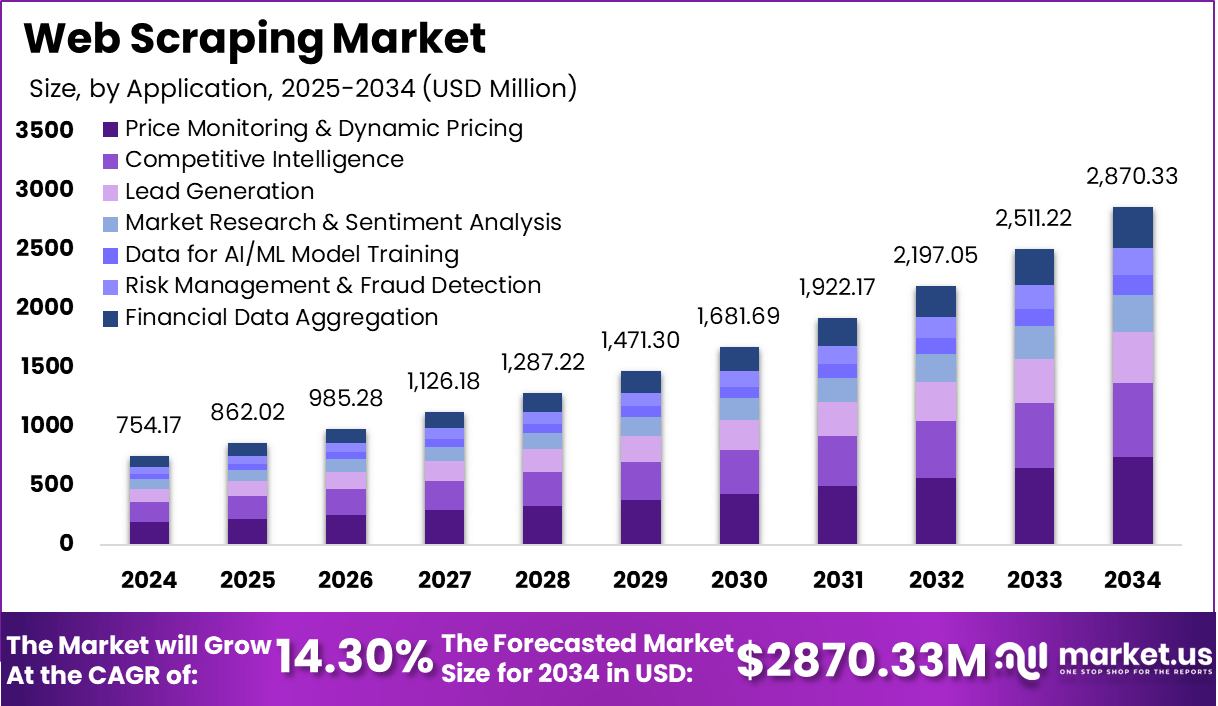
The global web scraping market was valued at USD 754.17 million in 2024 and is projected to reach USD 2,870.33 million by 2034, growing at a robust CAGR of 14.3% during the forecast period. The market expansion is driven by the rising need for data-driven decision-making, competitive intelligence, and large-scale data extraction across sectors such as e-commerce, finance, and digital marketing. Businesses are increasingly adopting web scraping tools and services to automate data collection, monitor pricing trends, and gather customer sentiment insights from multiple online platforms.
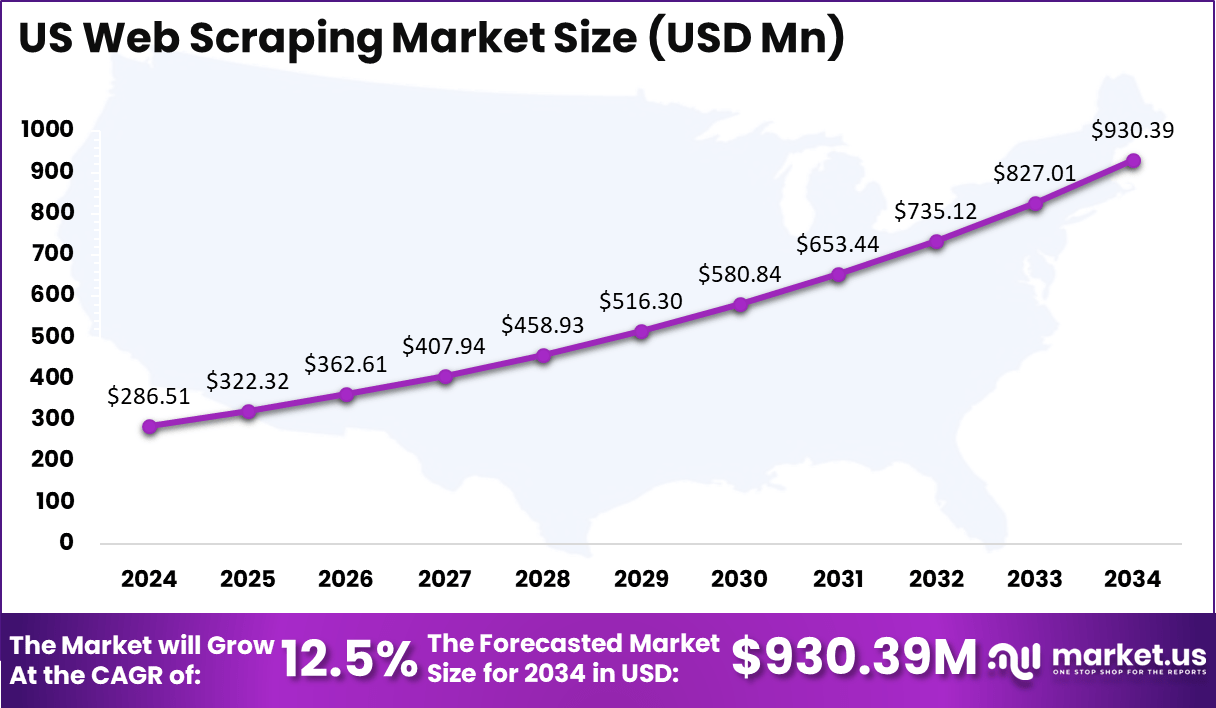
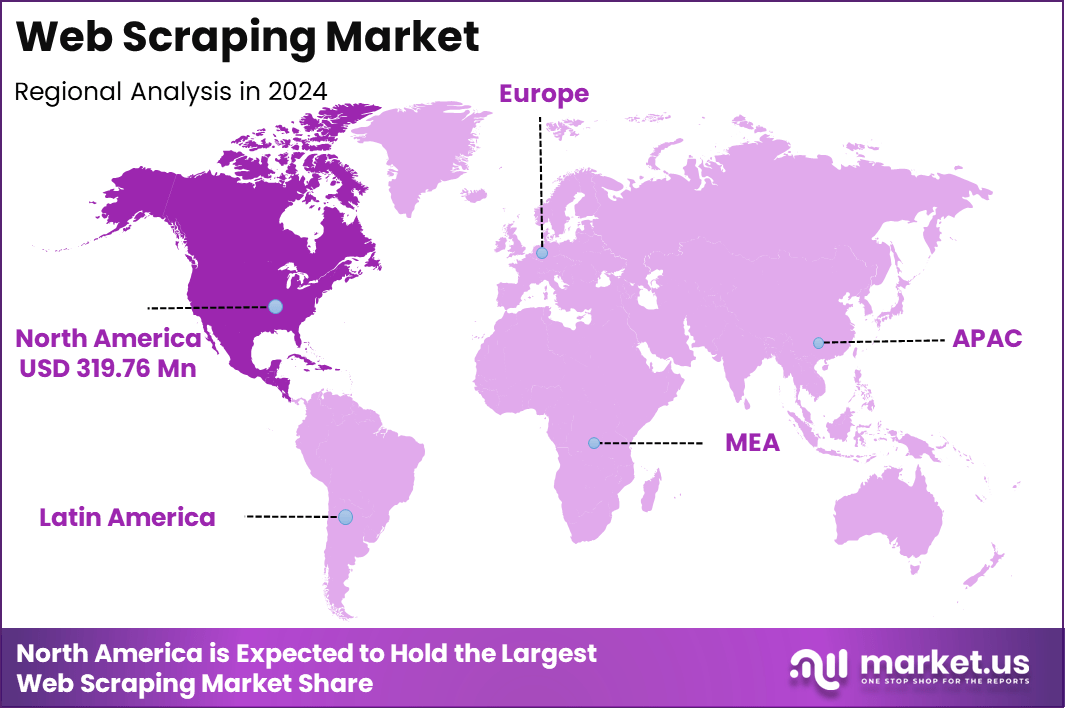
North America accounted for 42.4% of the global share in 2024, valued at USD 319.76 million, owing to the strong presence of advanced analytics firms and early adoption of AI-powered data extraction technologies. The US market, valued at USD 286.51 million in 2024, is expected to reach USD 930.39 million by 2034, growing at a CAGR of 12.5%, supported by widespread integration of web scraping solutions in retail, BFSI, and IT industries to enhance competitive advantage and operational intelligence.
The global web scraping market is experiencing strong growth, driven by the increasing need for data extraction, analytics, and automation across industries. Businesses are increasingly relying on web scraping tools to collect structured data from diverse online sources such as e-commerce platforms, social media, and company websites. This data is being used to enhance decision-making, monitor competitors, track market trends, and support digital marketing strategies. The growing importance of data-driven operations in sectors including finance, retail, and technology is fueling the widespread adoption of web scraping solutions.
The market is also benefiting from the integration of artificial intelligence, machine learning, and cloud technologies that enable faster and more accurate data extraction. Enterprises are moving beyond traditional manual data gathering methods and embracing automated scraping solutions for scalability and efficiency.
North America remains the leading region due to early technological adoption, a mature analytics ecosystem, and a growing demand for real-time business intelligence. Furthermore, the rising need for ethical data collection and compliance with privacy regulations is prompting companies to invest in secure and compliant scraping solutions. As digital transformation accelerates globally, the web scraping market is expected to continue expanding across multiple industry verticals.
Funding activity is also accelerating. Reworkd, an AI-agent scraping startup, secured USD 2.75 million in seed funding (on top of a USD 1.25 million pre-seed), drawing support from investors like Paul Graham, Nat Friedman, and General Catalyst.
This USD 4 million total fuels its AI-based web-scraping agents capable of autonomously generating customized code for large-scale, multi-site data extraction. In addition, there are now more than 2,700 active web scraping startups globally, collectively raising roughly USD 13.8 billion in capital, with an average of USD 200 million each—underscoring strong investor confidence in the space.
Product innovation is another focal point. New AI-powered, no-code scraping tools—like Parsera, BrowseAI, and Kadoa—are making data extraction accessible to non-developers, while API-centric platforms like ScraperAPI, Decodo, and the newly acquired ScrapingBee continue to cater to developers needing scale and reliability.
Scrapingdog launched a proprietary AI scraper that improves accuracy up to 99.5% and speeds up extraction by between 30–40%, according to its 2025 report. As these technologies mature, businesses across e-commerce, finance, and AI training are adopting scraping tools not just to gather information, but also to generate predictive and compliant data pipelines.
Key Takeaways
- The global web scraping market was valued at USD 754.17 million in 2024 and is projected to reach USD 2,870.33 million by 2034, expanding at a robust CAGR of 14.3%. The growth is driven by rising data extraction needs, increasing automation adoption, and the expanding use of analytics in business decision-making.
- North America accounted for 42.4% of the global market in 2024, representing an estimated USD 319.76 million share. The region’s dominance stems from advanced AI integration, cloud-based scraping tools, and a strong presence of technology and analytics companies.
- The US market, a key contributor to North America’s growth, recorded an estimated USD 286.51 million in 2024 and is expected to reach around USD 930.39 million by 2034, growing at a CAGR of 12.5%, driven by the adoption of automated data intelligence platforms across e-commerce, BFSI, and IT industries.
- By Component, Software held the largest share of 61.3% in 2024, supported by the increasing use of AI-driven web scraping tools and cloud-based automation frameworks for scalable data extraction.
- By Application, Price Monitoring & Dynamic Pricing accounted for a 25.8% share, driven by e-commerce companies leveraging scraping to track competitors’ pricing and optimize revenue strategies.
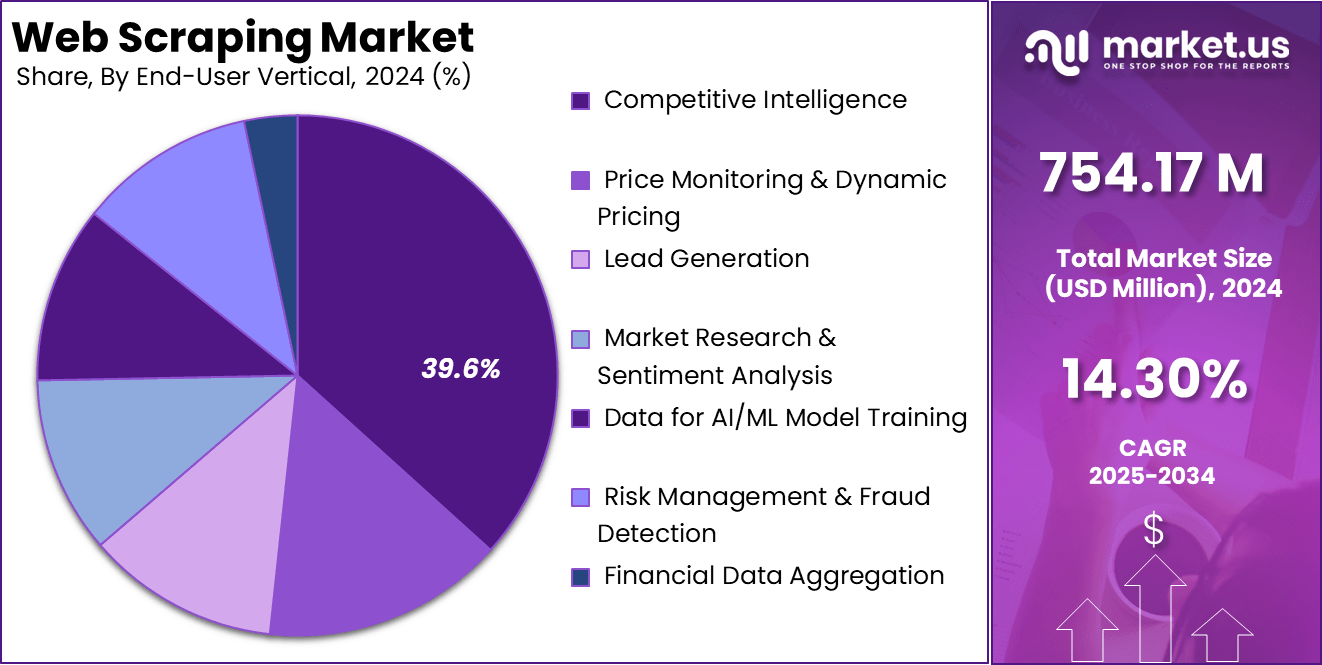
- By End-User Vertical, Retail & E-commerce dominated with 36.7% share, fueled by rising online retail activities, personalized marketing needs, and data-driven pricing intelligence initiatives.
Analysts’ Viewpoint
Analysts observe that the web-scraping market is entering a phase of maturation, where the initial surge of adoption is giving way to a deeper focus on scalability, compliance, and value creation. Firms note that while many organizations have already deployed basic scraping tools for tasks such as price monitoring and competitor benchmarking, the next wave involves embedding these capabilities into real-time data pipelines, machine learning models, and decision-making systems.
Another key vantage point points to rising regulatory, ethical, and operational headwinds. With stronger data protection laws and websites deploying anti-scraping mechanisms, companies must invest in “compliant scraping” infrastructure—tools that respect robot protocols, rate limits, and data licensing agreements.
Finally, analysts emphasise that the competitive differentiation will shift from simply extracting data to leveraging it. In other words, the value lies increasingly in real-time insights, predictive analytics, and business outcomes derived from scraped data, rather than the volume of raw data alone. This dynamic suggests that vendors offering integrated platforms combining scraping, cleansing, analytics, and visualization will be best positioned.
Role of AI
- Adaptive extraction engines: Traditional scrapers use hard‐coded rules (CSS selectors, XPaths) that often break when websites change. AI models (e.g., machine learning, computer‐vision modules) can “learn” page patterns and adjust to layout or structure changes automatically, making scraping far more robust.
- Improved data quality & processing: AI enhances data accuracy by filtering noise, recognising meaningful entities, and cleaning irregularities (e.g., using NLP to interpret textual content and extract relevant fields).
- Scalability and speed: With AI, scraping systems can handle larger volumes of webpages, respond in near real‐time, and process dynamic content (including JavaScript‐heavy sites) more efficiently than older methods.
- Insight‐driven transformation: AI doesn’t just extract data—it helps derive insights. Combined with analytics, AI‐augmented scraping helps businesses move from raw extraction to actionable intelligence (market trends, sentiment, competitor intelligence).
- Automation of anti‐bot and proxy management: Some advanced AI systems manage browser sessions, detect blocks or CAPTCHA, throttle requests, select proxies intelligently, and thus sustain large‐scale scraping without constant human intervention.
Why This Matters
- Because AI increases the reliability, speed, and value of scraping solutions, it supports the growth rate in the market (CAGR, adoption across industries).
- The ability to handle complex websites and large volumes makes scraping viable for more sectors (retail/e-commerce, finance, travel, etc.) and for real-time applications—thus expanding the market breadth.
- Vendors and service providers that incorporate AI capabilities (rather than traditional rule‐based tools) are likely to gain a competitive edge, aligning with the market’s shift toward integrated offerings (scraping + cleansing + analytics).
- From a region/vertical standpoint, technologically advanced markets (such as North America) are more likely to adopt these AI‐powered scraping tools, reinforcing their market dominance.
AI Industry Adoption
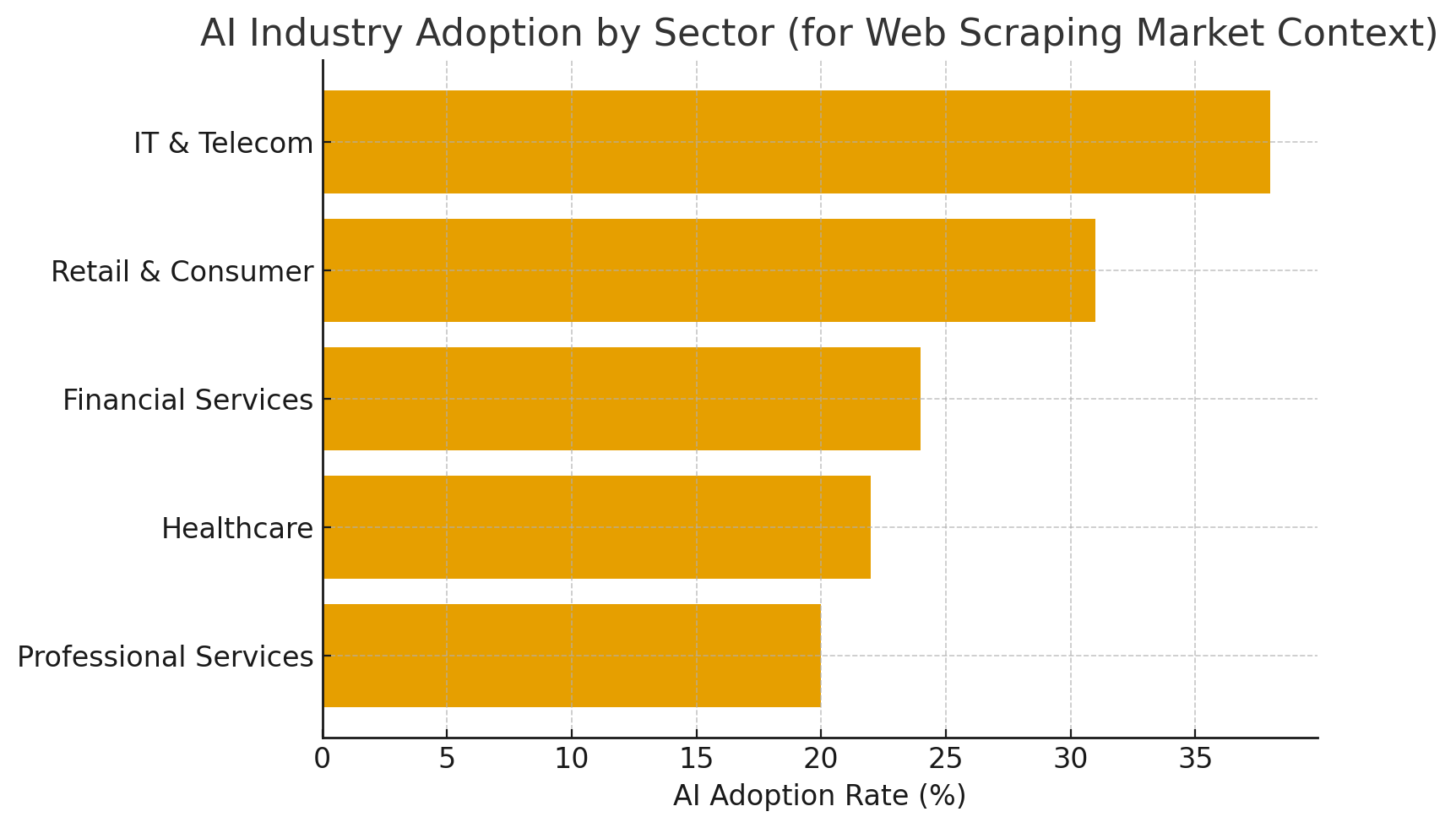
Industry adoption of artificial intelligence (AI) is rapidly gaining momentum across sectors, heralding a substantial transformation in how businesses operate and generate value. According to recent global surveys, roughly 77% of companies are either using or exploring AI technologies, with 63% intending to adopt AI in the next three years. In specific industry verticals, the pace varies: IT & Telecom leads with about a 38% adoption rate, followed by Retail & Consumer at 31%, Financial Services at 24%, and Healthcare at 22%.
The drivers behind this surge include the ability of AI to unlock productivity gains, enhance decision-making through advanced analytics, and automate repetitive tasks—shifting business processes from rule-based regimes to data-intensive, agile frameworks. For instance, enterprises investing in AI report that just 1% consider themselves fully mature in AI deployment—highlighting that while adoption is wide, true scaling is still nascent.
However, adoption is not without its challenges. Organizational readiness, talent gaps, leadership buy-in, and ethical and regulatory issues remain significant obstacles. As companies move from pilot to production, success hinges on aligning AI with business strategy, ensuring governance frameworks are robust, and building scalable infrastructure. Overall, the industry perspective paints AI as a strategic imperative—one that promises far-reaching impact—but also one that demands careful orchestration to fully realise its potential.
Emerging trends
The web scraping market is witnessing several emerging trends that are redefining how organizations collect and utilize data. One of the most prominent shifts is the integration of artificial intelligence and machine learning, which enables scraping tools to automatically adapt to changing website structures, extract complex data formats, and improve accuracy.
This trend is enhancing the efficiency and scalability of data extraction processes across industries. Another major development is the growing emphasis on ethical and compliant data scraping. With evolving data privacy regulations such as GDPR and CCPA, companies are increasingly focusing on transparent, permission-based scraping practices to ensure responsible data use and avoid legal risks.
The market is also experiencing the rise of no-code and low-code scraping platforms, which democratize access to data collection by allowing non-technical users to perform complex scraping tasks with minimal programming effort. This is expanding the user base from specialized IT teams to business and marketing professionals.
Furthermore, the shift toward real-time and high-velocity data extraction is enabling businesses to access up-to-date information for faster decision-making, especially in areas like pricing optimization and social sentiment analysis. Additionally, regionalization and infrastructure scaling, supported by cloud deployment and proxy networks, are helping vendors handle large-scale, cross-border data operations efficiently.
US Market Size
The US web scraping market is projected to experience steady expansion over the next decade, reflecting the country’s growing reliance on data-driven business intelligence and automation. Valued at USD 286.51 million in 2024, the market is expected to reach approximately USD 930.39 million by 2034, registering a compound annual growth rate of 12.5%.
This growth trajectory highlights the increasing adoption of advanced web scraping tools across industries such as e-commerce, finance, real estate, and digital marketing. Companies are leveraging these technologies to gather real-time data for competitive analysis, price monitoring, sentiment tracking, and strategic decision-making.
The relatively mature nature of the US market means that growth is now being driven more by technological advancements and compliance-oriented innovation rather than first-time adoption. The integration of AI and machine learning into scraping platforms is enhancing automation, while growing emphasis on ethical and regulation-compliant data collection aligns with evolving privacy frameworks like GDPR and CCPA.
Demand for cloud-based, scalable scraping solutions is also rising, as enterprises seek to process vast amounts of unstructured data efficiently. Overall, the US remains a major hub for innovation in the web scraping landscape, setting technological and ethical benchmarks that shape global market evolution.
Investment and Business Benefit
Investment in artificial intelligence within the web scraping market is rapidly expanding as organizations recognize its potential to transform data collection into a strategic business asset. Companies are increasingly allocating resources toward AI-driven scraping platforms that combine automation, predictive analytics, and natural language processing to extract and interpret data efficiently.
These investments not only reduce manual workload and operational costs but also enable faster and more accurate data gathering from dynamic websites and social platforms. Businesses that embrace AI-enhanced web scraping gain a competitive advantage through real-time market insights, allowing them to make informed decisions on pricing, product development, and customer engagement.
From a business benefit perspective, AI integration has elevated web scraping from a simple data extraction tool to a key enabler of intelligent automation. Firms can now derive actionable insights from large, unstructured datasets and identify emerging market trends ahead of competitors.
Moreover, AI-powered scraping improves compliance management by detecting data access restrictions and ensuring ethical data practices. The return on investment is seen not only in increased efficiency and cost savings but also in the strategic ability to anticipate consumer behavior, optimize operations, and innovate faster. This shift marks a fundamental transformation in how organizations leverage external web data for business growth.
By Component
The software segment accounted for the dominant share of 61.3% in the web scraping market in 2024, driven by the increasing adoption of automated, AI-enabled scraping tools that allow businesses to extract and process vast amounts of data efficiently. Within this segment, cloud-based software solutions are gaining strong traction due to their scalability, flexibility, and cost-effectiveness.
Cloud deployment enables seamless data access, integration with analytics platforms, and real-time updates, making it the preferred choice for enterprises that rely on continuous data extraction across multiple sources. On-premises solutions, while gradually declining in share, continue to find relevance among organizations prioritizing data security, internal control, and compliance with strict regulatory standards.
The services segment, comprising professional services and managed services, supports the growing need for customized solutions and operational expertise. Professional services include consulting, integration, and training offerings that help organizations deploy and optimize scraping tools tailored to specific business needs.
Managed services, on the other hand, provide end-to-end data management, monitoring, and maintenance, ensuring uninterrupted scraping operations with minimal in-house effort. The rising complexity of web data structures and demand for regulatory compliance are pushing enterprises to increasingly rely on service providers, reinforcing the synergy between software deployment and specialized support solutions.
By Application
The price monitoring and dynamic pricing segment accounted for 25.8% of the web scraping market in 2024, making it one of the leading application areas. The segment’s growth is primarily driven by the widespread adoption of data intelligence strategies among e-commerce, retail, and travel companies that depend on real-time competitor insights to optimize pricing and improve profit margins.
Web scraping tools enable businesses to automatically track competitor prices, discounts, product availability, and consumer demand patterns across thousands of online platforms. This information supports dynamic pricing models that adjust prices in response to market conditions, customer preferences, and inventory fluctuations, resulting in better revenue management and enhanced competitiveness.
Alongside this, other emerging applications are contributing to the broader adoption of web scraping technologies. Competitive intelligence uses scraping to analyze rivals’ offerings and performance trends. Lead generation leverages extracted data for targeted sales outreach, while market research and sentiment analysis utilize it to assess brand perception and consumer behavior.
Data for AI/ML model training is increasingly sourced through scraping, enabling algorithms to learn from diverse, real-world datasets. Additionally, risk management and fraud detection, as well as financial data aggregation, are gaining importance as businesses rely on continuous data extraction to monitor market risks, compliance, and investment patterns.
By End-User Vertical
The retail and e-commerce segment accounted for 36.7% of the web scraping market in 2024, emerging as the largest end-user vertical. This dominance is attributed to the growing dependence of online retailers and marketplaces on real-time data for price optimization, competitor tracking, and consumer behavior analysis.
Web scraping plays a pivotal role in enabling e-commerce companies to monitor rival pricing strategies, track product availability, analyze customer reviews, and enhance personalized recommendations. With the rise of omnichannel retail and AI-driven marketing, retailers are leveraging scraped data to refine their dynamic pricing models, improve customer engagement, and strengthen supply chain visibility. The growing competition among global and regional e-commerce platforms continues to drive heavy investment in automated data collection systems.
Beyond retail, other verticals are also expanding their use of web scraping. Financial services and banking employ scraping for market intelligence, investment analysis, and fraud detection. Marketing and advertising sectors use it to gather audience insights and assess campaign effectiveness. Travel and hospitality firms depend on scraping for price comparison, sentiment monitoring, and demand forecasting.
In real estate, data extraction supports property valuation and rental trend analysis, while manufacturing utilizes it for supplier tracking and demand estimation. Collectively, these sectors highlight the diverse and strategic utility of web scraping in driving data-informed decision-making.
Key Market Segments
By Component
- Software
- Cloud-based
- On-Premises
- Services
- Professional Services
- Managed Services
By Application
- Competitive Intelligence
- Price Monitoring & Dynamic Pricing
- Lead Generation
- Market Research & Sentiment Analysis
- Data for AI/ML Model Training
- Risk Management & Fraud Detection
- Financial Data Aggregation
By End-User Vertical
- Retail & E-commerce
- Financial Services & Banking
- Marketing & Advertising
- Travel & Hospitality
- Real Estate
- Manufacturing
- Others
Regional Analysis
North America accounted for 42.4% of the global web scraping market in 2024, making it the leading regional contributor with a market size of approximately USD 319.76 million. The region’s dominance is supported by a mature digital infrastructure, high adoption of cloud-based technologies, and a strong ecosystem of data analytics and AI-driven enterprises.
Businesses across industries such as e-commerce, financial services, and digital marketing are increasingly deploying advanced web scraping tools to automate data collection and enhance market intelligence. The presence of major technology players and startups specializing in data aggregation, machine learning, and API-based scraping solutions further reinforces the region’s leadership position.
The United States remains the core growth engine within North America, supported by widespread digital transformation initiatives, a strong focus on predictive analytics, and the growing use of data-driven business models. The region is also witnessing increasing demand for compliant and secure scraping practices due to evolving data protection regulations.
Companies are investing heavily in ethical scraping frameworks to balance innovation with privacy standards. Moreover, the expansion of AI and big data analytics is expected to further accelerate adoption, making North America a hub for innovation and technological advancement in the global web scraping landscape.
Regional Analysis and Coverage
- North America
- US
- Canada
- Europe
- Germany
- France
- The UK
- Spain
- Italy
- Russia
- Netherlands
- Rest of Europe
- Asia Pacific
- China
- Japan
- South Korea
- India
- Australia
- Singapore
- Thailand
- Vietnam
- Rest of Latin America
- Latin America
- Brazil
- Mexico
- Rest of Latin America
- Middle East & Africa
- South Africa
- Saudi Arabia
- UAE
- Rest of MEA
Driving Factors
The rapid digital transformation across industries is one of the primary driving factors for the web scraping market. Organizations are increasingly depending on automated data collection tools to extract, organize, and analyze information from multiple online sources for business intelligence. The growing need for real-time insights in areas such as competitive pricing, consumer sentiment, and market forecasting has accelerated the adoption of web scraping solutions.
The integration of artificial intelligence and machine learning has further enhanced the capability of these tools, allowing them to handle complex and dynamic web structures efficiently. In addition, the rise of e-commerce and digital marketing activities is fueling demand for data-driven decision-making, where scraping plays a critical role in tracking consumer trends and optimizing operations. Enterprises are also leveraging web scraping for fraud detection, risk management, and financial analytics, demonstrating its strategic importance in modern business ecosystems.
Restraint Factors
Despite strong growth potential, the web scraping market faces significant restraints, primarily centered around legal, ethical, and regulatory challenges. Data privacy laws such as the GDPR, CCPA, and other regional frameworks impose strict limitations on data collection, processing, and storage, creating compliance risks for companies using large-scale scraping operations.
Many websites employ anti-scraping mechanisms like CAPTCHA, IP blocking, and bot-detection tools, which increase operational complexity and restrict data accessibility. Additionally, the ambiguity surrounding intellectual property rights and the ownership of scraped data has created legal uncertainties for enterprises.
Smaller organizations often find it difficult to invest in the advanced infrastructure and proxy networks required for secure and scalable scraping operations. Moreover, excessive reliance on third-party scraping vendors may expose companies to data quality issues and cybersecurity risks, limiting the market’s ability to achieve its full growth potential.
Growth Opportunities
The growing demand for structured and actionable web data presents vast growth opportunities for the web scraping market. Businesses are recognizing the value of integrating web scraping with AI, cloud computing, and big data analytics to drive predictive insights and operational efficiency. Expanding applications in sectors such as finance, healthcare, travel, and real estate are opening new avenues for innovation.
The rise of low-code and no-code platforms allows non-technical professionals to perform complex scraping tasks, broadening the market’s accessibility and end-user base. Additionally, the surge in demand for data for AI and machine learning model training creates an emerging opportunity, as companies require diverse and continuously updated datasets.
With the increasing shift toward digital commerce and online customer engagement, real-time data extraction for personalization, trend forecasting, and product intelligence is expected to be a major revenue driver. Furthermore, the development of region-specific, compliant scraping solutions offers vendors the chance to differentiate themselves through transparency, security, and legal adherence.
Challenging Factors
The web scraping market faces several challenges that could hinder its scalability and adoption. A key challenge lies in maintaining data accuracy and consistency when extracting from unstructured or frequently changing web sources. Many websites alter their layouts, making scrapers prone to breaking and requiring constant maintenance.
The growing use of anti-bot technologies and paywalled content adds further barriers, forcing developers to invest in advanced crawling frameworks and proxy management. Another major challenge is the evolving legal landscape, where varying international data protection laws complicate cross-border data scraping operations. Ethical concerns regarding data ownership, user consent, and responsible data use also pose reputational risks for enterprises.
Moreover, as the volume of web data continues to grow exponentially, managing storage, processing speed, and computational costs becomes a major operational hurdle. The shortage of skilled professionals capable of designing compliant, high-performance scraping systems adds to the market’s constraints, emphasizing the need for automation, governance frameworks, and standardized practices to sustain long-term growth.
Competitive Analysis
The competitive landscape of the web scraping market is highly fragmented, featuring a mix of established global players and specialized niche providers. Bright Data Ltd. leads the market with its extensive proxy network and end-to-end data collection infrastructure, offering solutions designed for enterprise-scale deployments and strong compliance with GDPR and CCPA regulations.
Zyte Group Ltd., formerly Scrapinghub, focuses on AI-driven scraping automation, providing advanced capabilities for dynamic website extraction and integrated unblocking services that appeal to developers and large-scale users. Apify Technologies s.r.o. and Octopus Data, Inc. emphasize no-code and low-code scraping environments, catering to businesses seeking simplified data collection without heavy technical expertise.
Import.io Ltd. and PhantomBuster SAS specialize in API-based extraction and automation for marketing, social media, and business intelligence applications, while Diffbot Technologies Corp. leverages machine learning for knowledge graph creation and structured data extraction.
Companies such as Mozenda, Sequentum International, ScrapeHero, ParseHub, and Oxylabs are expanding through customized solutions and managed services targeting specific verticals like e-commerce, finance, and travel.
Emerging players, including DataWeave, PromptCloud, and Actowiz Solution, focus on scalable, cloud-based scraping and competitive intelligence offerings. Overall, the competition is shaped by innovation in AI integration, compliance management, proxy efficiency, and the ability to deliver high-quality, real-time, and ethically sourced data to clients worldwide.
Top Key Players in the Market
- Bright Data Ltd.
- Zyte Group Ltd.
- Apify Technologies s.r.o.
- Octopus Data, Inc.
- Import.io Ltd.
- PhantomBuster SAS
- Diffbot Technologies Corp.
- Mozenda, Inc.
- Sequentum International Pty Ltd
- ScrapeHero LLC
- ParseHub Inc.
- UAB Oxylabs
- DataWeave Pvt Ltd
- PromptCloud Technologies Pvt Ltd
- ScrapingAnt OU
- DataHen Inc.
- Actowiz Solutions LLC
- PilotFish Technology LLC
- Datopian Ltd.
- Newprosoft LLC
- Smartproxy Ltd.
- Datafiniti LLC
- CrawlingAPI LLC
- Bright Data Labs Ltd.
- Others
Major Developments
- October 21, 2025: Bright Data Ltd. announced a partnership with Dify to launch a new Web Scraper extension on the Dify Marketplace. The plug-in enables direct access to real-time, structured web data, integrating Bright Data’s enterprise-grade scraping infrastructure into the Dify ecosystem.
- February 12, 2025: Zyte Group Ltd. released its 2025 Web Scraping Industry Report titled “Surviving the Shifts”, which highlights how AI-powered scraping is transforming the market and places increasing emphasis on ethical and compliant data extraction practices.









