


Report Overview
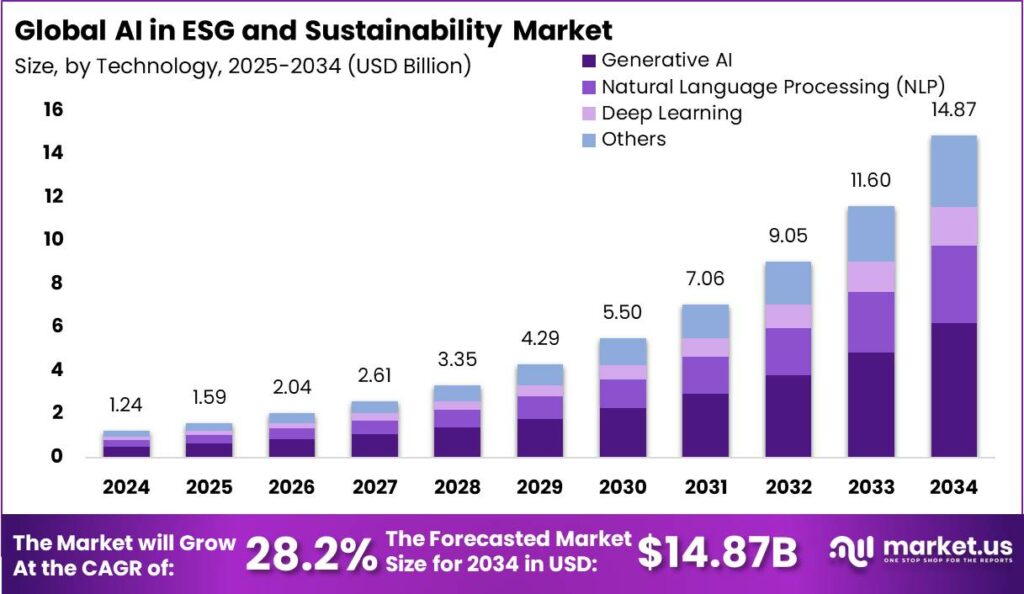
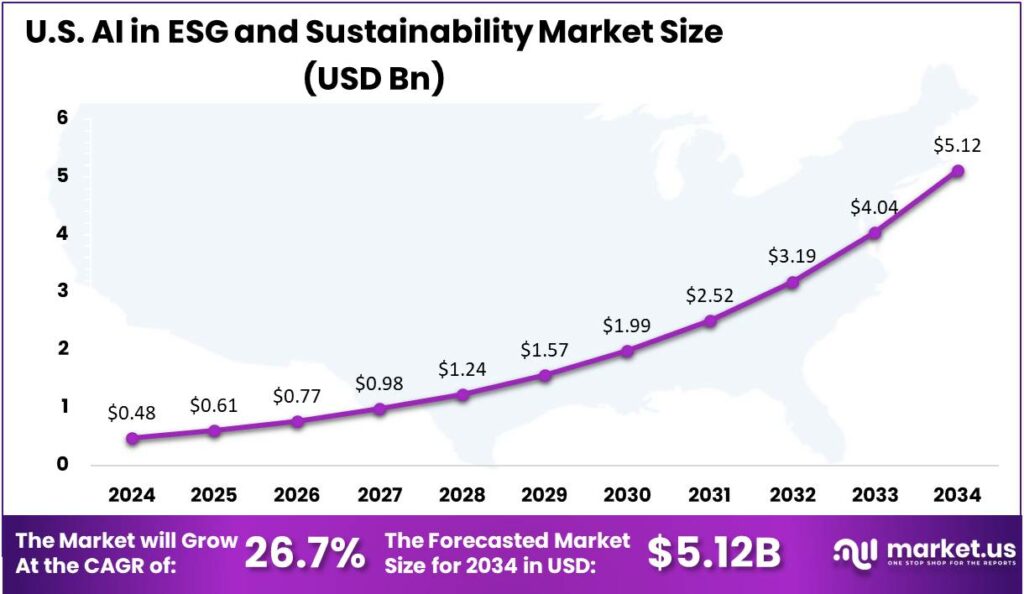
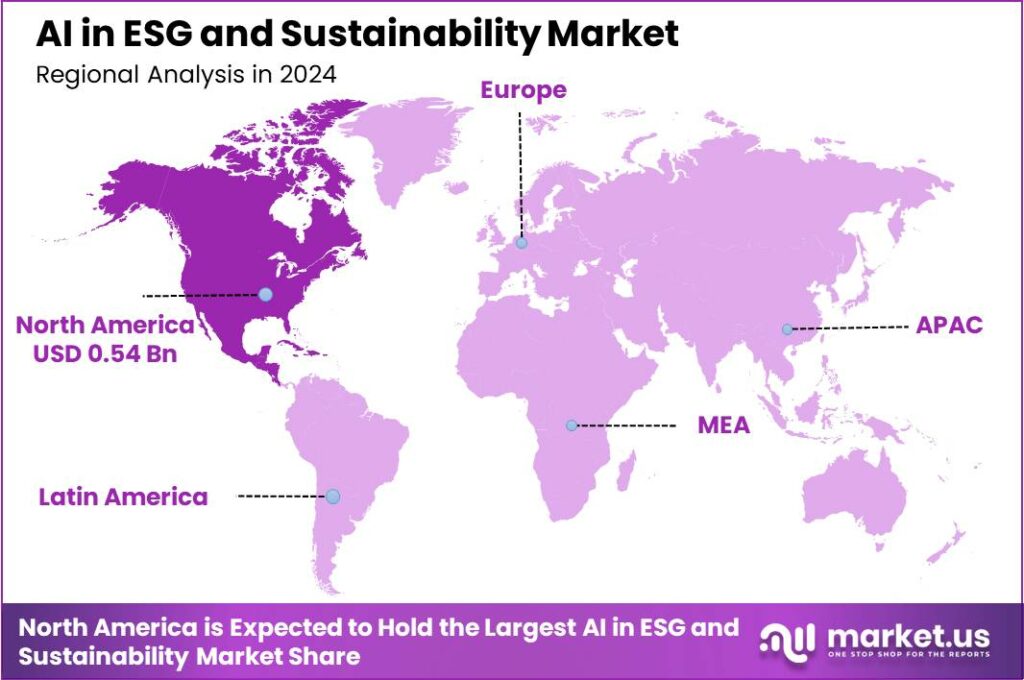
The Global AI in ESG and Sustainability Market size is expected to be worth around USD 14.87 Billion By 2034, from USD 1.24 Billion in 2024, growing at a CAGR of 28.20% during the forecast period from 2025 to 2034. In 2024, North America led the AI in ESG and Sustainability market with a 43.8% share, generating around USD 0.54 billion. The U.S. market alone was valued at USD 0.48 billion and is projected to grow at a CAGR of 26.7%, indicating substantial future expansion.
AI in ESG and sustainability leverages artificial intelligence to help organizations improve their environmental, social, and governance practices. By analyzing large volumes of data from reports, climate models, and supply chains, AI generates insights for transparent reporting, risk management, sustainable investments, and compliance.
Key drivers accelerating AI adoption in ESG and sustainability include regulatory frameworks like the EU SFDR and U.S. SEC climate mandates, which enhance ESG data transparency and compliance. Growing investor pressure, especially from institutional funds focused on ESG performance, is also driving demand for AI-driven sustainability solutions.
The growing volume of ESG data from satellites, IoT, financial disclosures, and social media exceeds manual analysis, making AI essential for real-time processing. AI enables corporations to assess climate risks, predict sustainability, and improve efficiency, leading to cost savings, stronger brand value, and faster industry adoption.
According to Market.us’s research, The Global Environmental, Social, and Governance (ESG) Consulting Market is projected to reach approximately USD 39 Billion by 2034, rising from USD 8.12 Billion in 2024, at a robust CAGR of 16.90% during 2025–2034. In 2024, North America dominated the global landscape, accounting for over 42.15% of the total market share, with revenue exceeding USD 3.4 Billion.
AI’s growing popularity in the ESG domain is particularly evident in high-complexity, highly regulated sectors like finance, manufacturing, and energy. It enhances ESG reporting and compliance by streamlining data analysis, improving efficiency, and boosting credibility with stakeholders. As organizations see the tangible benefits of AI in meeting sustainability goals, its adoption is becoming a key part of corporate strategy.
Investment opportunities in the AI-driven ESG and Sustainability sector are expanding, with venture capital and institutional investors increasingly funding startups and technologies that offer innovative solutions for sustainability challenges. This investment trend reflects a growing recognition of the financial and societal benefits associated with integrating AI into ESG frameworks.
The regulatory environment surrounding ESG and Sustainability is becoming increasingly stringent, with governments and international bodies implementing policies that mandate comprehensive ESG reporting and accountability. AI technologies assist organizations in navigating these regulatory landscapes by automating compliance processes and ensuring adherence to evolving standards.
Key Takeaways
- The Global AI in ESG and Sustainability Market is projected to reach approximately USD 14.87 Billion by 2034, growing from USD 1.24 Billion in 2024, at a compound annual growth rate (CAGR) of 28.20% during the forecast period from 2025 to 2034.
- In 2024, the Generative AI segment dominated the AI in ESG and Sustainability market, holding more than 41.8% of the market share.
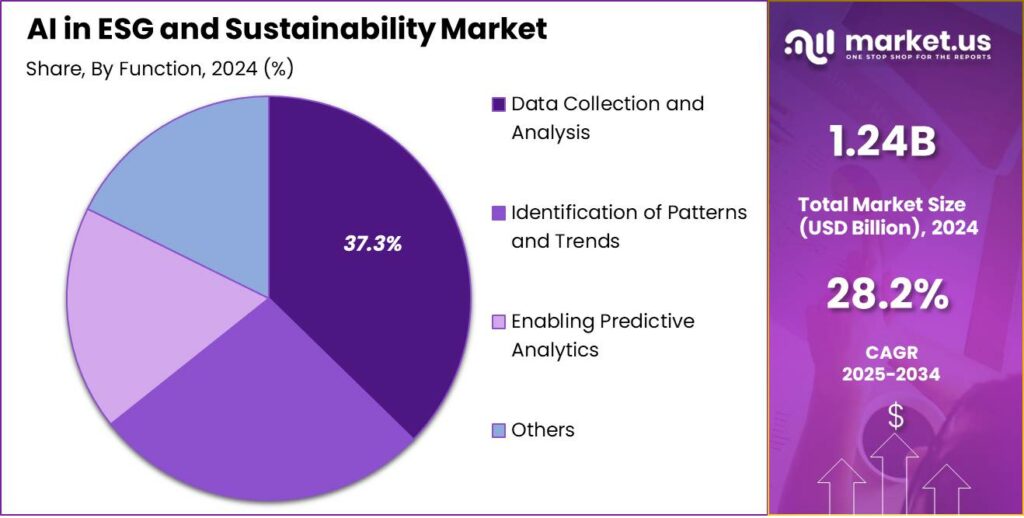
- The Data Collection and Analysis segment also held a dominant position in 2024, capturing over 37.3% of the AI in ESG and Sustainability market share.
- The Building & Construction segment led the market in 2024, accounting for more than 31.7% of the market share.
- North America held a dominant market position in the AI in ESG and Sustainability sector in 2024, with more than 43.8% of the market share and generating approximately USD 0.54 billion in revenue.
- The U.S. Artificial Intelligence (AI) in ESG and Sustainability market was valued at about USD 0.48 billion in 2024 and is expected to grow at a CAGR of 26.7%, signaling significant expansion in the coming years.
AI Impact
- Enhancement of ESG Reporting: AI facilitates the collection, processing, and analysis of vast ESG-related data, leading to more accurate and timely reporting. By automating data validation and identifying inconsistencies, AI improves the reliability of sustainability disclosures.
- Risk of Data Bias and Inaccuracy: The effectiveness of AI in ESG applications depends on the quality of input data. Poor or biased data can lead to inaccurate analyses and flawed recommendations, undermining ESG goals. Ensuring data integrity is vital to avoid reinforcing biases and maintain trustworthy AI insights.
- Environmental Footprint of AI Technologies: The deployment of AI technologies entails significant energy and water consumption, contributing to environmental concerns. Training and operating large AI models require substantial computational resources, leading to increased greenhouse gas emissions and water usage.
- Potential to Advance Climate Solutions: Despite its environmental costs, AI can help tackle climate challenges by optimizing energy use, enhancing renewable integration, and improving climate modeling. Through better resource management and predictive analytics, AI can reduce emissions and support climate resilience.
- Challenges in Governance and Accountability: Integrating AI into ESG frameworks raises concerns about governance, transparency, and accountability. Automated decisions can obscure reasoning, making oversight challenging. Clear governance structures and ethical guidelines are essential for responsible AI use in sustainability.
U.S. Market Analysis
In 2024, the U.S. Artificial Intelligence (AI) in ESG and Sustainability market was valued at approximately USD 0.48 billion, highlighting the growing adoption of AI-driven solutions to enhance environmental, social, and governance (ESG) practices.
The U.S. market is projected to expand at a compound annual growth rate (CAGR) of 26.7% from 2025 onward, indicating a rapidly accelerating demand for advanced, AI-integrated ESG solutions across industries. This growth is driven by rising ESG mandates from federal agencies, the SEC’s push for ESG disclosures, and Wall Street’s focus on sustainable finance.
Additionally, the growing influence of institutional investors and ESG-focused funds is pushing enterprises to integrate AI tools for predictive analytics, ESG scoring, and automated compliance tracking. AI is particularly being utilized by financial institutions to screen investment portfolios for sustainability risks, helping investors make informed decisions aligned with long-term climate goals.
U.S. tech companies and sustainability startups are developing AI platforms for carbon accounting, biodiversity monitoring, and labor auditing. Sectors like energy, manufacturing, retail, and finance are integrating AI into ESG strategies for a competitive edge. As corporate America prioritizes climate resilience and social responsibility, the U.S. AI market for ESG and sustainability will shift from a compliance tool to a strategic enabler of responsible growth.
In 2024, North America held a dominant market position in the AI in ESG and Sustainability sector, capturing more than a 43.8% share and generating approximately USD 0.54 billion in revenue. This leadership stems from North America’s early adoption of advanced technologies, a strong regulatory push for ESG compliance, and a robust digital infrastructure.
The U.S. leads North America in AI-driven ESG solutions, backed by federal initiatives on climate disclosure, carbon neutrality, and corporate governance. American companies use AI to automate ESG reporting, track environmental impact, and drive sustainability strategies. The presence of major AI firms and cloud providers boosts this growth, enabling wide adoption of ESG analytics across industries.
Institutional investors in North America are driving demand for real-time ESG disclosures, pushing large investment firms and asset managers to use AI platforms to optimize sustainability portfolios. AI’s ability to analyze satellite data, monitor supply chains, and predict climate risks is crucial for long-term ESG performance.
Canada’s focus on net-zero emissions and sustainable finance is driving Canadian companies to integrate AI for meeting ESG targets and aligning with global frameworks like TCFD. Supported by favorable policies, technological readiness, and investor demand, North America provides a strong ecosystem for AI-based ESG solutions. With the ongoing push for green transformation, the region is poised to maintain its leadership in the coming decade.
Technology Analysis
In 2024, Generative AI segment held a dominant market position, capturing more than a 41.8% share in the AI in ESG and Sustainability market. This leadership can be primarily attributed to its ability to generate comprehensive ESG reports, simulate future sustainability scenarios, and create synthetic data for ESG model training.
The growing need for automated ESG reporting has driven the widespread adoption of generative AI across industries. Companies, facing pressure to produce high-quality disclosures, often lack the expertise for manual reporting. Generative AI converts structured metrics and unstructured data into cohesive, investor-ready ESG reports, saving time and ensuring consistency and transparency key for building trust.
Generative AI aids in scenario planning and climate risk modeling, crucial for long-term sustainability. It simulates climate impacts, supply chain disruptions, and governance risks, helping decision-makers evaluate resilience strategies and create data-driven sustainability roadmaps. Its flexibility and predictive power support organizations in staying agile and compliant as ESG frameworks evolve.
Generative AI is increasingly integrated into ESG platforms, helping users draft compliance documents, sustainability proposals, and automated stakeholder responses. This boosts operational efficiency and reduces costs, making ESG more accessible to mid-sized enterprises. As the market evolves, generative AI will remain a key driver in ESG digital transformation.
Function Analysis
In 2024, the Data Collection and Analysis segment held a dominant market position, capturing more than a 37.3% share in the AI in ESG and Sustainability market. This dominance is largely driven by the urgent need for real-time, accurate, and transparent ESG data among organizations that are under growing pressure from investors, regulators, and customers.
Companies today are expected to demonstrate their environmental and social performance in measurable ways, and AI-powered data collection systems provide that foundational layer. These tools enable automated extraction of ESG metrics from structured and unstructured sources like CSR reports, satellite imagery, sensor data, and public disclosures, allowing firms to establish a credible baseline for sustainability reporting.
AI-based data analysis tools are essential for firms to process large, fragmented datasets across operations, suppliers, and geographies. These tools transform raw sustainability data into actionable insights, helping companies identify inefficiencies and gaps in their ESG initiatives, and better align with net-zero goals, diversity benchmarks, and compliance targets.
The segment’s leadership also stems from its role in enhancing transparency and accountability—two pillars of ESG credibility. AI systems are increasingly used to validate claims, spot anomalies in reporting, and reduce greenwashing risks by identifying inconsistent disclosures. With institutional investors embedding ESG metrics into portfolio decisions, the demand for trustworthy, AI-curated sustainability data is growing rapidly.
Industry Vertical Analysis
In 2024, the Building & Construction segment held a dominant market position in the AI in ESG and Sustainability market, capturing more than a 31.7% share. AI is increasingly being used in construction planning and materials optimization, helping developers assess the environmental footprint of building projects.
A significant factor contributing to the dominance of this segment is the integration of AI with smart building technologies. AI is enabling real-time tracking of water usage, temperature regulation, air quality, and occupancy patterns, ensuring compliance with ESG goals while reducing operational costs. These innovations not only align with sustainability frameworks but also improve the long-term asset value of real estate properties.
The pressure from governments and green financing institutions has also accelerated the adoption of AI in this vertical. Infrastructure projects backed by public-private partnerships and sustainability-linked bonds are now often contingent on measurable ESG impact, pushing stakeholders to embrace AI-driven reporting and predictive analytics.
The construction industry, a major contributor to material consumption and carbon output, is a key focus for decarbonization. AI solutions for lifecycle assessment, resource efficiency, and sustainability scoring are gaining traction, especially in large infrastructure projects. As ESG compliance becomes integral to building codes, the construction sector is set to remain a leader in the AI for ESG and sustainability market.
Key Market Segments
By Technology
- Deep Learning
- Natural Language Processing (NLP)
- Generative AI
- Others
By Function
- Data Collection and Analysis
- Identification of Patterns and Trends
- Enabling Predictive Analytics
- Others
By Industry Vertical
- Building & Construction
- Agriculture
- Food & Beverage
- Oil & Gas
- Mining
- Chemicals
- Others
Key Regions and Countries
- North America
- US
- Canada
- Europe
- Germany
- France
- The UK
- Spain
- Italy
- Rest of Europe
- Asia Pacific
- China
- Japan
- South Korea
- India
- Australia
- Singapore
- Rest of Asia Pacific
- Latin America
- Brazil
- Mexico
- Rest of Latin America
- Middle East & Africa
- South Africa
- Saudi Arabia
- UAE
- Rest of MEA
Driver
Enhancing ESG Data Accuracy and Decision-Making
Artificial Intelligence (AI) significantly enhances Environmental, Social, and Governance (ESG) initiatives by improving data accuracy and decision-making processes. Traditional ESG reporting often grapples with fragmented data sources and manual data collection, leading to inconsistencies and inefficiencies.
AI addresses these challenges by automating data aggregation from diverse sources such as satellite imagery, social media, and corporate disclosures. This automation ensures real-time monitoring and more accurate assessments of ESG metrics.
AI can enhance ESG frameworks by analyzing satellite data for deforestation and carbon emissions, detecting labor rights violations, and monitoring compliance through pattern recognition. This proactive approach helps organizations identify issues early, improve sustainability performance, and build stakeholder trust through transparent reporting. AI-driven insights also support strategic decisions, aligning operations with sustainability goals and regulations.
Restraint
Environmental Impact of AI Technologies
AI offers significant benefits for ESG initiatives, but its environmental footprint is a concern. Developing large-scale AI models requires substantial computational power, increasing energy consumption and carbon emissions. Data centers, often powered by non-renewable energy, further exacerbate these environmental challenges.
Training large AI models can emit significant CO2 and strain natural resources through water-intensive cooling systems, potentially undermining sustainability goals. To address this, companies should invest in energy-efficient hardware, optimize algorithms for lower energy use, and transition to renewable energy for data centers. Incorporating environmental impact assessments into AI development ensures sustainability remains a priority.
Opportunity
Advancing Sustainable Supply Chain Management
AI offers a transformative opportunity for sustainable supply chain management within ESG frameworks. By analyzing vast datasets, AI can map complex supply chains, enhancing transparency and identifying issues like carbon footprints, labor violations, and resource inefficiencies. This enables more informed decision-making and supports efforts to improve environmental and social impacts.
Machine learning algorithms help companies predict disruptions, optimize logistics, and ensure environmental compliance. AI can accurately forecast demand, reducing overproduction and waste, while monitoring suppliers for ethical labor standards and environmental policies. AI-driven supply chain analytics support sustainability goals, reduce risks, enhance brand reputation, and boost stakeholder confidence.
Challenge
Ensuring Ethical Use and Governance of AI in ESG
A critical challenge in integrating AI into ESG practices is ensuring ethical use and robust governance. AI systems, if not properly managed, can perpetuate biases, infringe on privacy, and make opaque decisions that are difficult to audit. These issues pose significant risks to the social and governance aspects of ESG.
AI systems trained on biased data can lead to discriminatory outcomes, while lack of transparency and poor data protection may erode trust and violate privacy. To address these challenges, clear governance frameworks are needed, including accountability, transparency, and regular audits. Engaging diverse stakeholders and continuously updating practices ensures ethical standards align with evolving risks and societal expectations.
Emerging Trends
Artificial Intelligence (AI) is increasingly shaping ESG strategies, revolutionizing how organizations pursue sustainability. A key trend is AI-driven ESG reporting, where real-time data processing and analysis help companies efficiently detect risks and uncover opportunities.
Another development is the application of AI in supply chain management. AI tools can assess supplier practices, ensuring compliance with environmental standards and ethical labor practices. This not only mitigates risks but also promotes transparency and accountability within the supply chain .
AI is also helping organizations optimize energy use and cut carbon emissions. Machine learning analyzes usage patterns to suggest efficiency improvements, promoting greener operations. Additionally, AI supports biodiversity conservation by monitoring wildlife data and detecting illegal activities like poaching, enabling more effective protection efforts.
Business Benefits
AI optimizes resource usage by identifying inefficiencies in operations, leading to cost savings. For instance, it can suggest ways to reduce energy consumption or minimize waste. This not only lowers operational costs but also supports environmental sustainability efforts.
Transparent and accurate ESG reporting, facilitated by AI, builds trust among stakeholders, including investors, customers, and regulators. Demonstrating a commitment to sustainability can enhance a company’s reputation and competitiveness. This trust is crucial for long-term business success and stakeholder engagement.
AI analyzes complex ESG data to offer actionable insights, enhancing decision-making and helping companies align with sustainability goals. By identifying inefficiencies, AI optimizes resource use, reduces costs, and supports environmental sustainability, such as cutting energy consumption and minimizing waste. This fosters more responsible and effective business practices.
Key Player Analysis
Workiva is a leading name in ESG reporting. Known for its cloud-based platform, Workiva helps companies collect, manage, and report ESG data with accuracy and compliance. It supports integrated financial and non-financial reporting, making ESG easier for both small and large organizations. Its strong presence in regulatory reporting also adds a layer of trust for investors.
Briink stands out for using AI to simplify ESG data analysis, especially in relation to EU regulations like the Taxonomy and CSRD. Briink uses natural language processing to turn regulatory documents and company data into actionable ESG insights, helping businesses navigate European sustainability regulations efficiently. Its strength lies in processing large volumes of text to extract relevant information quickly and accurately.
Sweep offers a platform focused on carbon management. It allows companies to track, reduce, and report their carbon emissions across their value chains. Sweep’s AI tools help businesses identify emission hotspots and model different reduction scenarios. The platform also supports collaboration by allowing suppliers and teams to work together on sustainability goals.
Top Key Players in the Market
- Clarity AI
- Workiva
- Briink
- Sweep
- GaiaLens
- GLYNT.AI
- Persefoni
- Kanini
- Dcycle
- Watershed
- Sunairio
- Exowatt
- FactSet
- Others
Top Opportunities for Players
- Enhancing ESG Reporting Accuracy and Efficiency: AI technologies are streamlining the ESG reporting process by automating data collection and analysis. AI-driven ESG data management has helped companies reduce processing time and improve report accuracy, enabling better compliance with regulations and more effective allocation of resources to sustainability efforts.
- Optimizing Supply Chain Sustainability: AI-driven analytics are providing deeper insights into supply chain operations, allowing companies to identify and mitigate environmental and social risks. By analyzing vast datasets, AI helps in monitoring supplier compliance, reducing carbon footprints, and enhancing overall supply chain resilience.
- Advancing Climate Risk Assessment: AI is playing a crucial role in assessing climate-related risks by analyzing complex environmental data. This capability supports businesses in understanding potential climate impacts on operations and in developing strategies to mitigate these risks, thereby contributing to long-term sustainability goals.
- Facilitating Sustainable Investment Strategies: Investors are leveraging AI to evaluate ESG performance metrics, enabling more informed decision-making in sustainable investments. AI tools assist in identifying companies with strong ESG practices, thus promoting responsible investing and encouraging businesses to adopt sustainable operations.
- Promoting Energy Efficiency and Carbon Reduction: AI applications are instrumental in optimizing energy usage and reducing carbon emissions. Through predictive analytics and real-time monitoring, AI helps organizations in managing energy consumption more effectively, leading to cost savings and a smaller environmental footprint.
Recent Developments
- In December 2024, Sunairio raised $6.4 million to enhance its AI-driven climate and energy analytics platform, which simulates energy asset risk and grid variability using high-resolution climate data.
- In March 2024, Sweep launched generative AI-powered features aimed at simplifying compliance with the Corporate Sustainability Reporting Directive (CSRD) and other regulatory requirements.









