


Report Overview
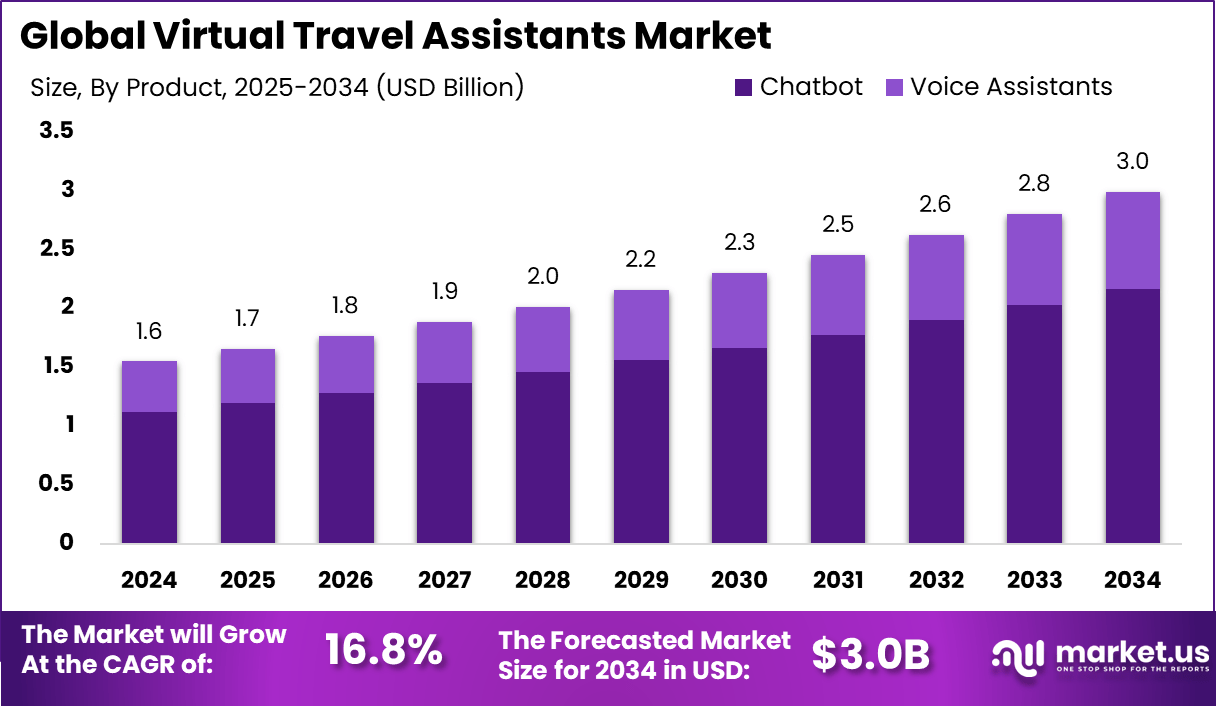
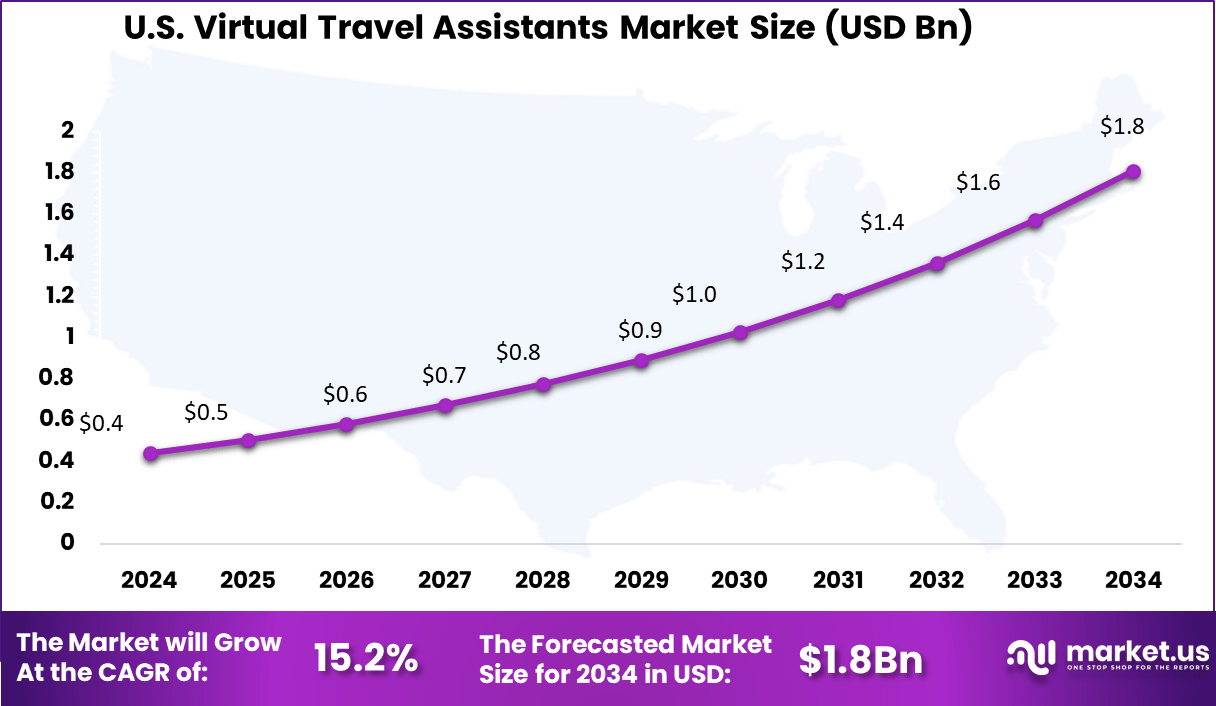
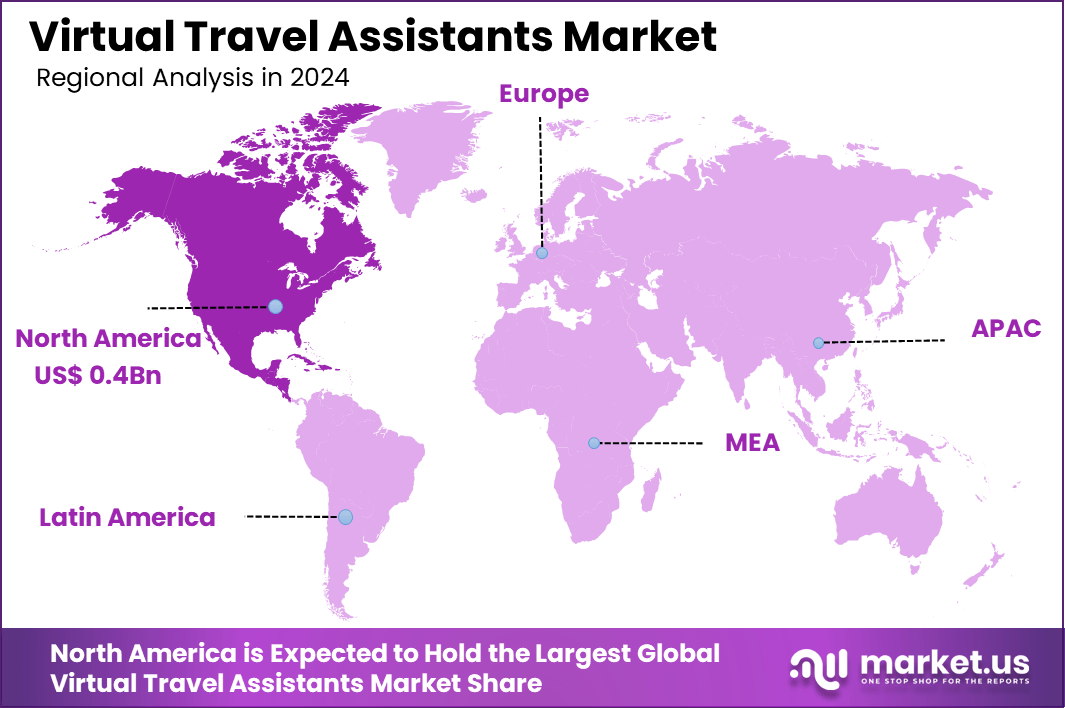
The Global Virtual Travel Assistants Market size is expected to be worth around USD 3.0 Billion By 2034, from USD 1.6 billion in 2024, growing at a CAGR of 16.8% during the forecast period from 2025 to 2034. In 2024, North America held a dominant market position, capturing more than a 31.2% share, holding USD 0.4 Billion revenue. The U.S. market is forecasted to grow at a CAGR of 15.2%, from USD 0.44 billion in 2024.
Virtual Travel Assistants (VTAs) are AI-powered digital tools designed to assist travelers in planning, booking, and managing their journeys. These assistants leverage technologies such as natural language processing and machine learning to provide personalized recommendations, real-time updates, and seamless communication. By automating routine tasks, VTAs enhance efficiency and offer travelers a more streamlined experience.
The Virtual Travel Assistant market has experienced significant growth, driven by increasing demand for personalized travel experiences and advancements in AI technology. Several factors are propelling the adoption of VTAs. The increasing preference for 24/7 customer support, the need for cost-effective solutions, and the desire for personalized travel planning are primary drivers.
The demand for VTAs is on the rise, particularly among tech-savvy travelers seeking convenience and personalization. Businesses in the travel industry are increasingly adopting these tools to meet customer expectations and stay competitive. The ability of VTAs to handle multiple inquiries simultaneously and provide consistent service quality makes them invaluable assets in managing high volumes of customer interactions.
According to Expedia, 37% of users prefer using intelligent chatbots to compare booking options or plan travel, while 33% rely on them to make hotel or restaurant reservations. This growing dependence reflects how virtual travel assistants are no longer just reactive tools but active participants in the user’s decision-making process.
Technological advancements have significantly improved the capabilities of VTAs. The integration of AI and machine learning enables these assistants to learn from user interactions, refining their responses over time. Natural language processing allows for more human-like conversations, while real-time data analysis ensures up-to-date information on travel conditions, pricing, and availability.
Businesses are embracing VTAs for several compelling reasons. They offer scalability, allowing companies to handle increased customer interactions without proportional increases in staffing. VTAs also provide consistent service quality, reduce operational costs, and free up human agents to focus on more complex tasks. Moreover, the data collected through VTAs can offer valuable insights into customer preferences and behavior, informing strategic decisions.
Key Takeaways
- The Global Virtual Travel Assistants Market is forecast to grow from USD 1.6 billion in 2024 to nearly USD 3.0 billion by 2034, expanding at a promising CAGR of 16.8% over the forecast period.
- In 2024, North America held a leading position, capturing over 31.2% of the global market, generating approximately USD 0.4 billion in revenue due to early adoption of AI in travel platforms.
- The U.S. market, valued at USD 0.4 billion in 2024, is projected to rise steadily to around USD 1.8 billion by 2034, growing at a strong CAGR of 15.2%, driven by demand for real-time, AI-powered travel assistance.
- By solution type, the Chatbot segment dominated the VTA market in 2024, holding more than 72.4% share, as conversational AI continues to streamline itinerary planning and customer service.
- Text-based interfaces remained the preferred interaction mode in 2024, securing over 62.4% of the market, favored for their simplicity and accessibility across devices.
- Among use cases, the Customer Support segment led with a 44.9% share in 2024, reflecting the high utility of VTAs in resolving travel queries, booking changes, and service requests.
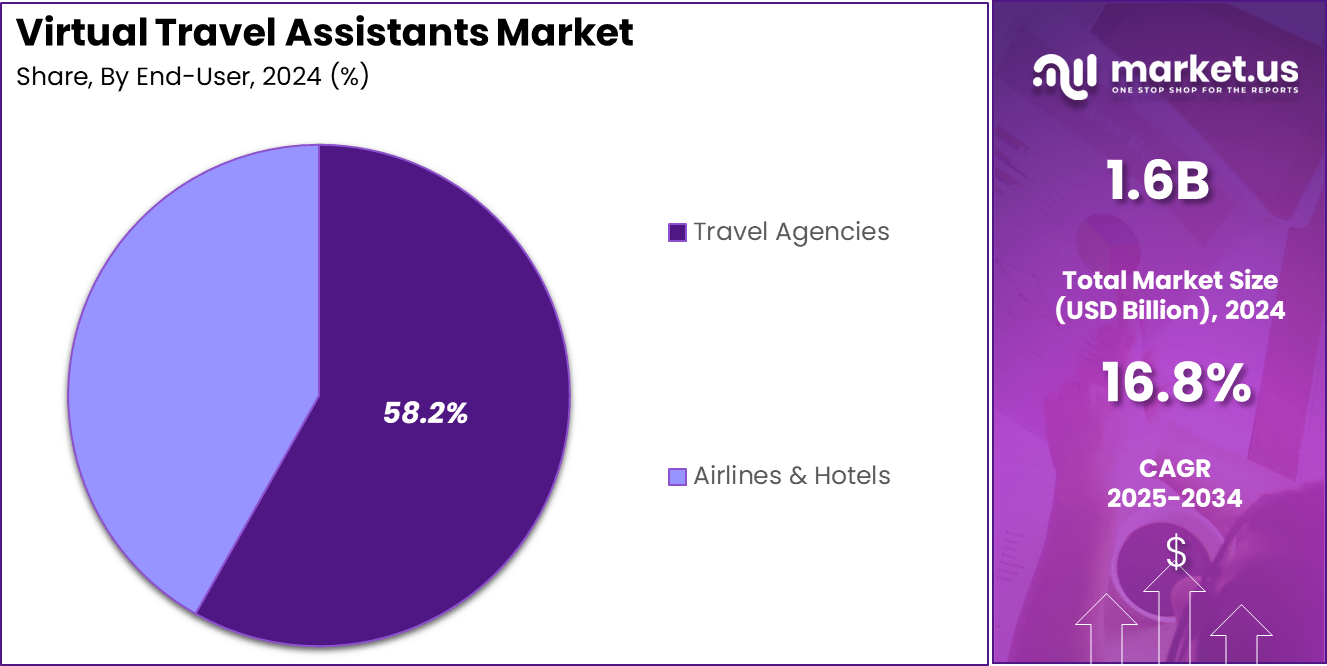
- In terms of end-users, Travel Agencies emerged as key adopters, holding more than 58.2% of the global share in 2024, as they integrated VTAs to offer seamless, round-the-clock digital support to travelers.
Analysts’ Viewpoint
Investment opportunities in the VTA market are expanding, with significant funding directed toward AI startups specializing in virtual assistant technologies. In 2023, various companies received substantial investments to develop and enhance their AI capabilities, driving innovation in the virtual assistant market . This influx of capital is fostering the development of more sophisticated and versatile VTAs, further fueling market growth.
The adoption of VTAs offers numerous business benefits, including improved customer satisfaction through personalized service, increased operational efficiency, and enhanced data collection for market analysis. By automating routine tasks, businesses can allocate resources more effectively, focusing on strategic initiatives and complex problem-solving. Additionally, the consistent and reliable service provided by VTAs helps build customer trust and loyalty.
The regulatory environment for VTAs is evolving, with increasing emphasis on data privacy and security. Compliance with regulations such as the General Data Protection Regulation (GDPR) is essential to protect user information and maintain trust. Businesses must ensure that their VTAs are designed and operated in accordance with these legal frameworks to avoid potential penalties and reputational damage.
US Market Expansion
The U.S. Virtual Travel Assistants Market was valued at approximately USD 0.4 billion in 2024, reflecting the growing reliance on AI-driven tools for personalized travel planning and real-time assistance. The market is expected to witness steady growth, projected to rise from USD 0.5 billion in 2025 to around USD 1.8 billion by 2034, registering a CAGR of 15.2% over the forecast period from 2025 to 2034.
This upward trajectory is being driven by rising demand for instant, automated, and hyper-personalized travel support, particularly among tech-savvy millennials and business travelers. Consumers increasingly prefer digital assistants that can manage itineraries, suggest destinations, offer real-time language translations, and provide local insights – all without the need for human intervention.
North America Economic Growth
In 2024, North America held a dominant market position, capturing more than 31.2% share of the global Virtual Travel Assistants (VTA) market and generating approximately USD 0.4 billion in revenue. This regional leadership can be attributed to the early adoption of AI-driven customer service tools across the travel and hospitality sector.
Major U.S.-based airlines, online travel agencies (OTAs), and hotel chains have been integrating voice- and chat-based travel assistants to enhance booking support, personalize travel recommendations, and provide multilingual assistance in real-time. These solutions are not only improving user satisfaction but also reducing operational overheads by automating routine inquiries and itinerary modifications.
By Product Analysis
In 2024, the Chatbot segment held a dominant market position, capturing more than 72.4% of the global Virtual Travel Assistants (VTA) market. This leadership is primarily attributed to the widespread adoption of chat-based interfaces by travel service providers aiming to enhance customer engagement and operational efficiency.
Chatbots, leveraging advancements in natural language processing (NLP) and machine learning, have been instrumental in automating routine inquiries, providing instant responses, and offering personalized travel recommendations. Their ability to operate 24/7 across multiple platforms, including websites and mobile applications, has significantly improved user experience and satisfaction.
The preference for chatbots over voice assistants in the travel industry can be attributed to their ease of integration and cost-effectiveness. Chatbots require less complex infrastructure and can be deployed rapidly, making them accessible to a broader range of businesses, from large enterprises to small travel agencies.
Furthermore, the asynchronous nature of chat allows users to interact at their convenience, which aligns well with the dynamic and often unpredictable nature of travel planning. As the demand for personalized and immediate customer service continues to rise, the chatbot segment is expected to maintain its leading position in the VTA market.
By Technology Analysis
In 2024, the Text-based segment held a dominant market position, capturing more than 62.4% of the global Virtual Travel Assistants (VTA) market. This dominance is primarily attributed to the widespread adoption of text-based interfaces by travel service providers aiming to enhance customer engagement and operational efficiency.
Text-based VTAs, leveraging advancements in natural language processing (NLP) and machine learning, have been instrumental in automating routine inquiries, providing instant responses, and offering personalized travel recommendations. Their ability to operate 24/7 across multiple platforms, including websites and mobile applications, has significantly improved user experience and satisfaction.
The preference for text-based VTAs over voice-based counterparts in the travel industry can be attributed to their ease of integration and cost-effectiveness. Text-based solutions require less complex infrastructure and can be deployed rapidly, making them accessible to a broader range of businesses, from large enterprises to small travel agencies.
Furthermore, the asynchronous nature of text communication allows users to interact at their convenience, which aligns well with the dynamic and often unpredictable nature of travel planning. As the demand for personalized and immediate customer service continues to rise, the text-based segment is expected to maintain its leading position in the VTA market.
By Application Analysis
In 2024, the Customer Support segment held a dominant market position in the Virtual Travel Assistants (VTA) market, capturing more than 44.9% of the global share. This leadership is primarily attributed to the growing demand for efficient, 24/7 customer service solutions in the travel industry. Virtual assistants have become instrumental in handling a high volume of customer inquiries, providing instant responses, and offering personalized assistance, thereby enhancing customer satisfaction and loyalty.
The integration of AI-powered virtual assistants in customer support has enabled travel companies to automate routine tasks such as booking confirmations, itinerary changes, and real-time updates. This automation not only reduces operational costs but also allows human agents to focus on more complex customer needs. For instance, companies like Travel Co have reported automating up to 95% of their customer bookings using virtual assistants, significantly streamlining their operations.
Moreover, the advancement in natural language processing (NLP) and machine learning algorithms has enhanced the capabilities of virtual assistants to understand and respond to customer queries more accurately and contextually. This has led to a more seamless and human-like interaction experience for customers, further driving the adoption of virtual assistants in customer support roles within the travel sector.
By End-User Analysis
In 2024, the Travel Agencies segment held a dominant market position in the Virtual Travel Assistants (VTA) market, capturing more than 58.2% of the global share. This leadership is primarily attributed to the increasing adoption of AI-powered virtual assistants by travel agencies aiming to enhance customer service, streamline operations, and offer personalized travel experiences.
The integration of VTAs has enabled agencies to handle a higher volume of customer inquiries efficiently, provide instant responses, and manage bookings seamlessly, thereby improving overall customer satisfaction and loyalty. The implementation of virtual assistants in travel agencies has led to significant operational efficiencies.
For instance, AI agents can manage routine tasks such as answering frequently asked questions, processing bookings, and providing travel recommendations, allowing human agents to focus on more complex customer needs. This shift not only reduces operational costs but also enhances the scalability of services, enabling agencies to cater to a larger customer base without compromising on service quality.
Moreover, the advancements in natural language processing and machine learning have made VTAs more adept at understanding and responding to customer queries in a human-like manner. This has resulted in more engaging and satisfying customer interactions, further driving the adoption of VTAs among travel agencies. The ability of these assistants to operate 24/7 ensures that customers receive timely assistance regardless of time zones, which is particularly beneficial for agencies serving international clients.
Key Market Segments
By Product
- Chatbot
- Voice Assistants
By Technology
- Automatic Speech Recognition
- Text to Speech
- Text-based
By Application
- Trip Planning & Itinerary Management
- Real-Time Assistance
- Customer Support
- Others
By End-User
- Travel Agencies
- Airlines & Hotels
Key Regions and Countries
North America
- US
- Canada
Europe
- Germany
- France
- The UK
- Spain
- Italy
- Russia
- Netherlands
- Rest of Europe
Asia Pacific
- China
- Japan
- South Korea
- India
- Australia
- Singapore
- Thailand
- Vietnam
- Rest of APAC
Latin America
- Brazil
- Mexico
- Rest of Latin America
Middle East & Africa
- South Africa
- Saudi Arabia
- UAE
- Rest of MEA
Driver
Rising Demand for Personalized Travel Experiences
In recent years, the travel industry has witnessed a significant shift towards personalization, driven by travelers’ desire for tailored experiences. Virtual travel assistants have emerged as pivotal tools in meeting this demand, offering customized itineraries, real-time updates, and personalized recommendations.
These AI-powered assistants analyze user preferences, past behaviors, and real-time data to curate travel plans that align closely with individual interests and needs. This level of personalization enhances customer satisfaction and loyalty, as travelers feel their unique preferences are understood and catered to.
Moreover, the integration of advanced technologies such as machine learning and natural language processing enables virtual travel assistants to continuously learn and improve their services. They can adapt to changing circumstances, provide instant support, and offer alternative solutions when disruptions occur, thereby enhancing the overall travel experience.
Restraint
Data Privacy and Security Concerns
Despite the benefits, data privacy and security remain significant concerns hindering the widespread adoption of virtual travel assistants. These assistants require access to sensitive personal information, including travel itineraries, payment details, and location data, to function effectively.
The collection and storage of such data raise potential risks related to unauthorized access, data breaches, and misuse of personal information. Furthermore, varying international data protection regulations, such as the General Data Protection Regulation (GDPR) in Europe, impose stringent requirements on how personal data is handled.
Compliance with these regulations necessitates robust data security measures, which can be resource-intensive for companies. These privacy concerns may lead to user reluctance in adopting virtual travel assistants, thereby restraining market growth.
Opportunity
Integration with Emerging Technologies
The integration of virtual travel assistants with emerging technologies presents significant growth opportunities. For instance, combining AI assistants with augmented reality (AR) can offer immersive travel experiences, such as virtual tours of destinations before booking.
Similarly, integrating with Internet of Things (IoT) devices can provide real-time updates on flight statuses, weather conditions, and local events, enhancing the traveler’s experience. Additionally, the use of blockchain technology can enhance data security and transparency in transactions, addressing some privacy concerns associated with virtual assistants.
Challenge
Language and Cultural Barriers
Language and cultural differences pose challenges in the effectiveness of virtual travel assistants. While many assistants support multiple languages, nuances, idioms, and cultural contexts can lead to misunderstandings or misinterpretations. This can affect the accuracy of recommendations and the overall user experience, particularly for travelers in regions with diverse linguistic and cultural landscapes.
Moreover, cultural preferences influence travel behaviors, such as dining choices, accommodation preferences, and activity selections. Virtual assistants must be equipped with culturally relevant data and the ability to adapt recommendations accordingly. Addressing these challenges requires continuous updates to language processing algorithms and the incorporation of culturally diverse data sets to ensure inclusivity and relevance in service offerings.
Growth Factors
The expansion of the virtual travel assistant market can be attributed to several key factors. Firstly, the integration of AI technologies has enhanced the capabilities of VTAs, enabling them to provide more accurate and personalized recommendations. This technological advancement has improved user experience, leading to increased adoption rates.
Secondly, the widespread use of smartphones and other smart devices has made VTAs more accessible to a broader audience, facilitating real-time assistance and convenience for travelers. Additionally, the growing preference for contactless services, especially in the wake of global health concerns, has accelerated the adoption of VTAs as they offer safe and efficient alternatives to traditional travel planning methods.
Moreover, the demand for 24/7 customer support and the ability to manage travel arrangements on-the-go have further propelled the growth of VTAs. Businesses are increasingly recognizing the cost-saving potential of automating customer service through VTAs, reducing the need for extensive human support staff. This shift not only cuts operational costs but also ensures consistent service quality, enhancing customer satisfaction and loyalty.
Emerging Trends
Several emerging trends are shaping the future of virtual travel assistants. One notable trend is the integration of VTAs with social media platforms and messaging apps, allowing users to plan and manage their travel itineraries within their preferred communication channels.
This integration enhances user engagement and simplifies the travel planning process. Another trend is the incorporation of voice recognition and natural language processing, enabling more intuitive and conversational interactions between users and VTAs.
Furthermore, VTAs are increasingly leveraging big data analytics to provide hyper-personalized travel recommendations based on user preferences, past behaviors, and real-time data. This level of personalization enhances the travel experience by offering tailored suggestions that align with individual interests and needs.
Business Benefits
Implementing virtual travel assistants offers numerous benefits for businesses in the travel industry. One significant advantage is the enhancement of customer service. VTAs can handle a multitude of customer inquiries simultaneously, providing instant responses and support around the clock. This capability not only improves customer satisfaction but also allows businesses to manage higher volumes of interactions without proportionally increasing staff.
Another benefit is the collection and analysis of customer data. VTAs can gather valuable insights into customer preferences, behaviors, and feedback, which businesses can utilize to refine their services and marketing strategies. This data-driven approach enables more targeted offerings and personalized marketing campaigns, potentially increasing conversion rates and customer loyalty.
Key Player Analysis
The virtual travel assistant market has witnessed significant developments in 2025, with key players expanding their capabilities through strategic acquisitions, product innovations, and partnerships. These initiatives aim to enhance user experiences and solidify market positions.
Expedia Group has focused on enhancing its virtual assistant capabilities by integrating AI-driven features across its platforms, including Expedia, Hotels.com, and Vrbo. These enhancements aim to provide users with real-time assistance, personalized recommendations, and streamlined booking experiences.
HomeToGo has made significant strides in integrating AI into its services. In 2024, the company launched “Super AI Sunny,” an AI-powered travel assistant designed to provide personalized vacation rental recommendations and assist users throughout their travel planning journey. This development underscores HomeToGo’s commitment to enhancing user experience through technology.
In 2024, Booking Holdings introduced an AI-powered trip planner on Booking.com, integrating OpenAI’s ChatGPT to offer personalized travel recommendations and streamline the booking process. This innovation reflects the company’s commitment to leveraging advanced technologies to improve user engagement and satisfaction.
Top Key Players in the Market
- Google LLC
- IBM Corporation
- Amazon.com, Inc.
- Microsoft Corporation
- Nuance Communications, Inc.
- Inbenta Technologies, Inc.
- Kore.ai, Inc.
- Avaamo, Inc.
- Pypestream, Inc.
- Ada Support Inc.
- Cognigy GmbH
- Swyft Technologies, Inc.
- Others
Recent Developments
- In March 2025, Amazon introduced “Alexa+,” an upgraded version of its virtual assistant. Alexa+ offers enhanced conversational abilities and can perform tasks such as booking tickets, ordering taxis, and making restaurant reservations. This service is available for free to Prime members or at a monthly fee, aiming to provide a more integrated and efficient user experience.
- In April 2025, Google unveiled several AI-driven travel tools aimed at enhancing trip planning. These tools, integrated into Google Maps, Lens, and the Gemini platform, assist users in building itineraries and tracking hotel rates, offering a more personalized travel experience.









