


Report Overview
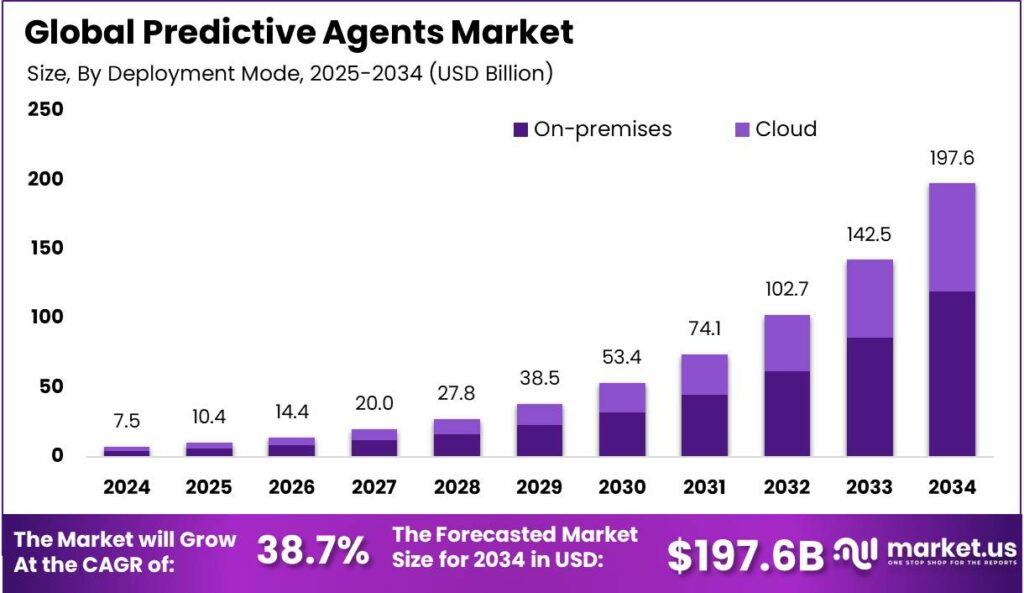
The Global Predictive Agents Market size is expected to be worth around USD 197.6 Billion By 2034, from USD 7.5 Billion in 2024, growing at a CAGR of 38.70% during the forecast period from 2025 to 2034. In 2024, North America held a dominant position in the global predictive analytics market with a 33.4% revenue share. The U.S. Predictive Agents market was valued at USD 2.46 billion, driven by the rapid adoption of intelligent automation technologies.
Predictive Agents are advanced AI-powered systems designed to anticipate user needs, environmental changes, or system behaviors in real time.These agents use data analysis and machine learning to predict outcomes and make proactive decisions. Their applications include customer service, cybersecurity, smart cities, autonomous vehicles, and healthcare, improving automation, response times, and decision-making accuracy.
The predictive agents market is experiencing significant growth, primary factors driving the growth of the predictive agents market include the increasing volume of data from connected devices and enterprise systems, which demands real-time analysis and forecasting. Predictive agents help businesses shift from reactive to proactive strategies. The demand for hyper-personalized experiences is driving organizations to deploy systems that predict user intent.
The demand for predictive agents is surging across multiple industries. In the healthcare sector, they are used for patient monitoring and predicting disease outbreaks. Financial institutions employ predictive agents for risk assessment and fraud detection. Retailers utilize them to forecast consumer behavior and manage inventory effectively.
The manufacturing industry benefits from predictive maintenance, reducing equipment downtime and operational costs. This widespread applicability underscores the growing reliance on predictive agents to drive efficiency and innovation. The integration of predictive agents with emerging technologies such as cloud computing, Internet of Things (IoT), and big data analytics is accelerating their adoption.
According to allaboutai, over 24,000 mentions related to AI agents have been recorded from the United States alone, positioning it as the most active region in public discourse on this topic. A remarkable 96% of these mentions were tracked on X (formerly Twitter), underlining the platform’s role as a central hub for AI-related engagement.
In the consumer space, 87% of U.S. users express dissatisfaction with conventional customer service experiences, particularly with frequent call transfers – an issue AI agents are increasingly helping to resolve through seamless automation. Furthermore, the healthcare sector is undergoing rapid transformation, with 90% of hospitals projected to integrate AI agents by 2025.
Cloud-based solutions offer scalability and flexibility, allowing businesses to deploy predictive agents without significant infrastructure investments. IoT devices generate real-time data, which, when analyzed by predictive agents, can lead to proactive decision-making. The integration of advanced technologies has significantly improved the functionality and accessibility of predictive agents, establishing them as essential tools in today’s business operations.
Organizations are adopting predictive agents to enhance decision-making processes, improve operational efficiency, and gain a competitive edge. By providing accurate forecasts and insights, predictive agents enable businesses to anticipate market trends, optimize resource allocation, and mitigate risks. In today’s fast-moving business environment, the ability to make quick, data-driven decisions is essential.
Key Takeaways
- The Global Predictive Agents Market is projected to reach a value of USD 197.6 Billion by 2034, growing from USD 7.5 Billion in 2024, at a CAGR of 38.70% during the forecast period from 2025 to 2034.
- In 2024, the Solutions segment held a dominant market position, capturing more than a 70.7% share in the Predictive Agents market.
- The On-premises segment also dominated in 2024, securing more than a 60.6% share of the global Predictive Agents market.
- The Single Agent System segment led in 2024, holding a significant market position with more than a 55.2% share in the global predictive agents market.
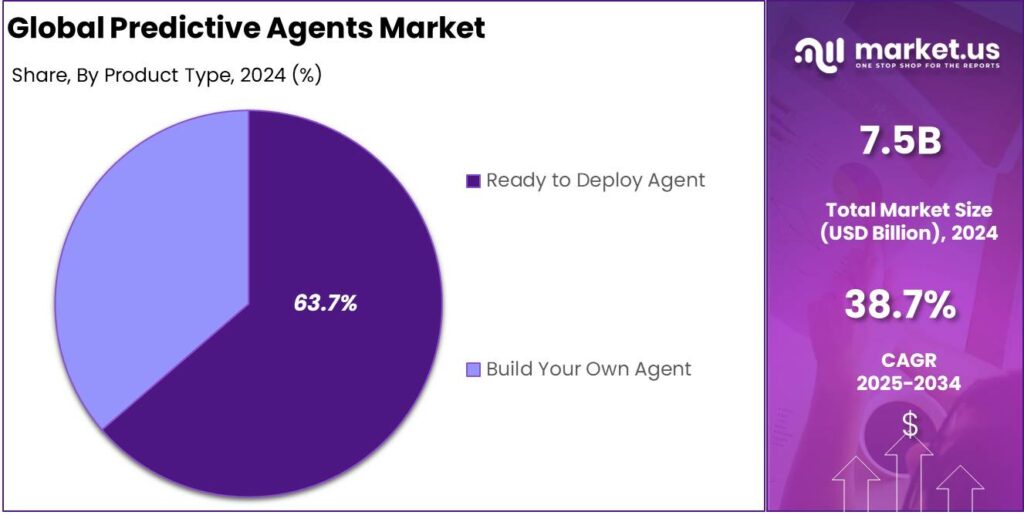
- The Ready to Deploy Agent segment was the market leader in 2024, commanding over 63.7% of the Predictive Agents market.
- Large Enterprises accounted for a dominant market share of over 74.7% in 2024 within the Predictive Agents market.
- The BFSI segment captured a notable 28.6% share of the global predictive agents market in 2024.
- In 2024, North America held a dominant position in the global predictive analytics market, contributing to approximately 33.4% of the total revenue share.
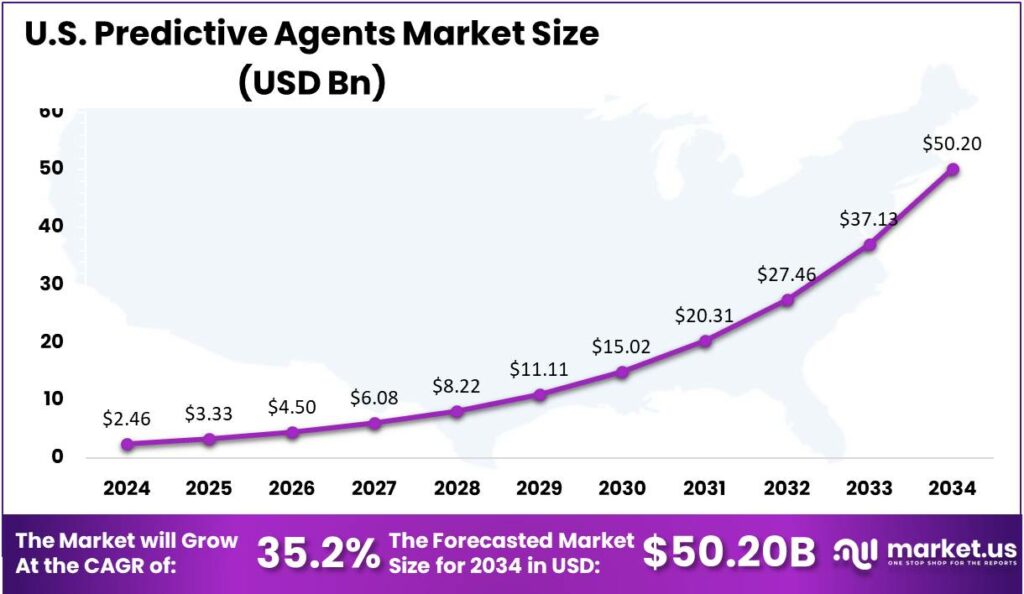
- The U.S. Predictive Agents market was valued at USD 2.46 billion in 2024, reflecting the rapid adoption of intelligent automation technologies across various sectors.
Business Benefits
Implementing AI agents can lead to significant cost savings by minimizing the need for extensive human intervention in routine tasks. Automating customer support and data analysis cuts labor costs and operational expenses, allowing savings to be reinvested in business growth.
As per the MoldStud report, Predictive maintenance can cut operational costs by up to 15% by reducing waste and optimizing resources. AI agents refine their algorithms through continuous learning from new data, improving accuracy in predictions and recommendations.
This adaptability helps businesses stay aligned with evolving market demands. A recent report by HashStudioz reveals that retailers who tap into predictive analytics are enjoying a 30% boost in customer retention proving that data-driven decisions are transforming the customer experience.
As businesses grow, AI agents can handle more tasks without increasing costs, ensuring consistent performance and supporting expansion without sacrificing efficiency. As per the same report by HashStudioz, reveals that manufacturers can cut costs by as much as $50 billion each year by adopting predictive maintenance strategies.
Key Features
- Advanced data aggregation and analysis using machine learning.
- Real-time insights and automated data processing.
- Continuous learning and adaptability to new data.
- User-friendly interfaces for seamless business integration
U.S. Market Size
In 2024, the U.S. Predictive Agents market was valued at USD 2.46 billion, reflecting the rapid adoption of intelligent automation technologies across sectors. The market has been gaining significant momentum due to the increasing integration of AI-powered decision-making systems in customer service, marketing, supply chain, and enterprise operations.
The market is further expected to expand at a compound annual growth rate (CAGR) of 35.2% over the forecast period, indicating a robust surge in demand. This accelerated growth can be attributed to rising investments in AI, machine learning (ML), and natural language processing (NLP) technologies.
Moreover, the evolution of generative AI, federated learning, and edge intelligence is expected to further enhance the capabilities of predictive agents in the U.S. market. These advancements enable predictive agents to function with higher autonomy, learn continuously, and adapt to dynamic environments, thus increasing their reliability and relevance across diverse use cases.
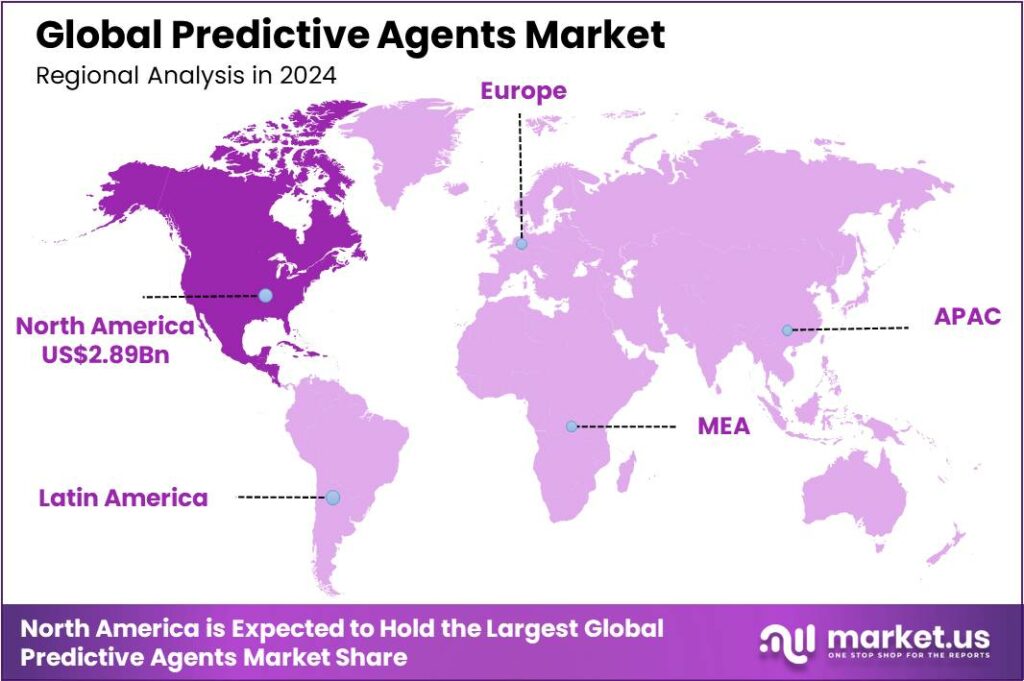
In 2024, North America held a dominant position in the global predictive analytics market, accounting for approximately 33.4% of the total revenue share. This leadership is primarily attributed to the region’s advanced technological infrastructure and a strong emphasis on data-driven decision-making across various industries.
The North America has been a significant contributor to this dominance, with a market size evaluated at USD 2.89 billion in 2024. The country’s substantial investment in advanced analytics solutions and the increasing adoption of artificial intelligence and machine learning technologies have been key factors driving growth.
Organizations across sectors such as healthcare, finance, and retail are leveraging predictive analytics to enhance operational efficiency and improve customer experiences.The presence of leading technology firms and a robust ecosystem for innovation further strengthens the growth of the predictive analytics industry in North America.
Moreover, the region’s focus on innovation and the early adoption of emerging technologies have positioned North America as a leader in the predictive analytics market. The integration of predictive analytics into business strategies has enabled companies to gain valuable insights, optimize processes, and maintain a competitive edge in the market.
Component Analysis
In 2024, the Solutions segment held a dominant market position, capturing more than a 70.7% share in the Predictive Agents market. This leadership can be largely attributed to the growing enterprise need for actionable intelligence and data-driven decision-making tools across various operational domains.
Financial and risk analytics are vital for large enterprises to manage economic uncertainty and compliance, helping optimize capital and mitigate risks. Supply chain analytics is also growing, aiding in forecasting, inventory control, and supplier performance amid global challenges.
Web and social media analytics are also contributing significantly to the Solutions segment’s growth. With the rising digital footprint of consumers, companies are leveraging these tools to decode consumer behavior, sentiment trends, and brand perception in real-time. This is especially crucial for sectors like retail, media, and entertainment, where audience engagement directly impacts revenue.
While Services like consulting and integration support the deployment of predictive analytics tools, their revenue share remains modest. This is due to the growing preference for cloud-based, ready-to-use solutions that require minimal external support. The Solutions segment leads the market, driven by demand for scalable, pre-configured platforms aligned with business goals.
Deployment Mode Analysis
In 2024, the On-premises segment held a dominant market position, capturing more than a 60.6% share of the global Predictive Agents market. This leadership can be attributed primarily to the high demand from large-scale enterprises operating in highly regulated industries such as banking, healthcare, and government sectors, where data privacy and compliance are critical.
These organizations typically prefer full control over their IT infrastructure and data, making on-premises deployment a more secure and reliable choice. The ability to customize systems based on internal policies and integrate with legacy infrastructure has also driven strong adoption of on-premises predictive agent solutions.
Additionally, industries with mission-critical workloads and low tolerance for latency such as manufacturing, energy, and logistics have shown strong preference for on-premises deployments. In such environments, the need for real-time data processing and uninterrupted system access outweighs the flexibility offered by cloud systems.
Moreover, organizations with mature IT departments and existing infrastructure investments have opted to enhance their existing ecosystems by deploying predictive agents locally. The control over data storage, access management, and software updates remains within the organization’s reach, making it easier to manage internal governance and avoid third-party vulnerabilities.
Agent System Analysis
In 2024, Single Agent System segment held a dominant market position, capturing more than a 55.2% share in the global predictive agents market. This leadership is largely driven by its simplicity, ease of deployment, and lower computational requirements compared to multi-agent frameworks.
Single agent systems are particularly favored in applications where the focus is on a specific goal or task, such as financial forecasting, customer sentiment prediction, or inventory optimization. These systems require fewer coordination layers, which reduces complexity and makes them ideal for businesses seeking cost-effective AI-driven automation solutions without the overhead of managing inter-agent communication.
The scalability and adaptability of single agent systems have further accelerated their adoption across sectors such as retail, logistics, and banking, where immediate actionable insights are prioritized over complex agent collaboration. These systems are designed to operate independently, making them suitable for environments with limited technical infrastructure or smaller datasets.
From a development perspective, the single agent approach significantly reduces the burden on AI model training and maintenance. Unlike multi-agent systems that require sophisticated synchronization mechanisms and conflict resolution protocols, a single agent system can be built, tested, and deployed more efficiently.
Product Type Analysis
In 2024, the Ready to Deploy Agent segment held a dominant market position, capturing more than a 63.7% share in the Predictive Agents market. This dominance is primarily driven by the increasing demand for quick-to-implement AI tools that offer out-of-the-box functionalities without the need for extensive customization.
Businesses across sectors are under growing pressure to make faster, data-backed decisions, and ready-to-deploy predictive agents provide a plug-and-play solution that accelerates time-to-value. These agents are pre-configured with industry-specific algorithms and use cases, making them ideal for organizations looking to rapidly integrate AI into their operations without building from scratch.
Ready-to-deploy agents offer a major advantage with low implementation complexity and minimal reliance on internal tech resources. They’re especially favored by SMEs lacking deep AI expertise, as these prebuilt solutions include vendor support, regular updates, and platform integrations. Their ease of use and maintenance makes them ideal for businesses pursuing digital transformation without extensive development capabilities.
From a cost-efficiency standpoint, Ready to Deploy Agents also present a lower initial investment compared to Build Your Own solutions, which require extensive development time, skilled data scientists, and infrastructure support. The subscription-based or SaaS pricing models adopted by most vendors allow businesses to scale their usage as needed without large upfront costs.
Organization Size Analysis
In 2024, the Large Enterprises segment held a dominant market position in the Predictive Agents market, capturing more than a 74.7% share. This dominance is largely driven by the capacity of large enterprises to invest heavily in advanced analytics infrastructure and AI technologies.
Furthermore, large enterprises operate in highly competitive markets where customer behavior, risk exposure, and operational inefficiencies must be constantly monitored and optimized. Predictive agents enable these companies to preempt challenges and seize market opportunities faster than traditional analytical methods.
Another contributing factor to this segment’s lead is the presence of skilled internal IT and data science teams within large enterprises, which facilitates seamless integration, customization, and scaling of predictive agent solutions. These organizations are often early adopters of AI-based platforms, using them to develop internal tools or integrate with enterprise resource planning (ERP) systems, business intelligence (BI) platforms, and CRM software.
In contrast, small and medium-sized enterprises often face budgetary constraints and limited access to technical expertise, which slows their adoption of advanced predictive tools. While SMEs are beginning to explore predictive solutions especially cloud-based offerings the scale, integration capability, and strategic focus of large enterprises continue to drive the majority of market revenue.
Vertical Analysis
In 2024, BFSI segment held a dominant market position, capturing more than a 28.6% share of the global predictive agents market. This leadership is primarily attributed to the sector’s high demand for real-time risk analysis, fraud detection, credit scoring, and customer behavior prediction.
Financial institutions are leveraging predictive agents to automate complex decision-making processes, enhance regulatory compliance, and mitigate operational risks. The increased adoption of AI-driven tools in banking and insurance workflows has made predictive agents critical for delivering intelligent automation and faster service delivery across the sector.
The BFSI sector operates in a highly data-intensive environment, where timely and accurate predictions can significantly impact financial outcomes. Predictive agents enable banks and insurers to process vast amounts of structured and unstructured data, drawing actionable insights for everything from loan approvals to investment strategies.
Regulatory demands and transparency needs have driven the adoption of predictive agents in BFSI. These systems support audit-friendly decisions, especially in fraud detection and credit assessments. As cybersecurity threats evolve, they’re also key in anomaly detection and ensuring compliance with financial governance standards.
Key Market Segments
By Component
- Solutions
- Financial Analytics
- Risk Analytics
- Marketing Analytics
- Sales Analytics
- Customer Analytics
- Web and Social Media Analytics
- Supply chain Analytics
- Network Analytics
- Services
- Professional Services
- Consulting
- Deployment and Integration
- Support and Maintenance
- Managed Services
- Professional Services
By Deployment Mode
- Cloud
- On-premises
By Agent System
- Single Agent System
- Multi Agent System
By Product Type
- Ready to Deploy Agent
- Build Your Own Agent
By Organization Size
- Large enterprises
- Small and medium-sized enterprises (SMEs)
By Vertical
- BFSI
- Manufacturing
- Retail and eCommerce
- Government and Defense
- Healthcare and Life Sciences
- Energy and Utilities
- Telecommunications and IT
- Transportation and Logistics
- Media and Entertainment
- Travel and Hospitality
- Other Verticals
Key Regions and Countries
- North America
- US
- Canada
- Europe
- Germany
- France
- The UK
- Spain
- Italy
- Rest of Europe
- Asia Pacific
- China
- Japan
- South Korea
- India
- Australia
- Singapore
- Rest of Asia Pacific
- Latin America
- Brazil
- Mexico
- Rest of Latin America
- Middle East & Africa
- South Africa
- Saudi Arabia
- UAE
- Rest of MEA
Driver
Real-Time Decision-Making and Operational Efficiency
The integration of predictive agents in market research is driven by the need for real-time decision-making and improved operational efficiency. These AI-powered agents enable continuous data analysis, helping businesses monitor market trends, consumer behaviors, and competition in real-time.
Continuous monitoring through predictive agents enables quick strategy adjustments, helping businesses stay agile and responsive to new opportunities or threats. Their automation capabilities reduce the time and resources needed for data collection and analysis, allowing human analysts to focus on strategic planning and creative problem-solving. This enhances overall productivity and efficiency within organizations.
Restraint
Data Privacy and Ethical Concerns
Despite the advantages offered by predictive agents, their deployment raises significant data privacy and ethical concerns. The extensive data collection and analysis capabilities of these agents often involve processing sensitive personal information, which can lead to potential breaches of privacy if not managed appropriately.
The use of predictive agents requires strict adherence to data protection regulations and ethical standards to protect privacy. Organizations must implement robust data governance frameworks, including obtaining informed consent, ensuring data anonymization, and maintaining transparency.
Additionally, algorithms may unintentionally perpetuate biases in the data, leading to discriminatory outcomes. This highlights the need for regular audits and updates to AI models to mitigate bias and ensure fairness in decision-making.
Opportunity
Personalized Consumer Engagement
Predictive agents present a significant opportunity for enhancing personalized consumer engagement. By analyzing individual consumer behaviors, preferences, and purchase histories, these agents enable businesses to tailor their offerings and communications to meet specific customer needs effectively.
Predictive agents enable businesses to deliver personalized experiences, strengthening customer relationships and boosting brand loyalty. By analyzing consumer data, they help anticipate needs and offer relevant products or services, leading to higher conversion rates and improved customer satisfaction.
These agents enhance the customer experience with timely, relevant information, helping businesses stand out in competitive markets. Additionally, their scalability ensures consistent personalization across diverse customer segments, making them ideal for companies in varied markets with different consumer preferences.
Challenge
Integration with Existing Systems
A significant challenge in implementing predictive agents lies in their integration with existing organizational systems and processes. Many businesses operate with legacy systems that may not be compatible with advanced AI technologies, leading to potential disruptions during the integration process.
The successful deployment of predictive agents requires seamless integration with current data infrastructures, customer relationship management systems, and operational workflows. This integration often demands substantial investments in technology upgrades and staff training to ensure that the new systems function effectively alongside existing ones.
Moreover, resistance to change within organizations can impede the adoption of predictive agents. Employees may be hesitant to embrace new technologies due to concerns about job security or unfamiliarity with AI systems.
Emerging Trends
One significant trend is the integration of predictive agents into customer service operations. Companies are deploying these agents to manage routine inquiries, allowing human employees to focus on more complex issues. This not only enhances efficiency but also improves customer satisfaction by providing quicker responses.
In cybersecurity, predictive agents are being utilized to detect and respond to threats in real-time. Their ability to analyze vast amounts of data and identify anomalies helps in proactively mitigating potential security breaches.
Furthermore, the development of frameworks such as AutoGen and LangChain is democratizing the creation of predictive agents. These tools enable businesses to build customized agents tailored to specific needs without requiring extensive programming knowledge.
Key Player Analysis
Major players in Predictive Agents Market are investing heavily in machine learning, big data, and AI technologies to stay ahead of the competition.
Oracle Corporation is a major force in predictive analytics and artificial intelligence. Its strength lies in integrating predictive capabilities with its existing cloud infrastructure and enterprise solutions. Oracle’s predictive agents are designed to help businesses anticipate trends, automate decision-making, and improve customer engagement.
SAP SE stands out for its focus on enterprise resource planning (ERP) and how it applies predictive intelligence to business operations. Its AI-powered solutions help companies forecast demand, manage resources, and respond faster to market changes. SAP’s uniqueness comes from combining data from across an organization into one system and using predictive agents to deliver real-time insights.
Google LLC brings deep expertise in machine learning and data science to the predictive agents space. With its advanced AI models and access to massive data sets, Google is helping businesses make more accurate forecasts and automate customer interactions. Google Cloud’s AI tools are widely used for everything from sales forecasting to predictive maintenance.
Top Key Players in the Market
- International Business Machines Corporation (IBM)
- Microsoft Corporation
- Oracle Corporation
- SAP SE
- Google LLC
- Salesforce, Inc.
- Hewlett Packard Enterprise (HPE)
- Amazon Web Services, Inc.
- Teradata
- FICO
- Altair Engineering Inc.
- Domo, Inc.
- Cloudera, Inc.
- Others
Top Opportunities for Players
- Enhancing Healthcare Outcomes: Predictive agents are revolutionizing healthcare by enabling early disease detection and personalized treatment plans. By analyzing patient data, these systems can forecast potential health issues, allowing for timely interventions. Major tech companies like Amazon and Nvidia are investing heavily in AI-driven medical solutions, indicating a strong industry trend towards AI integration in healthcare.
- Optimizing Manufacturing Processes: In manufacturing, predictive agents facilitate proactive maintenance by analyzing equipment data to predict failures before they occur. This approach reduces unplanned downtime and maintenance costs. Companies like Siemens Energy are leveraging AI-powered platforms to enhance operational efficiency.
- Advancing Retail Personalization: Retailers are utilizing predictive agents to analyze consumer behavior, enabling personalized marketing and improved customer experiences. AI-driven tools help in tailoring product recommendations and optimizing inventory management, leading to increased customer satisfaction and sales.
- Streamlining Legal Services: Law firms are adopting predictive analytics to foresee potential legal issues and enhance compliance. By analyzing historical data, AI systems can predict litigation risks and streamline legal processes, improving client outcomes and operational efficiency.
- Transforming Market Research: Predictive agents are reshaping market research by enabling real-time data analysis and forecasting market trends. AI-driven tools allow businesses to gain deeper insights into consumer preferences and market dynamics, facilitating more informed decision-making.
Recent Developments
- In January 2025, FICO collaborated with Mortgage Capital Trading (MCT) to bring the predictive FICO® Score 10 T to the secondary mortgage marketplace, enhancing predictive analytics in credit scoring.
- In September 2024, Salesforce completed its acquisition of PredictSpring, a cloud-based point-of-sale (POS) software vendor. The deal was completed aiming to enhance Salesforce’s retail capabilities by integrating PredictSpring’s modern POS solutions into its Commerce Cloud platform.









