


Report Overview
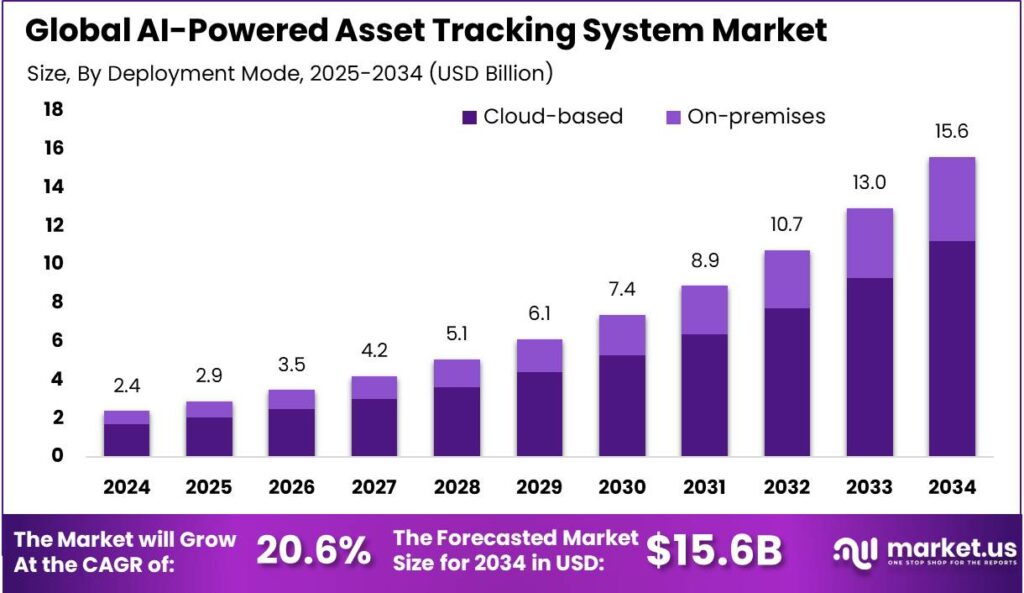
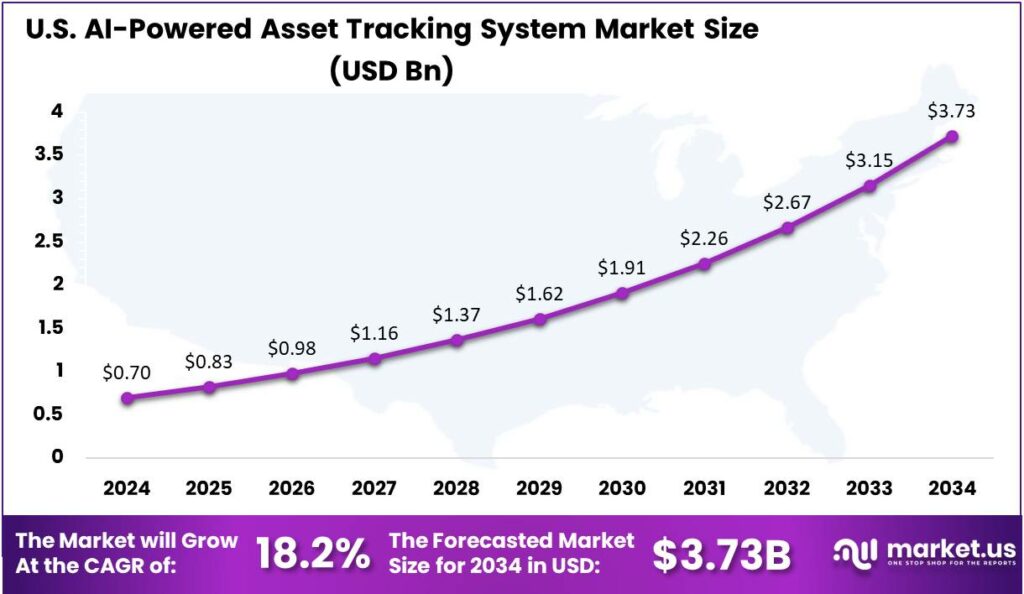
The AI-Powered Asset Tracking System Market size is expected to be worth around USD 15.6Billion By 2034, from USD 2.4 Bn in 2024, growing at a CAGR of 20.60% during the forecast period from 2025 to 2034. In 2024, North America led the global market with over 34% share and revenue of approximately USD 0.8 billion. The U.S. accounted for around USD 0.7 bn, projected to grow at a strong CAGR of 18.2% due to rising demand for intelligent, real-time asset management solutions.
AI-powered asset tracking system combines artificial intelligence with asset management to monitor and optimize the use of physical assets. It uses data from IoT devices, GPS, and RFID tags for real-time insights into location, condition, and performance. This enables predictive maintenance, reduces downtime, and prevents asset loss, benefiting industries like manufacturing, logistics, healthcare, and IT.
The AI-Powered Asset Tracking System market is experiencing significant growth, driven by the increasing need for efficient asset management across various industries. Key driving factors for this market include the demand for real-time asset visibility, the need to reduce operational costs, and the increasing complexity of supply chains. AI-powered systems provide predictive analytics that help in forecasting maintenance needs, thus preventing equipment failures and minimizing downtime.
The demand for AI-powered asset tracking systems is particularly strong in sectors that require stringent asset management, such as healthcare, where equipment tracking is critical, and in logistics, where real-time tracking of goods can significantly improve delivery times and customer satisfaction.
Technological advancements are playing a crucial role in the increasing adoption of AI-powered asset tracking systems. The development of more sophisticated AI algorithms, improved sensor technologies, and the proliferation of IoT devices have made these systems more accessible and effective.
Investment opportunities in the AI-powered asset tracking market are abundant, given the technology’s potential to transform asset management practices. Companies that develop AI algorithms, sensor technologies, and integrated platforms for asset tracking are attracting significant investment.
The regulatory environment for AI-powered asset tracking systems is evolving, with governments and industry bodies establishing standards and guidelines to ensure data privacy, security, and interoperability. Compliance with regulations such as the General Data Protection Regulation (GDPR) and industry-specific standards is essential for organizations deploying these systems.
Key Takeaways
- The Global AI-Powered Asset Tracking System Market is projected to grow from USD 2.4 billion in 2024 to approximately USD 15.6 billion by 2034, registering a strong CAGR of 20.60% during the forecast period from 2025 to 2034.
- In 2024, the hardware segment held a leading position in the AI-powered asset tracking system market, accounting for more than 45% of the market share.
- The Cloud-Based segment dominated the deployment landscape in 2024, capturing over 72% of the global market share.
- Among tracking technologies, the GPS segment led the market in 2024, securing more than 28% share globally.
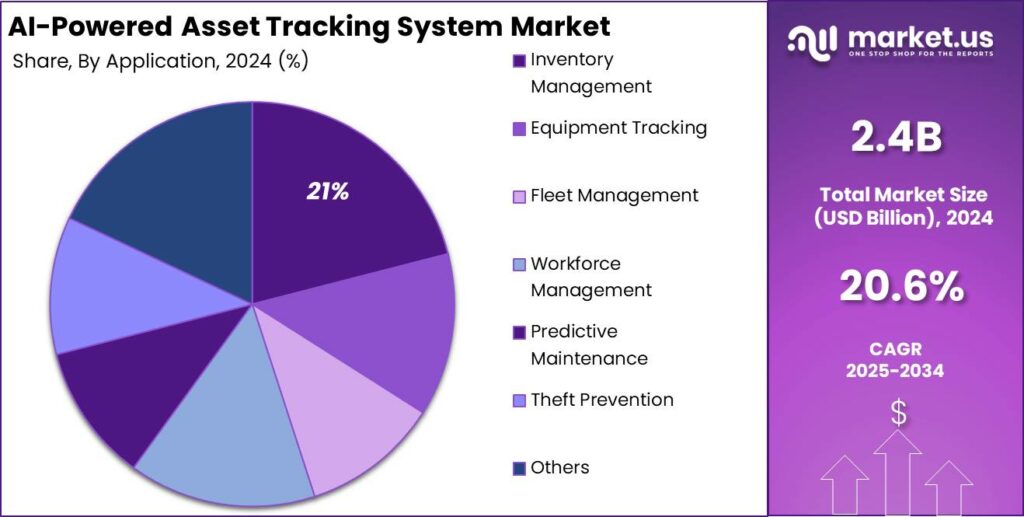
- The Inventory Management segment emerged as the top application area in 2024, with a market share of over 21%.
- In terms of end-use industries, the Transportation & Logistics segment held the dominant position in 2024, capturing more than 24% share.
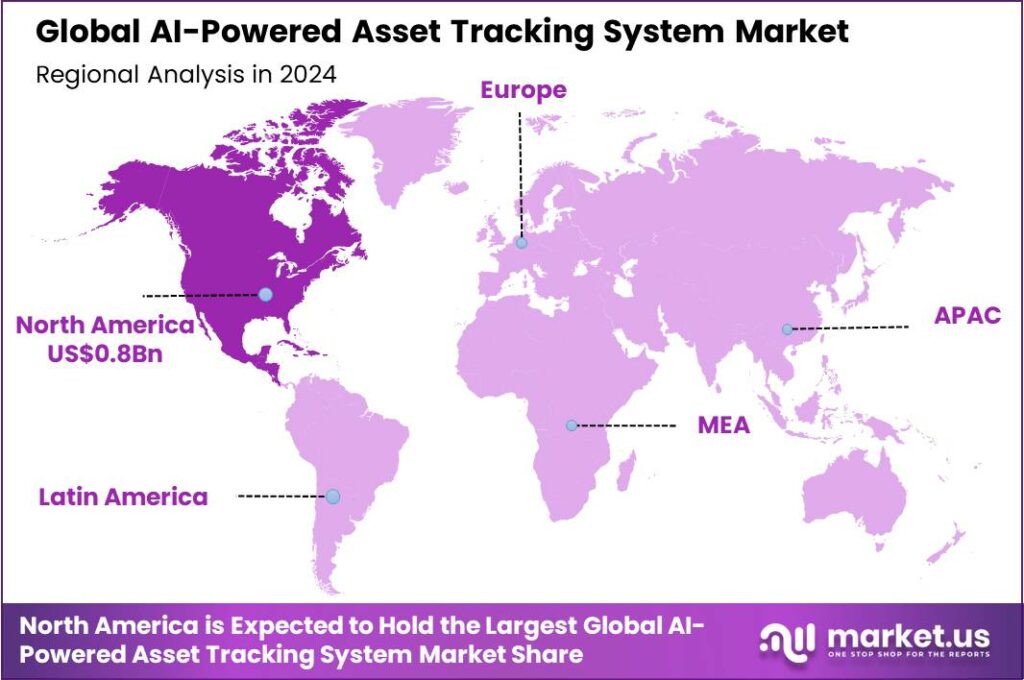
- North America led the regional market in 2024, accounting for more than 34% of the global market, with total revenue of approximately USD 0.8 billion.
- Within North America, the U.S. market was valued at around USD 0.7 billion in 2024 and is forecast to expand at a robust CAGR of 18.2%, driven by increasing demand for intelligent, real-time asset management solutions.
Impact Of AI
- Predictive Maintenance: AI enables systems to anticipate equipment failures by analyzing historical and real-time data. This proactive approach helps in scheduling maintenance before issues arise, reducing unexpected downtimes and extending asset lifespans.
- Enhanced Decision-Making: By processing vast datasets, AI provides actionable insights into asset utilization and performance. This facilitates informed decision-making, optimizing resource allocation and operational efficiency.
- Real-Time Monitoring: AI-powered systems offer continuous monitoring of assets, ensuring real-time visibility into their status and location. This constant oversight aids in promptly addressing any anomalies or inefficiencies.
- Cost Reduction: Through predictive analytics and optimized maintenance schedules, AI helps in minimizing operational costs. By preventing equipment failures and reducing manual interventions, organizations can achieve significant cost savings.
- Improved Asset Utilization: AI assists in maximizing the use of assets by analyzing usage patterns and identifying underutilized resources. This ensures better asset management and contributes to overall productivity.
U.S. Market Analysis
In 2024, the U.S. AI-powered asset tracking system market was valued at approximately USD 0.7 billion, reflecting the country’s growing dependence on intelligent monitoring and real-time asset management solutions. The market is undergoing steady transformation, driven by the need for transparency, logistics automation, and AI advancements like machine learning and computer vision.
The market is forecasted to expand at a robust compound annual growth rate (CAGR) of 18.2%, indicating a strong momentum over the next several years. This rapid growth is driven by supply chain digitization, increased demand for predictive maintenance, and AI-powered IoT monitoring. AI enables real-time insights, supporting faster, data-driven decisions in asset deployment and lifecycle management.
Additionally, government initiatives encouraging the use of smart technologies and the growing demand for secure, transparent, and efficient asset movement in critical sectors are playing a significant role in driving market expansion. The integration of AI with technologies such as GPS, RFID, and cloud platforms is expected to further enhance tracking accuracy, lower operating costs, and reduce human errors. A
In 2024, North America held a dominant market position, capturing more than a 34% share of the global AI-powered asset tracking system market, with a revenue contribution of approximately USD 0.8 billion. This leadership can be attributed to the region’s advanced digital infrastructure, early adoption of artificial intelligence across industries, and strong presence of major technology companies.
One of the key reasons behind North America’s lead is its well-established ecosystem for integrating AI with complementary technologies such as IoT, cloud computing, and geospatial tools like GPS and RFID. Companies in this region are increasingly relying on AI algorithms for predictive analytics, enabling them to proactively manage asset maintenance.
Another contributor to North America’s dominance is the region’s stringent regulatory environment around asset management, data accuracy, and compliance, which has encouraged businesses to adopt smarter and more automated solutions. Additionally, the growth of e-commerce, urban mobility, and fleet management has further accelerated the implementation of asset tracking tools powered by AI.
While North America remains at the forefront, the competitive pressure from rapidly advancing regions like Asia-Pacific is likely to intensify in the coming years. However, due to its early mover advantage, strong R&D base, and high enterprise tech-readiness, North America is expected to maintain a significant lead in the AI-powered asset tracking market through the foreseeable future.
Component Analysis
In 2024, the hardware segment held a dominant market position in the AI-powered asset tracking system market, capturing more than a 45% share. This dominance is attributed to the essential role of physical tracking devices such as GPS trackers, RFID tags, BLE beacons, and various sensors in establishing the foundational infrastructure for asset monitoring.
The hardware segment’s leadership is further reinforced by the increasing demand for real-time asset tracking and monitoring across various industries. Industries such as logistics, manufacturing, healthcare, and transportation rely heavily on hardware components to ensure the accurate tracking of assets, which is essential for operational efficiency and cost reduction.
Advancements in hardware technology have significantly contributed to the segment’s growth. Enhanced tracking devices with longer battery life, better connectivity, and greater accuracy have made hardware solutions more attractive to organizations. These improvements have led to more efficient asset tracking and increased adoption of hardware in asset tracking systems.
The hardware segment thrives on its scalability and flexibility, allowing easy integration into existing systems and scalable solutions tailored to organizational needs. This cost-effective adaptability has made hardware a preferred choice for enhancing asset tracking without major infrastructure changes.
Deployment Mode Analysis
In 2024, the Cloud-Based segment held a dominant market position, capturing more than a 72% share in the AI-powered asset tracking system market. This leadership can be attributed to the increasing need for real-time access, flexibility, and scalability across industries. The rise of remote work environments, mobile field operations, and globally distributed supply chains has further boosted reliance on cloud-hosted tracking solutions.
The cloud model has also gained popularity due to its lower upfront cost compared to on-premises setups. Organizations, particularly small and medium enterprises, prefer cloud-based solutions as they eliminate the need for expensive hardware, IT infrastructure, and dedicated maintenance teams. Subscription-based pricing models make these platforms more financially accessible, while offering faster implementation and automatic updates without disrupting core operations.
Another key reason for the dominance of cloud deployment is the ease of integration with other enterprise systems like ERP, inventory management, and logistics platforms. Cloud-based asset tracking systems can seamlessly pull and push data across various digital touchpoints, enabling real-time decision-making and improving the flow of operations.
On-premises deployments are seen as rigid and hard to scale, while cloud solutions are favored for their speed, mobility, and adaptability. With improved cybersecurity and compliance, even cautious industries are increasingly adopting cloud-based AI tracking systems. This trend signals that the cloud segment will lead future adoption in asset intelligence technologies.
Technology Analysis
In 2024, the GPS segment held a dominant market position, capturing more than a 28%share of the global AI-powered asset tracking system market. GPS is widely used for its ability to provide accurate, real-time location data over large areas. Industries like logistics, transportation, and construction depend on GPS to track valuable assets and fleet vehicles.
One of the major reasons why GPS has remained the leading segment is its high compatibility with AI algorithms that analyze location patterns, detect anomalies, and predict asset movement trends. When integrated with AI, GPS systems become more intelligent, offering route optimization, fuel consumption analysis, and predictive maintenance alerts.
GPS’s widespread adoption is driven by its global coverage, scalability, and cost-effectiveness. Unlike other technologies with limitations like indoor coverage, GPS works worldwide without needing extensive hardware. The decline in GPS hardware costs and easier access to satellite data have also made it an appealing choice for businesses of all sizes.
Despite the rise of technologies like Ultra-Wideband (UWB) and Bluetooth Low Energy (BLE) for indoor tracking, GPS remains the market leader. Its proven reliability, wide applicability, and seamless integration with AI platforms make it essential for companies seeking end-to-end visibility in complex asset networks. GPS-based AI asset tracking is set to remain central to this digital transformation.
Application Analysis
In 2024, the Inventory Management segment held a dominant market position, capturing more than a 21%share of the AI-powered asset tracking system market. This leadership can be attributed to the increasing need for real-time visibility, accuracy, and automation in inventory operations across sectors such as retail, manufacturing, logistics, and warehousing.
Traditional inventory management practices, often reliant on manual processes, are being rapidly replaced by AI-integrated systems that reduce human error, optimize stock levels, and accelerate decision-making. AI-powered asset tracking solutions are enabling organizations to monitor goods across the supply chain, minimizing overstocking and stockouts while enhancing operational productivity.
The growing scale and complexity of global supply chains have significantly elevated the demand for intelligent inventory systems that can process high volumes of data with predictive accuracy. AI solutions using RFID, GPS, and computer vision technologies can continuously track item-level movement, provide real-time alerts for discrepancies, and even forecast future inventory requirements based on historical consumption patterns.
In addition, the rise of cloud-based inventory platforms integrated with AI and machine learning algorithms has made adoption more scalable and cost-effective, especially for small and medium enterprises. These platforms not only reduce upfront infrastructure investment but also allow seamless integration with enterprise resource planning (ERP) and warehouse management systems.
Industry Vertical Analysis
In 2024, the Transportation & Logistics segment held a dominant market position, capturing more than a 24% share in the AI-powered asset tracking system market. This leadership is largely attributed to the growing complexity of supply chains, increasing cross-border e-commerce activity, and the need for real-time visibility into cargo and fleet operations.
AI-enabled tracking technologies, including predictive analytics and automated alerts, are being widely deployed by logistics providers to monitor vehicle locations, estimate delivery times, and reduce instances of cargo theft or route deviations. With high reliance on timely and safe deliveries, this sector continues to be the most aggressive adopter of AI in asset tracking.
A key factor driving the dominance of this segment is the demand for intelligent fleet management systems. AI-powered tracking systems enable logistics companies to optimize fuel usage, reduce idle times, and prevent maintenance issues before they occur. These solutions help in planning efficient delivery schedules based on historical traffic data, driver behavior, and predictive modeling.
Regulatory compliance and sustainability goals are driving transportation and logistics companies to update their asset monitoring systems. Stricter tracking and emissions standards across North America, Europe, and Asia-Pacific are met with AI solutions that reduce manual work and improve route efficiency, helping companies stay at the forefront of AI-powered asset tracking.
Key Market Segments
By Component
- Hardware
- GPS Trackers
- RFID Tags & Readers
- BLE Beacons
- Sensors (Temperature, Motion, etc.)
- Software
- Asset Management Platforms
- AI-based Analytics Engines
- Others
- Services
- Deployment & Integration
- Consulting
- Support & Maintenance
By Deployment Mode
- On-Premises
- Cloud-Based
By Technology
- GPS
- RFID
- Bluetooth Low Energy (BLE)
- Wi-Fi
- Ultra-Wideband (UWB)
- Cellular (4G/5G)
- Others
By Application
- Inventory Management
- Equipment Tracking
- Fleet Management
- Workforce Management
- Predictive Maintenance
- Theft Prevention
- Others
By Industry Vertical
- Transportation & Logistics
- Healthcare
- Manufacturing
- Retail & E-Commerce
- Construction
- Energy & Utilities
- Government & Defense
- Agriculture
- Others
Key Regions and Countries
- North America
- US
- Canada
- Europe
- Germany
- France
- The UK
- Spain
- Italy
- Rest of Europe
- Asia Pacific
- China
- Japan
- South Korea
- India
- Australia
- Singapore
- Rest of Asia Pacific
- Latin America
- Brazil
- Mexico
- Rest of Latin America
- Middle East & Africa
- South Africa
- Saudi Arabia
- UAE
- Rest of MEA
Driver
Transition from Reactive to Proactive Asset Management
The adoption of AI-powered asset tracking systems is primarily driven by the shift from reactive to proactive asset management. Traditional methods often involve responding to issues after they occur, leading to unplanned downtime and increased maintenance costs.
By continuously monitoring asset conditions through sensors and AI algorithms, organizations can detect anomalies and address them before they escalate. This proactive approach not only enhances operational efficiency but also extends the lifespan of assets.
Moreover, the integration of AI facilitates better decision-making by providing actionable insights derived from vast datasets. This enables organizations to optimize maintenance schedules, allocate resources effectively, and reduce operational costs.
Restraint
Integration Challenges with Legacy Systems
Despite the advantages of AI-powered asset tracking, integration with existing legacy systems poses a significant restraint. Many organizations operate with established infrastructures that may not be compatible with modern AI technologies. The process of integrating AI solutions requires substantial modifications to existing systems, which can be time-consuming and costly.
Legacy systems often lack the interfaces and data structures to support real-time data exchange with AI platforms, creating data silos and hindering effective asset tracking. Customization to bridge these gaps strains IT resources and budgets, while workforce training and resistance to change further complicate adoption. As a result, integrating AI-powered asset tracking with legacy systems remains a significant barrier.
Opportunity
Enhancing Operational Efficiency through AI Analytics
The integration of AI analytics in asset tracking presents a significant opportunity to enhance operational efficiency. By leveraging AI algorithms, organizations can analyze vast amounts of data to uncover patterns and insights that were previously inaccessible.
AI-powered asset tracking systems can optimize maintenance schedules by predicting equipment failures before they occur, thereby reducing downtime. They also facilitate better inventory management by providing accurate, real-time data on asset locations and conditions.
Furthermore, AI analytics can identify inefficiencies in operations, such as underutilized assets or bottlenecks in processes, enabling organizations to implement targeted improvements. The continuous learning aspect of AI ensures that the system evolves with the organization’s needs, providing ongoing enhancements to operational performance.
Challenge
Ensuring Data Quality and Integrity
A critical challenge in implementing AI-powered asset tracking systems is maintaining data quality and integrity. AI algorithms rely heavily on accurate and consistent data to function effectively. Inaccurate, incomplete, or inconsistent data can lead to erroneous insights, undermining the reliability of the system.
Data quality issues, such as faulty sensors, human error, or inconsistent data formats, can undermine AI system accuracy. Integrating data from various sources further complicates maintaining consistency. To overcome this, organizations must establish strong data governance with regular audits, validation, and standardized protocols. Investing in quality sensors and training staff in data management practices are essential for maximizing AI-powered asset tracking systems’ benefits.
Emerging Trends
AI-powered asset tracking systems are transforming how businesses manage their resources. One significant trend is the shift from reactive to proactive asset management. By analyzing real-time data from IoT sensors, AI can predict potential equipment failures, allowing for timely maintenance and reducing unexpected downtimes .
A key development is the use of Natural Language Processing (NLP) in asset management platforms, enabling systems to process human language for efficient data extraction from maintenance logs and service records. Moreover, the increasing adoption of digital twins virtual replicas of physical assets lets businesses simulate and analyze asset performance in various scenarios, enhancing decision-making.
Moreover, the convergence of AI with blockchain technology is boosting data security and transparency in asset management, ensuring tamper-proof records essential for compliance and auditing. Additionally, mobile AI applications are on the rise, offering field personnel real-time insights and updates on asset conditions, which enhances responsiveness and operational efficiency.
Business Benefits
AI-powered asset tracking systems continuously monitor equipment conditions, identifying potential issues before they escalate. By analyzing data patterns, these systems can predict failures, allowing for timely maintenance and reducing unexpected breakdowns. This proactive approach ensures smoother operations and minimizes costly interruptions.
Traditional maintenance often relies on fixed schedules, which may not align with actual equipment needs. AI-driven tracking systems assess real-time usage and performance data, enabling maintenance to be scheduled based on actual wear and tear. This targeted approach extends asset lifespan and reduces unnecessary service costs.
Accurate asset tracking ensures that businesses maintain compliance with industry regulations by providing detailed records of asset histories. Additionally, real-time monitoring can detect unauthorized movements or usage, enhancing security measures and protecting valuable resources.
Key Player Analysis
AI-powered asset tracking systems are revolutionizing how businesses manage their resources, enabling real-time monitoring and improved operational efficiency. IBM Corporation is a key player in the AI-powered asset tracking market, offering advanced solutions through its Watson IoT platform.
Microsoft Corporation has emerged as a prominent player with its Azure IoT platform, providing businesses with scalable solutions for asset tracking and management. Leveraging Azure’s cloud capabilities, Microsoft enables companies to monitor assets in real-time, predict potential failures, and optimize their supply chain operations.
Amazon Web Services (AWS) is another dominant force in the AI-powered asset tracking market. AWS offers a suite of services such as AWS IoT Core and AWS IoT Device Management, which help businesses manage their assets efficiently. With the power of AI and machine learning, AWS enables real-time data collection, predictive maintenance, and advanced analytics for asset tracking.
Top Key Players in the Market
- IBM Corporation
- Microsoft Corporation
- Amazon Web Services (AWS)
- Zebra Technologies
- Samsara Inc.
- Geotab
- Roambee Corporation
- Wiliot
- Tive Inc.
- Others
Recent Developments
- In February 2024, Geotab introduced the GO Anywhere asset tracker, offering improved management and monitoring of assets across various industries, including transportation and construction.
- In October 2024, IBM acquired Prescinto, an Indian-based asset performance management software provider. This move aims to enhance IBM’s capabilities in managing renewable energy assets using AI-driven predictive analytics.









