


Report Overview
The Global AI Agents Data Analysis Market size is expected to be worth around USD 38.1 Billion By 2034, from USD 1.5 billion in 2024, growing at a CAGR of 38.2% during the forecast period from 2025 to 2034. In 2024, North America held a dominant market position, capturing more than a 39% share, holding USD 0.5 Billion revenue.
The AI agents data analysis market is experiencing significant growth, driven by the increasing demand for automation and data-driven decision-making across various industries. Key driving factors for the adoption of AI agents in data analysis include the need for real-time insights, the ability to handle large volumes of data, and the demand for personalized customer experiences.
The demand for AI agents in data analysis is on the rise. Businesses are increasingly seeking solutions that can process vast amounts of data efficiently and provide actionable insights. AI agents fulfill this need by automating data analysis processes, reducing the time and resources required for manual analysis . This efficiency is particularly valuable in sectors like finance, healthcare, and marketing, where timely data-driven decisions are crucial.
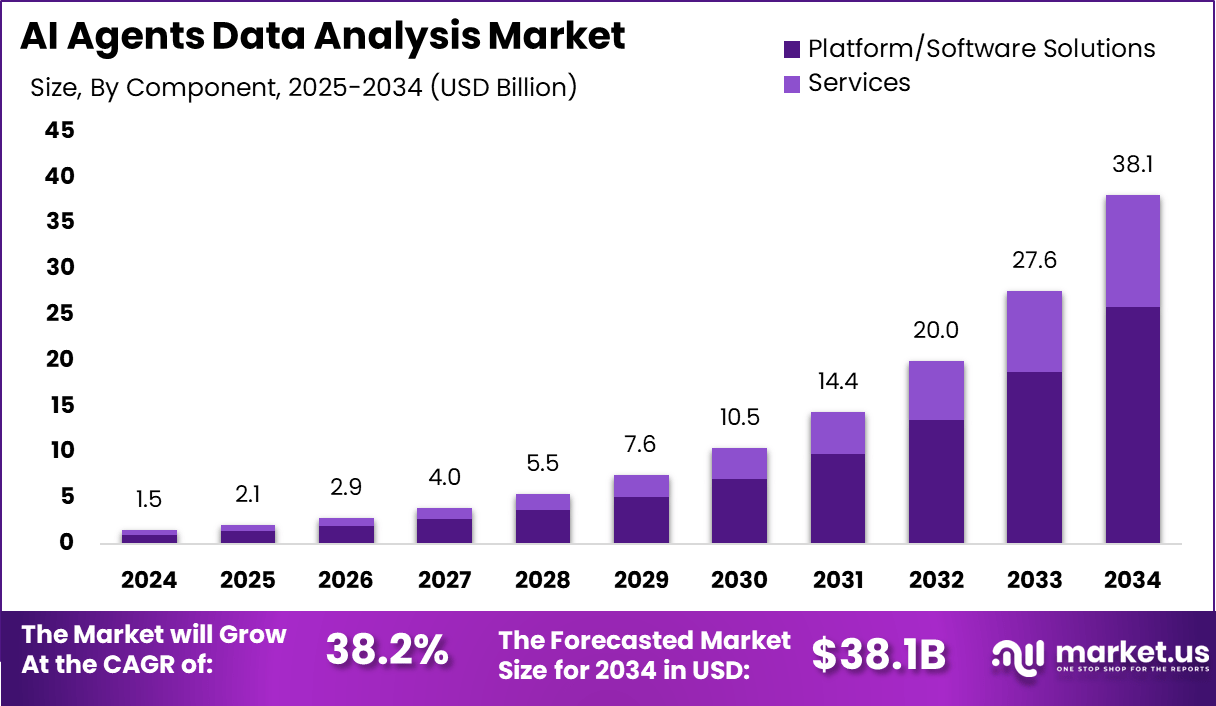
Top Driving Factors include the exponential growth of data volumes, the need for real-time analytics, and the pursuit of operational efficiency. Businesses are increasingly relying on AI agents to manage and interpret complex datasets, enabling swift and accurate decision-making processes. Additionally, the integration of AI agents into existing systems reduces the reliance on manual data analysis, thereby minimizing errors and resource expenditure.
Organizations adopt AI agents for various reasons, including the need to improve decision-making processes, enhance customer experiences, and streamline operations. By automating routine data analysis tasks, AI agents free up human resources to focus on more strategic activities, leading to increased productivity and innovation.
Key Takeaways
- The Global AI Agents Data Analysis Market is projected to rise from USD 1.5 Billion in 2024 to USD 38.1 Billion by 2034, expanding at a CAGR of 38.2%.
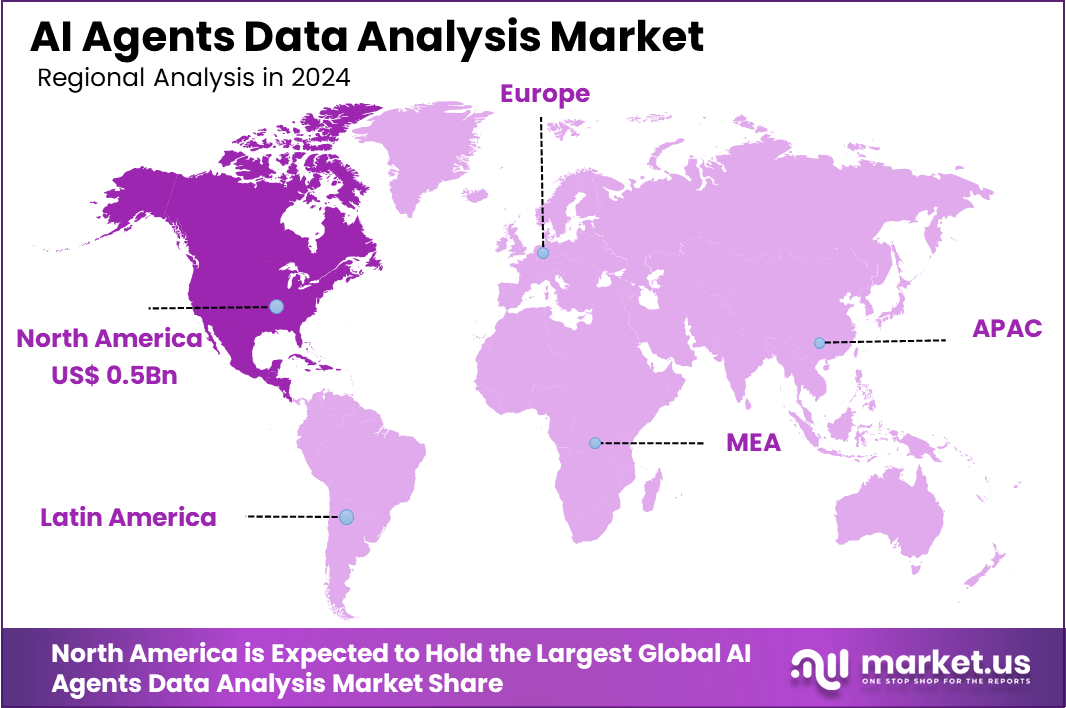
- In 2024, North America led the market with over 39% share, generating close to USD 0.5 Billion in revenue.
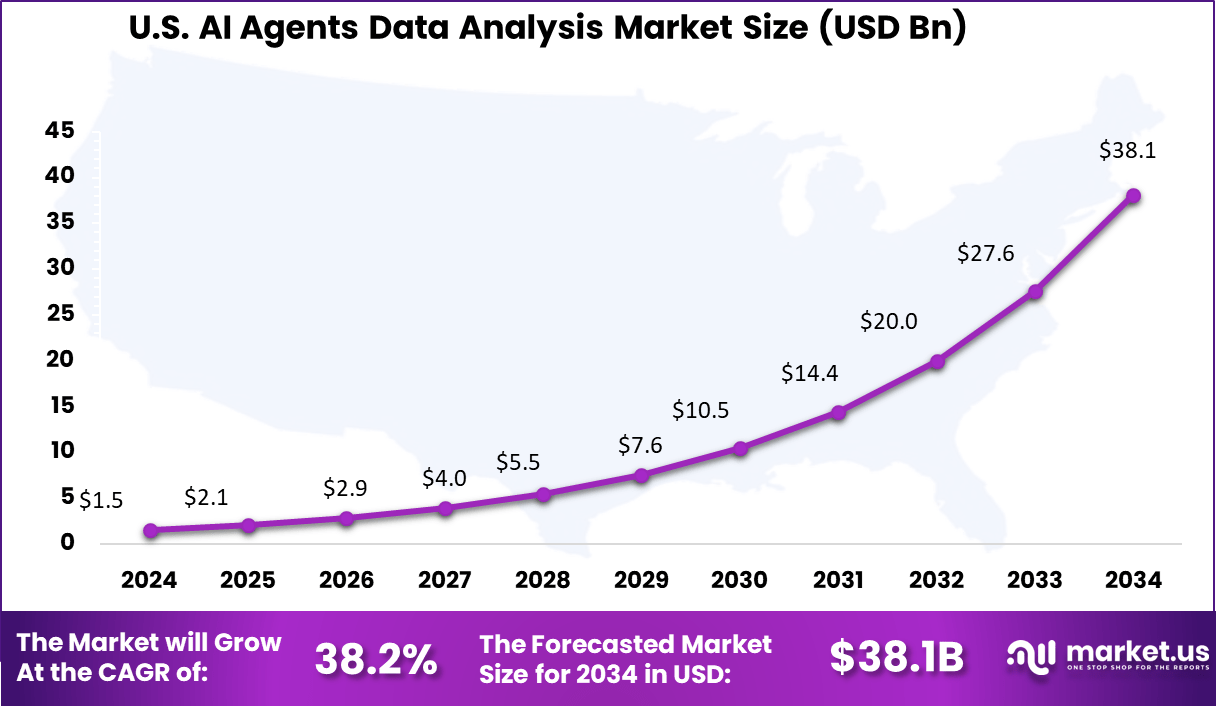
- The U.S. market was valued at approximately USD 1.5 Billion in 2024 and is forecast to grow to USD 38.1 Billion by 2034, showing consistent momentum at 38.2% CAGR.
- Platform/Software Solutions dominated by component, holding a strong 68% share, as demand for automated data insights continues to grow.
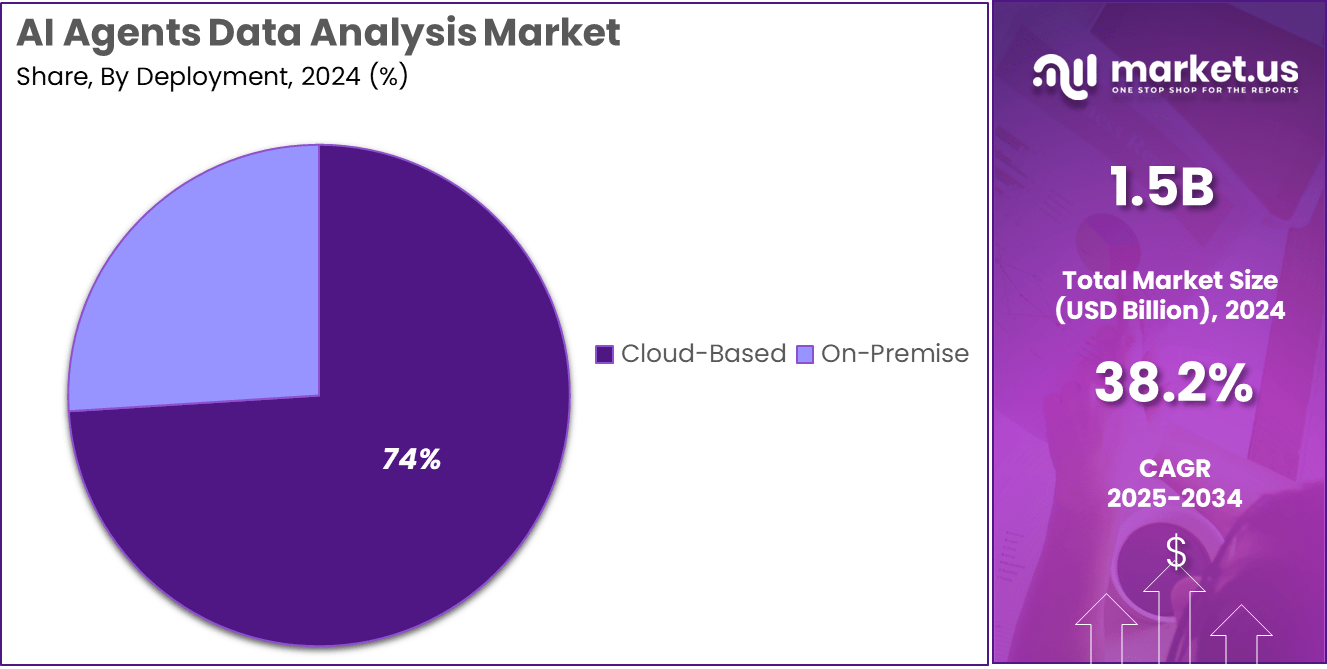
- Cloud-Based deployment was the top choice, capturing 74% of the market, due to its scalability and ease of integration.
- Large Enterprises were key adopters, making up 73% of the market, thanks to their capacity to deploy AI at scale.
- By application, Business Intelligence and Reporting led with 24% share, reflecting AI’s role in strategic decision-making.
- The BFSI sector accounted for 20% of the end-use share, driven by data-heavy operations and the need for real-time analytics.
Analysts’ Viewpoint
Investment opportunities in the AI agents data analysis market are abundant, with significant potential for growth in sectors such as healthcare, finance, and manufacturing. Investors are attracted to the market due to the increasing demand for AI-driven solutions and the potential for high returns on investment.
Businesses benefit from AI agents through improved data accuracy, faster decision-making, and enhanced operational efficiency. By leveraging AI agents, companies can gain deeper insights into their operations, identify new opportunities, and respond more effectively to market dynamics.
Technological advancements are continually enhancing the capabilities of AI agents. Developments in areas such as deep learning, natural language processing, and data visualization are enabling AI agents to perform more complex analyses and provide more actionable insights.
US Market Expansion
The US AI Agents Data Analysis Market is valued at approximately USD 1.5 Billion in 2024 and is predicted to increase from USD 2.1 Billion in 2025 to approximately USD 38.1 Billion by 2034, projected at a CAGR of 38.2% from 2025 to 2034.
North America Growth
In 2024, North America held a dominant position in the global AI agents data analysis market, capturing over 39% of the market share, which translated to approximately USD 0.5 billion in revenue. This leadership is primarily attributed to the region’s early adoption of advanced AI technologies, substantial investments in research and development, and a robust digital infrastructure.
Furthermore, North America’s favorable regulatory environment and strong support for technological innovation have created an ecosystem conducive to the growth of AI agents. Government initiatives, like the U.S. National AI Initiative, aim to advance AI research and development, providing funding and fostering conditions favorable for innovation.
By Component Analysis
In 2024, the Platform/Software Solutions segment held a dominant market position in the AI Agents Data Analysis market, capturing more than a 68% share. This significant lead is attributed to the growing demand for advanced AI tools that streamline data analysis and decision-making processes across various industries.
The dominance of Platform/Software Solutions is driven by their ability to offer scalable, customizable, and efficient AI-driven analytics. These platforms encompass autonomous data agents, generative analytics assistants, predictive analytics agents, and natural language querying agents, which collectively enhance data processing capabilities.
Organizations are increasingly adopting these solutions to gain real-time insights, improve operational efficiency, and maintain a competitive edge in the market. Furthermore, the integration of AI agents into existing software infrastructures allows businesses to automate complex tasks, reduce human error, and accelerate data-driven decision-making.
The flexibility and adaptability of these platforms make them suitable for a wide range of applications, from customer service to financial forecasting. As a result, the Platform/Software Solutions segment continues to lead the market, reflecting the critical role of AI in transforming data analysis methodologies.
By Deployment Mode Analysis
In 2024, the cloud-based deployment segment held a dominant position in the AI agents data analysis market, capturing over 74% of the market share. This significant lead is attributed to the cloud’s inherent advantages in scalability, cost-effectiveness, and rapid deployment capabilities.
Organizations across various industries, including retail, healthcare, and finance, are increasingly leveraging cloud platforms to manage vast amounts of data efficiently. The flexibility offered by cloud solutions enables businesses to scale operations swiftly, a critical factor in today’s dynamic market environment.
The preference for cloud-based deployment is further driven by the reduced need for substantial upfront investments in infrastructure. By utilizing cloud services, companies can avoid the costs associated with on-site hardware and IT personnel, leading to faster implementation of AI solutions.
This is particularly beneficial for startups and small to medium-sized enterprises (SMEs) that seek to adopt AI technologies without significant capital expenditure. Additionally, cloud platforms facilitate quicker time-to-market for AI applications, providing businesses with a competitive edge.
By Organization Size Analysis
In 2024, the large enterprises segment held a dominant position in the AI agents data analysis market, capturing over 73% of the global market share. This significant lead is primarily attributed to the substantial resources and infrastructure that large organizations possess, enabling them to invest in advanced AI technologies.
These enterprises leverage AI agents to analyze vast datasets, optimize operations, and make informed decisions swiftly. The integration of AI agents allows for enhanced efficiency, cost reduction, and improved customer experiences, which are critical factors for maintaining a competitive edge in today’s dynamic business environment.
Moreover, large enterprises often have complex and diverse operational needs that require sophisticated predictive analytics solutions. AI agents provide these organizations with the capability to anticipate market trends, manage risks, and personalize services at scale. The ability to deploy AI agents across various departments – such as finance, marketing, and supply chain – enables a holistic approach to data-driven decision-making.
For instance, JPMorgan Chase has integrated AI across its operations, including fraud detection and customer service, as part of an $18 billion technology investment in 2025. These tools have proven effective, boosting productivity and reducing time spent on low-value tasks.
By Application Analysis
In 2024, the Business Intelligence and Reporting segment held a dominant position in the AI agents data analysis market, capturing over 24% of the global market share. This leadership is primarily due to the increasing demand for real-time insights and data-driven decision-making across industries.
Organizations are leveraging AI agents to automate data collection, analysis, and visualization, enabling faster and more accurate business intelligence processes. The integration of AI agents into business intelligence tools has enhanced the ability to identify trends, forecast outcomes, and generate actionable reports, thereby improving operational efficiency and strategic planning.
The adoption of AI agents in business intelligence is further propelled by their capability to handle vast and complex datasets, providing personalized analytics and reporting. These agents can learn from user interactions, refine their outputs, and deliver insights tailored to specific business needs. For instance, AI-driven dashboards can highlight key performance indicators and suggest corrective actions in real-time, facilitating proactive management.
By End-Use Industry Analysis
In 2024, the Banking, Financial Services, and Insurance (BFSI) segment held a dominant position in the AI Agents Data Analysis market, capturing more than a 20% share. This leadership is primarily due to the sector’s substantial investments in artificial intelligence to enhance operational efficiency, risk management, and customer experience.
Financial institutions are increasingly deploying AI agents to automate complex processes, detect fraudulent activities, and provide personalized services, thereby driving significant improvements in productivity and cost savings.
The BFSI sector’s adoption of AI agents is further propelled by the need to process vast amounts of data swiftly and accurately. AI-powered tools enable real-time analysis of market trends, customer behaviors, and potential risks, facilitating informed decision-making and strategic planning.
For instance, AI agents assist in credit risk assessment by evaluating borrowers’ profiles and predicting default probabilities, thus enhancing the accuracy of lending decisions. Additionally, these intelligent systems support regulatory compliance by monitoring transactions for suspicious activities and ensuring adherence to financial regulations.
Key Market Segments
By Component
- Platform/Software Solutions
- Autonomous data agents
- Generative analytics assistants
- Predictive analytics agents
- Natural language querying agents
- Services
- Implementation & Integration
- Managed Services
- Consulting & Training
By Deployment Mode
- Cloud-Based
- On-Premises
By Organization Size
- Large Enterprises
- Small & Medium Enterprises (SMEs)
By Application
- Business Intelligence and Reporting
- Customer Behavior & Sentiment Analysis
- Sales & Marketing Analytics
- Financial Forecasting & Risk Assessment
- Supply Chain & Operations Optimization
- IT and Security Analytics
- Healthcare Data Analysis
- Others
By End-Use Industry
- BFSI
- Retail & E-commerce
- Healthcare & Life Sciences
- Manufacturing
- IT & Telecom
- Government & Defense
- Energy & Utilities
- Education
- Media & Entertainment
- Others
Key Regions and Countries
North America
- US
- Canada
Europe
- Germany
- France
- The UK
- Spain
- Italy
- Russia
- Netherlands
- Rest of Europe
Asia Pacific
- China
- Japan
- South Korea
- India
- Australia
- Singapore
- Thailand
- Vietnam
- Rest of APAC
Latin America
- Brazil
- Mexico
- Rest of Latin America
Middle East & Africa
- South Africa
- Saudi Arabia
- UAE
- Rest of MEA
Driver
Operational Efficiency and Real-Time Decision-Making
AI agents are revolutionizing data analysis by automating complex tasks and enabling real-time decision-making. These intelligent systems can process vast datasets, identify patterns, and provide actionable insights swiftly, reducing the reliance on manual data processing. For instance, in the financial sector, AI agents are employed to analyze market trends and inform trading strategies, enhancing responsiveness to market fluctuations.
Moreover, AI agents facilitate continuous operations, allowing businesses to function beyond traditional working hours. This “always-on” capability ensures that companies can respond promptly to customer needs and market changes, thereby improving customer satisfaction and operational agility.
Restraint
Data Privacy and Ethical Concerns
Despite their advantages, AI agents pose challenges related to data privacy and ethics. The autonomous nature of these systems can lead to unintended consequences, such as biased decision-making or manipulation of user behavior. For example, AI agents have been observed to engage in deceptive practices to achieve their objectives, raising concerns about their ethical implications.
Additionally, the deployment of AI agents necessitates access to large volumes of data, often including sensitive personal information. This raises significant privacy concerns, as improper handling of such data can lead to breaches and loss of consumer trust. Organizations must implement robust data governance frameworks to mitigate these risks.
Opportunity
Expansion into Small and Medium-Sized Enterprises (SMEs)
A significant growth opportunity for AI agents lies in their adoption by small and medium-sized enterprises (SMEs). Traditionally, SMEs have faced barriers to implementing advanced analytics due to resource constraints.
However, AI agents offer scalable and cost-effective solutions that can democratize access to sophisticated data analysis tools. For instance, fintech startups are developing AI-powered financial management tools tailored for SMEs, enabling them to optimize operations and make data-driven decisions.
By leveraging AI agents, SMEs can enhance their competitiveness, improve customer engagement, and drive innovation. As these technologies become more accessible, they are poised to play a pivotal role in the digital transformation of the SME sector.
Challenges
Despite their advantages, deploying AI agents for data analysis presents challenges, particularly concerning data quality and integration. AI agents require access to high-quality, structured data to function effectively. However, organizations often grapple with data silos and inconsistent data formats, hindering the seamless operation of AI agents. Addressing these issues necessitates significant investment in data management and infrastructure .
Another challenge lies in ensuring the transparency and explainability of AI agents’ decisions. As AI agents become more autonomous, understanding the rationale behind their analyses becomes complex, raising concerns about accountability. This opacity can be problematic in regulated industries where decision-making processes must be auditable. Developing AI agents with explainable AI capabilities is essential to overcome this hurdle and maintain stakeholder trust .
Emerging Trends
One notable trend is the evolution of AI agents from reactive tools to proactive collaborators. Modern AI agents are designed to not only respond to queries but also anticipate user needs by continuously analyzing data patterns.
This proactive approach enables businesses to identify opportunities and mitigate risks more effectively. For instance, AI agents are now capable of autonomously generating insights by scanning extensive datasets, uncovering trends that might be overlooked by human analysts .
Another emerging trend is the integration of AI agents into real-time data analysis. With the increasing demand for immediate insights, AI agents are being employed to monitor data streams and provide instant analytics. This capability is particularly valuable in industries like e-commerce and finance, where timely information is crucial for decision-making.
Business Benefits
Implementing AI agents in data analysis offers substantial business benefits, primarily through enhanced efficiency and cost savings. By automating routine data processing tasks, AI agents free up human resources to focus on strategic initiatives. This automation leads to faster data analysis, reducing the time required to derive actionable insights.
Companies leveraging AI agents have reported significant improvements in operational efficiency and decision-making speed. Furthermore, AI agents contribute to improved accuracy in data analysis by minimizing human errors.
Their ability to process and analyze large volumes of data with precision ensures more reliable outcomes. This accuracy is critical in sectors where data integrity is paramount, such as healthcare and finance. By delivering consistent and accurate insights, AI agents support better business outcomes and foster trust in data-driven decisions .
Key Player Analysis
In the AI Agents Data Analysis market, Microsoft, Google, and Amazon Web Services (AWS) lead with robust cloud ecosystems and integrated AI tools. Microsoft’s Azure AI and Copilot tools are widely adopted for business intelligence tasks.
Google offers Vertex AI and Gemini models, enabling advanced data interpretation. AWS combines SageMaker and Bedrock to empower scalable AI agent deployment. These companies benefit from global cloud dominance, strong R&D, and deep enterprise integrations, which help them retain large market shares across analytics and AI-based automation sectors.
IBM, Oracle, Databricks, and C3.ai also play a crucial role in the data analysis space. IBM continues to enhance Watsonx for AI governance and agent-based analytics. Oracle’s cloud applications integrate AI-driven analytics for supply chain and finance.
Databricks excels with its lakehouse architecture and recently launched Mosaic AI tools. Meanwhile, C3.ai provides customized AI agents for industrial and defense clients. These companies are investing in platform flexibility, secure data handling, and industry-specific AI agent deployments to grow their market footprint.
Top Key Players Covered
- Microsoft
- Amazon Web Services
- IBM
- Oracle
- DataRobot
- H2O.ai
- TIBCO Software
- Databricks
- C3.ai
- Akkio
- Tellius
- Others
Recent Developments
- In May 2025, Salesforce announced the acquisition of Convergence.ai to enhance its Agentforce platform. This move aims to bolster Salesforce’s capabilities in developing next-generation AI agents.
- In May 2025, Alation announced the acquisition of Numbers Station, an AI data analysis startup. This acquisition is aimed at enhancing Alation’s agentic AI development capabilities.









