


Report Overview
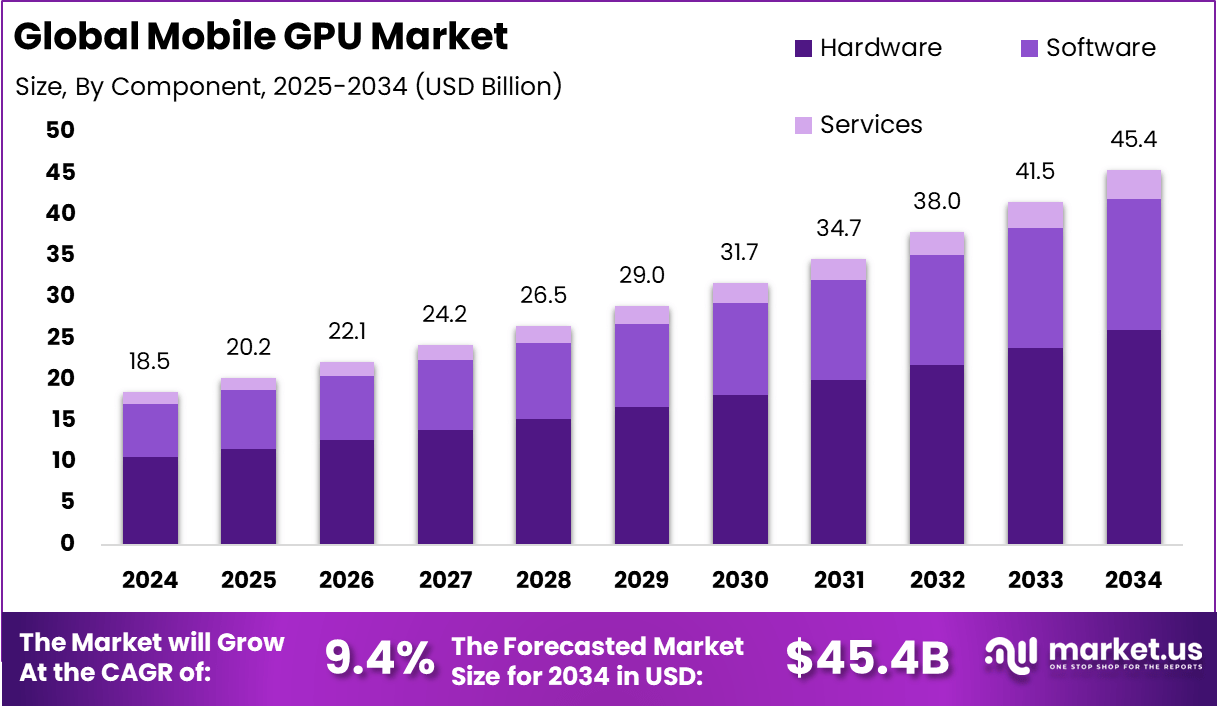
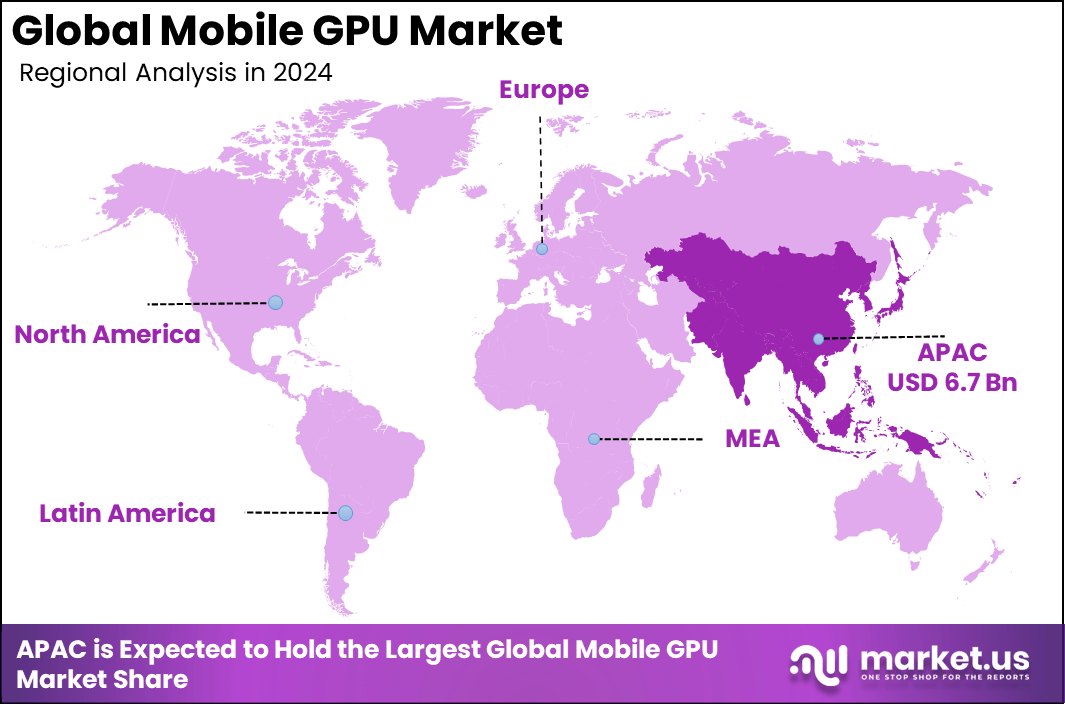
The Global Mobile GPU Market size is expected to be worth around USD 45.4 billion by 2034, from USD 18.5 billion in 2024, growing at a CAGR of 9.4% during the forecast period from 2025 to 2034. In 2024, Asia Pacific held a dominant market position, capturing more than a 36.4% share, holding USD 6.7 Billion in revenue.
A Mobile GPU, or Mobile Graphics Processing Unit, is a specialized chip integrated into smartphones, tablets, and laptops to handle graphics rendering and parallel processing tasks. Unlike their desktop counterparts, mobile GPUs are designed with a focus on power efficiency and thermal management to suit the compact and battery-powered nature of mobile devices.
The Mobile GPU market is experiencing significant growth, driven by the increasing demand for high-performance graphics in portable devices. Several factors are propelling the Mobile GPU market forward. The surge in mobile gaming has led to a demand for GPUs that can deliver console-quality graphics on handheld devices.
Additionally, the increasing use of AR and VR applications in areas like education, healthcare, and retail necessitates powerful mobile GPUs capable of handling complex visual computations. The trend towards high-resolution displays in smartphones and tablets also requires more advanced GPUs to ensure seamless user experiences.
The demand for mobile GPUs is closely tied to the adoption of technologies such as 5G, which enables faster data transmission and enhances the capabilities of mobile applications. Furthermore, the integration of AI in mobile devices for features like real-time language translation, facial recognition, and intelligent photography relies heavily on the parallel processing power of GPUs.
According to market.us, The Global Graphics Processing Unit (GPU) Market is witnessing explosive growth, projected to surge from USD 62.4 billion in 2024 to a staggering USD 821.3 billion by 2034, expanding at a robust CAGR of 29.40% over the forecast period (2025-2034). This surge reflects the soaring demand for high-performance computing across AI workloads, gaming, autonomous driving, digital twins, and virtual content creation, among other applications.
For instance, in January 2024, NVIDIA announced at CES 2024 its strategic move to integrate generative AI capabilities into RTX PCs and workstations, marking a major leap in on-device AI computing. These next-gen systems harness the power of Tensor Cores in RTX GPUs to significantly improve AI performance across both professional and consumer-grade application
Key Takeaways
- In 2024, the hardware segment led the Mobile GPU market with a commanding 57.4% share, reflecting strong demand for physical GPU components.
- The integrated GPU segment also held a dominant role, capturing 44.7% of the global market, driven by efficiency and cost advantages in mobile chipsets.
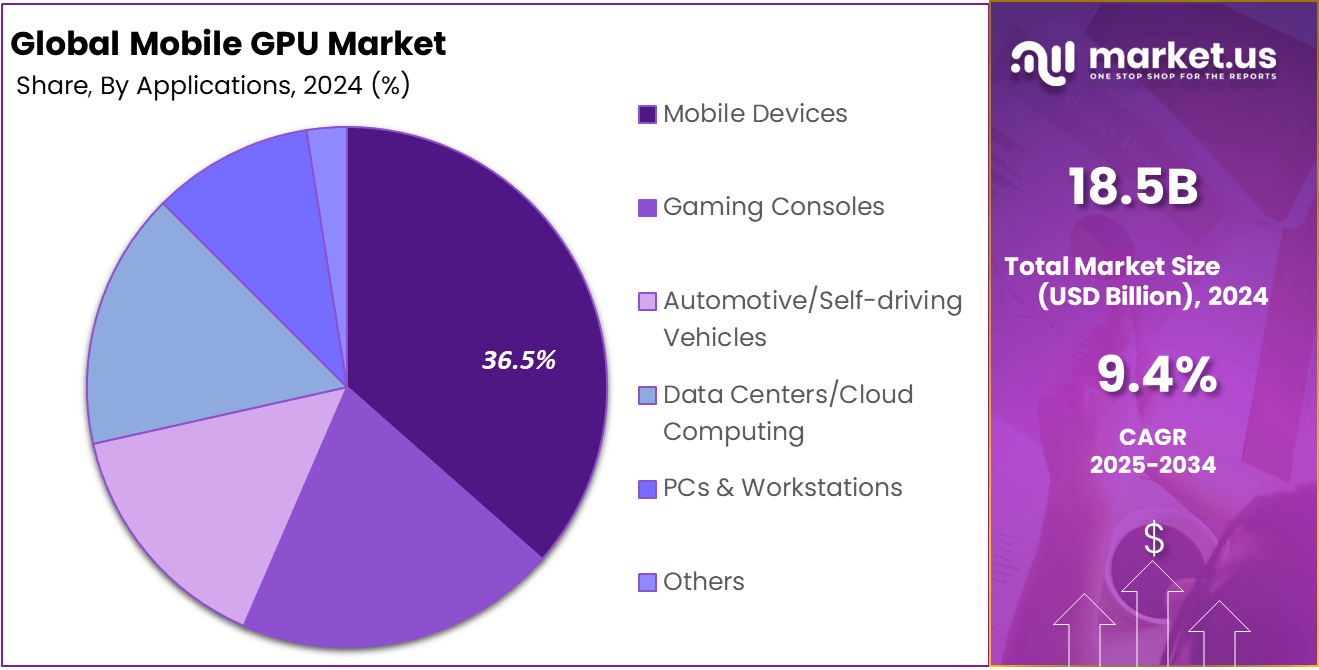
- Within application categories, mobile devices accounted for 36.5% of the global market, highlighting their widespread use in smartphones and tablets.
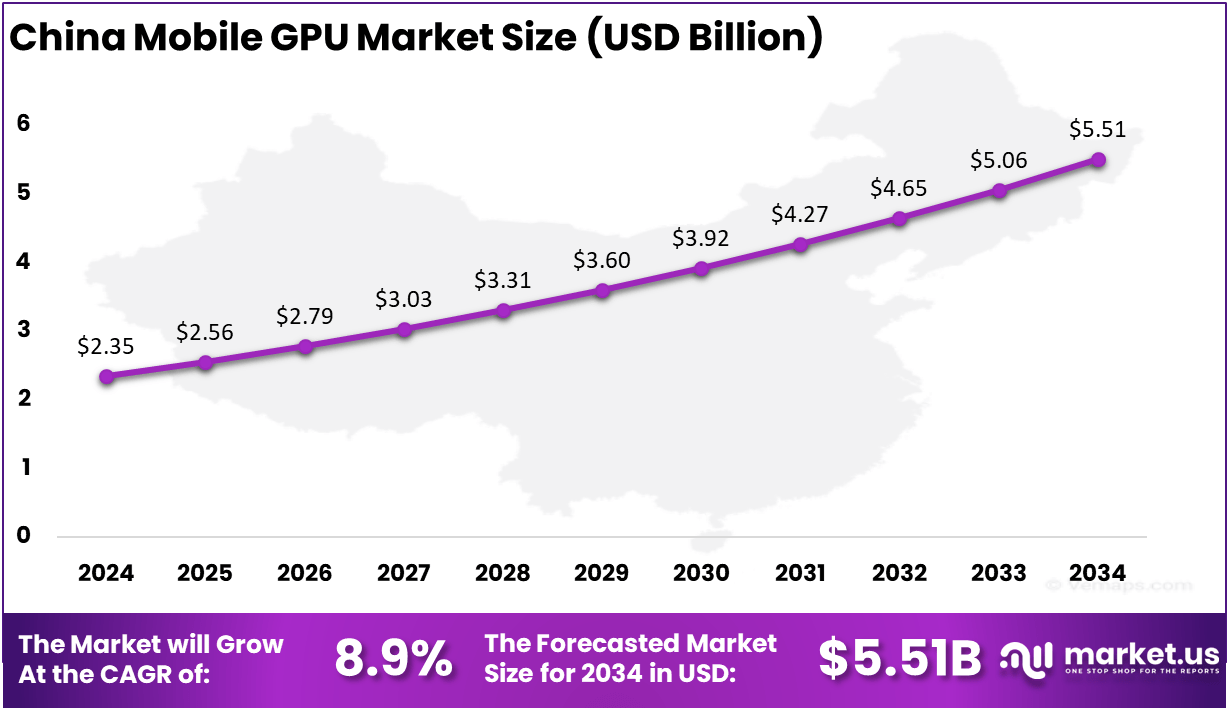
- The China Mobile GPU market was valued at USD 2.35 billion in 2024, supported by a steady growth trajectory at a CAGR of 8.9%.
- Regionally, Asia Pacific led the global market in 2024, holding more than a 36.5% share, fueled by high smartphone penetration and semiconductor manufacturing dominance.
Analysts’ Viewpoint
Businesses are investing in mobile GPU technology to stay competitive and meet consumer expectations for high-performance mobile experiences. The ability to offer advanced graphics and AI capabilities on mobile platforms opens up new opportunities for app developers, gaming companies, and content creators. Moreover, the continuous innovation in GPU technology allows businesses to differentiate their products and services in a crowded market.
From a technological standpoint, mobile GPUs have seen significant advancements in recent years. Manufacturers are focusing on developing GPUs with higher efficiency, better thermal management, and support for advanced APIs like Vulkan and DirectX 12. These improvements enable more realistic graphics, smoother gameplay, and enhanced battery life, which are critical factors for mobile device users.
Regulatory environments also play a role in shaping the Mobile GPU market. Policies promoting energy efficiency and reducing electronic waste encourage manufacturers to design GPUs that consume less power and have longer lifespans. Compliance with international standards ensures that mobile GPUs meet safety and environmental requirements, facilitating their adoption across different regions.
China Market Expansion
The market for Mobile GPU within CHINA is growing tremendously and is currently valued at USD 2.35 billion. Emerging rapidly, the market has a projected CAGR of 8.9%. This growth is fuelled by the growing need for graphics-intensive applications, such as mobile gaming, augmented reality (AR), and virtual reality.
Moreover, the fast-paced growth of artificial intelligence (AI) is prompting the requirement for GPUs with high processing power to handle complex computations and data processing. Government initiatives aimed at promoting digital infrastructure and technological innovation also increase the demand for mobile GPUs.
For instance, In January 2025, China rolled out a nationwide subsidy program targeting digital goods, including smartphones, which has significantly boosted the momentum of the mobile GPU market. Under this policy, consumers receive a 15% one-time subsidy on the sales price of qualifying devices, with a cap of 500 yuan per unit.
The initiative is designed to stimulate domestic spending, particularly in the smartphone sector, where high-end GPUs are vital for immersive gaming and multimedia. Analysts estimate that if even 10% of China’s 1.727 billion mobile phone users leverage this subsidy, it could drive a 100 billion yuan market for new devices.
APAC Market Growth
In 2024, Asia Pacific held a dominant market position in the global Mobile GPU market, capturing more than a 36.4% share. This rapid growth is due to the high demand for smartphones and consumer electronics, strong government investments in high-performance computing and semiconductor manufacturing, and widespread adoption of cutting-edge technologies such as artificial intelligence (AI), and cloud computing.
Among the leading nations are China, South Korea, and India (China), with China being a major producer and consumer of semiconductors, having received substantial government support for digital transformation and technological innovation. The thriving mobile gaming market, rising internet penetration, and increasing utilization of GPUs in new applications like autonomous vehicles and cybersecurity all contribute to faster market growth in the region.
For instance, In August 2024, Singtel and Hitachi announced a strategic collaboration to build next-generation data centers and GPU cloud services in Japan, with an expansion roadmap across the Asia Pacific beginning the same month. This partnership combines Singtel’s strength in data center operations and connectivity with Hitachi’s expertise in green power, advanced cooling (including ASO servers), and storage infrastructure.
Component Type Analysis
In 2024, the hardware segment held a dominant market position in the mobile GPU market, capturing more than a 57.4% share. This leadership is primarily due to the continuous innovation and introduction of new GPU models that offer enhanced performance and energy efficiency.
Companies are heavily investing in research and development to create advanced hardware that supports higher resolutions and faster processing speeds. This segment is also influenced by the increasing integration of GPUs in a wide range of mobile devices, from smartphones to tablets and even wearable technology.
For instance, In October 2024, MediaTek launched the Dimensity 9400 chipset, a major milestone that spurred growth in the mobile GPU hardware segment. At the heart of this flagship SoC is the ARM Immortalis-G925 MC12 GPU, engineered to deliver 35% better single-core performance, 41% faster graphics, and up to 44% power efficiency gains compared to its predecessor.
The dominance of the hardware segment is further reinforced by the growing demand for high-performance mobile devices capable of handling complex graphics rendering, immersive gaming experiences, and improved video processing. As mobile applications become more sophisticated, the need for powerful and efficient GPU hardware becomes more critical.
Type Segment Analysis
In 2024, the integrated segment held a dominant market position in the mobile GPU market, capturing more than a 44.7% share. This leadership is primarily due to the widespread adoption of integrated GPUs in mobile devices such as smartphones, tablets, and laptops.
Integrated GPUs offer a balance between performance and power efficiency, making them ideal for devices where battery life and thermal management are critical considerations. Additionally, advancements in integrated GPU technology have significantly improved their capabilities, allowing them to handle more demanding graphical tasks than before.
For instance, In October 2024, AMD unveiled its Ryzen™ AI PRO 300 Series processors, marking a major leap in integrated mobile GPU and on-device AI processing. Powered by the new “Zen 5” architecture and featuring the XDNA™ 2 NPU, these chips can handle up to 55 AI tasks per second, showcasing high efficiency in trillions of operations per second (TOPS). This shift enables smoother, real-time AI execution directly on devices, reducing cloud dependency and enhancing responsiveness.
The dominance of the integrated segment is further reinforced by the cost-effectiveness and space-saving benefits of integrating the GPU directly into the system’s main processor. This integration reduces the need for additional hardware components, leading to thinner and lighter device designs, which are highly desirable in the consumer electronics market.
Application Analysis
In 2024, the Mobile Devices segment held a dominant market position in the mobile GPU market, capturing more than a 36.5% share. This leadership is primarily driven by the widespread adoption of smartphones and tablets, which require efficient and powerful graphics processing units (GPUs) to handle high-resolution displays, gaming, and multimedia applications.
The integration of advanced GPUs in mobile devices enhances user experiences by enabling smoother graphics, faster rendering, and improved battery efficiency. The dominance of the Mobile Devices segment is further reinforced by the continuous advancements in mobile GPU technology, which have significantly improved the performance and capabilities of smartphones and tablets.
Manufacturers are increasingly focusing on developing GPUs that support artificial intelligence (AI) and machine learning (ML) functionalities, enabling features such as real-time image processing, augmented reality (AR), and virtual reality (VR) applications. These technological enhancements have expanded the use cases of mobile devices, making them more versatile and essential in daily life.
For instance, In February 2025, Imagination Technologies introduced its latest GPU IP, ‘Imaginations DXTP’, targeting graphics and compute acceleration on power-constrained devices like smartphones and automotive systems. This next-gen GPU IP delivers up to 20% better power efficiency (FPS/W) compared to its predecessor, thanks to smart micro-architectural enhancements.
Designed with ultra-low power environments in mind, the DXTP offers impressive specs – up to 64 GPixel/s, 2 TFLOPS FP32, and 8 TOPS INT8, driven by a 1GHz ultra-parallel compute engine. Available in two flexible configurations, the DXTP has already been licensed for both mobile and automotive applications, highlighting growing demand for high-efficiency, AI-ready GPU solutions in energy-sensitive use cases.
Key Market Segments
By Component
- Hardware
- Software
- Services
By Type
- Integrated
- Dedicated
- Hybrid
By Application
- Mobile Devices
- Gaming Consoles
- Automotive/Self-driving Vehicles
- Data Centers/Cloud Computing
- PCs & Workstations
- Others
Key Regions and Countries
North America
- US
- Canada
Europe
- Germany
- France
- The UK
- Spain
- Italy
- Russia
- Netherlands
- Rest of Europe
Asia Pacific
- China
- Japan
- South Korea
- India
- Australia
- Singapore
- Thailand
- Vietnam
- Rest of APAC
Latin America
- Brazil
- Mexico
- Rest of Latin America
Middle East & Africa
- South Africa
- Saudi Arabia
- UAE
- Rest of MEA
Drivers
Growing Popularity for Mobile Gaming
The mobile gaming market is experiencing significant growth, which can be attributed in part to the popularity of GPUs. Mobile GPUs are becoming more popular as the gaming industry continues to evolve, leading to a demand for more immersive and graphic-intensive experiences.
To achieve smooth gameplay, high frame rates, and realistic graphics, GPUs with significant speed are crucial for resource-intensive games, AR/VR applications, or cloud gaming. With the multi-billion-dollar industry of mobile gaming attracting more and more demanding graphics cards (and other types of video processing devices), manufacturers have started to develop powerful, but relatively inefficient GPUs that can also handle high power consumption.
For Instance, In January 2024, mobile esports tournaments achieved impressive viewership figures worldwide, demonstrating the growing global interest in this genre. The Mobile Legends: Bang Bang M6 game showcased an exciting new format and its unique gameplay mechanics. With a peak concurrent viewership of 4.13 million, the World Championship is among the top-rated esports events globally.
In the same way, the PUBG Mobile Global Championship’s grand finals garnered more than 985,000 peak viewers underscoring the game’ continued popularity. The emergence of mobile gaming and the demand for high-performance mobile GPUs to ensure smooth and immersive gaming is highlighted by these events.
Restraint
Power Consumption and Battery Life
Managing power consumption and optimizing battery life is a significant hurdle in the mobile GPU market. With the development of mobile GPUs that offer improved graphics and performance, they also consume more power. The overall battery life of mobile devices, including smartphones, tablets, and gaming handhelds, can be significantly impacted by the extra power consumed.
The balance between battery life and performance is a crucial consideration for consumers. Battery usage is typically accelerated by the use of powerful GPUs, which are crucial for demanding applications like mobile gaming and augmented reality. In response, manufacturers are pursuing energy-efficient GPU architectures and power management technologies.
For instance, In December 2023, the launch of Snapdragon 8 Gen 3 brought substantial performance improvements, yet raised concerns about power consumption and thermal efficiency. An evaluation by Digitec on the Redmagic 9 Pro, equipped with this chipset, revealed that battery drain accelerated during high-demand tasks like video streaming – noticeably faster than its predecessor, the Redmagic 8S Pro.
While Qualcomm touted better energy management, real-world tests suggested otherwise. In the 3DMark Wild Life Extreme stress test, the Redmagic 9 Pro peaked at 59°C, compared to 49°C on the 8S Pro. This thermal increase resulted in performance throttling, which can compromise both GPU longevity and sustained performance, highlighting a critical trade-off between peak speed and energy balance in next-gen chipsets.
Opportunities
Cloud Gaming Expansion
The rise of cloud gaming is transforming the way people play games, with mobile devices becoming powerful platforms for remotely accessing high-performance gaming experiences. Game developers no longer need to invest in high-end hardware for game processing, as this shift has made it possible to play games with higher graphics.
This is why mobile GPUs are essential, as they provide seamless game streaming with minimal latency and excellent graphics. To succeed in cloud gaming, mobile devices must offer smooth and high-fidelity gameplay even in less-than-ideal network conditions.
For instance, In April 2025, Xbox Cloud Gaming reached a major milestone, with users now logging tens of millions of gameplay hours per month, as confirmed by CEO Phil Spencer. Although smartphones currently represent just 6.7% of the platform’s total usage, the surge in mobile gaming demand is pushing the need for advanced mobile GPUs that can deliver high-fidelity graphics with minimal latency.
Challenges
Disruption in the Mobile GPU Supply Chain due to tariff change
The recent decision by the U.S. administration to impose tariffs of up to 145% on selected Chinese imports, including graphics cards, is sending ripples through the mobile GPU market. These steep tariffs have substantially increased production costs for electronics manufacturers in China, especially for firms like NVIDIA and AMD that rely on Chinese assembly for key components.
The result is a sharp rise in supply chain costs, which is already trickling down into higher prices for mobile devices powered by advanced GPUs. Consumers may feel the impact in the form of more expensive smartphones and gaming hardware, while manufacturers are being forced to either absorb the added costs or raise end-product pricing.
On a broader scale, this tariff escalation has introduced significant uncertainty, as fears grow over potential Chinese countermeasures that could disrupt the global electronics supply chain, causing delays in production and distribution. The overall sentiment is one of caution, as stakeholders across the industry navigate pricing pressure and geopolitical risk.
The introduction of new export restrictions and steep U.S. tariffs has dramatically altered the economics of GPU manufacturing, particularly for Chinese operations involving NVIDIA and AMD. The financial impact is substantial – NVIDIA’s H20 chip alone incurred a staggering $5.5 billion in fees, while AMD has projected a hit of around $800 million due to tariff-related disruptions.
These pressures are further amplified by the uncertainty surrounding future trade policy and fears of Chinese countermeasures, which together are shaking the stability of the global supply chain. As a result, mobile GPU makers are actively reevaluating their supply strategies, increasingly shifting toward domestic or non-Chinese suppliers to mitigate geopolitical risks.
Latest Trends
The mobile GPU market in 2025 is undergoing a major transformation, driven by the deep integration of AI and machine learning into graphics processing. Today’s mobile GPUs are evolving well beyond traditional rendering engines – they are becoming intelligent computing cores capable of real-time upscaling, adaptive resolution, power optimization, and contextual enhancements.
Features like DLSS (Deep Learning Super Sampling) are making their way from desktops to handheld devices, helping maintain high frame rates without compromising visual fidelity. AI algorithms now allow mobile GPUs to intelligently manage workloads, improve image and video quality, and support tasks such as facial recognition, speech processing, and real-time scene interpretation, making smartphones more responsive and capable.
A notable advancement came in April 2025, when Qualcomm launched the Snapdragon 8s Gen 4, marking a significant performance leap in the mid-range smartphone segment. Built on TSMC’s 4nm N4P process, it features the new Adreno 825 GPU, which delivers a 49% boost in graphics performance over its predecessor.
It also supports Snapdragon Elite Gaming technologies, including the Adreno Frame MotionEngine 2.0 and the Adaptive Performance Engine, a power-efficiency mechanism inspired by AMD’s GPU tech. These features enable smoother gameplay and reduced power drain, while the addition of on-device ray tracing brings console-level lighting and visual effects to mobile devices.
Key Player Analysis
In January 2025, MediaTek and NVIDIA announced a major leap in mobile GPU innovation with the launch of the GB10, built on the power of NVIDIA’s Grace Blackwell Superchip. This new SoC combines up to 1 petaflop of AI performance at FP4 precision, making it one of the most capable mobile computing platforms ever developed.
The GB10 features a Blackwell GPU equipped with fifth-generation Tensor Cores, linked via NVLink-C2C to a 20-core Arm CPU. This configuration supports real-time AI workloads, helping developers and researchers build and test large models locally – without relying on cloud infrastructure. The GB10 underpins Project DIGITS, NVIDIA’s initiative to democratize personal AI supercomputing.
Meanwhile, in December 2024, Unisoc, the chipmaking arm of Tsinghua Unigroup, secured fresh equity financing of CNY 2 billion (approx. USD 448 million), boosting its cumulative capital to NT$26.8 billion. This funding surge reflects growing investor confidence in China’s push for chip sovereignty.
Unisoc is not just expanding capacity – it’s scaling across 5G, satellite connectivity, smart wearables, and automotive electronics. The company shipped 29 million mobile processors in Q3 alone, signaling strong demand and a clear intent to challenge dominant players in the mid-tier and entry-level chip segments across Asia and emerging markets.
Top Key Players Covered
- NVIDIA Corporation
- Advanced Micro Devices, Inc. (AMD)
- Apple Inc.
- Qualcomm Technologies, Inc.
- ARM Holdings plc
- Imagination Technologies Group plc
- Intel Corporation
- Samsung Electronics Co., Ltd.
- Broadcom Inc.
- MediaTek Inc.
- Huawei Technologies Co., Ltd.
- Vivante Corporation
- ZiiLABS Inc., Ltd.
- Rockchip Electronics Co., Ltd.
- Spreadtrum Communications, Inc.
- PowerVR (Imagination Technologies)
- Others
Recent Developments
- In April 2025, NVIDIA made waves at CES with the official launch of its RTX 50-series mobile GPUs, marking a bold step forward in mobile gaming hardware. Built on the advanced Blackwell architecture, the new series includes standout models like the RTX 5090 and RTX 5080, which come equipped with 16GB of GDDR7 memory and a TDP of up to 175W – an unprecedented spec in mobile GPU design.
- In February 2025, Imagination Technologies unveiled its IMG DXT GPU, a significant development for mid-range and entry-level smartphones. The DXT GPU introduces hardware-accelerated ray tracing to mobile platforms using its innovative Photon architecture, which meets Level 4 standards on the Ray Tracing Layer System. Features like Fragment Shading Rate (FSR) and dual-rate texturing help boost rendering quality and frame rates while preserving battery life.









