


Report Overview
The Global Visual Effects (VFX) Market size is expected to be worth around USD 28,073.92 Million By 2033, from USD 10,440.5 Million in 2023, growing at a CAGR of 10.7% during the forecast period from 2024 to 2033.
Visual Effects (VFX) refer to the process of creating or manipulating imagery outside the context of live-action footage. This technique encompasses a range of methods, including computer-generated imagery (CGI), compositing, and motion capture, to produce environments, objects, creatures, and effects that would be impractical or impossible to capture on film.
The global Visual Effects (VFX) market has been experiencing significant growth, driven by the escalating demand for high-quality visual content across various media platforms. Key driving factors for the VFX market include the rising consumer appetite for immersive experiences, advancements in technology, and the globalization of media content.
The surge in demand for realistic and high-quality visuals has compelled production houses to invest heavily in VFX to meet audience expectations. Moreover, the competitive landscape of streaming platforms has intensified the need for distinctive and visually captivating content, further propelling the adoption of VFX in content creation.

The adoption of emerging technologies such as artificial intelligence (AI), augmented reality (AR), and virtual reality (VR) has revolutionized the VFX landscape. AI facilitates more efficient workflows by automating complex processes, while AR and VR offer new dimensions for immersive storytelling. These technologies enable VFX professionals to create more realistic and interactive experiences, thereby expanding the scope and application of visual effects in various industries.
The primary reasons for adopting these technologies include the need for cost-effective production methods, the desire to streamline workflows, and the ambition to push creative boundaries. By integrating AI, AR, and VR into VFX processes, studios can reduce production time and costs while enhancing the quality and complexity of visual effects. This technological synergy allows for greater experimentation and innovation in content creation.
According to WorldMetrics, the average annual salary for VFX artists in the United States is $71,110, reflecting the high demand and specialization required in this field. The United States leads the global VFX industry, holding over 35% of the market share. VFX is deeply embedded in Hollywood, with over 80% of blockbusters incorporating visual effects to captivate audiences and enhance storytelling.
However, the industry is grappling with a talent shortage. More than 80% of VFX companies report a scarcity of skilled professionals, highlighting a critical gap in the workforce. India is emerging as a strong contender, rapidly expanding its footprint in the VFX industry at an impressive 16% growth rate annually. This growth is attributed to a combination of skilled labor availability and lower operational costs, making India an attractive hub for VFX production and outsourcing.
The gaming industry is a significant driver of VFX demand, representing over 25% of the market share. Additionally, advances in virtual reality (VR) and augmented reality (AR) are fueling new opportunities, with a projected market value of $124.5 billion by 2023. These technologies are pushing the boundaries of VFX, creating immersive experiences that are reshaping entertainment and beyond.
Key Takeaways
- Visual Effects (VFX) Market size is expected to reach USD 40 billion by 2033, projected at a CAGR of 10.7% during forecast period.
- In 2023, the Simulation FX segment held a dominant position in the Visual Effects (VFX) market, capturing more than a 26% share.
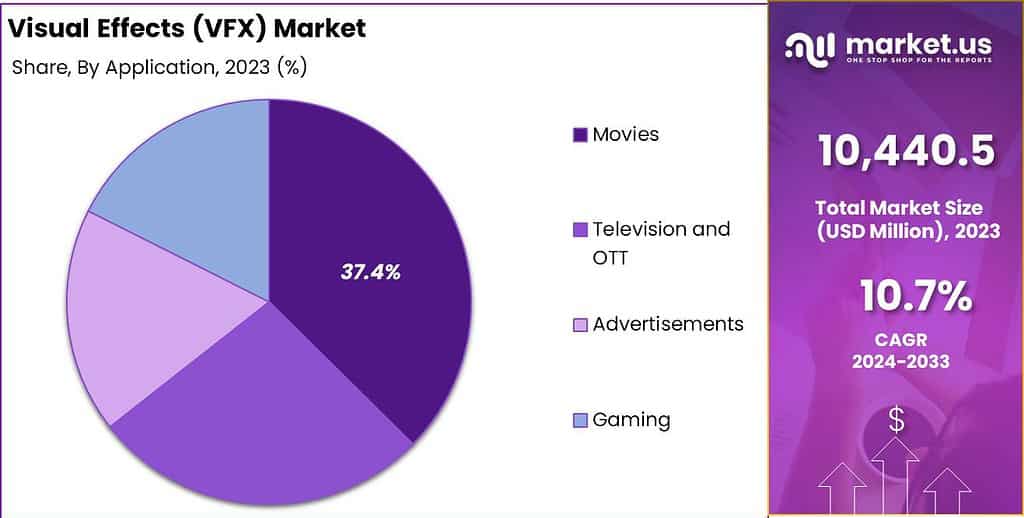
- In 2023, the Movies segment held a dominant position in the Visual Effects (VFX) market, capturing more than a 37% share.
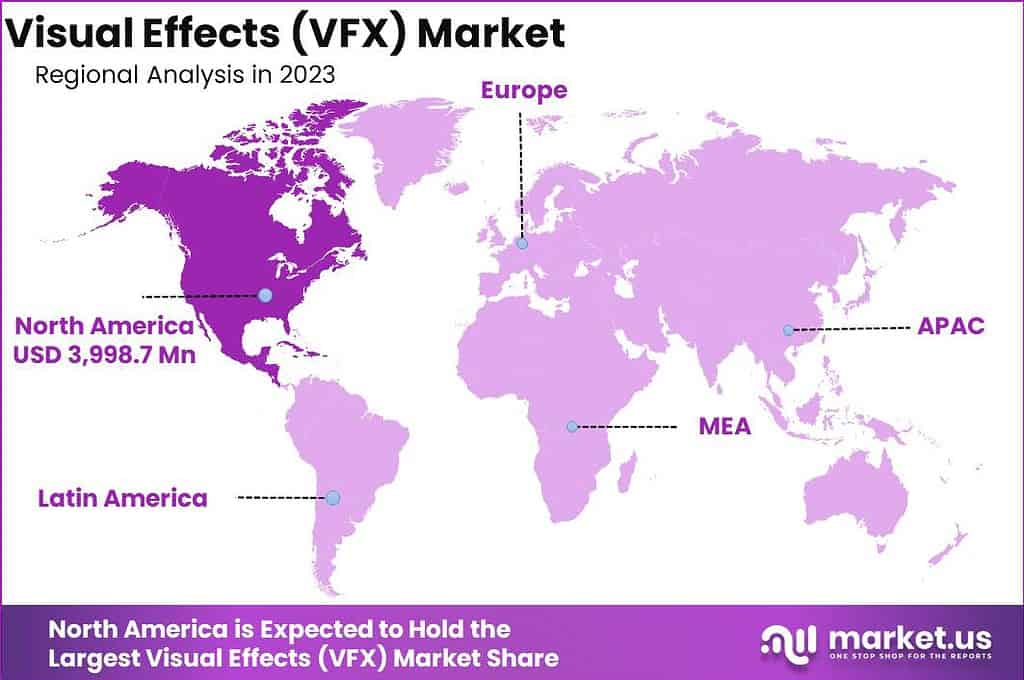
- In 2023, North America held a dominant market position in the Visual Effects (VFX) industry, capturing more than a 41% share of the global market.
- AI systems are predicted to handle 25% of all roto work in the VFX industry by 2024. This incorporation signifies a substantial shift towards automation in repetitive tasks within the industry.
- By 2025, the adoption of artificial intelligence (AI) and machine learning in the VFX and Animation industry is expected to grow at a compound annual growth rate (CAGR) of approximately 14.3%. This growth underscores the increasing reliance on these technologies to enhance creativity and efficiency in film production.
- Movies that have utilized AI-powered VFX have experienced an increase in ticket sales by 25% compared to those using traditional VFX methods. This trend highlights the commercial advantages of integrating advanced AI techniques in visual effects, appealing to a broader audience through more engaging and innovative visual storytelling.
- In a recent survey, 88.5% of VFX artists expressed their belief that AI will not replace their jobs but will rather serve as an aid. This perspective reflects a recognition of AI as a tool that enhances their capabilities rather than a threat to their professional existence.
Type Analysis
In 2023, the Simulation FX segment held a dominant position in the Visual Effects (VFX) market, capturing more than a 27.5% share. This segment leads due to its critical role in creating highly realistic environments and elements such as fire, smoke, water, and explosions, which are increasingly demanded in high-action films, video games, and virtual reality simulations.
The demand is particularly high in blockbuster films and AAA gaming titles, which rely on Simulation FX to deliver immersive and visually compelling experiences to audiences. The strength of the Simulation FX segment is further bolstered by technological advancements that have improved the speed and quality of simulations.
Developments in computer processing power, along with more sophisticated software capabilities, allow for more detailed and complex effects to be rendered in shorter times. This has enabled studios to include Simulation FX in a wider range of projects, from big-budget movies to independent productions seeking to enhance their visual appeal.
Moreover, the expansion of virtual and augmented reality platforms has opened new markets for Simulation FX. These technologies rely heavily on realistic simulations to engage users, making Simulation FX indispensable in the development of content for VR and AR experiences.
As these platforms grow, the demand for Simulation FX is expected to increase, ensuring its continued dominance in the VFX market. This segment’s growth is underpinned by the ongoing innovation in software and hardware technologies, as well as the global rise in content production that requires high-quality visual effects.
Application Analysis
In 2023, the Movies segment held a dominant position in the Visual Effects (VFX) market, capturing more than a 37.41% share. This significant market presence can be attributed to the escalating demand for high-quality, visually captivating content that enhances storytelling and viewer engagement. As filmmakers increasingly turn to VFX to deliver groundbreaking cinematic experiences, this segment benefits from substantial investments in advanced technologies and skilled talent.
Major blockbuster films, particularly in genres such as action, science fiction, and fantasy, heavily rely on VFX to create realistic and immersive worlds that are often impossible to achieve through traditional filmmaking techniques alone. The leadership of the Movies segment is further reinforced by the global box office’s recovery post-pandemic, which has seen an upsurge in audience attendance and a strong consumer preference for visually enhanced cinematic experiences.
Moreover, the integration of VFX in movies is not just limited to special effects but extends to subtle enhancements that improve the overall quality of the visual output, making it a critical component in modern filmmaking. This trend is supported by data indicating that VFX-heavy films consistently rank among the highest-grossing titles globally, driving substantial revenue for the VFX market.
Further bolstering the dominance of the Movies segment is the competitive landscape of the VFX industry, where leading studios invest heavily in proprietary software and artistic capabilities to deliver unparalleled visual experiences. This investment is driven by the studios’ need to differentiate their offerings in a highly saturated market, ensuring audience engagement and loyalty.
As technology continues to evolve, the application of VFX in movies is expected to grow, leveraging new innovations such as virtual reality and artificial intelligence to push the boundaries of what is visually possible, thus maintaining its lead in the VFX market.
Key Market Segments
By Type
- Matte Painting
- Simulation FX
- Motion capture
- Compositing
- Others
By Application
- Movies
- Television & OTT
- Advertisements
- Gaming
Driver
Technological Advancements in VFX Software and Hardware
The continuous advancements in VFX software and hardware act as a significant driver for the Visual Effects market. Innovations such as real-time rendering, AI-driven simulation, and enhanced motion capture technologies have revolutionized how visual effects are integrated into various media. These technological improvements not only allow for more detailed and realistic visuals but also streamline the VFX production process, reducing turnaround times and lowering costs.
As a result, even productions with modest budgets can now incorporate high-quality effects, broadening the scope of projects that utilize VFX. This democratization of VFX technology is instrumental in driving its adoption across movies, television, advertisements, and gaming, ensuring a dynamic expansion of the VFX market.
Restraint
High Costs of VFX Production
The high costs associated with VFX production remain a substantial restraint for the market. Creating detailed and high-quality visual effects requires significant investment in both technology and skilled personnel. The expense of advanced VFX software, along with the need for specialized artists who command premium salaries, can be prohibitively high, especially for small to medium-sized enterprises and independent filmmakers.
Additionally, the complexity of VFX tasks often necessitates extended production timelines, further escalating costs. These financial barriers can limit the accessibility of advanced visual effects in lower-budget films and regional markets, potentially stifling the growth of the VFX industry in less affluent sectors.
Opportunity
Expansion of Virtual Production
An emerging opportunity in the VFX market is the expansion of virtual production, which integrates physical filming with real-time VFX. This method uses technologies such as LED walls and augmented reality to blend real environments with CGI during the filming process itself, allowing for more immersive and visually compelling productions.
Virtual production not only enhances creative possibilities but also offers practical benefits like reduced need for on-location shoots and greater control over environmental conditions. As this technology becomes more accessible and cost-effective, it opens up new avenues for filmmakers, potentially transforming production methodologies across the industry and expanding the market for VFX.
Challenge
Keeping Pace with Rapid Technological Change
One of the main challenges facing the VFX market is the rapid pace of technological change. The constant evolution of software and hardware requires continuous learning and adaptation from professionals within the industry. VFX studios must regularly update their technological capabilities and train their staff to keep up with new tools and techniques.
This ongoing need for investment in both technology and human resources can strain resources, especially for smaller studios. Additionally, the fast-changing landscape can lead to compatibility issues between new and existing technologies, complicating production workflows and project delivery.
Growth Factors
- Increased Demand for High-Quality Content: As audiences worldwide develop a taste for high-resolution, visually engaging content, the demand for sophisticated visual effects in movies, TV shows, and online media continues to grow. This trend is driving the VFX industry’s growth as producers seek to meet viewer expectations for cutting-edge visual storytelling.
- Rise of Streaming Services: The expansion of streaming platforms like Netflix, Amazon Prime, and Disney+ has led to an increase in original content production, each vying for uniqueness and viewer engagement through high-quality visual effects, thereby fueling the VFX market.
- Advancements in Virtual Reality (VR) and Augmented Reality (AR): The integration of VR and AR into entertainment and advertising creates new opportunities for VFX to enhance immersive experiences, pushing the boundaries of how visual effects are used and perceived.
- Global Film Production Increases: As global film production volumes rise, with countries offering favorable tax incentives and high-quality production facilities, there is a corresponding increase in the utilization of VFX, boosting the sector’s growth.
- Hybrid Workflows in Production: The adoption of hybrid workflows, which combine remote and on-site production processes, has been accelerated by the pandemic. This model reduces logistical costs and makes VFX production more flexible and scalable, contributing to market growth.
Emerging Trends
- AI and Machine Learning Integration: AI is increasingly being used to automate routine VFX tasks like rotoscoping and cleanup, allowing artists to focus on more creative aspects of VFX production. Machine learning algorithms are also being used to improve the quality and efficiency of effects simulations.
- Real-Time Rendering: Technologies such as Unreal Engine are promoting real-time rendering in VFX, which significantly reduces the time between concept and final output, enabling faster revisions and more dynamic production schedules.
- Virtual Production Uptake: Following the lead of high-profile productions like “The Mandalorian,” virtual production is gaining traction as a major trend. This technology allows for shooting with real-time VFX backgrounds, offering directors and cinematographers unprecedented flexibility.
- Sustainability in Production: There is an increasing focus on reducing the environmental impact of film production, including VFX work. Energy-efficient computing resources and virtual production techniques are being employed to minimize the carbon footprint of producing visual effects.
- Expansion of 3D Animation and Motion Capture: The use of 3D animation and motion capture in live-action films is becoming more prevalent, expanding beyond traditional animation. This trend is enhancing the realism and appeal of visual effects, driving further growth in the VFX market.
Regional Analysis
In 2023, North America held a dominant market position in the Visual Effects (VFX) industry, capturing more than a 38.3% share of the global market. This leading position can primarily be attributed to the region’s robust entertainment and media sector, particularly in the United States, which is home to Hollywood, the world’s premier hub for film and television production.
The demand for Visual Effects (VFX) in North America was valued at USD 3,998.7 Million in 2023 and is anticipated to grow significantly in the forecast period. The presence of major film studios, along with a high concentration of VFX companies, contributes significantly to the region’s market supremacy. Additionally, North America benefits from advanced technological infrastructure and a skilled workforce that are essential for the cutting-edge developments in VFX technology.
Further bolstering North America’s market position is its pioneering role in adopting new technologies such as 4K and 8K resolution, virtual reality (VR), and augmented reality (AR), which are increasingly integrated into visual effects to produce more immersive and high-quality content.
The region’s VFX industry is also supported by favorable government policies, including tax incentives offered to film and production companies, which encourage more domestic and foreign film productions to utilize North American VFX services.
Moreover, the demand for VFX in North America is propelled by the growing trend of streaming services, which are investing heavily in original content that relies on high-quality visual effects to attract viewers. Companies like Netflix, Amazon Prime Video, and Disney+ are becoming significant players in content creation, necessitating expansive VFX work that supports the region’s growth in this sector.
The combination of technological prowess, a highly skilled talent pool, supportive government policies, and a strong digital content streaming presence solidifies North America’s leading position in the global VFX market.
Key Regions and Countries
North America
- US
- Canada
Europe
- Germany
- France
- The UK
- Spain
- Italy
- Netherlands
- Rest of Europe
Asia Pacific
- China
- Japan
- South Korea
- India
- Australia
- Singapore
- Thailand
- Vietnam
- Rest of APAC
Latin America
- Brazil
- Mexico
- Rest of Latin America
Middle East & Africa
- South Africa
- Saudi Arabia
- UAE
- Rest of MEA
Key Players Analysis
The Visual Effects (VFX) market is characterized by a competitive landscape comprising key players who significantly influence the industry’s dynamics and growth trajectory. Prominent among these are Industrial Light & Magic (ILM), Weta Digital, and Framestore, each renowned for their contributions to major blockbuster films and substantial technological advancements. ILM, a division of Lucasfilm, continues to set industry standards with its innovative techniques and has a storied history of creating groundbreaking visual effect
Top Key Players in the Market
- The Walt Disney Co.
- Adobe Inc.
- Autodesk Inc.
- DNEG
- Animal Logic
- Maxon Computer GMBH
- Blackmagic Design Pty Ltd
- SideFX
- The Foundry Visionmongers Limited
- CINESITE
Recent Developments
- In March 2024, Digikore Studios Limited (NSE – DIGIKORE), a company with extensive experience in providing visual effects for various projects, made an exciting announcement. They shared their plans to launch the world’s first cloud-based marketplace for virtual production sets. This innovative platform will revolutionize the industry by offering a convenient and accessible way for filmmakers to access virtual sets for their productions.
- In 2023, Disney focused on strengthening its streaming services and content offerings. Notably, the company announced a restructuring to enhance accountability and creativity across its businesses. Disney also released new programs on Disney+, such as “Percy Jackson and the Olympians,” and planned new releases like “Moana 2” for November 2024.
- In October 2023, a group of companies, associations, and experts in the visual effects industry came together to create a special event called World VFX Day. This exciting global celebration is set to kick off on December 8 and aims to bring attention to the incredible work done by the visual effects sector. These talented professionals help filmmakers bring their stories to life in ways that were previously unimaginable.









