


Market Size & Trends
The Global Continuous Variable Transmission Market size is expected to be worth around USD 41.3 Billion by 2034, from USD 22.4 Billion in 2024, growing at a CAGR of 6.3% during the forecast period from 2025 to 2034. This growth is driven by increasing demand for fuel-efficient vehicles and advancements in automotive transmission technology.

Key Takeaways
- The Global Continuous Variable Transmission Market is projected to reach USD 41.3 Billion by 2034, growing from USD 22.4 Billion in 2024 at a CAGR of 6.3%.
- In 2024, the Belt-drive segment dominated the By Type Analysis with a 31.2% share due to its fuel efficiency and smooth power delivery.
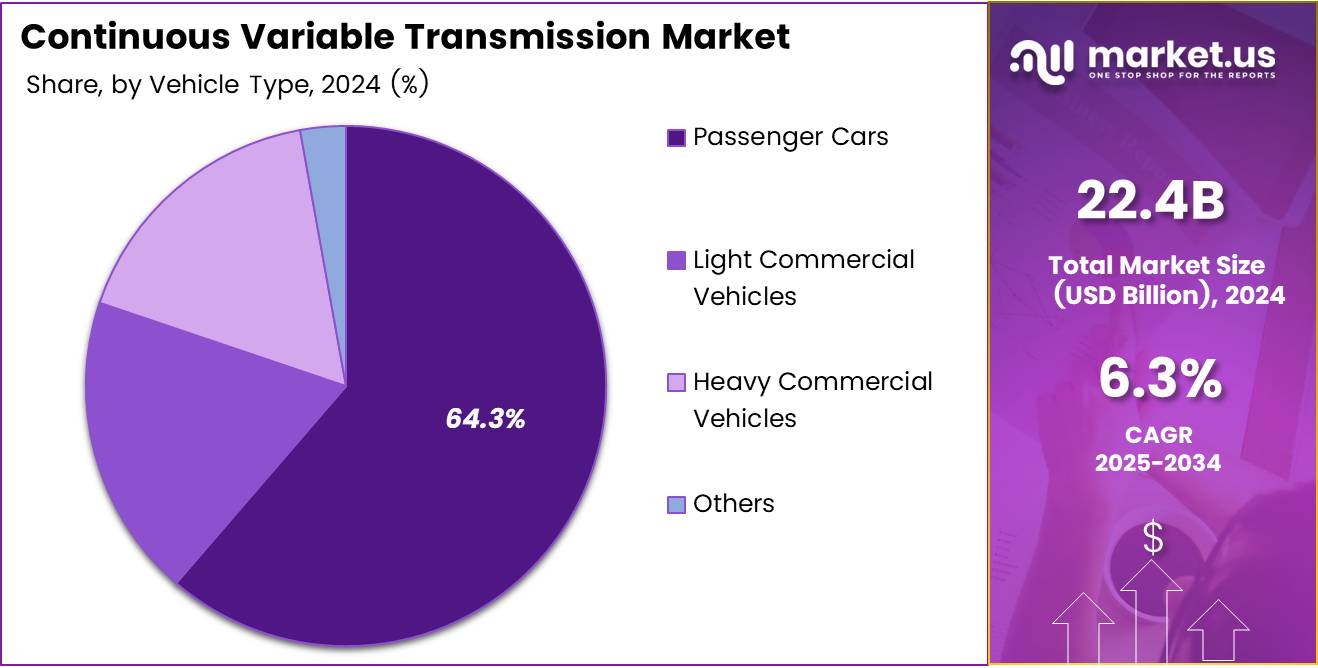
- Passenger Cars led the By Vehicle Type segment in 2024, holding a significant 64.3% market share driven by consumer preference for fuel-efficient vehicles.
- The Hybrid fuel type dominated the By Fuel Type Analysis in 2024, highlighting the growing focus on emission reduction and fuel efficiency.
- OEMs were the primary end-users in 2024, accounting for the majority of CVT demand through direct integration in new vehicles.
- Asia Pacific led the regional market in 2024 with a commanding 48.5% share, valued at approximately USD 10.7 billion, fueled by automotive production and emission-reduction initiatives.
Report Overview
The Continuous Variable Transmission (CVT) market refers to the sector focused on advanced automotive transmission systems that provide seamless gear ratio changes without the distinct steps of traditional transmissions. CVTs enhance fuel efficiency and deliver smoother acceleration, making them increasingly popular in modern vehicles.
Continuous Variable Transmission technology itself offers superior drivability and energy efficiency compared to conventional gearboxes. It plays a vital role in optimizing power delivery in hybrid and electric vehicles, which are gaining traction worldwide due to environmental regulations and consumer demand for greener transportation.
Market growth is being propelled by rising adoption of hybrid and electric vehicles. According to Statbel, electric car sales surged to 127,908 units in 2024, up from 93,086 in 2023, reflecting accelerating consumer acceptance. This shift boosts demand for CVT systems, as they are well-suited for optimizing the powertrain efficiency in these vehicles.
Furthermore, consumer preferences are evolving rapidly. As reported by AutoWorldJournal, interest in hybrid vehicles in the U.S. has risen by 5%, now representing 26% of potential buyers, while interest in traditional internal combustion engine vehicles has declined by 5%, falling to 62%. This trend underscores the growing market opportunity for CVTs integrated into hybrid drivetrains.
Government investments and stricter emission regulations globally are encouraging manufacturers to develop efficient transmission technologies. Incentives promoting electric and hybrid vehicles further accelerate the CVT market expansion, as automakers prioritize transmission solutions that improve fuel economy and reduce emissions.
Looking ahead, the CVT market is positioned for significant growth driven by technological innovation, increasing environmental awareness, and supportive policies. As automotive players continue to integrate CVTs into their product lines, opportunities for suppliers and manufacturers expand, especially in emerging markets where vehicle electrification is gaining momentum.
Type Analysis
Belt-drive leads with a 31.2% share, reflecting its widespread adoption for its reliability and efficiency.
In 2024, Belt-drive held a dominant market position in the By Type Analysis segment of the Continuous Variable Transmission Market, with a 31.2% share. This segment’s dominance is driven by its proven performance in fuel efficiency and smooth power delivery, making it a preferred choice in many automotive applications.
Following Belt-drive, Hydrostatic and Toroidal types also maintain significant presence but with comparatively smaller shares. Hydrostatic transmissions are favored in specialized heavy machinery due to their high torque capabilities. Toroidal transmissions, though less common, are appreciated for their compact design and precise control.
Chain Drive and Others make up the remaining market share, primarily serving niche segments or specific vehicle requirements. Chain Drives offer durability but face competition from Belt-drive due to noise and maintenance factors.
Overall, Belt-drive’s dominance is anchored in balancing cost-effectiveness, efficiency, and ease of integration, positioning it well for continued growth.
Vehicle Type Analysis
Passenger Cars dominate with a 64.3% share, driven by strong demand for fuel-efficient transmission systems.
In 2024, Passenger Cars held a dominant market position in the By Vehicle Type Analysis segment of the Continuous Variable Transmission Market, with a 64.3% share. This significant share is attributed to the rising consumer preference for fuel-efficient and smooth-driving vehicles, where CVT technology is highly beneficial.
Light Commercial Vehicles (LCVs) represent a moderate portion of the market, as these vehicles increasingly adopt CVT systems to meet fuel economy and emission standards. Heavy Commercial Vehicles (HCVs), however, exhibit slower CVT adoption due to the high torque demands and current technological limitations.
The Others category covers specialty vehicles and emerging segments that are experimenting with CVT technology for niche applications. The dominance of Passenger Cars reflects the automotive industry’s shift toward more sustainable and efficient drivetrains in everyday mobility.
Fuel Type Analysis
Hybrid vehicles lead the segment with a strong share, underscoring the transition to greener propulsion systems.
In 2024, Hybrid held a dominant market position in the By Fuel Type Analysis segment of the Continuous Variable Transmission Market, reflecting the growing emphasis on reducing emissions and improving fuel efficiency. Hybrid powertrains benefit greatly from CVT systems, which optimize engine and motor performance seamlessly.
Gasoline-powered vehicles continue to hold a significant portion, driven by their longstanding market presence and technological maturity. Diesel vehicles see a declining share as stricter emissions regulations challenge their viability.
Electric vehicles, while still emerging in the CVT space, represent a growing segment as manufacturers experiment with integrating CVT technology to complement electric drivetrains. Overall, the hybrid segment’s leadership highlights market momentum toward sustainable automotive technologies.
End-User Analysis
OEMs dominate with a major share, reflecting their integral role in vehicle production and technology integration.
In 2024, OEM held a dominant market position in the By End-User Analysis segment of the Continuous Variable Transmission Market. Original Equipment Manufacturers (OEMs) account for the majority of demand, as they integrate CVT technology directly into new vehicles to meet evolving fuel efficiency and emission standards.
The Aftermarket segment remains smaller but is growing as vehicle owners seek upgrades or replacements to enhance performance and extend vehicle life. However, OEM dominance reflects the primary channel through which CVT technologies are adopted and innovated.
This trend emphasizes the importance of OEM partnerships for CVT suppliers aiming to capitalize on market growth driven by regulatory compliance and consumer preferences for advanced drivetrains.
Key Market Segments
By Type
- Belt-drive
- Hydrostatic
- Toroidal
- Chain Drive
- Others
By Vehicle Type
- Passenger Cars
- Light Commercial Vehicles
- Heavy Commercial Vehicles
- Others
By Fuel Type
- Hybrid
- Gasoline
- Diesel
- Electric
By End-User
- OEM
- Aftermarket
Drivers
Rising Demand for Fuel-Efficient and Low-Emission Automotive Technologies Drives Market Growth
The Continuous Variable Transmission (CVT) market is gaining momentum due to increasing demand for fuel-efficient and low-emission vehicles. Consumers and manufacturers alike are prioritizing technologies that help reduce fuel consumption, making CVT an attractive solution. CVTs optimize engine performance by providing seamless gear ratio changes, improving overall fuel economy.
Another important driver is the growing adoption of electric and hybrid vehicles that often integrate CVT systems. These vehicles require transmissions that complement electric powertrains, and CVTs provide smooth and efficient power delivery, enhancing the driving experience.
Government regulations worldwide are also pushing the market forward. Stricter emission standards are forcing automakers to adopt advanced transmission technologies, including CVTs, to meet environmental norms and reduce carbon footprints. These policies create a favorable environment for CVT adoption across various vehicle segments.
Lastly, advancements in CVT design have improved system durability and performance. Modern materials and engineering innovations have addressed earlier concerns about reliability, making CVTs more viable for a broader range of vehicles. These improvements boost consumer confidence and encourage wider market penetration.
Restraints
High Manufacturing and Maintenance Costs Restrain Continuous Variable Transmission Market Growth
Despite the benefits, the Continuous Variable Transmission market faces challenges related to high manufacturing and maintenance costs. Advanced CVT systems involve complex components and precision engineering, leading to elevated production expenses. Maintenance can also be costly due to specialized servicing requirements.
Limited consumer awareness and acceptance of CVT technology in certain regions hinder market expansion. Some buyers prefer traditional automatic or manual transmissions due to familiarity or misconceptions about CVT performance and reliability, restricting wider adoption.
Additionally, competition from alternative transmission systems, such as dual-clutch transmissions (DCT) and traditional automatics, poses a significant restraint. These alternatives offer strong performance advantages in specific applications, making CVTs less appealing in certain segments.
Technical challenges remain, particularly related to torque capacity limitations in heavy-duty applications. CVTs are typically less suitable for vehicles requiring high torque, such as trucks or heavy machinery, limiting their use in those markets.
Growth Factors
Expansion in Emerging Markets and Development for Electric Vehicles Offer Growth Opportunities in the CVT Market
Emerging markets present significant growth opportunities for the Continuous Variable Transmission market. Rapid growth in automotive production and sales in regions like Asia-Pacific and Latin America fuels demand for efficient transmission systems, creating new market avenues.
The development of CVT systems tailored for electric vehicles (EVs) and autonomous driving applications is another promising area. As EV adoption accelerates, manufacturers seek CVT designs that optimize electric powertrains and enable smoother autonomous vehicle operations.
Integration of smart transmission systems with Internet of Things (IoT) and vehicle connectivity technologies opens further opportunities. Connected vehicles benefit from adaptive transmissions that adjust to driving conditions and user preferences, enhancing efficiency and comfort.
Finally, increasing aftermarket demand for CVT replacements and upgrades supports steady growth. As more vehicles with CVTs reach end-of-life or require servicing, the aftermarket segment expands, creating revenue streams beyond new vehicle sales.
Emerging Trends
Adoption of Hybrid CVT Systems and AI-Driven Controls Shape Current Trends in the Market
The Continuous Variable Transmission market is witnessing trends such as the adoption of hybrid CVT systems that combine mechanical and electronic controls. These hybrid designs offer better performance and adaptability compared to purely mechanical CVTs.
Lightweight materials are increasingly used to reduce the overall system weight, which improves vehicle efficiency and handling. This material innovation is key to meeting stricter fuel economy and emission standards.
AI-driven adaptive transmission controls represent another trend. These smart systems use artificial intelligence to optimize gear ratios in real time, enhancing driving comfort, fuel efficiency, and responsiveness.
Collaborations between automotive original equipment manufacturers (OEMs) and technology companies are driving innovation in CVT solutions. Such partnerships accelerate the development of cutting-edge systems that integrate advanced software and hardware features, keeping the market competitive and dynamic.
Regional Analysis
Asia Pacific Dominates the Continuous Variable Transmission Market with a Market Share of 48.5%, Valued at USD 10.7 Billion
In 2024, the Asia Pacific region led the Continuous Variable Transmission market, capturing a commanding share of 48.5%, valued at approximately USD 10.7 billion. The market growth is driven by increasing automotive production, rising demand for fuel-efficient vehicles, and expanding hybrid and electric vehicle adoption. Rapid industrialization and government initiatives to reduce emissions also fuel regional market expansion.

North America Continuous Variable Transmission Market Insights
North America holds a significant position in the CVT market, supported by stringent emission regulations and the growing adoption of electric and hybrid vehicles. The region benefits from advanced automotive technologies and increasing consumer demand for fuel-efficient transmissions, which drives ongoing innovation and market penetration.
Europe Continuous Variable Transmission Market Trends
Europe is witnessing steady growth in the CVT market, propelled by strong environmental regulations and a shift towards low-emission vehicles. Government incentives for electric vehicle adoption and investments in automotive R&D contribute to the region’s expanding market share.
Middle East and Africa Continuous Variable Transmission Market Outlook
The Middle East and Africa market is gradually developing, supported by increasing automotive sales and infrastructure investments. Growing awareness of fuel efficiency and emissions standards is expected to create new opportunities for CVT adoption in the coming years.
Latin America Continuous Variable Transmission Market Dynamics
Latin America is experiencing moderate growth in the CVT market due to rising automotive production and consumer preference for fuel-efficient vehicles. However, slower technological adoption and economic variability in some countries present challenges to rapid market expansion.
Key Regions and Countries
North America
- US
- Canada
Europe
- Germany
- France
- The UK
- Spain
- Italy
- Rest of Europe
Asia Pacific
- China
- Japan
- South Korea
- India
- Australia
- Rest of APAC
Latin America
- Brazil
- Mexico
- Rest of Latin America
Middle East & Africa
- GCC
- South Africa
- Rest of MEA
Key Continuous Variable Transmission Company Insights
In 2024, Punch Powertrain remains a significant innovator in the continuous variable transmission (CVT) market, focusing on enhancing efficiency and durability through advanced design and manufacturing techniques. Their emphasis on reducing emissions aligns with the growing demand for eco-friendly automotive solutions.
Subaru Corporation continues to integrate CVT technology predominantly in its all-wheel-drive vehicles, capitalizing on the balance between fuel efficiency and performance. Their Symmetrical All-Wheel Drive system combined with CVT ensures smooth driving experience and contributes to Subaru’s competitive positioning.
Toyota Motor Corporation leads in the adoption of CVT systems across its hybrid and conventional vehicle portfolios, leveraging its expertise to optimize fuel economy and reduce emissions. Toyota’s continuous improvements in CVT technology underline its commitment to sustainability and innovation in drivetrain solutions.
Nissan Motor Co., Ltd. has been a pioneer in popularizing CVT technology, particularly in passenger cars, with a focus on delivering fuel-efficient, smooth-shifting transmissions. Nissan’s efforts to refine CVT designs have helped the company maintain a strong foothold in markets demanding eco-friendly vehicles with enhanced driving comfort.
These four companies collectively drive technological advancements and adoption of CVT systems, setting benchmarks for efficiency, performance, and sustainability within the global CVT market in 2024.
Top Key Players in the Market
- Punch Powertrain
- Subaru Corporation
- Toyota Motor Corporation
- Nissan Motor Co., Ltd.
- Hyundai Motor Company
- Honda Motor Co., Ltd.
- JATCO Ltd.
- ZF Friedrichshafen AG
- Bosch
- General Motors
- Aisin Seiki Co., Ltd.
Recent Developments
- In April 2025, passenger vehicle sales in March increased by 4%, while the overall sales for the fiscal year 2025 showed a growth of 2%. Key automakers including Maruti Suzuki, Hyundai, Tata Motors, and M&M experienced varied performance trends during this period.
- In January 2025, Eccentric Engine successfully raised US$5 million in Pre-Series A funding, marking a significant milestone to support its growth and innovation initiatives.
- In June 2024, VOC Automotive secured INR 1.5 crore in funding from Corporate Warranty India, aiming to transform the two-wheeler service industry in the Indian market.
- In September 2024, DeepDrive closed an oversubscribed Series B funding round, raising €30 million to accelerate its technological advancements and market expansion.









