


Report Overview
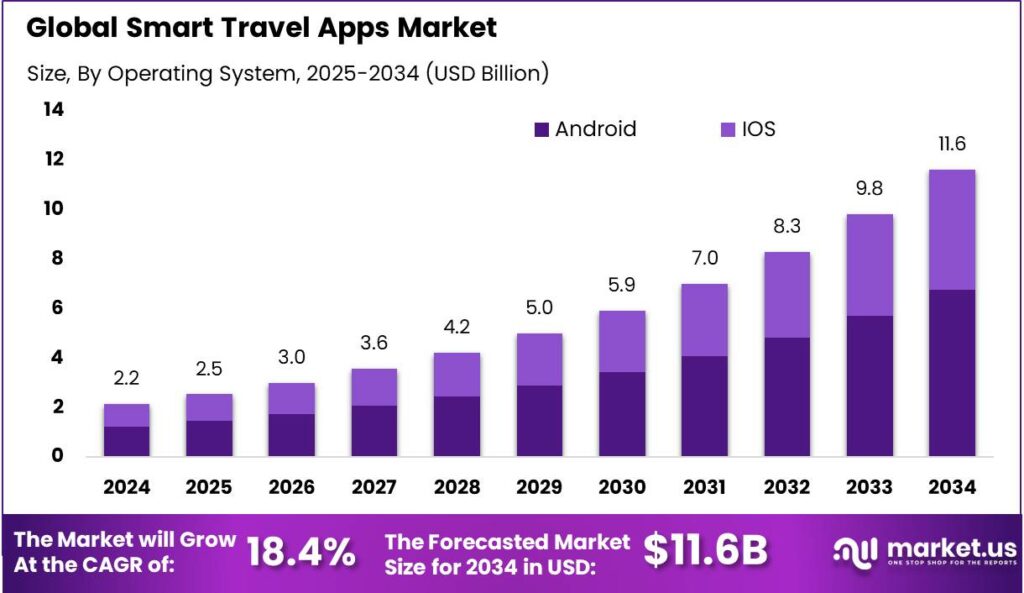
The Global Smart Travel Apps Market size is expected to be worth around USD 11.6 Billion By 2034, from USD 2.15 Billion in 2024, growing at a CAGR of 18.40% during the forecast period from 2025 to 2034. In 2024, North America led the Smart Travel Apps market with over 37.4% share and revenues above USD 0.80 billion. The U.S. market, valued at USD 0.72 billion, is projected to grow at a 16.9% CAGR due to rising smartphone use and changing travel habits.
The smart travel apps market has experienced significant growth in recent years. Several key factors are propelling the growth of the smart travel apps market. The increasing adoption of advanced technologies like AI, IoT, and big data analytics enables the development of apps that offer real-time information, predictive analytics, and personalized services.
Additionally, the growing demand for seamless and efficient travel experiences has led to the integration of various services – such as booking, navigation, and customer support – into single platforms. The emphasis on sustainability and eco-friendly travel options also influences the market, as travelers seek solutions that align with their environmental values.
According to Prioridata’s research, global tourism revenue is expected to rise from USD 11.39 trillion in 2023 to USD 18.45 trillion by 2032, reflecting strong post-pandemic recovery and growing international mobility. Within this expanding landscape, travel apps have already generated approximately USD 630 billion in revenue, indicating the sector’s increasing digitalization and user dependency on mobile solutions.
China is leading the travel eSIM segment, with an estimated market value of USD 556.1 million in 2024, underscoring the country’s dominance in digital travel infrastructure. In the United States, Expedia commands a 19.3% share of the travel app market, driven by its broad service offerings and strong brand recall. Globally, Booking.com was downloaded 74.6 million times, positioning it as one of the most preferred platforms for international travelers.
India accounts for 29% of all global travel app downloads, indicating its rapidly growing digital traveler base and mobile-first market behavior. Meanwhile, Europe contributes around 40% of global travel app revenue, supported by high per capita travel spending and widespread app monetization strategies.
Consumer behavior also plays a significant role in shaping travel app development. A notable 76% of global travelers actively seek apps that reduce stress and streamline travel processes – such as booking, itinerary management, and navigation. In terms of demographic patterns, millennials average 35 vacation days per year, making them the most time-rich travel cohort, while boomers lead in trip frequency, planning 4 to 5 trips annually.
Key Takeaways
- The Global Smart Travel Apps Market size is expected to reach USD 11.6 Billion by 2034, growing from USD 2.15 Billion in 2024 at a CAGR of 18.40% during the forecast period from 2025 to 2034.
- In 2024, the Family Travel segment held a dominant position, capturing more than 48.6% market share, driven by consistent demand for structured, safe, and well-planned travel experiences.
- The Android segment dominated in 2024, capturing over 58.3% share in the global Smart Travel Apps market.
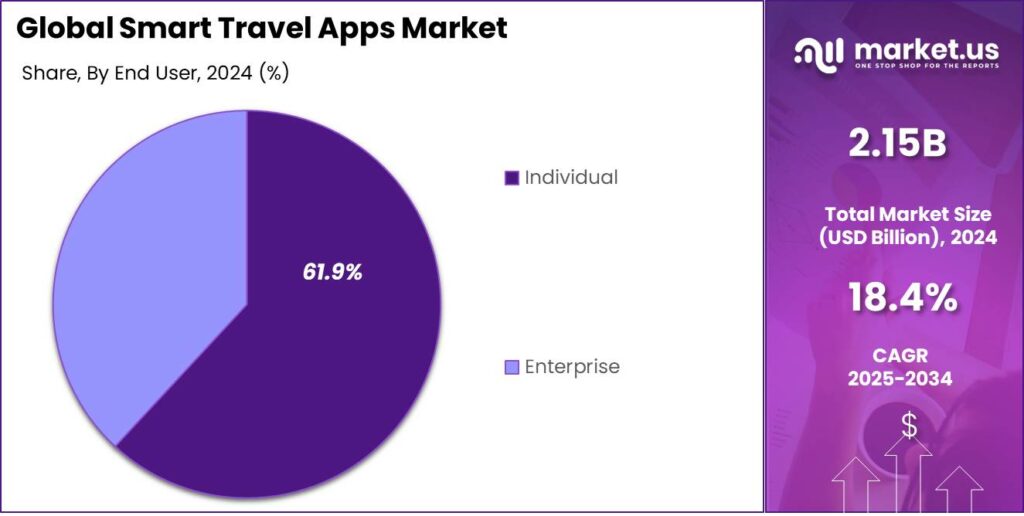
- The Individual segment led the market in 2024, holding more than 61.9% share in the global smart travel apps market.
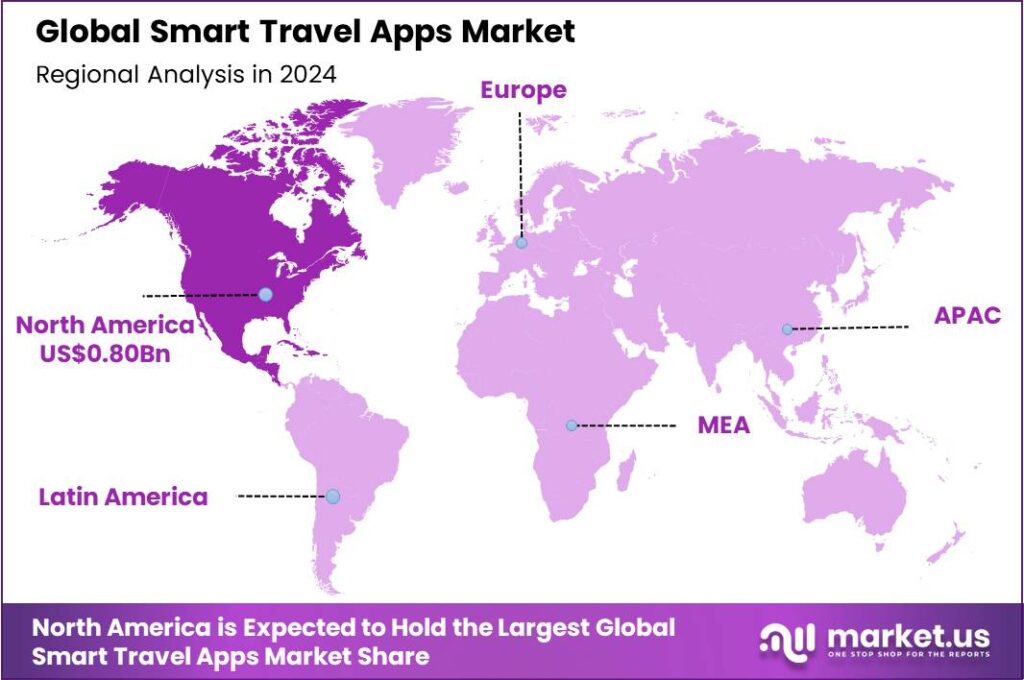
- In 2024, North America held a dominant market share of more than 37.4%, with total revenues exceeding USD 0.80 billion in the global Smart Travel Apps market.
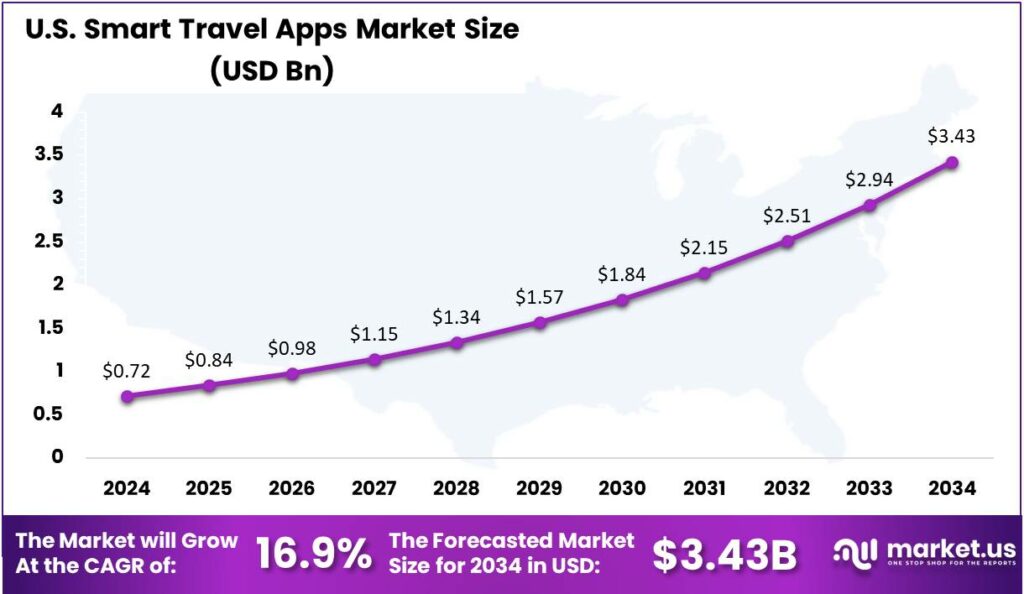
- The U.S. Smart Travel Apps market was valued at approximately USD 0.72 billion in 2024 and is expected to grow at a strong CAGR of 16.9%, fueled by increasing smartphone usage and evolving travel behaviors.
U.S. Market Growth & Size
In 2024, the U.S. Smart Travel Apps market reached a valuation of approximately USD 0.72 billion, reflecting its growing role in reshaping the way travelers plan, book, and manage their journeys. This growth has been significantly influenced by the increasing integration of mobile technologies and digital ecosystems within the travel and tourism industry.
The market is expected to grow at a strong CAGR of 16.9%, driven by rising smartphone use, high-speed internet access, and demand for seamless, touchless travel post-pandemic. Innovations like voice assistants, AI recommendations, and blockchain enhance app security and functionality, encouraging U.S. consumers to adopt smart travel technologies for greater transparency, savings, and better trip planning.
Consumers are showing a clear preference for real-time travel updates, AI-powered itinerary planning, mobile-based booking platforms, and location-aware services, which are now central features in many leading smart travel applications. These platforms are not only improving convenience for users but are also enhancing overall travel experiences through automation and personalization.
The U.S. smart travel apps market is attracting growing investment, with funds flowing to startups and tech firms developing advanced features like multi-language support, AR navigation, and smart wearable integration. This innovation is transforming the travel tech ecosystem, driving competition and continuous improvements to meet evolving user expectations and support long-term growth.
In 2024, North America held a dominant market position, capturing more than a 37.4% share, with total revenues surpassing USD 0.80 billion in the global Smart Travel Apps market. This regional dominance can be primarily attributed to the early adoption of advanced mobile technologies and the widespread presence of digital-first travelers.
The region’s smart travel leadership is driven by ongoing innovation from tech companies, startups, and mobility providers investing in real-time navigation, AI trip recommendations, mobile payments, and multi-modal transport connectivity. Growing demand for self-service options is boosting smart travel solutions, especially in airports, hotels, and urban transport.
North America also benefits from a supportive regulatory and investment landscape that fosters digital innovation in the travel and mobility sector. Government agencies and tourism boards have increasingly partnered with app developers to provide seamless digital access to public transport, tourist information, and travel safety alerts, making travel more efficient and personalized.
North America’s lead is driven by strong technological infrastructure and shifting consumer preferences for convenience, real-time updates, and automation. As the travel industry embraces hyper-personalization and data-driven services, the region is poised to maintain its edge and influence digital transformation globally.
Travel Type Analysis
In 2024, Family Travel segment held a dominant market position, capturing more than a 48.6% share, due to its consistent demand for structured, safe, and well-planned travel experiences. Smart travel apps cater to families by offering detailed itineraries, kid-friendly destinations, safety-focused accommodations, and group coordination tools.
One of the core strengths behind the rise of family travel in the smart travel apps market is the need for convenience and control. Family vacations typically involve multiple bookings, time-sensitive schedules, and dietary or health considerations. Smart travel apps help by offering synchronized calendars, real-time updates, and emergency contact features that make parents feel more secure.
Moreover, the increased preference for domestic and international family vacations, especially post-COVID, has accelerated digital adoption in this segment. Families are more likely to seek reassurance through verified reviews, hygiene ratings, medical facility locators, and language translation support all of which are integrated features in leading smart travel apps.
Additionally, the segment benefits from recurring usage patterns. Families tend to travel during school holidays, special occasions, or seasonal breaks, leading to regular interaction with travel apps throughout the year. This repeated engagement allows platforms to gather valuable user data and offer increasingly personalized experiences.
Operating System Analysis
In 2024, the Android segment held a dominant market position, capturing more than a 58.3% share in the global Smart Travel Apps market. The affordability and variety of Android devices make them highly accessible to a large population of travelers, thereby contributing to the higher download rates and user engagement levels for Android-based travel applications.
The open-source nature of the Android platform enables developers to build, test, and launch smart travel apps with greater flexibility and lower costs. This has encouraged a larger number of startups and app creators to innovate within the Android ecosystem, offering features such as multilingual support, GPS-based tracking, voice search integration, and localized travel content.
Google’s integration of Maps, Travel, and Assistant enhances Android travel apps by enabling smooth itinerary planning, real-time transit updates, and dynamic hotel and flight searches. This close connection between Android services and third-party apps creates a seamless, intuitive user experience, boosting loyalty to the Android platform.
Many travel businesses and government agencies prioritize Android-first apps due to the platform’s global reach, boosting Android’s leadership in the smart travel market. Ongoing advances in AI, data analytics, and security for Android apps will help maintain this competitive edge.
End User Analysis
In 2024, the Individual segment held a dominant market position, capturing more than a 61.9% share in the global smart travel apps market. This dominance can be attributed to the rising number of tech-savvy travelers who rely heavily on smartphones for real-time information, itinerary planning, booking services, and location-based recommendations.
The rise in solo travel, backpacking, and remote work has expanded the individual user base, who favor flexible tools to quickly adjust plans due to weather, transport, or budget changes. Smart travel apps offering AI-driven recommendations, offline maps, multi-lingual support, and currency converters have improved their ability to navigate unfamiliar places independently.
Moreover, individual users tend to use smart travel apps across all stages of their journey from discovery and booking to in-trip navigation and post-trip reviews. The repeat usage behavior and higher app engagement among individual users are driving app developers to prioritize features that cater to this segment.
The enterprise segment grows steadily but remains secondary due to complex integrations, data privacy concerns, and reliance on traditional corporate travel services. In contrast, the individual segment with lower barriers, faster adoption, and broader reach, is the primary revenue driver for most smart travel app providers.
Key Market Segments
By Travel Type
- Adventure Travel
- Family Travel
- Solo Travel
By Operating System
- Android
- IOS
By End User
- Individual
- Enterprise
Key Regions and Countries
- North America
- US
- Canada
- Europe
- Germany
- France
- The UK
- Spain
- Italy
- Rest of Europe
- Asia Pacific
- China
- Japan
- South Korea
- India
- Australia
- Singapore
- Rest of Asia Pacific
- Latin America
- Brazil
- Mexico
- Rest of Latin America
- Middle East & Africa
- South Africa
- Saudi Arabia
- UAE
- Rest of MEA
Driver
Social Influence and Peer Validation
The adoption of smart travel applications is significantly influenced by social dynamics and peer validation. Travelers often rely on recommendations and experiences shared by their social circles, which play a crucial role in shaping their perceptions and decisions regarding travel apps.
Integrating social features like sharing itineraries, reviews, and travel experiences creates community and trust among users. This boosts engagement and triggers a network effect, increasing the app’s value as more people in a social group use it. Visible app usage acts as social proof, encouraging others to adopt the platform. This highlights social influence as a key factor in the growth of smart travel apps.
Restraint
Data Privacy and Security Concerns
Although smart travel apps offer great convenience, concerns about data privacy and security remain major barriers to widespread adoption. Users are increasingly cautious about sharing personal information like location, travel preferences, and payment details due to potential risks.
Concerns arise from data breaches, unauthorized sharing, and misuse of sensitive information, worsened by some providers’ lack of transparency in data handling. To address this, developers must enforce strong security, comply with data protection laws, and clearly communicate data use. Establishing and maintaining user trust through strict privacy measures is vital for the long-term success of smart travel apps.
Opportunity
Expansion in Emerging Markets
Emerging markets present a substantial opportunity for the growth of smart travel applications. The increasing penetration of smartphones and improved internet connectivity in these regions have created a conducive environment for digital solutions.
Additionally, the rising middle-class population with disposable income and a growing interest in travel experiences contribute to the potential user base for these applications. By tailoring features to cater to local preferences, languages, and travel behaviors, developers can effectively tap into these markets.
Moreover, partnerships with local service providers and integration with regional payment systems can enhance the relevance and usability of the applications. The strategic focus on emerging markets can lead to significant user acquisition and revenue generation for smart travel application providers.
Challenge
Market Saturation and App Overload
The smart travel app market is saturated, with many apps offering similar services like booking, itinerary planning, and local recommendations. This abundance causes app overload, overwhelming users with choices, leading to decision fatigue and lower engagement.
Redundant features across apps reduce the perceived value of adopting new ones. To overcome this, developers should focus on differentiation by providing unique features, personalized experiences, and smooth integration with other services. By prioritizing user-centric design and solving specific pain points, apps can improve retention and satisfaction, standing out in a competitive market.
Emerging Trends
One notable trend is the integration of artificial intelligence (AI) to offer personalized recommendations. These apps analyze user preferences and behaviors to suggest destinations, accommodations, and activities tailored to individual interests. Such personalization enhances user satisfaction by providing more relevant options.
Another major advancement is the use of augmented reality (AR) and virtual reality (VR) technologies. AR helps travelers navigate unfamiliar places by overlaying digital info like translating signs or adding historical context to real-world views. VR offers virtual tours of destinations, allowing users to explore and make informed decisions before traveling.
Sustainability is now a key focus in travel app development, with features like carbon footprint calculators and eco-friendly accommodation options encouraging greener choices. Additionally, real-time updates on flights, weather, and local events help travelers adjust plans quickly, reducing stress and enhancing satisfaction.
Business Benefits
Smart travel apps provide businesses with a direct channel to engage customers through personalized experiences. Real-time notifications, tailored recommendations, and interactive content help companies engage travelers more deeply. By understanding user preferences, businesses can provide personalized services that boost satisfaction and loyalty.
Implementing smart travel apps can significantly streamline business operations. Automated booking systems, itinerary management, and customer support reduce the need for manual processes, leading to cost savings and increased efficiency.
Smart travel apps enable businesses to collect real-time data on customer preferences, behaviors, and feedback. This data is invaluable for making informed decisions regarding product offerings, marketing strategies, and service improvements. By analyzing usage patterns and customer interactions, companies can identify trends, anticipate needs, and tailor their services accordingly.
Key Player Analysis
As travelers look for smarter ways to plan trips, companies in this market compete by adding new features and improving user experience.
- Airbnb is famous for changing how people find places to stay. Airbnb connects travelers with hosts offering unique homes and experiences, emphasizing personalization and local living. Its wide variety of options and authentic travel experiences make it a popular choice beyond just accommodation.
- American Airlines stands out in the smart travel apps market by focusing on flight booking and travel management. Their app allows users to book flights, check-in, get real-time flight updates, and manage loyalty points easily. The app’s uniqueness comes from its integration with American Airlines’ vast flight network and services like seat upgrades and baggage tracking.
- Booking Holdings owns some of the largest travel platforms globally, including Booking.com, Kayak, and Priceline. Its smart travel apps are designed to cover every aspect of travel planning from flights and hotels to car rentals and activities. Booking Holdings focuses on offering users a smooth, one-stop-shop experience with competitive pricing and reliable customer service.
Top Key Players in the Market
- Airbnb
- American Airlines
- Booking Holdings
- Caival Corporation
- Expedia Group
- Lyft
- feizhu
- MakeMyTrip
- Trainline
- ctrip
- Others
Top Opportunities for Players
The smart travel app industry is experiencing significant growth, driven by technological advancements and evolving traveler expectations.
- Personalized Travel Experiences: Travelers increasingly seek tailored experiences. By leveraging AI and machine learning, apps can analyze user preferences and behaviors to offer customized recommendations, enhancing user satisfaction and engagement.
- Integration of Emerging Technologies: Incorporating technologies such as augmented reality (AR) and virtual reality (VR) allows users to virtually explore destinations, accommodations, and attractions before booking, thereby improving decision-making and user confidence.
- Emphasis on Sustainable Travel: With growing environmental awareness, there is a demand for eco-friendly travel options. Apps that highlight sustainable accommodations and activities can attract environmentally conscious travelers and promote responsible tourism.
- Expansion into Emerging Markets: The increasing smartphone penetration in developing regions opens new markets for travel apps. By localizing content and services, companies can tap into these growing user bases and diversify their market presence.
- Strategic Partnerships and Collaborations: Forming alliances with airlines, hotels, and local service providers can enhance app offerings, providing users with comprehensive travel solutions and exclusive deals, thereby increasing app utility and user retention.
Recent Developments
- In April 2025, American Airlines rolled out a redesigned mobile app that brings a more personalized interface. It now displays real-time travel updates, frequent flyer information, and an improved AAdvantage® program section. The update also includes full iPad optimization, ensuring consistency across devices, which aligns with the airline’s broader digital transformation strategy.
- Booking.com, under Booking Holdings, expanded its AI-driven features in October 2024 to improve the way users search and filter accommodations. The platform now offers Smart Filters through natural language queries, AI-generated review summaries, and real-time Q&A about properties. These tools aim to reduce planning friction and help travelers make informed decisions quickly.









