


Report Overview
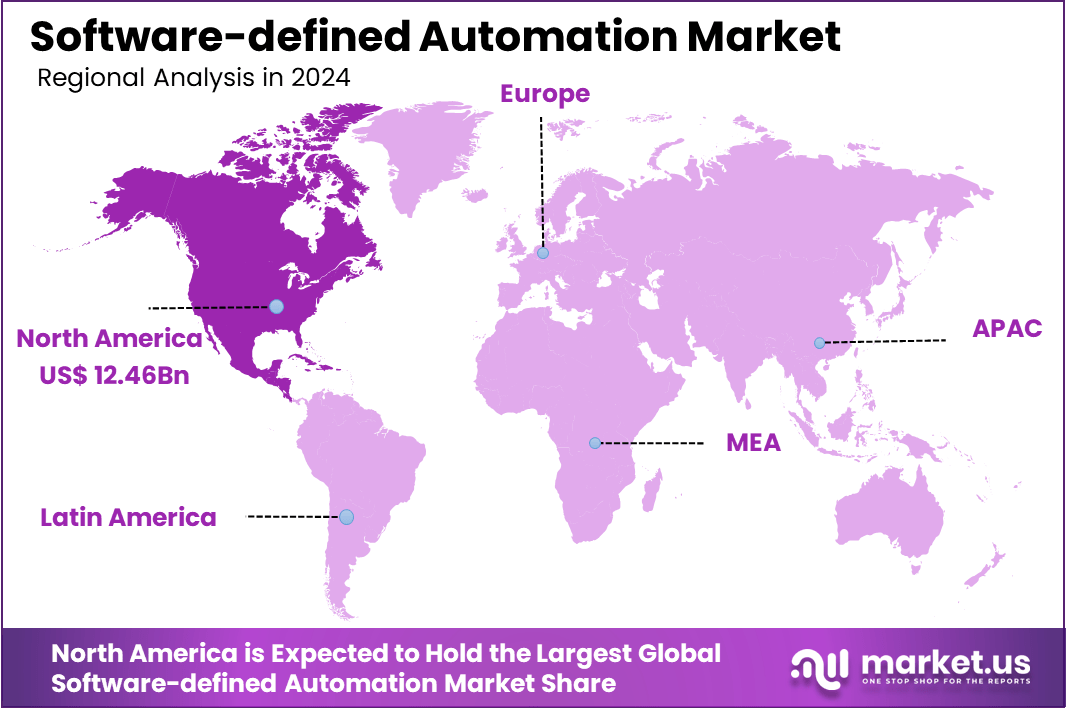
The Global Software-defined Automation Market size is expected to be worth around USD 108.4 Billion By 2034, from USD 32.8 billion in 2024, growing at a CAGR of 12.7% during the forecast period from 2025 to 2034. In 2024, North America held a dominant market position, capturing more than a 38% share, holding USD 12.46 Billion revenue.
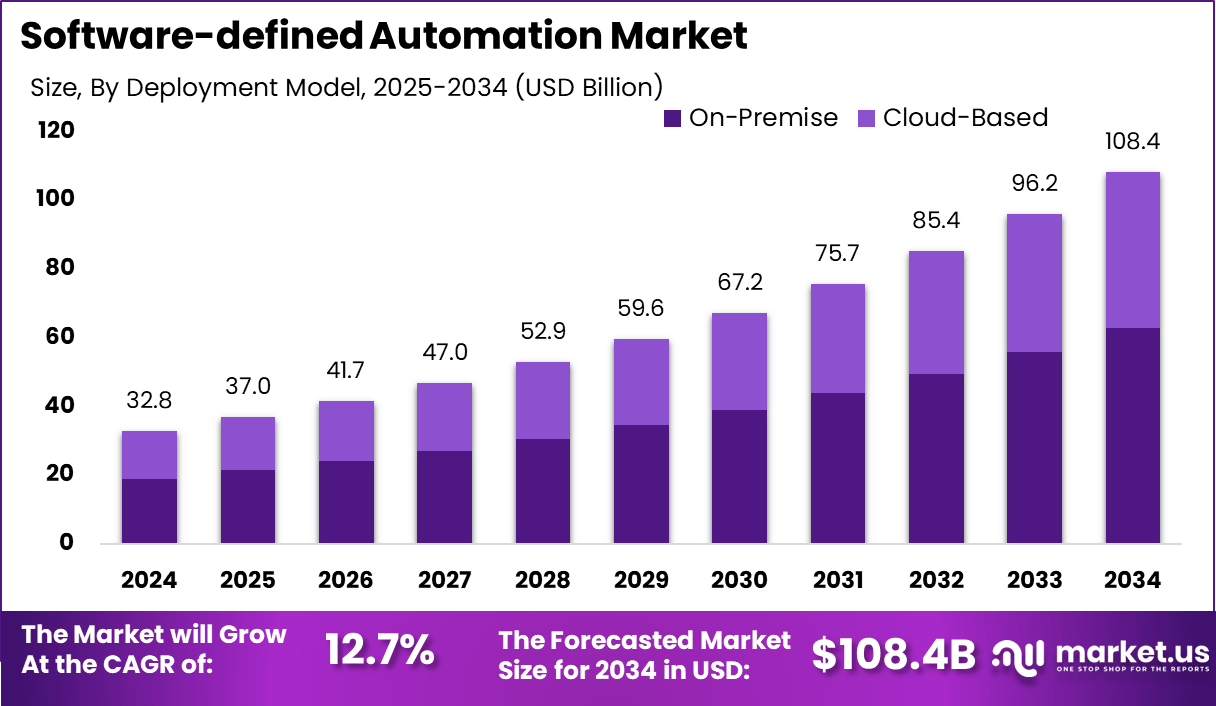
The global software-defined automation market has witnessed significant growth, several factors are propelling the adoption of Software-Defined Automation. The need for operational efficiency and cost reduction is paramount, as businesses seek to automate repetitive tasks and minimize manual intervention. The increasing complexity of IT infrastructures, driven by diverse applications and expanding data volumes, necessitates a unified approach to managing and automating these environments.
The demand for Software-Defined Automation is escalating as organizations recognize its potential to enhance operational agility and accelerate time-to-market. Industries are increasingly leveraging SDA to automate complex processes and data management tasks, thereby achieving greater productivity. The growing emphasis on digital transformation initiatives across sectors further amplifies this demand, as businesses seek to modernize operations and remain competitive in a rapidly evolving market landscape.
As per the latest insights from Paperform, automation is transforming modern workplaces at a rapid pace. 50% of current work activities can now be automated, reflecting the growing maturity of digital tools and intelligent systems. Already, 31% of businesses have fully automated at least one function, demonstrating a clear shift towards efficiency-driven models.
The automation landscape is expanding steadily, with automated job roles increasing by 14% every year. Despite this progress, 94% of employees still perform repetitive tasks, highlighting the untapped potential for broader automation adoption. Furthermore, automation is becoming essential for strategic advantage. 76% of businesses now rely on automation to standardize daily workflows, while 58% use it for data and reporting essential to planning.
In sectors where compliance is critical, 36% apply automation for regulation purposes. The benefits extend particularly to small businesses, as 88% of owners say automation helps them compete with larger firms. Productivity gains are also evident – two out of three knowledge workers report higher efficiency through automation. The cost advantage is clear too, with organisations saving an average of $46,000 annually by using workflow automation tools.
The increasing adoption of technologies such as cloud computing, edge computing, and AI is significantly influencing the software-defined automation landscape. Cloud-based SDA solutions offer scalability and flexibility, allowing organizations to manage automation processes remotely and efficiently. Edge computing enables real-time data processing at the source, reducing latency and enhancing decision-making capabilities.
Key Takeaways
- $108.4 Billion: The global Software-defined Automation market is projected to reach USD 108.4 billion by 2034, growing from USD 32.8 billion in 2024, with a strong CAGR of 12.7% during the forecast period.
- 38% Share – North America: In 2024, North America dominated the market, capturing over 38% share, which equaled USD 12.46 billion in revenue, driven by early adoption of industrial automation technologies and a strong presence of tech firms.
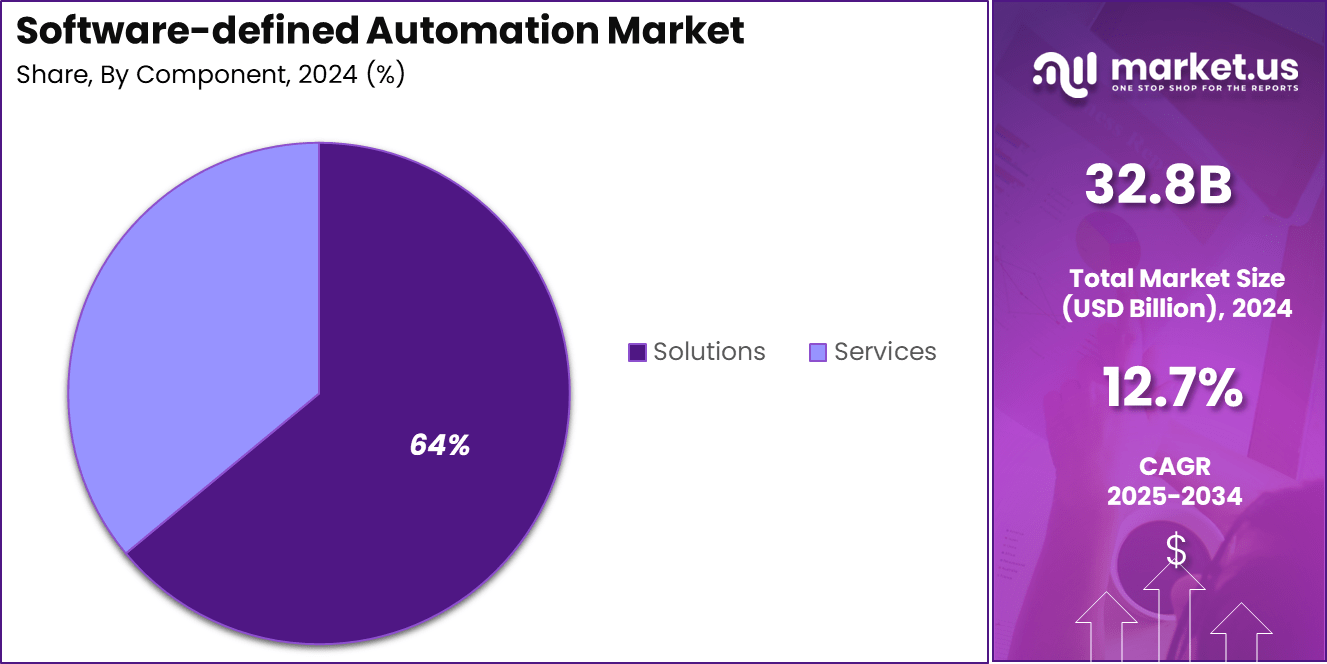
- 64% – Solution Segment: The Solution segment held the largest share at 64% under the component category in 2024, fueled by rising investments in cloud-native control systems and AI-integrated automation platforms.
- 58% – On-premises Deployment: On-premises deployment accounted for 58% of the total deployment in 2024, primarily due to industry demands for higher control, data security, and compliance in critical manufacturing environments.
- Process Automation – Top Application: Process automation emerged as the leading application area, reflecting rising demand for scalable, software-defined controls in energy, chemicals, and manufacturing sectors.
- 35% – IT & Telecom Segment: The IT & Telecom sector captured 35% market share in 2024 under end-use, driven by increasing automation in network operations, real-time analytics, and data orchestration.
North America Market Size
In 2024, North America held a dominant position in the global software-defined automation (SDA) market, capturing over 37% of the total market share, with revenues reaching approximately USD 14.5 billion.
This leadership is primarily attributed to the region’s early adoption of advanced technologies, a high concentration of tech-savvy enterprises, and substantial investments in IT infrastructure. The strong focus on operational efficiency and digital transformation initiatives further accelerates the demand for automation solutions in North America.
The United States, in particular, has been at the forefront, with major players like Rockwell Automation and Microsoft deepening partnerships to leverage cloud and AI technologies for improving operational efficiency across industries. Such collaborations enable real-time data analysis, predictive maintenance, and process optimization in manufacturing systems. Additionally, the region’s robust ecosystem encourages innovation and investments in advanced solutions, supporting the widespread implementation of SDA technologies.
Component Insights
In 2024, the Solutions segment held a dominant position in the global software-defined automation (SDA) market, capturing over 64% of the total share. This leadership is attributed to the increasing reliance on software-defined technologies across various industries, driven by the need for efficient, scalable, and cost-effective solutions that enhance operational capabilities.
Organizations are adopting software-defined approaches to streamline operations, improve resource management, and reduce dependency on traditional hardware. Consequently, the Solutions segment, encompassing software-defined networking, computing, and storage, has become integral to modern IT infrastructure, propelling significant market growth and innovation.
The prominence of the Solutions segment is further reinforced by the shift towards virtual programmable logic controllers (vPLCs) and the decoupling of hardware from software, enabling greater interoperability and vendor-agnostic implementations. This transition allows for the deployment of software-based controllers on various platforms, reducing downtime and costs.
Additionally, the integration of digital twin models facilitates the design, optimization, and validation of machine solutions in virtual environments, significantly reducing errors and accelerating time-to-market by up to 50%. These advancements underscore the Solutions segment’s critical role in modernizing operations and meeting the evolving demands of dynamic production environments.
Deployment Insights
In 2024, the On-premises segment held a dominant position in the global software-defined automation (SDA) market, capturing more than a 58% share. This leadership is primarily attributed to the critical need for enhanced control, security, and compliance across various industries.
Sectors such as finance, healthcare, and manufacturing, which handle sensitive data and operate under stringent regulatory frameworks, often prefer on-premises deployments to maintain direct oversight of their infrastructure. This approach ensures that data remains within the organization’s physical premises, reducing exposure to potential external threats and facilitating adherence to industry-specific compliance requirements.
Furthermore, on-premises solutions offer superior performance and reliability, which are crucial for operations requiring low latency and high availability. By hosting automation systems locally, organizations can minimize dependencies on external networks, thereby reducing the risk of downtime and ensuring consistent operational efficiency.
Additionally, the ability to customize and tailor systems to specific operational needs provides organizations with the flexibility to optimize their processes effectively. These factors collectively contribute to the sustained preference for on-premises deployments in the SDA market, particularly among enterprises prioritizing control, performance, and compliance.
Application Insights
In 2024, the process automation segment held a dominant position in the global software-defined automation (SDA) market, capturing the largest revenue share. This leadership is primarily attributed to the widespread adoption of automation technologies aimed at streamlining operations, reducing costs, and enhancing efficiency across various industries.
By automating repetitive tasks and workflows, organizations can minimize human errors, increase productivity, and improve overall process reliability. The growing demand for solutions that can automate complex processes – from manufacturing to customer service – has been a significant driver of segmental growth .
Furthermore, the integration of advanced technologies such as artificial intelligence (AI), machine learning (ML), and the Industrial Internet of Things (IIoT) into process automation solutions has enhanced their capabilities, enabling real-time data processing, predictive maintenance, and process optimization. These advancements have made process automation more adaptable and scalable, allowing businesses to respond swiftly to changing market demands and operational challenges.
As organizations continue to prioritize digital transformation initiatives, the process automation segment is expected to maintain its leading position in the SDA market, driven by its ability to deliver tangible improvements in operational performance and competitiveness .
End-use Insights
In 2024, the IT & Telecom segment held a dominant position in the global software-defined automation (SDA) market, capturing more than a 35% share. This leadership is primarily attributed to the sector’s rapid digital transformation and the increasing complexity of network infrastructures. Telecommunication companies are leveraging SDA to enhance network agility, reduce operational costs, and accelerate service delivery.
The adoption of software-defined networking (SDN) and network function virtualization (NFV) has enabled these organizations to decouple hardware from software, allowing for more flexible and efficient network management. This shift is crucial for supporting the growing demand for high-speed connectivity and the deployment of 5G networks.
Furthermore, the integration of artificial intelligence (AI) and machine learning (ML) into SDA solutions has empowered IT & Telecom enterprises to implement predictive maintenance, automate routine tasks, and enhance customer experiences through intelligent automation.
The sector’s emphasis on cybersecurity has also driven the adoption of SDA, as it facilitates real-time threat detection and response mechanisms. As the IT & Telecom industry continues to evolve, the reliance on software-defined solutions is expected to intensify, reinforcing its leading position in the SDA market.
Key Market Segments
By Component
- Solutions
- Services
By Deployment
- On-premises
- Cloud-based
By Application
- Process Automation
- Network Automation
- Security Automation
- Others
By End-use
- IT & Telecom
- BFSI
- Retail & E-commerce
- Healthcare & Life Sciences
- Manufacturing
- Automotive
- Transportation & Logistics
- Others
Key Regions and Countries
North America
- US
- Canada
Europe
- Germany
- France
- The UK
- Spain
- Italy
- Russia
- Netherlands
- Rest of Europe
Asia Pacific
- China
- Japan
- South Korea
- India
- Australia
- Singapore
- Thailand
- Vietnam
- Rest of APAC
Latin America
- Brazil
- Mexico
- Rest of Latin America
Middle East & Africa
- South Africa
- Saudi Arabia
- UAE
- Rest of MEA
Emerging Trends
Software-defined automation (SDA) is reshaping industrial operations by decoupling control logic from hardware, enabling greater flexibility and scalability. This shift allows for the deployment of virtual programmable logic controllers (vPLCs) on standard computing platforms, facilitating rapid adaptation to changing production needs.
The adoption of SDA is driven by the need for more agile manufacturing processes and the integration of advanced technologies such as artificial intelligence and machine learning. Another significant trend is the convergence of information technology (IT) and operational technology (OT) systems.
By centralizing control through software, organizations can achieve smoother integration between IT and OT, leading to improved interoperability and streamlined operations. This integration supports the development of smart factories, where real-time data analytics and predictive maintenance become standard practices, enhancing overall efficiency and responsiveness to market demands .
Business Benefits
Another significant trend is the convergence of information technology (IT) and operational technology (OT) systems. By centralizing control through software, organizations can achieve smoother integration between IT and OT, leading to improved interoperability and streamlined operations.
This integration supports the development of smart factories, where real-time data analytics and predictive maintenance become standard practices, enhancing overall efficiency and responsiveness to market demands. Additionally, SDA contributes to cost savings by minimizing the reliance on proprietary hardware and enabling the use of standardized, off-the-shelf components.
This approach not only lowers capital expenditures but also simplifies maintenance and upgrades. Furthermore, the enhanced data visibility provided by SDA systems facilitates better decision-making and resource optimization, leading to improved productivity and reduced operational costs .
Driver
Demand for Flexible and Scalable Manufacturing
The increasing need for adaptable production systems is a significant driver for the adoption of software-defined automation (SDA). Traditional manufacturing setups, often reliant on rigid hardware configurations, struggle to meet the demands of rapid product changes and customization.
SDA addresses this challenge by decoupling software from hardware, allowing for more agile and responsive manufacturing processes. This flexibility enables manufacturers to implement changes swiftly without extensive physical reconfiguration, thereby reducing downtime and improving efficiency.
Moreover, the transition towards Industry 5.0 emphasizes human-centric and sustainable production, further propelling the need for flexible automation solutions. SDA facilitates this by integrating advanced technologies such as edge computing and open architectures, which support incremental upgrades and interoperability across various systems.
Restraint
High Implementation and Maintenance Costs
Despite its advantages, the adoption of software-defined automation is often hindered by significant initial investment requirements. The costs associated with acquiring new software platforms, upgrading existing hardware, and training personnel can be substantial, particularly for small and medium-sized enterprises (SMEs). These financial barriers can delay or deter the implementation of SDA solutions, limiting their widespread adoption.
Additionally, ongoing maintenance and the need for specialized technical support add to the total cost of ownership. Regular updates, system integrations, and compliance with evolving industry standards require continuous investment. For many organizations, especially those with limited resources, these recurring expenses pose a significant challenge, potentially outweighing the long-term benefits of SDA.
Opportunity
Integration with AI and IoT Technologies
The convergence of software-defined automation with artificial intelligence (AI) and the Internet of Things (IoT) presents a substantial opportunity for enhancing industrial operations. By leveraging AI algorithms, SDA systems can analyze vast amounts of data in real-time, enabling predictive maintenance, quality control, and optimized decision-making processes.
This integration facilitates smarter manufacturing environments that can adapt to changing conditions and demands efficiently. Furthermore, the incorporation of IoT devices allows for seamless communication between machines, sensors, and control systems.
This interconnectedness enhances visibility across the production line, enabling more precise monitoring and control. As industries continue to embrace digital transformation, the synergy between SDA, AI, and IoT is poised to drive innovation, improve productivity, and create new business models.
Challenge
Cybersecurity Risks and Vulnerabilities
The increased reliance on software and connectivity in automation systems introduces significant cybersecurity challenges. Software-defined automation environments are susceptible to various threats, including unauthorized access, data breaches, and malicious attacks. The complexity and interconnectivity of these systems can create vulnerabilities that, if exploited, may lead to operational disruptions or safety hazards.
Moreover, the integration of legacy systems with modern SDA solutions can complicate security measures, as older equipment may not support current cybersecurity protocols. Ensuring the protection of sensitive data and maintaining system integrity require robust security frameworks and continuous monitoring. Addressing these concerns is critical to building trust in SDA technologies and ensuring their safe and effective deployment across industries.
Key Player Analysis
Siemens AG has recently made significant strides in the software-defined automation (SDA) sector. The company’s acquisition of Altair Engineering Inc. for approximately $10.6 billion enhances its capabilities in industrial simulation, high-performance computing, and AI-driven design, positioning Siemens as a leader in AI-powered design and simulation solutions.
Mitsubishi Electric India Pvt. Ltd. is also advancing in the SDA landscape through strategic collaborations and technological enhancements. The company announced its intention to acquire a stake in Indian software startup Gervigreind Data Science Pvt. Ltd., aiming to jointly develop and market no-code data analysis and report-generation applications.
Hewlett Packard Enterprise (HPE) is making significant moves to strengthen its position in SDA and AI-driven networking. The company announced plans to acquire Juniper Networks for approximately $14 billion, aiming to enhance its AI-native networking capabilities and provide customers with a modern, secure network built with AI technologies.
Top Key Players Covered
- Siemens AG
- Mitsubishi Electric India Pvt.Ltd
- Hewlett Packard Enterprise (HPE)
- Yokagawa India Ltd.
- Beckhoff Automation GmbH & Co. KG
- Bosch Rexroth Corporation
- Emerson Electric Co.
- Rockwell Automation, Inc.
- Cisco Systems, Inc.
- Juniper Networks
- Honeywell International
- Schneider Electric
- IBM Corporation
- Microsoft Corporation
- Other Key Players
Recent Developments
- In July 2024, Emerson Electric Co. enhanced its Ovation automation platform by embedding a software-defined architecture, marking a strategic leap toward intelligent infrastructure. This update enables energy and water utilities to harness AI, real-time data, and next-gen automation, targeting lower operational costs, improved reliability, and eco-efficient performance. The move responds to growing sector demands for smarter and sustainable utility operations.
- In May 2024, Broadcom Inc. entered into a strategic collaboration with SEW-EURODRIVE to drive the evolution of software-based industrial automation. Through the DriveOperations framework, Broadcom will support the delivery of flexible, modular software applications aimed at boosting performance, simplifying complex processes, and cutting operational expenses in discrete manufacturing environments.
- Also in May 2024, Red Hat, Inc. and Deloitte announced a joint initiative to streamline the management of multi-vendor software ecosystems for software-defined vehicles (SDVs). Their partnership focuses on end-to-end support for design, engineering, and lifecycle management of SDV platforms, helping industries manage the rising complexity in automotive software and accelerate time-to-market for next-gen mobility solutions.









