


Report Overview
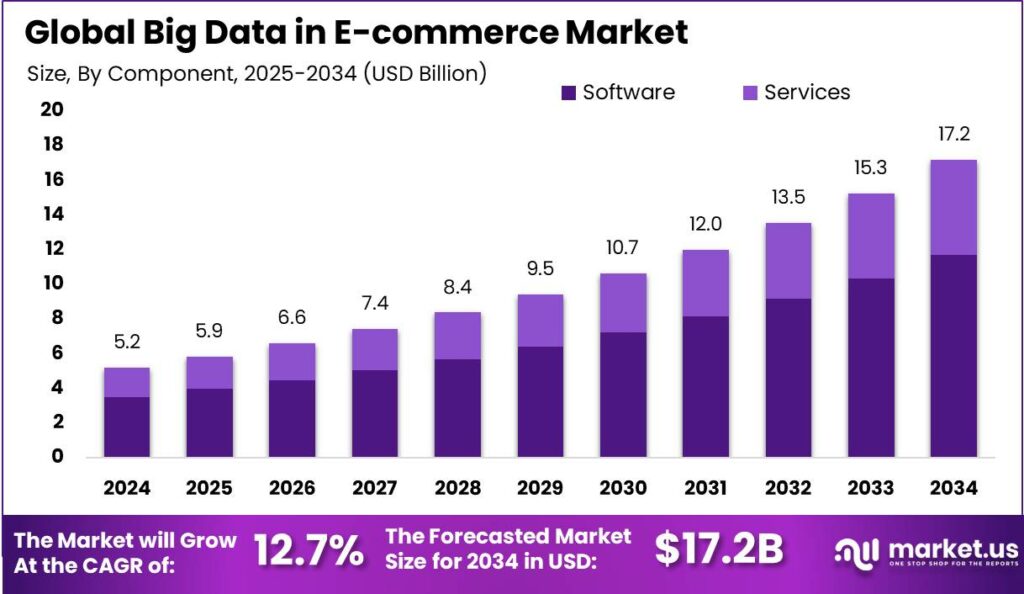
The Global Big Data in E-commerce Market size is expected to be worth around USD 17.2 Billion By 2034, from USD 5.2 Billion in 2024, growing at a CAGR of 12.70% during the forecast period from 2025 to 2034. In 2024, North America maintained a dominant market position in the Big Data in e-commerce market, accounting for over 40% of the global market share and generating revenues of USD 2.08 billion.
Big Data in e-commerce refers to the vast volumes of data generated from numerous online transactions and interactions associated with online shopping. E-commerce businesses leverage data from customer behaviors and operations to improve marketing, customer experience, and efficiency. The Big Data market is growing as companies use predictive analytics for trends, personalized marketing, and supply chain optimization.
Several factors are driving the growth of Big Data in e-commerce such as rapid increase in online shopping which has led to a surge in data generation, offering valuable insights for business strategies. Additionally, advancements in AI and machine learning have greatly improved the speed and effectiveness of processing and analyzing large datasets.
The growing demand for personalized shopping experiences and competitive pressures in e-commerce are driving businesses to adopt Big Data solutions. These insights help companies stay ahead of trends, respond quickly to shifting consumer preferences, and remain competitive in a dynamic market, fueling the expansion of Big Data applications in e-commerce.
AI plays a crucial role in unlocking the full potential of Big Data in e-commerce. By processing large datasets efficiently, AI provides actionable insights that improve decision-making. From personalized shopping advice through chatbots to AI-driven recommendation systems, AI enhances the customer journey, boosting retention and sales conversions.
The integration of Big Data offers numerous growth opportunities in the e-commerce industry. A key opportunity with Big Data is improving customer experience through personalized interactions and marketing. It also enables predictive analysis, helping businesses forecast demand accurately and identify new markets and customer segments.
Innovative applications of Big Data in e-commerce include advanced customer segmentation, predictive analytics for demand forecasting, and real-time price optimization. These innovations not only streamline operations but also enhance the user experience by providing more relevant content and interactions, which in turn boosts customer loyalty and satisfaction.
The Big Data market in e-commerce will keep expanding as businesses recognize the value of data-driven strategies. Advancements in data collection and AI tools make it easier for smaller players to implement Big Data solutions. As the digital landscape evolves, leveraging Big Data will become a key factor in the e-commerce industry’s competitive dynamics.
Key Takeaways
- The Global Big Data in E-commerce Market size is expected to grow at a CAGR of 12.70% during the forecast period from 2025 to 2034, reaching a value of USD 17.2 Billion by 2034, up from USD 5.2 Billion in 2024.
- In 2024, the Software segment held a dominant market position, capturing more than 68% of the Big Data in e-commerce market.
- In 2024, the Cloud-Based segment was the leading segment within the Big Data in e-commerce sector, commanding more than 65% of the market share.
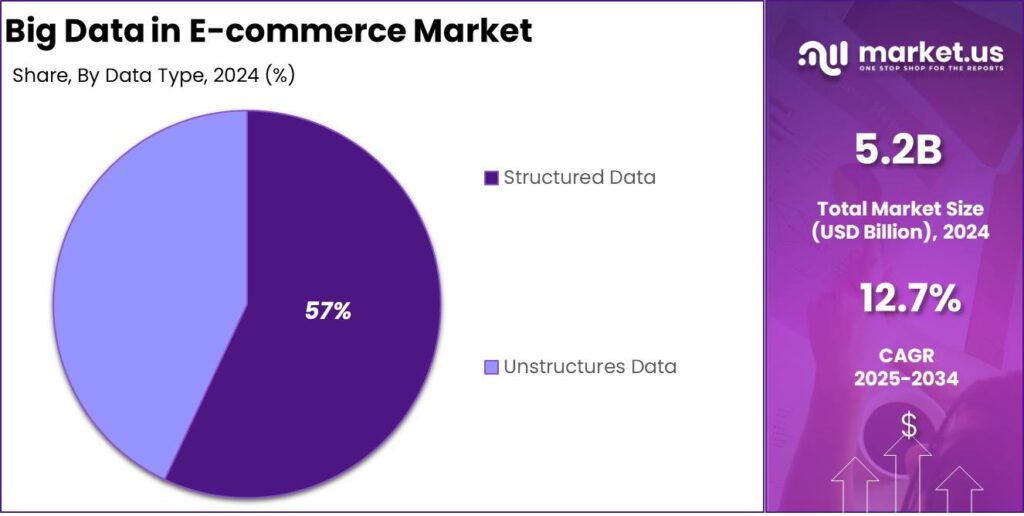
- In 2024, the Structured Data segment dominated the Big Data in e-commerce landscape, holding more than 57% of the market share.
- In 2024, Customer Experience Management (CEM) represented a dominant segment in the Big Data in e-commerce market, capturing over 30% of the market share.
- In 2024, the Retail segment of the Big Data in e-commerce market led the industry, with a commanding share of more than 40%.
- In 2024, North America maintained a dominant market position in the Big Data in e-commerce market, accounting for over 40% of the global market share and generating revenues of USD 2.08 billion.
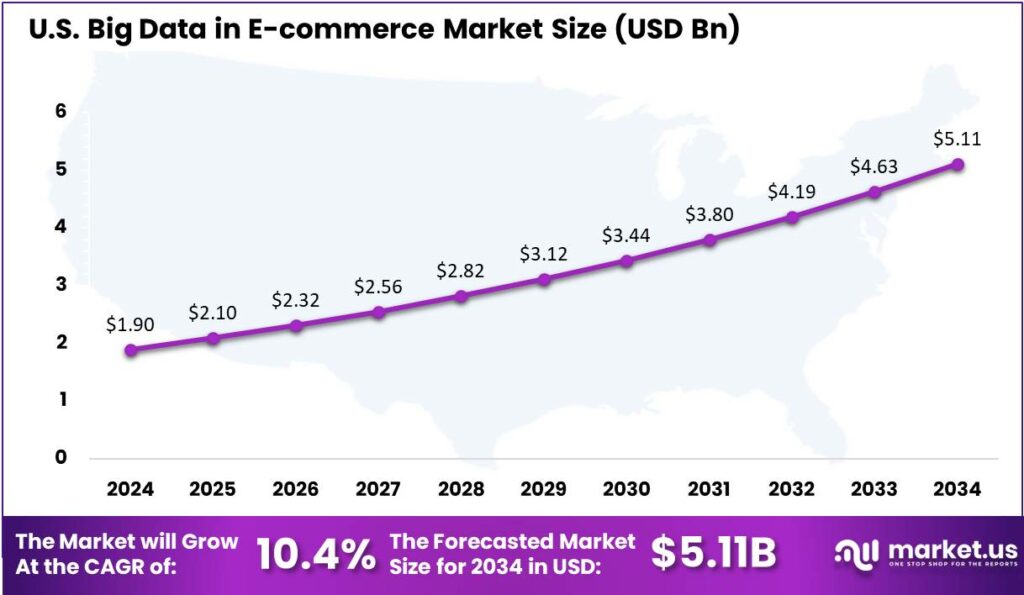
- The U.S. market for Big Data in e-commerce was valued at USD 1.9 billion in 2024 and is projected to grow at a CAGR of 10.4%, indicating strong future expansion.
Business Benefits
Big Data allows e-commerce platforms to tailor the shopping experience for each customer. By analyzing browsing history, purchase patterns, and preferences, businesses can offer personalized product recommendations and targeted promotions. According to the BigCommerce report, 87% of shoppers are more likely to make a purchase when online stores personalize their shopping experience .
E-commerce companies utilize Big Data to implement dynamic pricing models. By assessing factors such as demand, competitor pricing, and customer behavior in real-time, businesses can adjust prices to optimize sales and profit margins. A study by BARC reveals that big data is proving to be a game-changer for e-commerce companies helping 52% gain deeper insights into customer behavior and enabling 47% to cut down on costs.
Big Data empowers e-commerce companies to design marketing campaigns that resonate with specific customer segments. By understanding demographics, purchasing habits, and preferences, businesses can craft messages that are more likely to convert, increasing the effectiveness of marketing efforts.
U.S. Market Leadership
In 2024, the U.S. market for Big Data in e-commerce was estimated at a value of USD 1.9 billion. Projected to grow at a compound annual growth rate (CAGR) of 10.4%, this market is poised for significant expansion over the coming years. This growth reflects the rising use of data-driven decisions and personalized marketing in e-commerce.
The strong growth in the U.S. market is fueled by widespread mobile device use and internet access, enabling extensive consumer data collection. E-commerce companies leverage this data to refine marketing, improve customer service, and optimize supply chains. AI and machine learning further enhance data analysis, driving deeper consumer insights and accurate predictions.
Moreover, the U.S. is home to a mature e-commerce landscape with heavyweights like Amazon and eBay, which not only contribute extensively to the generation of big data but also invest heavily in its analysis. The competitive environment in the U.S. pushes companies to adopt the latest in technology advancements to gain a competitive edge, driving further growth in the Big Data sector.
In 2024, North America held a dominant market position in the Big Data in e-commerce market, capturing more than a 40% share and generating revenues amounting to USD 2.08 billion. This leading stance can be attributed to several key factors.
North America benefits from a highly developed technological infrastructure, which facilitates the widespread adoption and integration of Big Data analytics in e-commerce. The region’s readiness in adopting new technologies, combined with significant investments in cloud computing and AI, drives the effective utilization of Big Data tools.
The region is home to some of the largest tech companies in the world, including giants like Amazon, Google, and IBM, who are not only heavy users of Big Data analytics but also providers of Big Data services. This proximity to major market players creates a dynamic environment for innovation and implementation of advanced Big Data solutions.
The region shows one of the highest e-commerce penetration rates globally, driven by a tech-savvy consumer base that regularly interacts with online shopping platforms. This high level of engagement generates vast amounts of data, which in turn, increases the demand for Big Data analytics to derive insights and enhance the customer experience.

Component Analysis
In 2024, the Software segment held a dominant market position, capturing more than a 68% share in the Big Data in e-commerce market. This significant market share can be attributed to the critical role that software plays in the analytics and processing of large datasets. E-commerce businesses heavily rely on Big Data software for various functions including customer segmentation, sales forecasting, optimization of prices, and personalized marketing campaigns.
The rise of e-commerce platforms and the surge in digital transactions have created a need for advanced data handling, boosting demand for sophisticated Big Data software. These tools enhance data analysis accuracy and efficiency, allowing e-commerce businesses to swiftly adapt to market shifts and consumer behavior.
The integration of AI and machine learning into Big Data has transformed analytics, making it more dynamic and predictive. This enables e-commerce businesses to understand past behavior and forecast future trends, helping them stay competitive and improve customer satisfaction.
Regulatory compliance and data security concerns push e-commerce businesses to invest in reliable and advanced software solutions. Big Data software that ensures compliance with data protection laws and provides secure data management is increasingly becoming indispensable, thereby bolstering the dominance of the software segment in the Big Data e-commerce market.
Deployment Analysis
In 2024, the Cloud-Based segment held a dominant market position within the Big Data in e-commerce sector, capturing more than a 65% share. This significant market dominance can be attributed to several core factors that underscore the advantages of cloud-based solutions in managing the vast data streams generated by e-commerce platforms.
Cloud-based deployment offers scalability which is crucial for e-commerce businesses that experience varying levels of traffic and transactions. The flexibility to scale resources up or down based on data processing needs ensures that e-commerce businesses can manage costs effectively while maintaining optimal performance during peak periods.
The cloud-based model provides enhanced accessibility, allowing businesses to access data and insights from any location. This is particularly beneficial for e-commerce entities that operate on a global scale and need to coordinate operations across multiple regions and time zones. The ability to access and analyze data on-the-go enhances decision-making processes and operational agility.
The integration of advanced analytics and AI with cloud platforms has greatly enhanced e-commerce businesses’ ability to extract actionable insights. This enables techniques like predictive analytics and machine learning, allowing businesses to offer personalized experiences and optimize marketing strategies.
Data Type Analysis
In 2024, the Structured Data segment held a dominant market position within the Big Data in e-commerce landscape, capturing more than a 57% share. This significant market share can be attributed to several foundational aspects that favor structured data’s use in the e-commerce sector.
Structured data, which includes formats that are easily searchable and organized in databases (like SQL), lends itself well to straightforward analysis using traditional data analysis tools. For e-commerce businesses, this means being able to quickly sort through and analyze customer data, sales patterns, and inventory information to make informed decisions swiftly.
Most e-commerce platforms are built to handle structured data, making it easier to integrate with existing IT systems without the need for extensive modifications. This compatibility reduces costs and complexity in data handling, making structured data a preferred choice for many e-commerce businesses.
Structured data allows for precise segmentation of customer information, which can be used to tailor marketing efforts more effectively. E-commerce companies rely on structured data to run targeted campaigns, personalize offers, and improve customer engagement through detailed customer profiles and purchase histories.
Application Analysis
In 2024, the Customer Experience Management (CEM) segment in the Big Data in E-commerce market held a dominant position, capturing more than a 30% share. This prominence can be attributed to several key factors that underscore the critical role of effective customer experience strategies in driving e-commerce success.
The rise in online shopping has highlighted the need for personalized customer interactions. Big Data analytics allow e-commerce platforms to process vast consumer data, leading to more targeted marketing. This personalization boosts customer satisfaction and loyalty, essential for standing out in the competitive e-commerce market.
Big Data tools have enhanced e-commerce businesses’ ability to predict customer needs by analyzing past behavior. This predictive capability allows for personalized offerings and communications, improving the user experience and boosting sales conversion rates.
Big Data analytics create a feedback loop that drives continuous improvement in customer service. By analyzing customer interactions, companies can refine strategies to meet evolving expectations, ensuring the sustained growth and relevance of the Customer Experience Management (CEM) segment in the e-commerce market. This ongoing refinement is key to maintaining a competitive edge in customer experience.
End-User Industry Analysis
In 2024, the Retail segment of the Big Data in E-commerce market held a dominant market position, capturing more than a 40% share. This segment’s leadership is driven by several factors that emphasize the transformative impact of Big Data on the retail industry.
The retail sector has seen a major shift to e-commerce, driven by digital transformation and evolving consumer behavior. Big Data is key in this shift, allowing retailers to leverage consumer data to optimize sales strategies, improve operational efficiency, and predict demand, all of which help maintain a competitive advantage.
Customer personalization is now central to retail marketing. Big Data enables retailers to deliver personalized experiences through targeted ads, product recommendations, and tailored promotions, addressing individual preferences. This boosts customer engagement, conversion rates, and loyalty.
Furthermore, Big Data aids in the optimization of supply chains in the retail industry. By analyzing large datasets, retailers can forecast disruptions, adjust supply chain parameters in real-time, and cut costs linked to overstocking or understocking. This predictive ability is vital for ensuring supply chain efficiency and responsiveness in a volatile market.
Key Market Segments
By Component
- Software
- Services
By Deployment
- On-Premise
- Cloud-Based
By Data Type
- Structured Data
- Unstructures Data
By Application
- Customer Experience Management
- Supply Chain & Inventory Management
- Fraud Detection & Risk Management
- Pricing Optimization
- Other Applications
By End-User Industry
- Retail
- Consumer Electronics
- Fashion & Apparel
- Food & Grocery
- Others
Key Regions and Countries
- North America
- US
- Canada
- Europe
- Germany
- France
- The UK
- Spain
- Italy
- Rest of Europe
- Asia Pacific
- China
- Japan
- South Korea
- India
- Australia
- Singapore
- Rest of Asia Pacific
- Latin America
- Brazil
- Mexico
- Rest of Latin America
- Middle East & Africa
- South Africa
- Saudi Arabia
- UAE
- Rest of MEA
Driver
Enhanced Customer Personalization
Big Data analytics has greatly impacted e-commerce by enabling personalized customer experiences. By analyzing data like browsing history, purchase behavior, and demographics, platforms can customize product recommendations, marketing efforts, and pricing to suit individual preferences.
Companies like Amazon leverage Big Data to analyze customer behavior and offer personalized product suggestions, driving sales and satisfaction. Similarly, Alibaba uses Big Data to optimize recommendations, logistics, and customer service, especially during high-traffic events like Singles’ Day. Personalized experiences enhance customer engagement and loyalty, as e-commerce businesses track buying journeys to improve sentiment analysis and service.
Restraint
Data Privacy Concerns
Despite the advantages of Big Data in e-commerce, data privacy concerns remain a significant restraint. The collection and analysis of personal customer data raise issues related to consent, data security, and compliance with regulations such as the General Data Protection Regulation (GDPR).
Customers are increasingly aware of how their data is being used, leading to a demand for greater transparency and control over personal information. E-commerce companies must navigate these concerns carefully to maintain customer trust and avoid potential legal repercussions.
Moreover, data breaches and unauthorized access to sensitive customer information can result in substantial financial losses and damage to a company’s reputation. Implementing robust data security measures and ensuring compliance with data protection laws are essential to mitigate these risks.
Opportunity
Predictive Analytics for Demand Forecasting
Big Data presents a significant opportunity in e-commerce through predictive analytics for demand forecasting. By analyzing historical sales data, market trends, and customer behavior, e-commerce businesses can anticipate future demand for products and adjust their inventory and supply chain strategies accordingly.
Companies use predictive models to identify peak shopping periods and maintain optimal stock levels, reducing the risk of stockouts or overstocking. This proactive approach improves operational efficiency and customer satisfaction. Additionally, predictive analytics helps inform marketing strategies by pinpointing high-demand products, enabling businesses to allocate resources effectively and maximize sales, ultimately boosting profitability.
Challenge
Integration of Big Data Systems
Integrating Big Data into e-commerce systems is challenging, requiring advanced technology and skilled personnel. Companies often struggle to consolidate data from various sources, like customer interactions and sales, while ensuring consistency and accuracy for effective decision-making.
Implementing Big Data solutions requires significant investment in technology and training, which can be a challenge for small and medium-sized enterprises (SMEs) with limited resources. This may hinder their ability to compete with larger organizations. Additionally, the rapid pace of technological evolution demands constant updates to maintain system compatibility, with outdated systems potentially limiting data analysis capabilities.
Emerging Trends
A key trend is hyper-personalization, where retailers use big data to analyze customer behaviors, preferences, and purchase histories. This allows for tailored product recommendations and personalized shopping experiences, boosting both customer satisfaction and conversion rates.
Another key development is predictive analytics, where e-commerce businesses analyze historical data and market trends to forecast demand, optimize inventory management, and adjust pricing strategies. This proactive approach helps minimize overstock and stockouts, ensuring a smooth shopping experience for customers.
Real-time data processing is gaining traction, enabling retailers to make immediate decisions on promotions, inventory, and customer engagement, helping them respond quickly to market shifts. Additionally, AI and machine learning are revolutionizing e-commerce by automating customer service with chatbots, enhancing fraud detection, and improving supply chain logistics by predicting disruptions.
Key Player Analysis
In this competitive landscape, several tech giants dominate the market, offering powerful big data solutions to e-commerce businesses.
- Microsoft (Azure), with its Azure platform, stands as one of the top players in the big data market for e-commerce. Azure offers a comprehensive suite of cloud services that can handle massive amounts of data and help businesses gain actionable insights. Microsoft Azure offers scalability, robust security, and seamless integration with AI and machine learning tools, giving e-commerce companies a strong edge in enhancing data analysis and customer experiences.
- Google Cloud is another major player in the big data space, known for its powerful data processing tools and AI capabilities. The platform offers a range of services such as BigQuery, which enables e-commerce businesses to analyze data in real-time. Google Cloud’s machine learning tools allow companies to personalize customer experiences, predict trends, and optimize supply chains.
- IBM is a leader in providing big data solutions, especially through its IBM Cloud and Watson analytics tools. IBM helps e-commerce companies by offering advanced data analytics, AI-powered customer insights, and automation solutions. Watson’s ability to process large volumes of data and deliver personalized recommendations gives businesses an edge in understanding their customers’ behaviors.
Top Key Players in the Market
- Amazon Web Services (AWS)
- Microsoft (Azure)
- Google Cloud
- IBM
- SAP
- Cloudera
- Oracle
- SAS Institute
- Tableau Software (Salesforce)
- Teradata
- Hortonworks (now part of Cloudera)
- Qlik
- Sisense
- Snowflake
- Alteryx
- Other Key Players
Top Opportunities Awaiting for Players
- Advanced Analytics and AI Integration: The rapid advancement in artificial intelligence and machine learning technologies is transforming e-commerce. These technologies enable more precise analytics and insights, particularly through AI-driven data insights that can enhance customer experience, streamline operations, and optimize marketing strategies.
- Personalization and Customer Engagement: Utilizing big data allows e-commerce platforms to tailor the shopping experience to individual preferences and behaviors. This not only improves customer satisfaction but also increases loyalty and conversion rates by presenting products and offers that are most relevant to each customer.
- Fraud Detection and Enhanced Security: Big data tools provide powerful capabilities to detect fraudulent activities and enhance security measures. By analyzing large datasets, e-commerce businesses can identify unusual patterns that signify fraud, reducing losses and increasing trust among consumers.
- Supply Chain Optimization: Big data analytics play a crucial role in optimizing inventory management and logistics. By predicting demand more accurately and tracking inventory in real time, businesses can reduce overhead costs and improve delivery times, thereby enhancing overall operational efficiency.
- Market Expansion and Global Reach: E-commerce businesses are increasingly using big data to explore new market opportunities and expand globally. By analyzing diverse customer data across different regions, companies can identify and capitalize on untapped markets, customizing their offerings to meet local demands and preferences.
Recent Developments
- In December 2024, AWS introduced several analytics advancements at its re:Invent conference. Notably, the Trainium2 AI chip was launched, offering 30–40% improved price-performance for AI workloads. Additionally, new features in Amazon SageMaker and Amazon Bedrock were unveiled to enhance generative AI capabilities for e-commerce applications.
- In November 2024, Cloudera announced its intent to acquire Octopai, a company known for its data lineage and catalog platform. This acquisition is expected to bolster Cloudera’s data governance and discovery capabilities across hybrid cloud environments.
- In January 2024, Microsoft expanded its retail-focused offerings by integrating generative AI into the Microsoft Cloud for Retail. This includes new Copilot templates and industry-specific data solutions within Microsoft Fabric, aimed at personalizing shopping experiences and supporting store operations.









