


Market Size & Trends
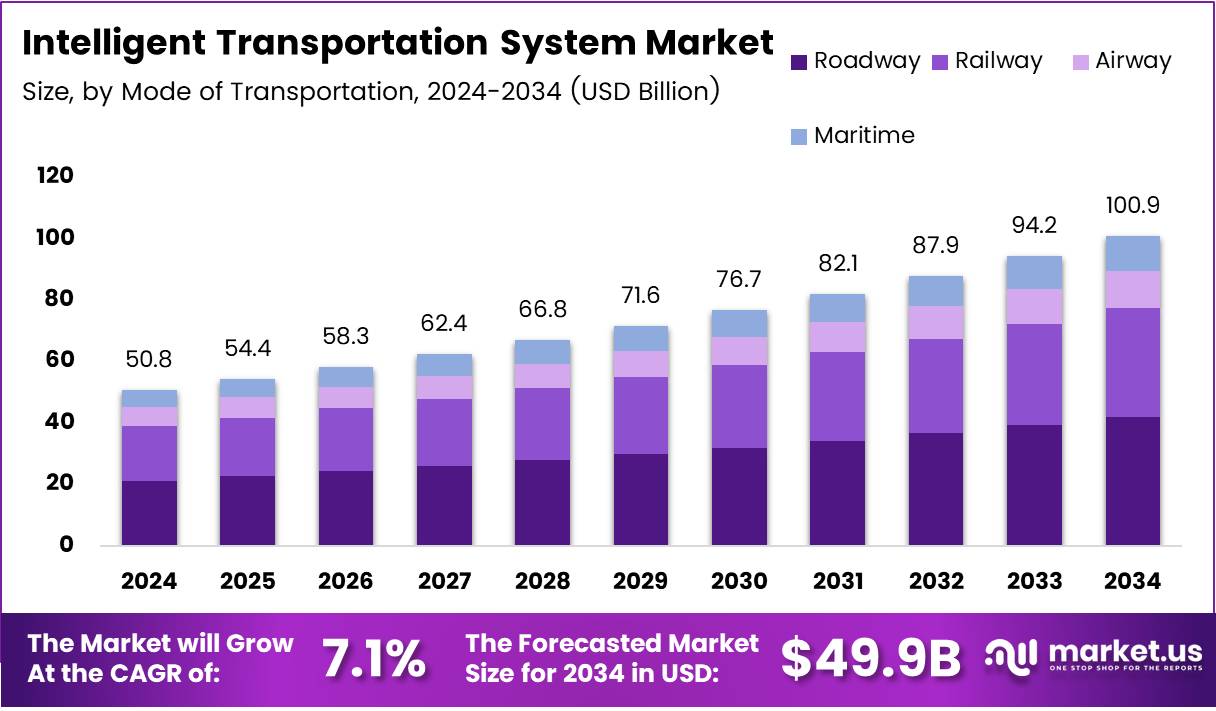
The Global Intelligent Transportation System Market size is expected to be worth around USD 100.9 Billion by 2034, from USD 50.8 Billion in 2024, growing at a CAGR of 7.1% during the forecast period from 2025 to 2034. Key drivers of this growth include increasing urbanization, rising demand for smart city infrastructure, and the growing need for enhanced transportation safety and efficiency.
Key Takeaways
- The Global Intelligent Transportation System Market is projected to reach USD 100.9 Billion by 2034, growing from USD 50.8 Billion in 2024 at a CAGR of 7.1%.
- In 2024, Roadway dominated the By Mode of Transportation segment with a 39.5% market share, driven by widespread road infrastructure and smart traffic system adoption.
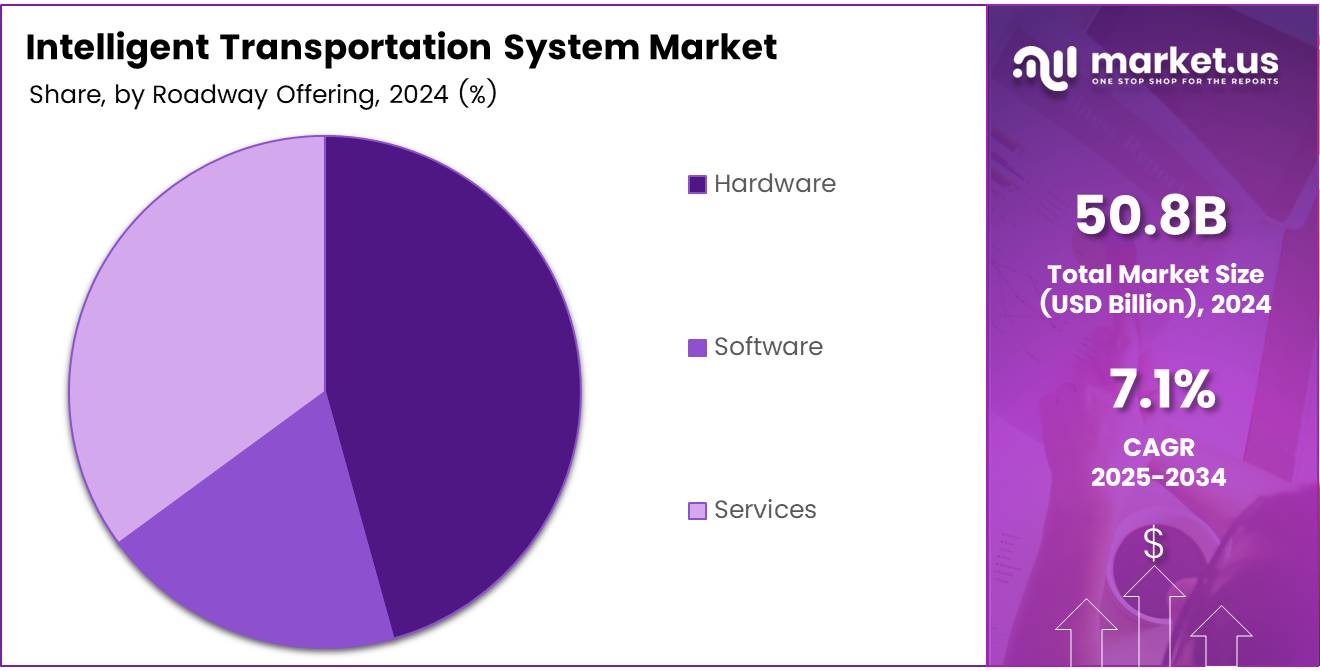
- Hardware led the By Roadway Offering segment in 2024, driven by the ongoing demand for sensors, surveillance cameras, traffic lights, and control devices.
- The Advanced Traffic Management System (ATMS) held the top spot in the By Roadway System Type segment in 2024, supporting smart mobility with real-time monitoring and adaptive signal control.
- Traffic Management was the dominant application in 2024 under the By Roadway Application segment, due to the urgent need for congestion reduction and improved signal timing.
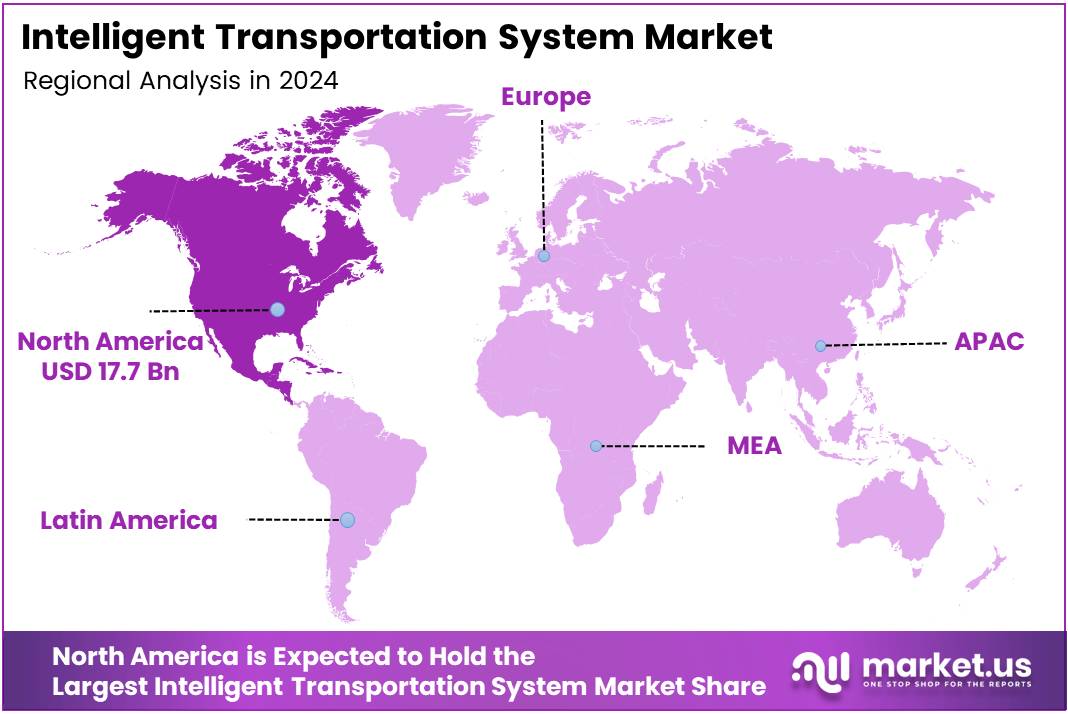
- North America led the global ITS market in 2024 with a 35.4% market share, valued at USD 17.7 Billion, thanks to robust infrastructure and government-backed smart mobility initiatives.
Report Overview
The Intelligent Transportation System (ITS) Market integrates advanced digital technologies into transportation infrastructure to enhance traffic flow, reduce congestion, and improve commuter safety. By combining communication, control, and information processing technologies, ITS enables real-time decision-making for both public and private mobility services. This innovation is redefining how cities manage transportation networks efficiently.
Driven by the global push for smart urban mobility, the ITS market is witnessing rapid expansion. Government-backed funding, digitalization of traffic control systems, and growing concerns over road safety are fueling demand. In particular, emerging economies are adopting ITS solutions to ease urban congestion and improve air quality.
According to masstransitmag, the U.S. Department of Transportation (USDOT) has allocated $3.2 billion through 180 infrastructure grants covering over 3,200 projects. This surge in funding reflects growing federal commitment to modernize transport infrastructure using intelligent systems.
Moreover, the same source states that since taking office, the USDOT has sanctioned a total of 329 grants, signaling strong support for ITS upgrades. These investments are expected to boost implementation of adaptive traffic signals, vehicle-to-infrastructure communication, and connected vehicle platforms nationwide.
In New York, government policy continues to prioritize low-emission transit. According to DOTNY, the Zero-Emission Transit Transition Program (ZETT) provides $100 million in funding to support battery-electric and hydrogen-electric transit fleet conversions. This underscores a broader trend of ITS adoption being aligned with sustainability goals.
In parallel, private sector participation is rising. Technology firms and mobility startups are collaborating with city planners to develop scalable ITS applications including real-time analytics, predictive maintenance, and AI-enabled traffic systems. This shift creates new revenue streams and enhances public-private partnerships.
As regulations evolve, mandates around emissions, smart tolling, and data security are becoming more prevalent. This regulatory shift promotes innovation in ITS design while also ensuring public safety and equitable access to mobility services.
Opportunities lie in integrating ITS with autonomous driving platforms. Intelligent intersections, sensor-based congestion monitoring, and 5G-enabled vehicle communications are forming the backbone of future mobility. These developments are creating a ripe environment for long-term market penetration.
Looking ahead, the Intelligent Transportation System Market is positioned for sustained growth, supported by federal grants, green transportation policies, and rapid urbanization. As nations prioritize digital mobility, ITS will play a pivotal role in transforming how transportation ecosystems operate, making cities more connected, safe, and efficient.
Mode of Transportation Analysis
Roadway leads with 39.5% share, reflecting its widespread implementation and network dominance.
In 2024, Roadway held a dominant market position in the By Mode of Transportation Analysis segment of the Intelligent Transportation System Market, with a 39.5% share. This dominance is primarily attributed to the extensive global road infrastructure and the increasing adoption of smart traffic control systems. Roadways form the backbone of urban and interurban transport, making them a prime focus for ITS investments.
Railway followed as an emerging mode with integrated systems for train control, signaling automation, and safety enhancements. Though not leading, the rising deployment of digitized operations positions this segment for progressive growth.
Airway, while vital for long-distance and time-sensitive logistics, sees limited ITS integration due to its regulatory complexity and smaller network scale. However, ITS applications in airport traffic coordination and safety are growing gradually.
Maritime remains niche in ITS but is gaining attention with ports modernizing their cargo and vessel traffic systems. Digital navigation aids and port efficiency tools are becoming part of ITS expansion plans in global shipping hubs.
Roadway Offering Analysis
Hardware dominates ITS investments due to high initial infrastructure demand.
In 2024, Hardware held a dominant market position in the By Roadway Offering Analysis segment of the Intelligent Transportation System Market. The need for physical components—such as sensors, traffic lights, surveillance cameras, vehicle detectors, and control devices—continues to drive the growth of this segment. Hardware remains essential in enabling the functionality of any intelligent transport framework.
Software plays a critical supporting role by offering traffic analysis, route optimization, and real-time communication. However, it depends heavily on hardware infrastructure for data collection and deployment.
Services, including maintenance, system integration, and consultancy, are essential for lifecycle support. Although service offerings are expanding in scope, their contribution remains supplementary compared to hardware in capital-intensive ITS deployments.
Roadway System Type Analysis
Advanced Traffic Management System (ATMS) takes the lead owing to growing urban congestion.
In 2024, Advanced Traffic Management System (ATMS) held a dominant market position in the By Roadway System Type Analysis segment of the Intelligent Transportation System Market. ATMS has become the cornerstone of smart mobility strategies across metropolitan areas. It integrates real-time traffic monitoring, adaptive signal control, and congestion mitigation technologies.
Advanced Traveler Information System (ATIS) is rising steadily as cities adopt digital signage and mobile apps to guide commuters. Meanwhile, Advanced Transportation Pricing System (ATPS) is gaining popularity through dynamic toll pricing and congestion fees to regulate urban traffic flow.
Advanced Public Transportation System (APTS) is contributing to smarter fleet scheduling and public transit usage optimization. Emergency Medical System (EMS) remains crucial for traffic-based emergency response and rapid dispatch coordination, especially in accident-prone urban corridors.
Roadway Application Analysis
Traffic Management dominates with highest adoption in urban transport regulation efforts.
In 2024, Traffic Management held a dominant market position in the By Roadway Application Analysis segment of the Intelligent Transportation System Market. Its prominence stems from the urgent need to reduce congestion, improve road safety, and optimize signal timing across densely populated cities. Governments and municipalities are heavily investing in ATMS infrastructure to streamline vehicle movement and enhance commuter efficiency.
Road Tolling Systems follow as urban congestion pricing gains traction, particularly in developed countries. Road Safety and Security is another key focus, with automated enforcement, surveillance, and accident detection systems being widely deployed.
Freight Management applications are improving logistics flow and reducing delivery delays. Parking Management is increasingly automated through real-time availability tracking. Public Transport applications are promoting ridership through digital ticketing and schedule optimization. Automotive Telematics supports vehicle-level tracking and diagnostics, while Environment Protection focuses on emission monitoring. The Others segment includes emerging areas like weather alerts and connected infrastructure services.
Key Market Segments
By Mode of Transportation
- Roadway
- Railway
- Airway
- Maritime
By Roadway Offering
- Hardware
- Interface Boards
- Sensors
- Surveillance Cameras
- Telecommunication Networks
- Monitoring and Detection Systems
- Others
- Software
- Visualization Software
- Video Detection Management Software
- Transit Management Software
- Others
- Services
- Cloud services
- Business services
- Professional services
By Roadway System Type
- Advanced Traveler Information System (ATIS)
- Advanced Traffic Management System (ATMS)
- Advanced Transportation Pricing System (ATPS)
- Advanced Public Transportation System (APTS)
- Emergency Medical System (EMS)
By Roadway Application
- Traffic Management
- Road Safety and Security
- Freight Management
- Public Transport
- Environment Protection
- Automotive Telematics
- Parking Management
- Road Tolling Systems
- Others
By Railway Offering
- Hardware
- Interface Boards
- Sensors
- Surveillance Cameras
- Telecommunication Networks
- Monitoring and Detection Systems
- Others
- Software
- Visualization Software
- Video Detection Management Software
- Transit Management Software
- Others
- Services
- Cloud services
- Business services
- Professional services
By Railway System Type
- Advanced Traveler Information System (ATIS)
- Advanced Traffic Management System (ATMS)
- Advanced Transportation Pricing System (ATPS)
- Advanced Public Transportation System (APTS)
- Emergency Medical System (EMS)
By Railway Application
- Rail-running Operation and Collision Avoidance
- Passenger Information Management
- Smart Ticketing
- Security Surveillance
- Emergency Notification
- Others
By Airway Offering
- Hardware
- Interface Boards
- Sensors
- Surveillance Cameras
- Telecommunication Networks
- Monitoring and Detection Systems
- Others
- Software
- Visualization Software
- Video Detection Management Software
- Transit Management Software
- Others
- Services
- Cloud services
- Business services
- Professional services
By Airway System Type
- Advanced Traveler Information System (ATIS)
- Advanced Traffic Management System (ATMS)
- Advanced Transportation Pricing System (ATPS)
- Advanced Public Transportation System (APTS)
- Emergency Medical System (EMS)
By Airway Application
- Security Surveillance
- Shuttle Bus Tracking
- Traveler Information Management
- Aircraft Traffic Management
- Smart Ticketing
- Emergency Notification
- Others
By Maritime Offering
- Hardware
- Interface Boards
- Sensors
- Surveillance Cameras
- Telecommunication Networks
- Monitoring and Detection Systems
- Others
- Software
- Visualization Software
- Video Detection Management Software
- Transit Management Software
- Others
- Services
- Cloud services
- Business services
- Professional services
By Maritime System Type
- Advanced Traveler Information System (ATIS)
- Advanced Traffic Management System (ATMS)
- Advanced Transportation Pricing System (ATPS)
- Advanced Public Transportation System (APTS)
- Emergency Medical System (EMS)
By Maritime Application
- Freight Arrival & Transit
- Real-time Weather Information Tracking
- Container Movement Scheduling
- Emergency Notification
- Others
Drivers
Growing Need for Safety and Security in Transportation Systems Drives Market Growth
The demand for safer and more secure transportation systems is one of the key drivers of the Intelligent Transportation System (ITS) market. Governments and city planners are increasingly focusing on reducing road accidents and enhancing public safety through smart traffic management tools and surveillance systems.
With traffic congestion becoming a daily challenge in urban areas, the need for efficient traffic control is rising. ITS solutions, such as adaptive traffic signals and real-time traffic updates, help manage the flow of vehicles more effectively, reducing travel time and improving safety.
The advancement of Internet of Things (IoT) technologies and connected devices plays a significant role in the growth of ITS. These technologies allow for real-time monitoring, automated incident detection, and immediate response measures, making transportation networks smarter and more responsive.
Urbanization and population growth are adding pressure on existing transportation infrastructures. As more people move to cities, the need for smarter and more integrated transport solutions increases. ITS provides a scalable way to accommodate growing travel demand without requiring extensive physical infrastructure changes.
Restraints
High Initial Implementation Costs Restrain Market Growth
One of the biggest challenges facing the ITS market is the high cost of initial setup and integration. Implementing these systems often requires major investments in infrastructure, equipment, and software, which can be a barrier for budget-constrained regions.
A lack of standardized infrastructure also limits market adoption. Different regions may use varying systems and technologies, making it difficult to implement unified or scalable ITS solutions.
Data privacy and cybersecurity concerns are another significant issue. As ITS relies heavily on data collection and real-time sharing, the risk of unauthorized access or data breaches becomes a serious concern for users and governments alike.
Older transportation systems often resist adopting new technologies. Legacy systems may not be compatible with modern ITS solutions, leading to added costs or operational inefficiencies when trying to upgrade or replace outdated components.
Growth Factors
Expansion of Smart City Initiatives Creates Growth Opportunities
The growing number of smart city projects around the world presents a major opportunity for the ITS market. These projects focus on using technology to improve the quality of urban life, and intelligent transportation systems are a key part of that vision.
The integration of artificial intelligence (AI) and machine learning into ITS is transforming how traffic is managed. These technologies enable predictive traffic analysis, helping reduce congestion and improve road safety through data-driven decision-making.
Increased government investments in transportation infrastructure are also fueling market growth. Many governments are allocating significant budgets for modernizing road networks and integrating intelligent traffic management systems.
The development of autonomous vehicle technologies further supports the adoption of ITS. These vehicles require sophisticated traffic systems that can communicate with them in real time, making ITS an essential foundation for future mobility.
Emerging Trends
Adoption of Cloud-Based Transportation Management Systems is a Key Trend
Cloud-based transportation management systems are gaining popularity due to their flexibility and scalability. These systems enable real-time monitoring and data sharing across multiple platforms, which improves efficiency and decision-making in transportation networks.
There is also a noticeable rise in electric and sustainable transportation solutions, such as electric buses and shared mobility. ITS plays a crucial role in supporting these developments by managing charging infrastructure and route optimization.
Real-time data analytics is becoming central to traffic management. By analyzing live traffic data, cities can adjust signals, reroute traffic, and reduce congestion effectively. This enhances not only efficiency but also commuter experience.
The integration of blockchain technology is another emerging trend. It offers a secure way to manage and share transportation data, helping ensure transparency and trust among various stakeholders in the ITS ecosystem.
Regional Analysis
North America Dominates the Intelligent Transportation System Market with a Market Share of 35.4%, Valued at USD 17.7 Billion
North America leads the global intelligent transportation system (ITS) market, driven by advanced infrastructure, strong government initiatives, and widespread adoption of smart mobility solutions. With a significant market share of 35.4% and valuation of USD 17.7 Billion, the region continues to benefit from high investment in intelligent traffic management and public safety technologies. The increasing demand for efficient urban mobility and vehicle-to-everything (V2X) communication systems further reinforces its dominance.
Europe Intelligent Transportation System Market Trends
Europe follows closely with strong regulatory support and a well-established transportation framework promoting the deployment of ITS. The region’s focus on sustainable urban development and reducing vehicular emissions is accelerating adoption. Countries across Western and Northern Europe are prioritizing smart mobility projects, contributing to steady market growth.
Asia Pacific Intelligent Transportation System Market Trends
Asia Pacific is emerging as a rapidly growing market for intelligent transportation systems due to ongoing urbanization, rising vehicle ownership, and increasing traffic congestion. Governments in the region are investing in digital traffic solutions and smart city projects, particularly in countries like China, Japan, and India. The region is expected to witness strong growth over the forecast period.
Middle East and Africa Intelligent Transportation System Market Trends
The Middle East and Africa are experiencing gradual adoption of ITS, supported by smart city developments and transportation modernization efforts in major urban centers. While the market is in a developing stage, initiatives to enhance traffic efficiency and safety are gaining momentum, especially in the Gulf Cooperation Council (GCC) countries.
Latin America Intelligent Transportation System Market Trends
Latin America is showing increasing interest in ITS technologies as urban centers face rising congestion and pollution challenges. Governments in the region are beginning to implement pilot projects and traffic management solutions, though infrastructure and funding limitations may pose challenges to rapid adoption.
Key Regions and Countries
North America
- US
- Canada
Europe
- Germany
- France
- The UK
- Spain
- Italy
- Rest of Europe
Asia Pacific
- China
- Japan
- South Korea
- India
- Australia
- Rest of APAC
Latin America
- Brazil
- Mexico
- Rest of Latin America
Middle East & Africa
- GCC
- South Africa
- Rest of MEA
Key Intelligent Transportation System Company Insights
In 2024, the global Intelligent Transportation System (ITS) market continues to evolve with strong contributions from technology-driven leaders focused on innovation, efficiency, and smart mobility integration.
Thales Group has maintained its competitive edge by enhancing its integrated traffic management platforms and prioritizing cybersecurity in smart mobility systems. The company’s focus on multimodal transport coordination strengthens its influence across both rail and urban traffic ecosystems.
Siemens AG continues to lead in adaptive traffic signal control and real-time traffic data analytics, leveraging its IoT and AI capabilities. Its emphasis on sustainable urban infrastructure and smart city solutions makes it a preferred choice for governments aiming to modernize public transport.
L3Harris Technologies, Inc. leverages its defense-grade surveillance and communication systems to improve vehicular and public safety monitoring. Its growing presence in aviation traffic management reflects a strategic diversification within ITS applications.
NEC Corporation is expanding its smart transportation offerings through AI-based facial recognition and data-driven passenger management solutions. Its integration of biometric systems with transit networks highlights the company’s approach to secure and efficient urban mobility.
Together, these players are shaping the future of transportation by advancing connectivity, reducing congestion, and promoting safer travel experiences. Their strategic focus on innovation, automation, and interoperability positions them well to capture long-term growth opportunities in the global ITS landscape.
Top Key Players in the Market
- Thales Group
- Siemens AG
- L3Harris Technologies, Inc.
- NEC Corporation
- Hitachi, Ltd.
- Advantech Co., Ltd.
- Indra Sistemas, S.A.
- Aireon
- Teledyne Technologies Incorporated
- KONGSBERG
Recent Developments
- In April 2024, new funding for rural roadway development was made accessible to local communities, aiming to enhance infrastructure and support regional connectivity. This move is expected to address transportation gaps in underserved rural areas.
- In May 2024, Hitachi Rail completed the acquisition of Thales’ Ground Transportation Systems business for €1,660 million, strengthening its global position in railway signaling and urban mobility solutions.
- In September 2024, EVO Transportation announced the acquisition of West Side Transport, a strategic move intended to expand its freight network and improve its service capabilities across the Midwest.









