


Report Overview
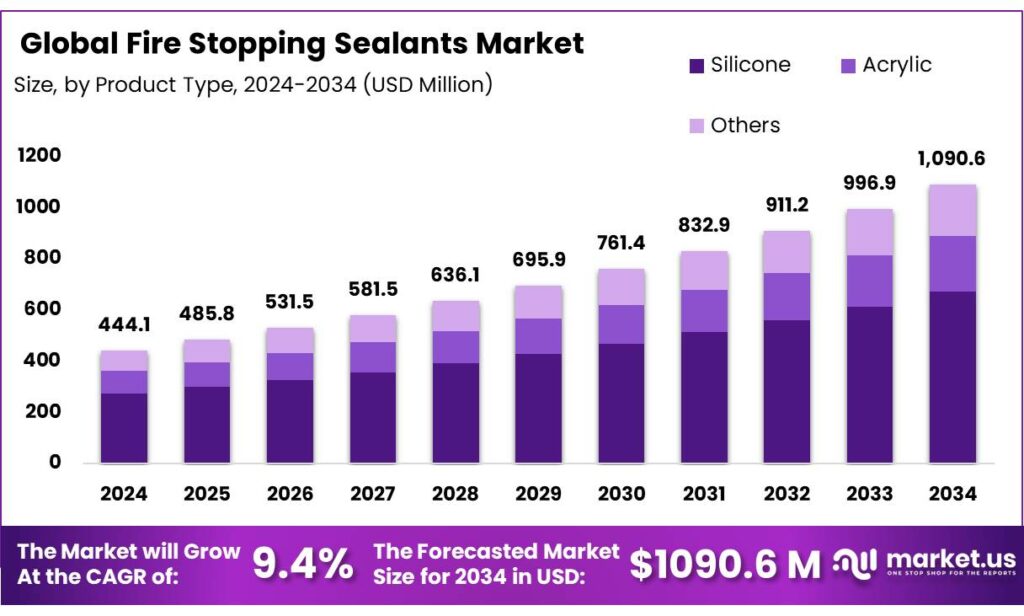
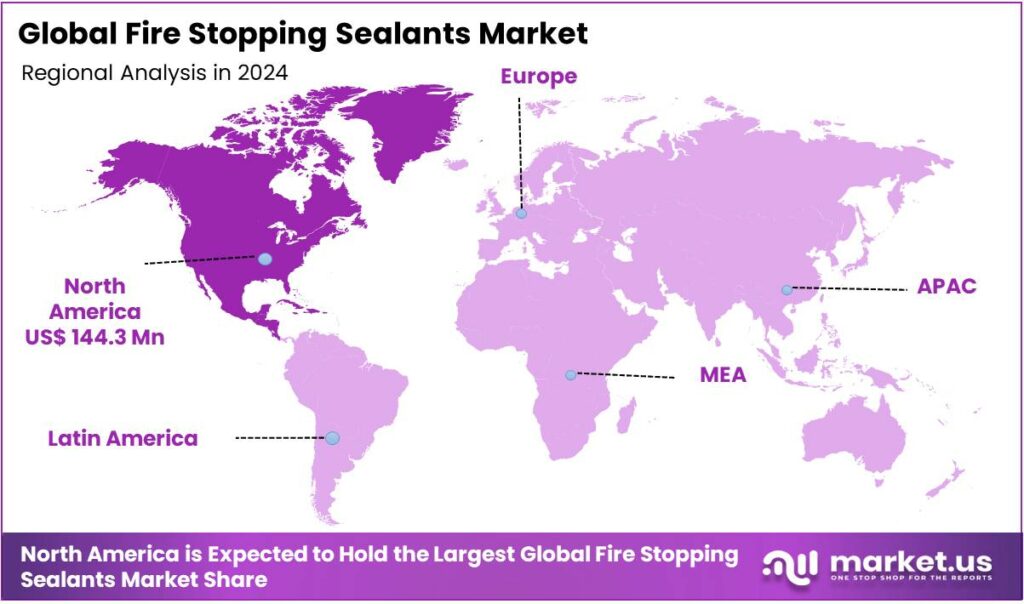
The Global Fire Stopping Sealants Market size is expected to be worth around USD 1090.6 Million by 2034, from USD 444.1 Million in 2024, growing at a CAGR of 9.4% during the forecast period from 2025 to 2034. In 2024 North America held a dominant market position, capturing more than a 32.5%share, holding USD 144.3 Million in revenue.
Fire-stopping sealants are fire-resistant materials used to seal gaps and openings in fire-rated walls, floors, and ceilings to prevent the spread of fire, smoke, and toxic gases. They are a critical part of passive fire protection systems, maintaining the integrity of fire barriers by expanding when exposed to heat to create a seal. Fire-stopping sealants come in various types, such as silicone, intumescent, and ablative, and are used to seal around penetrations such as pipes, cables, and ducts, as well as in linear joints.
- According to the United States National Fire Protection Association (NFPA), in 2023, a total of 3,800 individuals died due to fire/smoke inhalation. Out of these, 3,010 were due to structure fire, and 680 were due to motor vehicle fire, which equated to one fire-related death every 2 hours and 17 minutes in the United States.
To avoid casualties, in case of fire, several governments impose stringent laws, which are a major driver of the fire-stopping sealants market. For instance, the International Building Code (IBC) provides comprehensive standards for fire safety by establishing requirements for both passive and active fire protection systems in buildings. Similarly, the UK has its own set of standards for fire safety, British Standards (BS). BS 476 provides the fire tests on building materials and structures. BS 9999 provides the code of practice for fire safety in the design, management, and use of buildings.
Furthermore, as urbanization increases, the demand for modern housing increases, which increases the demand for fire-stopping materials. As the demand for these materials increases, several companies invest in R&D to develop innovative solutions. The fire-stopping materials market faces challenges from the complexity of complying with a patchwork of regional fire safety regulations.
Key Takeaways
- The global fire-stopping sealants market was valued at USD 444.1 Million in 2024.
- The global fire-stopping sealants market is projected to grow at a CAGR of 9.4% and is estimated to reach USD 1090.6 Million by 2034.
- Based on the types of sealants used for stopping the fire, elastomeric sealants dominated the market, with around 58.2% of the total global market.
- Among the applications, concrete sealants are the most dominant in the market, with 28.5% of the market share.
- Based on product types, the majorly used sealants are the silicone sealants, with approximately 61.7% of the market share.
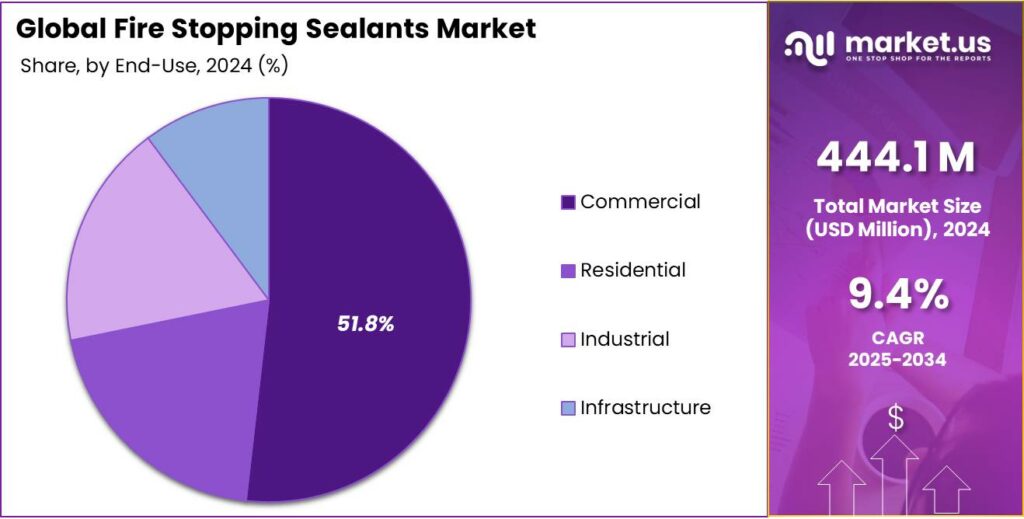
- On the basis of end-uses of fire-stopping sealants, the sealants are mainly used in commercial buildings, approximately 51.8%.
- North America was at the forefront of the fire-stopping sealants market, accounting for around 32.5% of the total global consumption.
Type Analysis
Elastomeric Sealants are the Most Widely Used Fire-Stopping Sealants.
The fire-stopping sealants market is segmented based on types as elastomeric and intumescent. The elastomeric sealants dominate the market, comprising around 58.2% of the market share. Elastomeric fire-stopping sealants are more widely utilized than intumescent sealants primarily due to their superior flexibility and long-term durability. These sealants maintain their elasticity even after curing, allowing them to accommodate building movement, joint expansion, and contraction without cracking or losing adhesion.
This is especially important in dynamic joints and areas subject to vibration or thermal changes. Unlike intumescent sealants, which expand under heat to fill gaps, elastomeric sealants provide an immediate airtight and fire-resistant barrier without requiring exposure to high temperatures. Their ease of application, compatibility with a wide range of construction materials, and low maintenance requirements further contribute to their preference in many firestopping applications, especially in non-combustible penetrations.
Product Type Analysis
Silicone Sealants Dominate the Fire-Stopping Sealants Market.
The fire-stopping sealants market is segmented based on sealant types as silicone, acrylic, and others. The silicone sealants dominate the market, comprising around 61.7% of the market share. Silicone fire-stopping sealants are often preferred over acrylic and other types due to their exceptional durability, flexibility, and resistance to environmental extremes. Unlike acrylic sealants, which can shrink or become brittle over time, silicone maintains its properties under a wide range of temperatures and humidity levels. This makes it ideal for both interior and exterior applications, especially in joints or penetrations exposed to weather, moisture, or movement.
Additionally, silicone sealants offer excellent adhesion to a variety of substrates, including glass, metal, and concrete, ensuring a reliable fire-resistant seal. Their ability to remain elastic after curing allows them to absorb building movement without cracking, making them more suitable for long-term firestopping performance in demanding conditions.
Application Analysis
Concrete Sealants Lead the Fire-Stopping Sealants Market.
On the basis of applications of fire-stopping sealants, the market is segmented into masonry, concrete, glass, metal, wood, gypsum, and others. Approximately 28.5% of the revenue in the fire-stopping sealants market is generated by concrete sealants. Concrete fire-stopping sealants are more commonly utilized as concrete is inherently fire-resistant and provides a stable, durable base for firestopping systems. When used as a sealant or backing material in firestop assemblies, concrete offers excellent thermal mass and structural integrity, helping to contain fire and prevent its spread through penetrations or joints.
Unlike materials such as wood, gypsum, or metal, which may burn, melt, warp, or degrade under high heat, concrete retains its form and performance in extreme temperatures. It also bonds well with a variety of firestop products, enhancing the overall effectiveness of the system. Its non-combustibility, strength, and low maintenance make it a reliable choice for long-lasting fire protection in structural applications.
End-Use Analysis
The Commercial End-Uses Held a Dominant Position in the Fire-Stopping Sealants Market.
Based on the end-uses of the fire-stopping sealants, the market is divided into commercial, residential, industrial, and infrastructure. In 2024, the commercial end-uses held a dominant market position, capturing more than a 51.8% market share. Fire-stopping sealants are more commonly used in commercial buildings as these structures typically have higher occupancy levels, more complex layouts, and stricter fire safety regulations compared to residential, industrial, or infrastructure settings. Commercial spaces such as offices, hospitals, and shopping centers contain numerous penetrations for electrical, plumbing, and HVAC systems, all of which require effective compartmentalization to prevent fire and smoke from spreading.
Building codes for commercial facilities often mandate the use of certified firestop systems to protect occupants and ensure safe evacuation routes. Additionally, commercial properties place a high priority on minimizing potential damage and downtime during emergencies, making reliable fire sealing essential for maintaining safety, compliance, and operational continuity in such environments.
Key Market Segments
By Type
- Elastomeric
- Intumescent
By Product Type
- Silicone
- Acrylic
- Others
By Application
- Masonry
- Concrete
- Glass
- Metal
- Wood
- Gypsum
- Others
By End-Uses
- Residential
- Single Family
- Multi Family
- Commercial
- Office Buildings
- Retail Spaces
- Hospitality
- Healthcare
- Educational Institutions
- Others
- Industrial
- Manufacturing
- Warehouse & Distribution
- Flex Space
- Infrastructure
- Airports
- Rail & Metro Stations
- Others
Drivers
Stringent Fire Safety Regulations Drive the Fire Stopping Sealants Market.
Stringent fire safety regulations have become a major driving force behind the increasing demand for fire-stopping sealants across various industries. Governments and regulatory bodies worldwide are enforcing strict building and fire safety codes to minimize the risk of fire-related disasters, especially in high-occupancy structures such as hospitals, schools, commercial buildings, and industrial facilities. For instance, the National Fire Protection Association (NFPA) in the United States and the Building Regulations in the UK mandate the use of fire-resistant materials to seal joints and openings in fire-rated walls and floors to prevent the spread of flames and smoke.
- According to data from the U.S. Fire Administration, nearly 1.3 million fires, 30% of which were structural fires, were reported in the U.S. in 2023 alone, resulting in over 13,350 reported civilian injuries and over 3,670 deaths.
Fire-stopping sealants, particularly those that can expand and form an insulating barrier when exposed to high temperatures, are increasingly specified in construction projects to comply with these safety codes and to ensure occupants have sufficient time to evacuate safely.
Restraints
The Complexity of Complying with Different Regional Fire Safety Regulations Might Pose a Challenge for the Fire-Stopping Sealants Market.
Complying with the myriad and often disparate fire‑safety regulations across regions presents a significant challenge for the fire‑stopping sealants industry. In several countries, such as India, states adopt different laws rather than uniformly applying a national standard, while the National Building Code of India is intended as a guideline; its provisions are not uniformly enforced, and some major states have yet to enact any legislation on fire safety. Service providers note considerable variation across the 28 states in local bylaws and fire‑safety norms.
Additionally, in jurisdictions such as the Regulatory Reform (Fire Safety) Order 2005 in England & Wales and corresponding measures in other countries, national standards exist, but building owners and contractors must still navigate local adaptations and documentation burdens. For manufacturers and suppliers of fire‑stopping sealants, they are obliged to specify and certify products differently for each region, maintaining a library of compliance matrices and constantly training local teams, all of which increases complexity and cost. Moreover, insufficient enforcement or delayed inspections in some areas lead to uncertainty about whether installed systems (including sealants) will meet the local fire authority expectations, raising legal and reputational risk for suppliers and installers alike.
Opportunity
Urbanization and Infrastructure Development Create Opportunities in the Fire-Stopping Sealants Market.
Rapid urbanization and ongoing infrastructure development are creating significant opportunities in the fire-stopping sealants market. As urban populations grow, cities are expanding vertically with the construction of high-rise residential, commercial, and mixed-use buildings, structures that demand robust fire safety systems. According to the United Nations, over 56% of the world’s population now lives in urban areas, a figure expected to rise to 68% by 2050. Similarly, according to a study by the Indian Ministry of Statistics and Program Implementation (MoSPI), it is expected that by 2030, more than 40% of India’s population will live in urban areas.
Similarly, about 66.2% of the population in China lives in cities. This urban growth necessitates the development of safe, code-compliant infrastructure, where fire-stopping solutions play a critical role. For instance, modern metro systems, airports, and healthcare facilities require fire-resistant sealants in cable trays, HVAC ducts, and wall penetrations to contain fire and smoke. Countries such as India and China, with large-scale smart city projects and urban housing schemes, are increasingly incorporating advanced fire protection measures into their construction norms. This surge in infrastructure projects globally is expanding the demand for reliable, high-performance fire-stopping sealants.
Trends
The Development of Sustainable Fire Stopping Sealants.
The development of sustainable and low‑VOC fire‑stopping sealants is rapidly becoming an important trend in the fire‑protection industry. Manufacturers are increasingly reformulating products so that they emit significantly fewer volatile organic compounds (VOCs) and use more environmentally friendly raw materials, while still delivering the fire containment performance required by modern construction codes.
- For instance, some intumescent sealants are now being formulated with bio-based ingredients that expand under heat to block fire and smoke while minimizing environmental impact. Similarly, many companies try to develop a product with a way lower VOC content compared to the typical limits of 250g/L.
In addition, the rise of green certification systems such as LEED (Leadership in Energy and Environmental Design) has incentivized the use of environmentally responsible fire protection products. According to the U.S. Green Building Council, in 2022, there were over 100,000 LEED-certified projects worldwide, reflecting a strong demand for sustainable construction materials. The concerns about indoor air quality and stricter environmental regulations are driving the adoption of these eco‑conscious alternatives in fire‑stopping systems. These innovations allow architects and builders to meet both fire safety and sustainability goals without having to accept a trade‑off in performance.
Geopolitical Impact Analysis
Geopolitical Scenarios are Impacting the Supply Chains of the Fire-Stopping Sealants Market
The current wave of geopolitical tensions is having a notable impact on the market for fire‑stopping sealants. The supply‑chain disruptions are increasingly common as many sealants rely on specialty raw materials and chemical compounds sourced from globally dispersed suppliers; trade sanctions, export restrictions, or transport bottlenecks can delay deliveries or force sourcing from more expensive alternatives. For instance, the broader chemical industry is experiencing feedstock and shipping cost spikes caused by the ongoing Russia-Ukraine war and strained U.S.-China relations.
The logistics costs and transport lead times are rising due to rerouted shipping lanes, increased insurance premiums, and port delays in response to instability in maritime corridors such as the Strait of Hormuz and the South China Sea. The chemicals and construction sectors are facing greater regulatory and operational uncertainty as governments respond to geopolitical risk with tariffs, restrictions on mandates, or import restrictions, which may raise manufacturing cost burdens for fire‑stopping product makers.
The downstream projects, such as high‑rise buildings, data centers, and infrastructure, may face material delays or cost overruns, potentially slowing adoption of new fire‑sealant installations or forcing substitution of lower‑grade products. However, in Europe, heightened security concerns have led to stricter building codes in military and government infrastructure, increasing demand for high-performance fire-stopping solutions but pressuring supply. While demand for fire‑stopping sealants remains, geopolitical instability is introducing supply‑chain fragility, cost inflation, and delivery risk across the value chain.
Regional Analysis
North America Held the Largest Share of the Global Fire-Stopping Sealants Market.
In 2024, North America dominated the global fire-stopping sealants market, holding about 32.5% of the total global consumption. The region holds the largest share of the global fire-stopping sealants market due to its well-established fire safety infrastructure, strict regulatory environment, and advanced construction standards. In the United States, codes such as the International Building Code (IBC) and standards from the National Fire Protection Association (NFPA) require the use of fire-stopping materials in buildings to prevent the spread of fire and smoke. These regulations are strictly enforced in both residential and commercial construction, leading to widespread adoption of fire-stopping sealants.
Additionally, the region has a high volume of high-rise buildings, hospitals, data centers, and other critical infrastructure that demand advanced fire protection systems. Cities such as New York, Los Angeles, and Toronto enforce strict fire compartmentalization standards, requiring fire-stopping materials to seal penetrations through fire-rated walls and floors.
In 2023, the U.S. Fire Administration reported property damage caused by fires to be estimated at US$23 billion. Similarly, according to the Canadian Association of Fire Chiefs (CAFC), in 2023, 46% of communities in the country were at risk of downgraded fire protection ratings. These factors, combined with a strong culture of compliance and safety, contribute to North America’s leadership in adopting and advancing fire-stopping technologies.
Key Regions and Countries
- North America
- The US
- Canada
- Europe
- Germany
- France
- The UK
- Spain
- Italy
- Russia & CIS
- Rest of Europe
- APAC
- China
- Japan
- South Korea
- India
- ASEAN
- Rest of APAC
- Latin America
- Brazil
- Mexico
- Rest of Latin America
- Middle East & Africa
- GCC
- South Africa
- Rest of MEA
Key Players Analysis
The major market players in the fire-stopping sealants market are Hilti Corporation, 3M Company, Sika AG, BASF SE, H.B. Fuller Company, Tremco CPG, Specified Technologies, RPM International, Promat International, Pecora Corporation, Rockwool, Arkema, Etex Group, RectorSeal, and Fosroc. These players majorly invest in research and development to develop sustainable and innovative fire-stopping sealants compared to the sealants available in the market.
In addition, several players expand their manufacturing facilities to cater to the growing demand for their products. Furthermore, players in the market partner with research companies for R&D and collaborate with builders to provide their materials for construction.
The major players in the industry
- Hilti Corporation
- 3M Company
- Sika AG
- BASF SE
- B. Fuller Company
- Tremco CPG Inc.
- Specified Technologies, Inc.
- RPM International Inc.
- Promat International
- Pecora Corporation
- Rockwool A/S
- Arkema
- Etex Group
- RectorSeal
- Fosroc, Inc.
- Other Key Players
Key Development
- In December 2024, Nullifire, Tremco CPG launched FS709 HP intumescent sealant and the iMist STH12 hose.
- In November 2024, Clariant launched its next-generation melamine-free flame retardant coating solution that provides superior fire resistance and meets the stringent demands of modern industries.









